

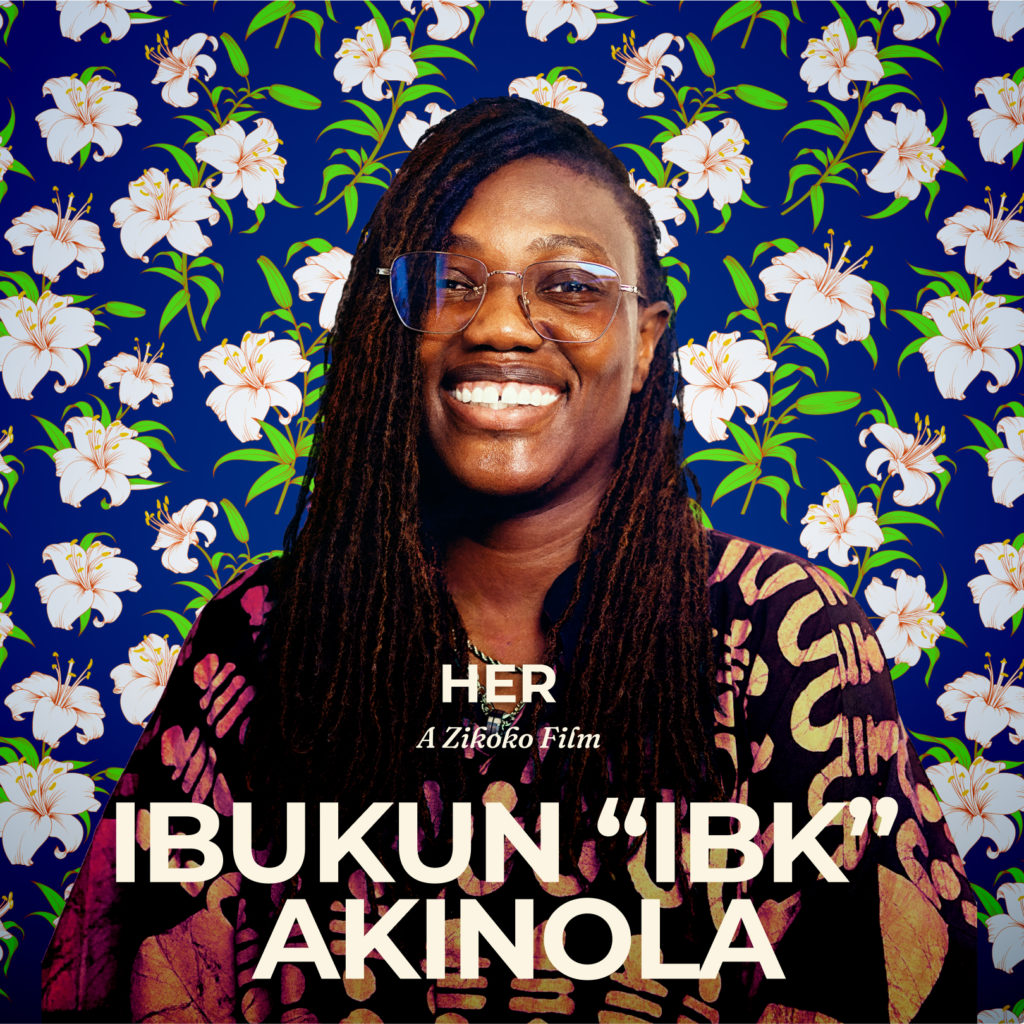
Zikoko’s docu-series “HER” is on the way, and it’s spotlighting some of the most audacious women ever. We love the stories, but the posters, created by Mariam Omoyele, bring the energy of the film into focus.
In this special spotlight, we go behind the scenes with Mariam, the poster designer whose floral motif has become the soul of the docu-series. Inspired by the idea of “giving women their flowers,” recognizing and celebrating their impact while they’re here, the designer chose blooms not just for their beauty, but for their powerful symbolism of resilience, recognition, and growth.

What was your first reaction when you were asked to create the visual motif for HER? What made you say yes?
I said yes because of friendship and my pre-existing relationship with Nana (Aisha Salaudeen, the documentary producer). When she told me more about the project, I got interested. Then, as it progressed and I got to know it, I started feeling excited.
You’ve created powerful visual art before, but this motif feels different. What was your creative vision going into it?
It feels different. The work I post on Instagram or social media is a fraction of the range of work I’ve done or worked on. What’s online is only a small window into that.
Why did you choose flowers as the central visual element?
When I had a fair understanding of what the project was about and began working on it, I immediately wanted to communicate the idea of giving people their flowers, especially while they are still alive. It’s something common amongst artists, the need to recognise and give people due recognition while they’re still alive, so I thought to do that for the women being spotlighted as well.
What personal meaning does women’s economic power hold for you? Did that influence your work?
The first thing I’ll say is: having money is a good feeling, and spending the money you have is an even better one. I’m still chasing financial independence. The economy is hard and keeps getting harder. It’s so bad that it affects the level of satisfaction I get in my career. I think economic and financial power are important for women because we’re always expected to provide value when we have some sort of financial independence. We’re expected to give back economic value and keep the chain going. Women keep helping and supporting women. Sometimes, the only reason I want to increase my financial independence is so I can patronise certain brands and keep that economic value chain moving. But even thinking about how much I want to increase this affects my creativity and productivity.
Walk us through the process — how did you go from idea to execution for the illustrations?
My initial idea was to develop a canvas, showing different aspects of their lives, like the intro to “The White Lotus.” I wanted to show bits of what the women would speak about in the documentaries, so that when people watched it, they’d understand and connect the dots. I planned to have this canvas turned into a newspaper and folded with flowers inside. So it’d feel like we were wrapping the flowers in their stories and giving it back. But it was difficult to execute, especially because of the format and time constraints. I then thought to just surround these women in flowers. I did a lot of research into flowers and women’s lives, trying to find a common theme that fit. I decided to work with the Amaryllis flower, which, from my research, signifies resilience, a common theme I identified across all the women and one I think is central to women in general.
Were there moments of doubt, tension, or creative breakthrough while working on this project?
Definitely. I had moments of tension while trying to execute the first grand idea. Sometimes it’s better to work with simple designs that fit. I also felt a bit frustrated during research; there was just too much information, and it became overwhelming. There were also moments in my communication with Nana. I wasn’t giving her regular updates because I assumed she knew I was on it, but she also needed to know how things were going. At some point, I felt curious about what the design would look like, because of how long the journey had been and the many steps I had taken. Then came relief, when my mind settled on something, and surprise at how well it was received. If you recall, I kept telling Nana to lower her expectations, but she loved it. The team loved it, and I was happy.
Your past work has evolved over time. How does this motif reflect your current identity as a designer?
My work is mostly influenced by how I feel or think about a subject. I try to help people confront negative emotions, acknowledge the ones we have, or just evoke emotions in people. When it’s for a specific project, I focus on the goal and think about how my ideas can help achieve it. Evolving has meant receiving a lot of feedback from friends, family, and clients, and that’s helped me fill in the gaps in my work. Feedback has helped refine my technical skills and identify my strengths and weaknesses that need improvement. I have also learnt to give myself flowers and be more confident in my ideas, feedback helps with that. When people don’t have as many criticisms as before, or they’re just happy with what I’ve produced. Deeper into my identity is learning to make peace with what I’ve produced, especially when it aligns with the project’s goal.
Why do you think storytelling, visual and narrative, is important for shifting perceptions about women?
Storytelling is key to shifting perspectives because life itself is a story. If we’re telling stories of our lives as women, then we need to take control of those stories. If we don’t, our lives and stories will be misrepresented. Stories are essential. Even God tells us about Himself through stories, so do plants. Everything we do is a confession about who we are. The world is such noisy. We need to keep saying our confessions, especially the good ones, so people can sift through the noise and see and hear our stories. We have to speak about these things: motherhood, pregnancy, and all the shared experiences among women. And even still, they are shrouded in secrecy. I became more comfortable with topics like sexual and reproductive health through storytelling. Knowledge on these subjects comforted me. Women need to share more stories to cut through the noise, for exposure. There’s so much exposure we need to fight for, exposure that men easily have.
If there’s one takeaway from your work on this project, what would you want people to hold onto?
A lot of the work is about invoking emotions and helping people acknowledge pre-existing ones. I hope viewers feel inspired. That they see my work, and the work of the women in the docu-series, and see how impactful they can be. However big or small the impact is, it is an impact. I want them to know that they’ll be celebrated once they start the work. That they’ll receive their flowers.
What do you hope viewers feel or think when they see the illustrations throughout the docuseries?
I want people to see the documentary and say, “Oh, the one with the flowers. The one about giving women their flowers.” I want them to be wowed by it. Ultimately, I want it to be a reference for positive conversations and subjects of impact.
ALSO READ: Zikoko is Launching a Docu-series, and Aisha Nana Salaudeen is Producing it
[ad]


