Every week, Zikoko seeks to understand how people move the Naira in and out of their lives. Some stories will be struggle-ish, others will be bougie. All the time, it’ll be revealing.
Your money deserves more. Grow it with Yield by Credit Direct and earn up to 21% p.a.
Visit us at the Naira Life Conference to learn more and sign up on the Credit Direct App using code NairaLife26. Download Now
What is your earliest memory of money?
When I was six years old, my parents began giving my younger sister and me ₦50 or ₦100 each daily during school holidays. Then my older aunt, who was around 13 or 14, would encourage us to save it. She kept a notebook where she logged our daily savings. At the end of every holiday, we would show our parents how much we saved, and they’d encourage us to buy something substantial, like a dress or birthday gifts for our siblings.
On some days, my parents would claim they didn’t have money just to teach us that the daily allowances weren’t guaranteed, but we didn’t mind since we weren’t even spending the money. Eventually, they bought us piggy banks, and we took over saving the money ourselves.
What was your family’s financial situation like growing up?
My dad is a lecturer at a higher institution, and my mum is a trader. Growing up, I thought we were rich. It was only when I got older that I realised we weren’t. My parents did their best to shield us from financial strain. They always told us, “If you need anything, ask us. Don’t buy it yourself.”
I could ask my dad for something, and he’d say, “not today. I don’t have money now,” but he’d still go ahead and do it. I was always assured that my parents would eventually get me whatever I needed (and even random wants). That built a lot of trust, and perhaps the notion that we were rich.
When did you realise you weren’t actually rich?
As I got older, I started paying attention to my parents’ conversations. As a child, your wants are trivial. I could ask for something worth ₦10k, which didn’t stretch my parents a lot. But over time, I began hearing them discuss household expenses and how there wasn’t enough money for certain major things.
At one point, my dad started a building project, and it took a massive toll on our household finances. My mum had to carry us through that period. Hearing “there’s no money for this” repeatedly made me realise we weren’t as comfortable as I thought.
When was the first time you did something to earn money?
My parents usually gave us small chores for tiny rewards, but the first significant time I worked for money was when I was 13. It was 2019, and I had just entered the polytechnic. My dad wanted me to learn how to do research projects, so he gave me his student’s project to type on the computer and paid me ₦8,000 for it.
He guided me through formatting the title page, preliminaries, abstract, and chapters, all the way to the appendix. I remember finishing and thinking, “Ha, this was so hard. I should have charged this man more.”
But ₦8,000 was the biggest amount of money I had ever earned at that point. I think I gave it to my mum to save, and later used it to buy novels and gifts.
Wait, you got into the polytechnic at 13? How did that happen?
I’ve always been academically fast. In primary four, a new government school opened that allowed pupils to resume JSS 1 before writing the Primary School Leaving Examination, instead of waiting a year. So, I skipped primary five, moved straight into JSS 1, wrote the exam there, and passed.
Then in SS 2, my dad suggested I write JAMB just to get a feel of the exam. I scored very well. He asked if I wanted to go to the university, and because I was tired of being bullied for being the youngest in my SS 2 class, I said yes. I wrote NECO, passed all my subjects, and applied to a university. They rejected me, though. They required candidates to be at least 16 years old, but I was 13. So, I applied to the polytechnic where my dad worked and was admitted.
Interesting. Did you do anything else for money while at the polytechnic?
Not immediately. I commuted from home, and my parents gave me transportation money. If I ran into my dad on campus, he’d give me money for snacks. It became frustrating because I wanted my own money, but I was 13 and didn’t know how to go about it.
I went on Google for answers, and my search led me to Wattpad. I started writing romance fiction on the platform. They didn’t pay me. I was just writing.
Eventually, in ND 2, I heard about another platform called GoodNovel that paid writers. So, I joined and landed a non-exclusive contract with them. The arrangement was that they’d pay only when the writer hit a certain word count in a particular time frame. I think it was around 150,000 words, which meant I had to write 2,000 to 3,000 words every single day for months to meet their earnings requirements.
I got paid $100 once and abandoned the platform. The workload was too intense.
The Naira Life Conference is returning on August 22, 2026, in Lagos! Come learn from finance experts and industry leaders, and partake in unfiltered conversations about building wealth and diversifying your income stream in a country like Nigeria. Real stories, expert advice you can actually use, and a community ready to build wealth together. Secure your spot here.
What did you do after walking away from the writing platform?
I started volunteering for a lot of things. I was a young child at a higher institution and didn’t have friends, so I felt I had to be doing something all the time.
I volunteered for two mental health brands, working as a social media manager for one, and as a content writer at the other. I realised I wasn’t really good at content writing, so I asked my dad for ₦3,000 to register for a content writing class. This was now 2021.
During the class, our tutor assigned content for us to write and published it under her name. That class helped me see that I could write practical articles, not just romance stories. It also opened my eyes to the possibilities of working remotely.
Even after the class ended, I kept researching and looking for opportunities. I finished my National Diploma around this time and moved on to the university in 2022. That same year, in 100 level, I noticed someone’s name under the “author” section of a post on a lifestyle platform.
I was very curious about how to get published, so I got a contact from the website and pitched them. At the time, I didn’t even know what cold pitching was. I just told them I wanted to write for them, too.
How did that go?
They said I would need to contribute 10 articles before my name could be published on their website. After that, I became a regular contributor, writing for their business and career categories. Sometimes I also did SEO. They didn’t pay, but I wasn’t in it for money.
That said, they started sending me occasional freelance writing gigs from other clients. I charged ₦1 per word for 2,000- to 3,000-word articles. Over seven months, I got about six or seven gigs from them.
At the same time, a friend paid me ₦5,000 monthly to manage the social media account for a mental health brand she was working with. The money only covered data, but again, I wasn’t focused on income. I spent my early career volunteering, and I always took the jobs seriously. People would ask me, “This work you’re doing, how much are they even paying you?”
Me, I just liked bringing excellence into everything I did. I was also really curious. When I wasn’t working, I was on my laptop, learning everything from SEO to Canva.
How long did you juggle the writing and social media management roles?
About seven months. Four months in, my friend hit a rough patch and stopped paying the ₦5,000 allowance, but I worked for three more months anyway until I became completely burnt out.
I was also writing academic research papers for my HOD for zero pay. Combining that with school, contributing articles for the lifestyle platform, and managing social media became overstimulating. So, I quit both the contributor duties and social media management to focus on the research papers and my studies.
The break was short-lived, though.
Why?
I found another job to do in 200 level. Someone posted a vacancy for a social media manager role, and I used my volunteer experience to build a CV and applied. I got the job, and my salary was ₦40k monthly. This was 2023.
I worked there for a full year, managing a tech professional’s LinkedIn, Instagram, and Facebook pages daily. It was my first official, steady-paying corporate job. However, posting daily, engaging with comments in real time, and managing school work put so much pressure on me. I was also writing people’s projects and seminar papers. Those paid me ₦20k/seminar and ₦10k/project chapter.
By January 2024, I was overstimulated again. I struggled with leaving because it felt like I was betraying my boss. I’d never resigned from an official paying job before, and it felt weird. But I eventually had to leave. I was so overwhelmed.
I took another short break, and, in April 2024, I joined a non-profit community as a volunteer content marketer and program manager.
I imagine this wasn’t a paid role?
It wasn’t at first, but as usual with me, I did the most there. I poured so much effort and worked so hard that the founder decided to start paying me ₦20k/month. She didn’t pay the other volunteers, just me. The payment started from September and lasted through December 2024.
When I was heading into my final year, she suggested we pause so I could focus on my project. She wanted me to take on more roles, but she knew final-year students handled so much schoolwork and didn’t want to overwhelm me. I honestly didn’t think it was anything I couldn’t handle, but I agreed. Two months later, in February 2025, she recommended me for a social media manager role at a podcast brand paying ₦85k/month.
In July, a LinkedIn contact reached out to me about another job opportunity. That’s how I got a full-time content marketing offer at a fintech company. To be honest, I was a bit scared. I hadn’t worked in content marketing before, but when I saw the job description, it was very similar to what I’d done all these years. I decided I’d take the job and work very hard to figure it out.
The salary was ₦100k, so my monthly income jumped from ₦85k to ₦185k instantly. This coincided with my writing my final exams and signing out of university.
Love it for you! Do you still juggle both jobs?
Actually, I have three now. I started my NYSC year in May 2026, and I work as a social media manager and content creator for a digital skills training brand. They pay me ₦20k/month, and I get ₦77k allawee from the government.
My salary at the fintech — I consider this my main job — has also increased. The first performance-based pay raise was in February, when they increased it to ₦150k. Then, after completing a full year at the company, they increased it again to ₦250k. My podcast job still pays ₦85k. All together, that puts my core monthly income at ₦432k.
On the side, I also sell personalised digital skill blueprints on social media.
Tell me more about that
It grew out of my passion for social impact. Whenever I go out to speak to people about digital skills and education, a lot of them ask me to teach them. I don’t have the capacity to teach one-on-one, so I suggest they take online courses. The problem with that is that many people often get overwhelmed and lose consistency. Some don’t even know where to start. I wanted to give them something tangible to fall back on so they could actually take action. So, I started creating the blueprints.
Instead of a generic, one-size-fits-all guide, someone clicks the link in my bio or reaches out to tell me the specific skill they want to learn, for instance, social media management. I build a step-by-step roadmap for them, complete with curated links to courses, blogs, and tools, explaining exactly how to master the skill from scratch.
I charge ₦2,000 per blueprint, which brings in an extra ₦10k- ₦20k per month. Honestly, it’s a lot of work for ₦2,000, but it’s definitely not about the money right now; it’s about impact and helping people bridge the gap between wanting a digital career and actually building one. There’s a huge demand for it, and once I have more capacity after NYSC, I’m definitely planning to scale it.
That’s so impressive. But how on earth do you manage all these jobs?
I can’t remember a time since I was 15 when I wasn’t doing a bunch of things. For me, doing nothing and doing too much are the same thing, so I’d rather do too much.
Also, I’d be too anxious to have nothing to do. It’s like, “I need to do something,” and if I’m doing something, I need to make sure I’m doing it well enough. I prefer the other end of the stick, where I’m doing a lot and making money.
Back to how I manage the jobs, my NYSC PPA is an on-site job, but I don’t have a manager. I write the content, shoot, edit and post. So, I set aside days to go there and batch-create their content. I also teach video editing there, so whenever students come in, I teach them.
Since I batch-create, I don’t need to go there daily, but I do so because there’s constant electricity at the office. So whenever I’m not shooting or teaching, I sit there to do my two other remote jobs.
My social media management duties for the podcast happen on my phone. It’s mostly posting and responding to comments, so I set time aside for that. When I finish, I go back to my content marketing job. As I said, it’s my main job and highest income stream, so I prioritise it above everything else.
I’m curious. Do your employers know you have other jobs?
They do, but no one really cares as long as I’m delivering my work. Sometimes meetings clash, and I can ask my team at the fintech to move them to the evening. They’re very understanding.
I also sacrifice a lot of sleep. If I have deadlines, I work straight through the night after coming back from my PPA. I refuse to let my output slip on any job because I don’t want to give anyone a reason to doubt my competence.
On top of all this, I still create content for my social media and LinkedIn pages and write a newsletter.
I get your need to constantly be doing something, but do you think you HAVE to do this many things at once?
As I’ve grown older, and from watching older people around me and how they think about money, I realise that many people’s perception of earning is limited by their exposure.
People who haven’t grasped the possibilities of the digital world have a limited view of money. I don’t want to live the kind of life where people just graduate, and the first thing on their minds is opening a perfume business or doing something small to make ends meet. This isn’t to talk down on small businesses, but I think life can be bigger than that.
You don’t always have to wait for a chance. You can actually do things to work towards those goals. So, all I’m doing now is for future me.
I want a financially secure future where I can make an impact on people and afford any level of education I want. Right now, when I pay for courses, people ask me why I do that. I want to be able to do what I want without having to explain to anybody.
Is there a particular net worth you’re aiming to reach to secure this future?
I don’t think there’s a specific figure right now, because I feel like my understanding of money grows as I earn it.
For instance, before I started earning a consistent income, I thought earning ₦100k monthly would help me achieve a lot. But I got there and realised it was a chicken change in Nigeria’s economy. The more money I make, the more pressure that comes with it. I just want a future where there’s no pressure or guilt about spending money.
How would you describe your relationship with money today?
Anxious. I constantly question my spending, whether I’m giving away too much, saving enough, or investing properly.
Because I’m 20, I frequently worry about whether I am managing this level of income well or making mistakes. There’s also the constant fear of losing my jobs. Now that I cover all my personal expenses, the thought of losing my income and having to rely on my parents again gives me serious anxiety.
What do your typical monthly expenses look like?
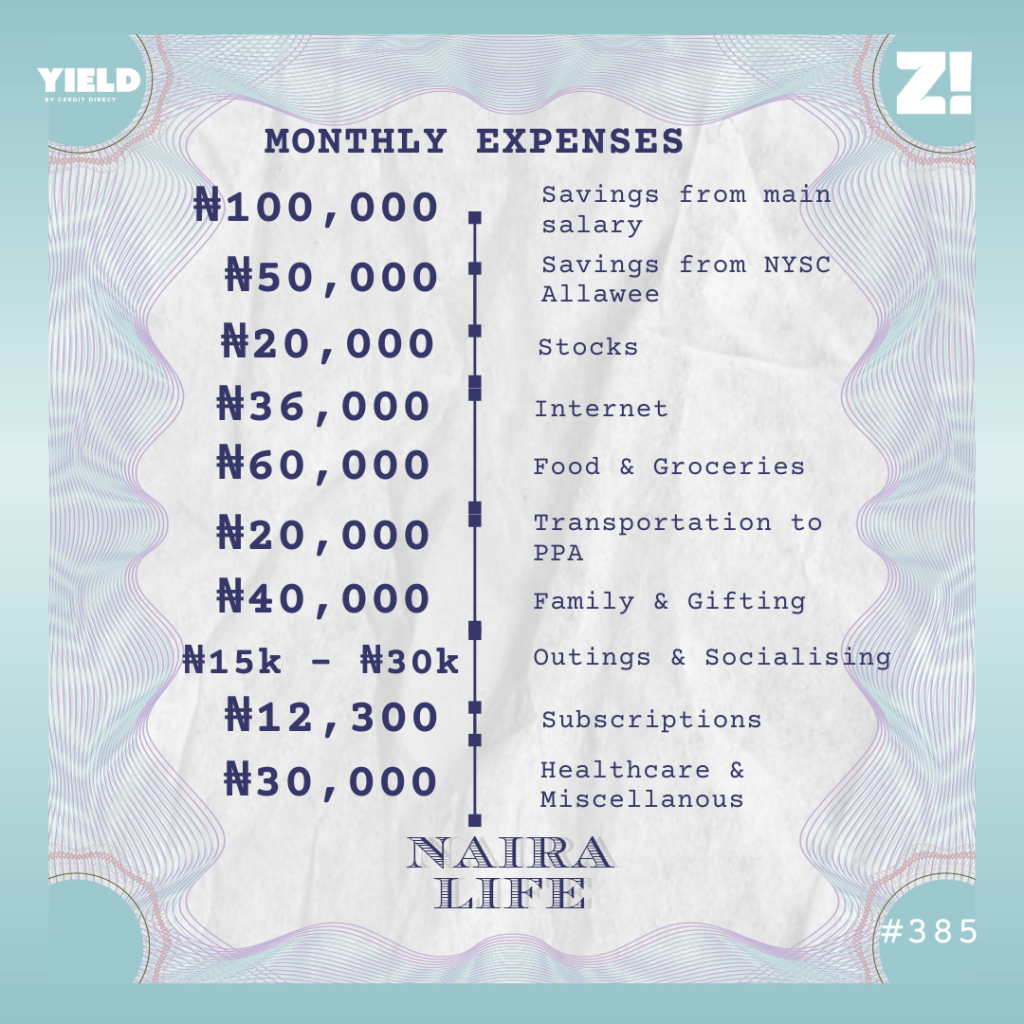
I don’t pay rent because my NYSC PPA provided accommodation. Whenever I’m not there, I’m at my parents’.
Currently, my total savings sit at around ₦500k. It’s low because I recently had to draw from it to cover graduation expenses, move to a new state for NYSC, fund my health expenses, and pay half of a new ₦250k laptop (my dad covered the other half). Now that I’m settled, I plan to rebuild my safety net. I also have about ₦40k in stocks. I don’t have a specific savings goal right now; I just save consistently to maintain financial stability.
Is there an ideal amount of money you think you should be earning right now?
This is funny because if I add one more job to my table, I might drop dead.
Haha. I mean, it doesn’t have to be an additional job
True. Ideally, I’d like to earn around ₦1 million per month from a single, stable job rather than splitting myself across multiple roles.
I think one stable job might even help treat my anxiety. I’m constantly thinking about deliverables and deadlines, so that may be keeping me on edge. If I had one well-paying job, I’d have more time to work on my side hustle and scale my digital product. It would help give me more ownership of my time and money and contribute to my peace of mind.
I don’t plan to wait for that one stable job, though. After my NYSC, I plan to focus heavily on personal branding and visibility on LinkedIn. I forgot to share this earlier, but I’ve been on and off Upwork since 2020. I couldn’t stay consistent because of everything I had to juggle. I plan to become more intentional and position myself for well-paying opportunities.
Rooting for you. Is there anything you want right now but can’t afford?
An international passport. I think I can afford this; I’ve just not budgeted for it. I think it’s about ₦100k now. I also want to upgrade my phone for content, and that should cost about ₦700k.
How would you rate your financial happiness on a scale of 1-10?
6. I’m still very anxious about money. But I’m still growing in my financial journey. The first raise I got at work this year happened after I asked, and they approved it immediately.
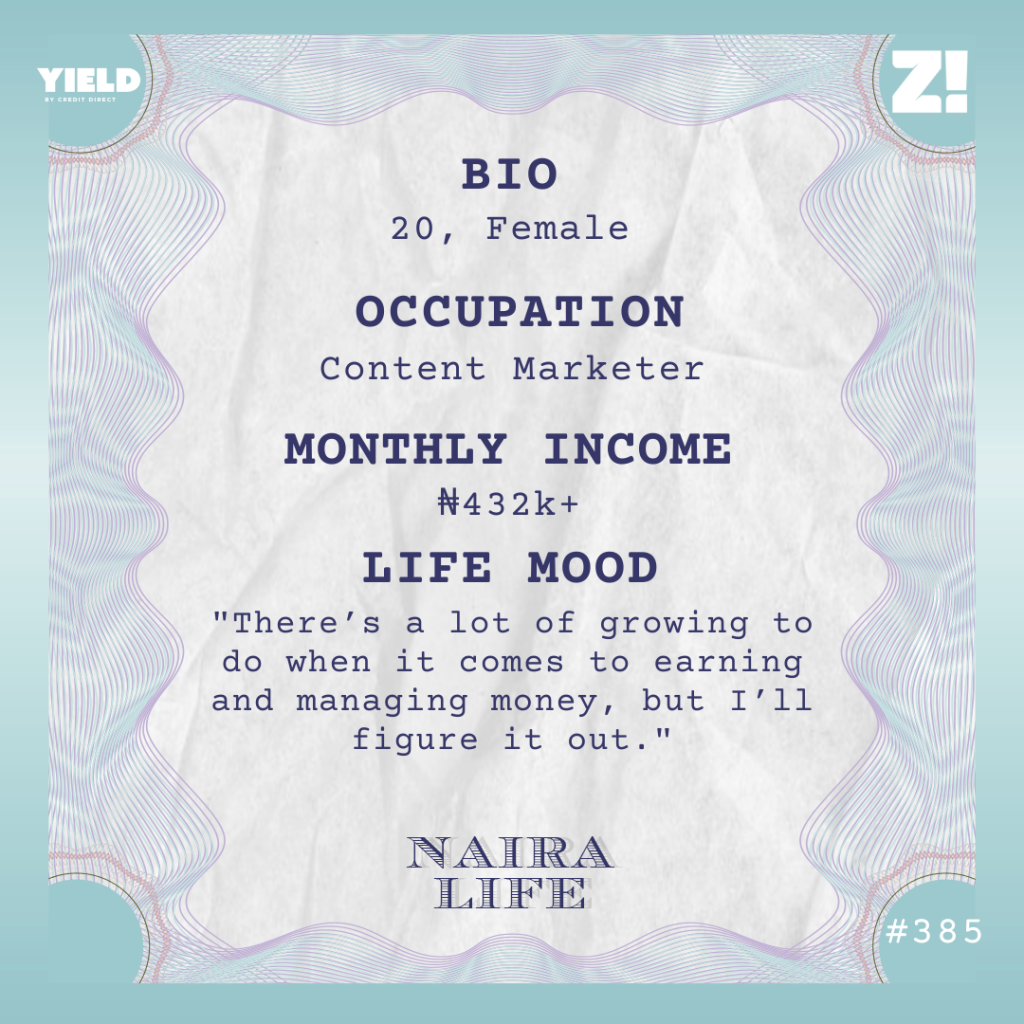
That experience taught me that anything is possible with money. You can earn ₦400k this month and earn ₦3 million next month. It’s possible. So, I’m still in my learning phase. There’s a lot of growing to do when it comes to earning and managing money, but I’ll figure it out.
If you’re interested in talking about your Naira Life story, this is a good place to start.
Find all the past Naira Life stories here.