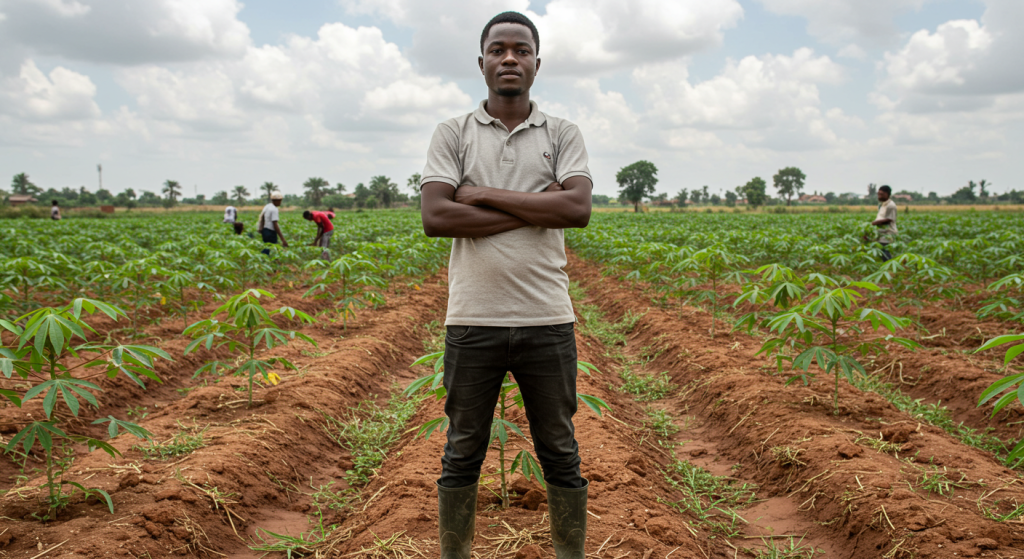
Agbo (27) wanted to build something steady outside his corporate career. He had been toying with the idea of a cassava farm, so when two of his friends saw what he was planning and asked to come on board as investors, it felt like a smart bet. It wasn’t foolproof, but with friends pooling money and cassava being a staple, it felt like a risk he could manage. But just as the farm began to take shape, the project manager he hired to run things ghosted with their funds, leaving Agbo to pick up the pieces of a dream he couldn’t afford to lose.
As told to Aisha Bello
I still remember my phone ringing relentlessly that day, and, of course, it was *Eke again.
I had just sent him ₦300k to pay the labourers cultivating the farm. But he wasn’t calling to confirm that the work was done; he wanted to let me know his sister had given birth, and he had to use the money to “support her.”
I froze. On the one hand, a new baby is good news. On the other hand, this was my friends’ money — not just mine. Still, I swallowed my anger and sent him another ₦300k from my own pocket. I thought of him like a brother.
That was only the beginning.
I grew up in Ebonyi, where farming was my family’s way of life. Every year, we cultivated and harvested together, so soil and sweat were familiar to me long before I became a lawyer. Even after I moved to Abuja, farming felt like something I’d eventually circle back to.
By 2024, I decided to try it independently. It was nothing serious, just a side project I could manage from a distance. I had already registered a company in 2022, but hadn’t done anything with it.
Then, one day, two friends saw me making moves on the project and said, “Guy, you always have something running, bro. Let’s join you, put money together and see where it goes.”
That’s how it became a collective venture. Three of us pooled around ₦700,000 to start a cassava farm. In Ebonyi, leasing land is easy. At ₦12,500 a plot, we secured 19 and a half plots for a year. The plan looked straightforward: lease the land, get a manager, hire labourers, cultivate cassava and cocoyam, and harvest within a year.
The emotional part was bringing *Eke on board as project manager. I’ve known him since 2019. He was always around my family home, helping with small tasks. We ate from the same pot. He called my father “Daddy.” My dad even introduced him to visitors as his adopted son. There was a brotherhood. I trusted him.
So I told him, “Come manage this project. You’ll get the harvests from one and a half plots as your settlement for managing the farm, in addition to feeding and transportation on farm days.” I didn’t think twice.
Farm operations kicked off in April 2024. *Eke was supposed to hire labourers, supervise the cultivation, and send me the bills. I’d pay him, he’d pay them. Simple.
But within two weeks, cracks started showing.
First, it was the labourers’ fees — the first ₦300k disappeared into his sister’s childbirth expenses. Then another ₦300k for cassava stems and cocoyam — extras that never even made it to the soil. After that, I sent him ₦180k for maize he claimed he’d buy, but never did.
I’d call and send messages. Nothing.
Sometimes I’d hear from people at home that he was just walking around, doing nothing, and nowhere near the farm.
That was when it hit me: he had no intention of making this work.
I had lost about ₦780k to his mismanagement and negligence.
The worst part was the time I had invested. From April to June, we managed to cultivate 11 plots out of 19 and a half. Then everything stalled. By July, it was just radio silence.
He’d bought some cassava stems, but since he never planted them, they were left to dry up and rot.
The farm just sat there. Eleven plots had been cultivated, but planting had stalled.
By August 2024, I was done with the entire mess. I transferred control to my grandmother. She became the new project manager.
She completed the cultivation, planted fresh cassava stems, and kept things moving. With her, there was discipline: farm visits on weekends, labourers supervised properly, no stories.
The project was back on track.
I haven’t calculated the overall expenses since I handed the project over to my grandmother. We only send money when it’s needed — for maintenance, pest control, fertilisation, labourer fees, and so on.
She has been at it for almost a year, and now it’s harvesting season. We processed 12 basins of garri on the first harvest; the second time, we processed 14 basins. If the estimates are correct, by the time all 11 cultivated plots are harvested, we might have over 80 basins — about 40 bags of 50kg garri.
At current market prices, that could translate to real money. But until everything is harvested and sold, the balance sheet is still blurry.
I’m still waiting to see the final numbers before I can call it a win. For now, the project drags on. We are still spending money on harvesting and processing, but everything goes through my grandma now.
Looking back, the betrayal stings more than the financial hit. It’s always the people you bring close, the ones you call brother, who hurt you the most.
I learned the hard way not to give second chances when money is involved, at least not until someone has proven themselves.
I tell myself I don’t mind losing money; I can always make it back. But the wasted time? That’s gone forever.
Still, I know one day I’ll return to Ebonyi, maybe retire into farming for the love of it. Whether this venture pays off or not, the soil is still home. As for Eke, I deleted his contact and cut him off completely. He’s been blowing up my phone for a while now, begging for forgiveness, but I haven’t blinked in his direction. In my heart, I’ve forgiven him. But trust? That door is shut forever. If I hadn’t walked away when I did, the farm would’ve collapsed entirely, and that would’ve been the end of everything we tried to build.