The first time Adeola* heard about the Human Papillomavirus (HPV) vaccine, she was afraid. Scrolling through Facebook, she saw claims that the vaccine was a secret plot to reduce Nigeria’s population. It didn’t matter how long she scrolled; post after post said the same thing. The speculation didn’t stop on social media; it continued at schools or among neighbours. “They said that if we allow the girls to take the vaccine, they won’t get pregnant in the future.”
Adeola considered accepting the rumour, contemplating within herself if the vaccine would really affect her daughter, like the Facebook posts said. The fear almost stopped Adeola from getting her daughter protected against cervical cancer.
Cervical cancer is the second most common cancer amongst Nigerian women, killing more than 8,000 women every year, with 12,000 new cases recorded in 2020 alone, according to the World Health Organisation. Almost all cases are linked to HPV, a virus so common that four in five sexually active people are guaranteed to get it at some point.
The vaccine is one of the most effective tools of prevention: HPV types 16 and 18 alone cause at least 70% of cervical cancers. Yet in Lagos, as across much of Nigeria, misinformation and mistrust are slowing down vaccine uptake, despite the government’s ambitious plan to vaccinate millions of girls aged 9–14 years in its 2023 rollout, the largest HPV campaign in Africa. By the end of the introduction phase, more than 12 million girls nationwide had been vaccinated, according to official figures.
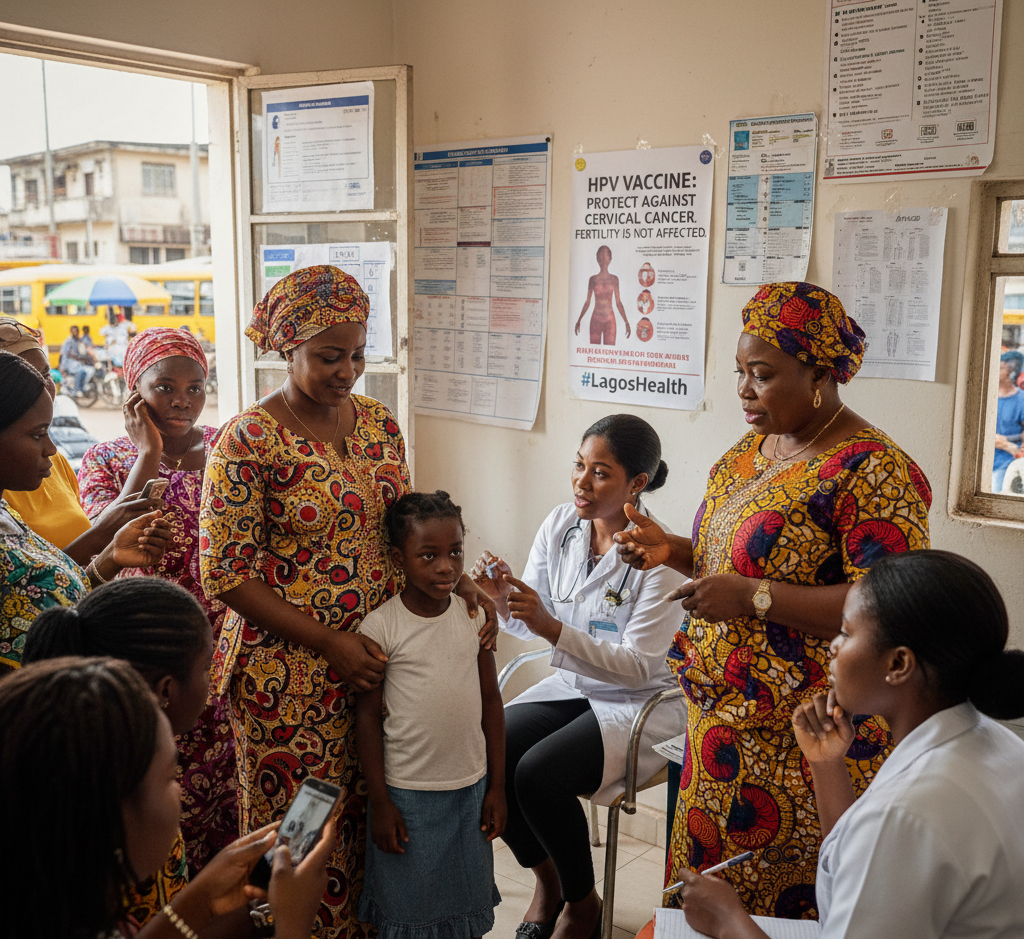
“I didn’t know what to believe,” Adeola recalled. “It wasn’t until a doctor explained to me that I became convinced. The doctor told me clearly: The vaccine doesn’t affect fertility, it protects against cervical cancer.”
After her daughter received the vaccine at a government health facility, Adeola tried to share her experience with other mothers in her community, hoping it would ease their fears. But the rumours proved harder to shake off than she expected. “People are difficult to convince,” she admitted. “I don’t know how to change their minds.”
Women Advocates for Vaccine Access (WAVA), established in 2016, was born out of a pressing need to close Nigeria’s immunisation gaps. At the time, routine vaccine coverage remained dangerously low, donor funding was beginning to waver, and millions of children risked being left behind. The coalition drew its strength from women-led organisations, recognising that women, often the primary decision-makers for family health, could be powerful advocates in demanding sustainable financing and equitable access to vaccines.
To address fear around the HPV vaccine, WAVA has focused on advocacy, policy engagement, and empowering women’s voices. Goodness Hadley, Director of Programs at WAVA, said, “We realised that one of the biggest barriers wasn’t access. It was fear. Many women worried about infertility, and others thought it was a vaccine only for teenagers. So, our work is to give correct, relatable information.”
Through its advocacy, WAVA has partnered with health agencies and communities to push for stronger vaccine uptake. One of their flagship efforts is the Amplify project, which equips young people and women leaders with skills to advocate for routine immunisation, including HPV. “We want girls and women to lead the conversation,” Goodness explained. “From essay competitions to digital campaigns, we are creating platforms for them to speak directly to decision-makers.”
Tackling Disinformation
Dr. Chizoba Wonodi, convener of WAVA and faculty member at Johns Hopkins University, says the roots of hesitancy in Lagos go deeper than casual gossip.
“There was a disinformation campaign just before the vaccine was introduced in the country,” she explained. Some people willfully created false narratives, like HPV vaccines causing infertility, for political or financial reasons. “That campaign had a dampening effect, especially in Lagos, where you’d expect higher uptake because of education levels and general acceptance of childhood vaccines.”
This disinformation made a dangerous mix with cultural and religious concerns. According to Dr. Womi Samuel-Nnah, Research Assistant for SHARP (a Johns Hopkins University project) and WAVA’s Lagos focal person, many parents struggled with the idea of talking about sexual health with girls as young as nine. “Some parents felt it was too early. Others simply didn’t know HPV was a major cause of cervical cancer. And then you’d hear things like, ‘Government wants to reduce Nigeria’s population by giving this vaccine.’ These beliefs came up again and again in the communities.”
Evidence and Impact
Dr. Womi-Samuel recalled one striking moment during an outreach in Lagos. “A mother refused, insisting the vaccine was population control. But another woman stood up and said she paid ₦60,000 privately for her daughter’s HPV vaccine. She explained in Yoruba why it was important. That testimony changed minds on the spot. Parents started bringing out their daughters to get vaccinated. That kind of peer-to-peer persuasion works even better than anything we can say.”
In schools, WAVA and its partners are already seeing changes. “In one school, after our session, over 100 girls were registered for HPV vaccination,” Dr. Womi-Samuel said. “That’s how we know the narrative is shifting.”
The testimonies of parents who made private sacrifices for the vaccine have also become powerful proof. “When someone spends that much money on something, people take it seriously. They start asking: If she paid, maybe this thing is truly valuable. That’s evidence of trust spreading within communities,” she added.
Learnings and Limitations
WAVA’s work has also revealed surprising insights into hesitancy.
“Interestingly, vaccine refusal doesn’t always follow education lines,” Goodness noted. “You’d expect literate, urban parents to be more accepting. But because of the early disinformation campaign, you sometimes find them more resistant than rural families. On the other hand, once women in less urban areas understand HPV’s link to cervical cancer, they are eager.”
Language and trust are equally crucial. “We realised mothers trust other mothers more than health workers,” Dr. Chizoba said. “That’s why we focus on community champions who can share their own stories in their local language. It works better than medical jargon.”
But the work is not without limits. Like many advocacy groups, WAVA grapples with dwindling donor support and the pressure to secure sustainable local funding for its activities. Capacity is another recurring hurdle; many smaller organisations in the coalition operate with lean teams and limited resources, making it challenging to sustain consistent outreach across multiple states. Beyond money and manpower, the persistent challenge of mistrust and misinformation demands ongoing community sensitisation to shift attitudes toward immunisation.
A Personal Reflection
Reporting this story made me confront my own blind spots. I wasn’t even sure whether I had taken the vaccine myself. When I asked my female friends, most of them weren’t sure either. That uncertainty shook me. If educated women like us with access to information didn’t know, how much harder must it be for women with less access to information?
Women like Adeola, once doubtful but now convinced, are showing their communities what’s possible. And advocates like WAVA are building systems to ensure those voices ripple outward. The hope is that one day soon, the whisper that girls won’t get pregnant if they take the HPV vaccine will fade into history, replaced by the louder truth that this vaccine saves lives.
As WAVA and other advocates continue their push, the hope is that more women in Agege, Surulere, Ikorodu, and Lekki will see the HPV vaccine not as a threat but as protection. For Adeola, the choice has already been made. She feels relieved. She knows she has done the right thing for herself, and she’s hoping other women will believe it too.
This story is made possible with support from Nigeria Health Watch as part of the Solutions Journalism Africa Initiative.