Same-sex relationships are often assumed to be free of gender roles — after all, if you’re the same gender, who’s expected to do what? Unfortunately, for many women in same-sex relationships, that isn’t the case. Even when roles aren’t discussed, they often still exist, shaped by habit, past relationships, or what we’ve learned to expect from love. Those same roles, provider, nurturer, initiator, still show up, just dressed a little differently.
Many queer couples will tell you, “We don’t do roles.” And yet, someone still ends up planning the trip, cooking the meals, holding the relationship steady when things get hard. So maybe it’s not about whether roles exist, but how they show up softly and subtly, without needing to be named.
From masc women who feel expected to “provide,” to femme partners dodging assumptions about submission, 9 Nigerian women share how they navigate gender roles in same-sex relationships.
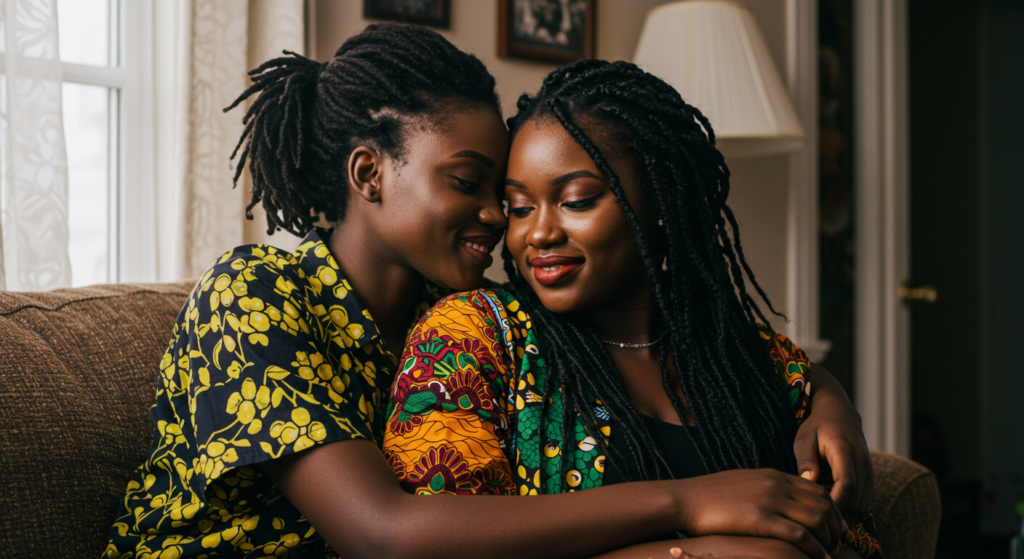
“The roles just kind of fell into our laps.” — Nikky*, 23, Lesbian
Nikky is femme, her girlfriend is masc, but nothing was ever spelled out. Their dynamic grew from who they were, not who they were “meant” to be.
“I’ve been with my girlfriend for three years. I’m femme-presenting and she’s masc-presenting, but we don’t explicitly talk about roles in our relationship. We generally just go with the flow.
I do most of the cooking and organise the house’s affairs. She earns more and is usually the one who plans our dates and trips. Either of us can initiate sex. When it comes to conflict resolution, there aren’t any fixed expectations. Honestly, none of these things come from some agreed-upon idea of who should do what; the roles just kind of fell into our laps. One person was either better at a task or just naturally took the lead on it.
We’ve had slight disagreements, but nothing major. It’s usually just one of us encouraging the other to step up a bit more with whatever they’re handling. I haven’t brought any expectations from past relationships into this one, and I don’t think gender roles are something we actively impose on each other.
What I wish people, queer or not, would understand is that WLW relationships don’t need to mirror heterosexual norms. We can be as unconventional as we want to be, and it’s not anyone’s place to judge or decide what our dynamic should look like.”
“That fear can shape how we show up in relationships.” — Amaka*, 22, Bisexual
Amaka is single now, but past relationships taught her how much outside pressure and internalised norms can sneak into queer love too.
“I’m currently single, but in my past same-sex relationships, we didn’t really talk about roles. Still, there were definitely some feminine expectations placed on me, sometimes from my partners, sometimes from outsiders, and sometimes even from myself. Things like always being the one to cook, plan dates, or be the more emotionally available one just felt expected of me, even when no one said it out loud.
We never had any disagreements or tension because of gender expectations, but I’ve noticed that I personally bring in some ideas from past relationships with men into how I expect my partner to behave, like assuming she should take the lead financially or initiate sex more often. It’s not always intentional, but it happens.
One thing I wish people, queer or not, understood is the fear that comes with coming out and being accepted. That fear can shape how we show up in relationships in ways people don’t always see or talk about.”
“Every mallam with em kettle.” — Chidera*, 25, Lesbian
Chidera’s ex was also masc, but still expected her to “play woman.” Now, even casual talking stages make her question who she’s allowed to be.
“My last relationship was with someone who was masculine-presenting like me. Looking back, we never explicitly talked about “roles,” but evaluating it from the outside now that we’ve ended, I’ve come to a few conclusions.
Neither of us really liked cooking, so eating out was the norm. Financially, I did most of the spending because I earned more, or so I convinced myself. But thinking back now, I realise that wasn’t enough of a reason for her not to make small financial sacrifices for me. Even something as simple as getting me a small gift, covering little expenses, or buying me suya once in a while with her own money would’ve gone a long way.
We rarely went on dates. She always preferred to spend her free time with “Little Miss She Is Just a Friend” rather than go out with me. I was usually the one initiating sex, which often ended in quick make-out sessions because she was “never in the mood.” She called herself a “touch-me-not” and “not too sexual,” though I suspect she was getting it elsewhere. But anytime she was finally in the mood, I would always jump at the chance, get myself in the mood too, because it was such a rare thing. We practically lived together and saw each other every day, but still, nothing was guaranteed. (The sex was always good, though.)
We were always having issues, and during arguments, she’d say I was too stubborn, that I needed to be more submissive, and stop questioning her moves and actions because she was the one who asked me out, and she was “more masculine” than me. So even though we were both masc-presenting, she expected me to be the more “womanly” one and let her take the “manly” title.
Honestly, I don’t think there’s anything people, queer or not, need to “understand” about how same-sex couples navigate gender or roles. Every mallam with em kettle. What matters is that the two people in the relationship find a mutual stance on what works for them. Outside noise and opinions mean nothing.
That said, whenever I find myself in new talking stages or situations now, I tend to overthink everything. I’m constantly in my head: What does this person expect of me? Am I supposed to be emotional or not? Am I supposed to be the “woman” or the “man”? Should I open up about how I feel, or keep it to myself? Should I take the initiative to pamper her, or let her pamper me? Am I supposed to plan dates, or wait for her to do that? Do I cover the financial responsibilities, or can I expect her to do that sometimes, too? During sex, should I be dominant or submissive? Do I initiate or wait for her to make the first move?
It’s a lot. And it’s something I’m still unlearning and navigating.”
“It’s like they feel someone’s gotta act like a man for the relationship to work.” — Atinuke*, 22, Pansexual
Atinuke is pansexual and masc-presenting, but that doesn’t make her the “man” in anything. Her last relationship worked because it ditched all that.
“My last relationship lasted almost a year. I was more masculine-presenting and she was more feminine-presenting, but there were no expectations like ‘you have to do this, I have to do that.’ It was never that kind of dynamic. We didn’t talk about roles because there was no point; everything just flowed naturally.
What I wish people would understand is that there’s no “man” in the relationship. I hate when people say, ‘you’re the man, abi?’ just because I present a bit more masculine. It’s so annoying. It’s like they feel someone’s gotta act like a man for the relationship to work. That mindset needs to go.”
“There’s no one way to do this.” — Rashidat*, 27, Lesbian
Rashidat’s past masc partners brought vibes, not structure. But some still held tight to masculine duties, even when she was the one keeping things afloat.
“I’m not in a relationship right now, but looking back on past ones, I don’t think roles were ever something we talked about directly. Most of my past relationships, usually with masc women, have been very vibes-based. There wasn’t much structure, just whatever felt natural in the moment.
That said, I’ve definitely been with someone who still clung to some heteronormative ideas. She once said it was her duty to provide as the masc woman, even though I was the one holding things down day-to-day. I think it was less about control and more about trying to reassure me that she’d eventually come through for us. But in practice, I was already doing the work, so it felt a bit hollow.
If there’s one thing I wish people understood about same-sex relationships, it’s that different things work for different people. There’s no one way to do this, and there doesn’t need to be.”
“I like cooking for her (and she kinda sucks at it 💀).” — Sabrina*, 24, Lesbian
Sabrina and her partner don’t talk about roles; they just do what works. For her, that means meals, emotional check-ins, and being very tall.
“We don’t really talk about roles. I’m more on the masculine side. I’m also way taller, so I do have certain expectations like getting things off the top shelf [laughs].
I feel my partner and I just do the work we’re best suited for. I do all the cooking because I like cooking for her (and she kinda sucks at it 💀). To compensate, she does the bulk of the cleaning. We both handle the financial aspect of the relationship because we earn very similar salaries, and it’s just common sense. The same thing goes for planning dates or trips and even sex. I’d say I handle most of the conflict resolution and emotional check-ins, not for any particular reason other than the fact that I just like doing it.
I do think it’s stupid to attach heteronormative principles to a homosexual relationship. I wish a lot of queer people would educate themselves on that. I’ve noticed a wave of this on (Nigerian) TikTok and it pisses me off to a degree I didn’t even know was possible.”
Also Read: What She Said Is Back — And She’s Louder Than Ever!
“She earns more than I do — my sugar mummy 😩 — and she’s also the one who plans most of our trips because she’s just better at it.” — Vera*, 24, Lesbian
From shared chores to finances to planning trips, Vera and her partner’s dynamic is a soft rebellion. It’s not about power, it’s about partnership.
“We don’t really talk about roles. We just share chores and figure things out together. I’m the more masc-presenting one, so I do most of the heavy lifting. I joke that I “wear the pants,” but it’s mostly just what feels natural between us.
She earns more than I do — my sugar mummy 😩 — and she’s also the one who plans most of our trips because she’s just better at it. We both initiate sex and handle our finances together. When things come up, we talk them out. There’s no pressure to perform or fit into specific roles, and that’s probably why we haven’t had any real tension around that.
That said, I do think we both carry some influence from past relationships, especially with men, but in a way that helps. It’s a reminder of what not to bring into this. A lesson in how not to act.
One thing I wish people understood is that WLW couples don’t copy and paste heteronormative dynamics; we build our own. Gender roles aren’t automatic. They’re either intentional or not even part of the equation. Who does what isn’t about “masculine” or “feminine” energy; it’s about compatibility, communication, and care. It’s not about mimicking a blueprint. It’s about writing one that actually fits us.”
“We have to be intentional” — Ibinabo*, 21, Bisexual
Ibinabo is only 21, but she already sees how quietly gender roles can sneak into queer love, even when no one says them out loud.
“I’ve been with my partner for a year now, and we don’t really talk about “roles” in the relationship. But even without saying it out loud, I’ve noticed gendered expectations show up, mostly from her. It’s in subtle things, like who’s expected to take initiative or who’s supposed to be the more ‘put-together’ one emotionally. Nothing we’ve argued about, but it’s there.
I think a lot of it comes from past relationships, especially with men. We both carry some of that baggage; how we were treated, what we were expected to do or be. Even if we’re trying to unlearn those things, they still show up. Sometimes it feels like we’re just repeating patterns without meaning to.
I don’t really have a clear answer yet on what WLW relationships should look like. I just know that those same gendered roles, the ones we think we left behind, can still follow us in. And we have to be intentional if we don’t want to keep playing them out.”
“If you want them to protect you like a man would, then you should be ready to protect them in a similar way.” — Sonia*, 24, Queer
Sonia is six months in and already unlearning a lot. For her, equality in WLW relationships means shared protection, shared effort, and no silent expectations.
“We’ve been together for six months, and while we both like to think we should be equals in the relationship, I’ve noticed some masculine expectations from my partner. When it comes to planning dates, I’m expected to choose the day and time, and because I earn more, I’ve had to pay for our meals or activities. I’m also the one who initiates sex the most. We’ve had a discussion about this and are currently working on reaching a compromise.
Yes, we’ve had disagreements about gender expectations. The first one was about going on dates. I expressed that I didn’t want to always be the one expected to plan everything or pay, and she explained her reasoning, which had to do with her financial status.
I think I personally bring in ideas from past relationships, but it’s not just about how I expect her to behave. It’s more that I want to do things men have done for me in the past for her, and I’d love to have her do the same for me.
What I wish queer people would learn is to stop expecting their partners to fulfil a gender role in the relationship. For example, if you want them to protect you like a man would, then you should be ready to protect them in a similar way.”
Names marked with an asterisk (*) have been changed to respect the speaker’s privacy.
If you enjoyed reading this you will also enjoy reading: “Queer Nigerians On Having Supportive Parents