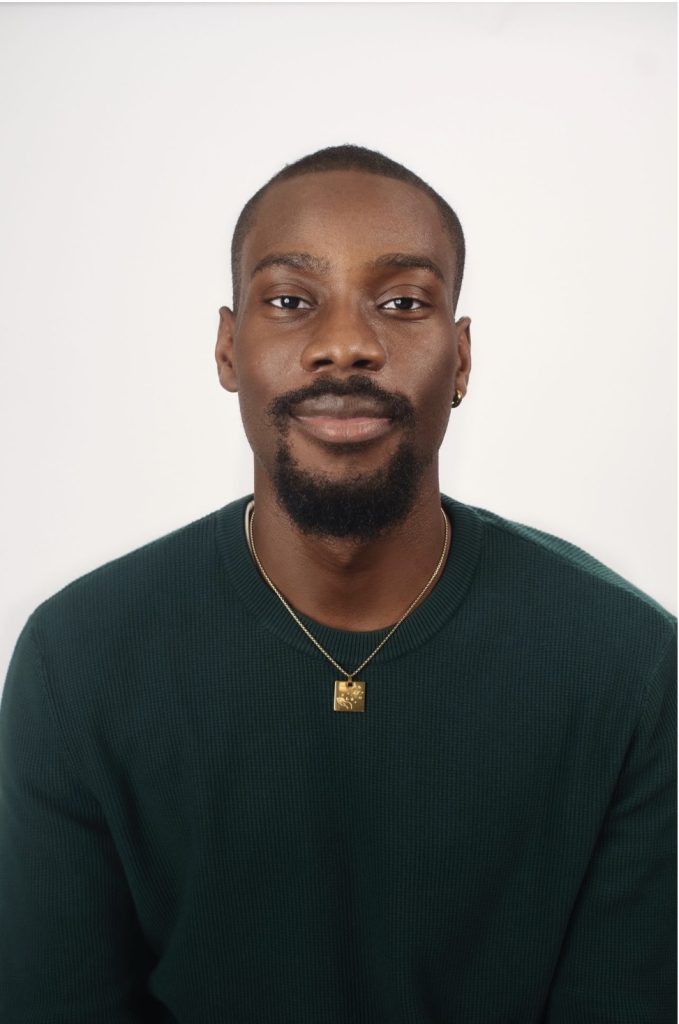
If you’ve spent enough time on the internet, you’ve probably heard Deji’s voice in a Coca-Cola commercial. If you haven’t, you might have heard him hyping up the crowd before a Fireboy concert. Or, more recently, hosting Overthinkers Anonymous, a weekly show that explores masculinity, relationships, money and the realities of modern adulthood.
In this article, he discusses vulnerability, dealing with online criticism, and why meaningful conversations between men matter now more than ever.
Would you say that you are an overthinker?
One thousand per cent. Overthinking, to me, means cycling through a billion possible scenarios far longer than you need to before arriving at an answer. Or not always arriving at an answer. Sometimes it’s staying in one cycle of thinking until you’re exhausted, and then it forms an action.
Is that why you wanted to be a part of Overthinkers Anonymous?
Funny enough, I don’t think the name came until after I joined the team. What initially drew me to it was the idea that the show was going to be centred on healthy conversations with men (and women). It aligned with stuff I already planned on doing. I’m passionate about improving the PR and behaviour of men. It’s not like I’m perfect, but I see that there are ways we’re dropping the ball. And we could definitely be doing better. This show is supposed to be a vehicle for that.
How would you describe the show to someone who hasn’t seen an episode?
Overthinkers Anonymous is a conversation that happens in my living room. There’s a slight structure, but for the most part, everybody’s just allowed to bare their hearts on their sleeve. It’s men having conversations that we have every day in private or don’t have at all with themselves and with women.
My biggest pitch to anybody who would love to watch Overthinkers Anonymous is that if you’re a man, there is a likelihood that you will see yourself in some of the people who appear on the show. If you don’t, it will at least give you a fresh perspective on things that you haven’t considered before. I also think you’ll be met with softness. I’m a soft person. I like soft people, and I lead with softness to encourage people to be gentle.
What specific gap do you think the show would fill?
Hopefully, this doesn’t come across as an insult to anybody. I think we needed to create a space where we would be able to have conversations in good faith. We’re not trying to come across as experts speaking down on people and telling them to do better.
Particularly because a lot of these conversations are hard for people to have. It is important to us that there is a level of vulnerability being displayed by the hosts. And I’m nothing if not vulnerable. I don’t think of it as just a means to get views. It feels more like a service. It was cathartic for me as well.
How?
I am having a lot of conversations about things that I was dealing with in real time. There was an episode where we had Seye Bandele, and he was talking about the struggles of entrepreneurship and building a family with his wife. He spoke about ensuring that his wife trusted him enough to decide to get married to him. I was asking questions that I actually had, like ‘what does it take to get your partner to buy into an unrealised vision?’
I’m an entrepreneur, and I’m still very early in my career. So these were answers that I needed to hear. There were also things underneath the surface that the show was helping me to process. Nigeria is really tough, being a man is really tough and having conversations that help you to lean on other people makes it easier.
So, about marriage, should we be expecting to hear wedding bells soon?
Hahaha. I mean, if you’d like to hear wedding bells, I can play some on my phone. Wedding bells are not hard to get at all.
How do you balance humour with sensitivity?
To be honest with you, I don’t know if I do it consciously. I’m the kind of person who is very quick to make a joke out of a difficult subject. And if there’s something extra sensitive, I’m very careful about the way that it’s worded. I don’t want people to feel like they’re being interrogated or prodded for gist.
At the end of the day, if there are things a guest doesn’t want to share, it’s well within their rights. My co-host, EDK, is the same way. He’s an emotionally intelligent guy who knows that you don’t go beyond certain aspects of a conversation.
If you’re so intentional about vulnerability, how do you prepare for conversations that seem spontaneous?
Working with my producer, Anita Eboigbe, is very central to that. She helps with calling topics and developing the different discussions that we have. Outside of that, I try to deal with the material honestly.
When I speak, it’s from a genuinely curious place. I’m not just trying to tick off the bullet points on the list. I don’t hit all the notes exactly the way that they’re described in the brief because I do a lot of editing. If something super interesting comes up and it wasn’t initially part of my original plan, I allow it to flow naturally.
What made EDK the right person to co-host the show with?
Our chemistry and brotherhood comes from having conversation after conversation. The first time we ever met, it was over food, and we just kept gisting. We realised that we got along, and the rest is history.
Did you have any doubts about how well the audience would receive the show?
Several. One, I was nervous about just being perceived. As much as I do a lot of front-facing stuff, there’s never a guarantee of how people might receive you. Men, in particular, can be very interesting people. Another thing I was nervous about was posturing like an expert.
There was a tweet where someone said, ‘Tell that brother to uncross his legs; nobody wants to take advice from a feminine Tupac. ’ I thought it was hilarious because the set of the show is my living room, and I’m obviously very comfortable. But the reason why it was even more interesting as feedback is that I don’t want it to feel like we’re giving advice. I’m not trained as a counsellor. The idea is that I’m a guy like you who’s just figuring it out or a friend giving you a listening ear. That way, it might be easier to accept.
Wow
I was also nervous about toxic masculinity. You always wonder if you’ll be able to break past all the different walls and actually touch something real within a man. It’s not always the easiest thing. Also, it’s not something that you’ll always be able to do because a lot of men have put up so many defences.
How many of your doubts turned out to be true?
All of them. Some people are listening through the lenses of their insecurity, which I’ve seen with the money episode. Also, as I said, no one wants to take advice from a feminine Tupac. I’m grateful that I’ve done things that’ve made my skin thicker. The toxic masculinity aspect has definitely shown that people don’t look at things in context. They engage with the clip, they drop their mean comments, and they move on.
However, there’s been so much positive feedback within that as well. The conversations that have resulted from our episodes and seeing the profiles of the guests on the show grow. I know that it’s actually helping people. A recurring comment we get is ‘Just when I was thinking about my life, this pops up. Thank you’.
The show makes itself a space for the male perspective. How do you see these shifting, existing, harmful gender norms in Nigerian society?
To be honest, I don’t see the show being the vehicle for that by itself. This being the shift itself would be too ambitious a goal to set. I don’t think people change that easily. But I think it’s a significant start to the shift.
There’s a two-part quote that says, ‘I don’t know that I’m going to be the change, but I think that I will influence the person who will change’. I think that is us.
Are there topics you are especially excited to tackle as the show continues?
Oh! We tackled the manosphere and the ways that masculinity is being projected to younger men. I would love to see how that plays with the audience.
I’ve also been looking forward to talking about male friendship. I would love to dedicate an entire episode to male friendship and what it looks like. The ways that we can show up for each other. I’d also probably even like to have that conversation adjacent to women because I think there’s a strength in female friendships that we need to learn from.
Next Read: Uzoamaka Power Made Call of My Life for Everyone Who Has Ever Loved Too Much