Recently, a roll-up flyer from the University of Lagos (UNILAG) went viral on social media platforms for what it said.
The flyer, which contained sexual harassment counselling tips for women, advised them to, among other ridiculous things, avoid shaking hands “anyhow” with men, avoid frequent gifts from men, and “learn to say no.”
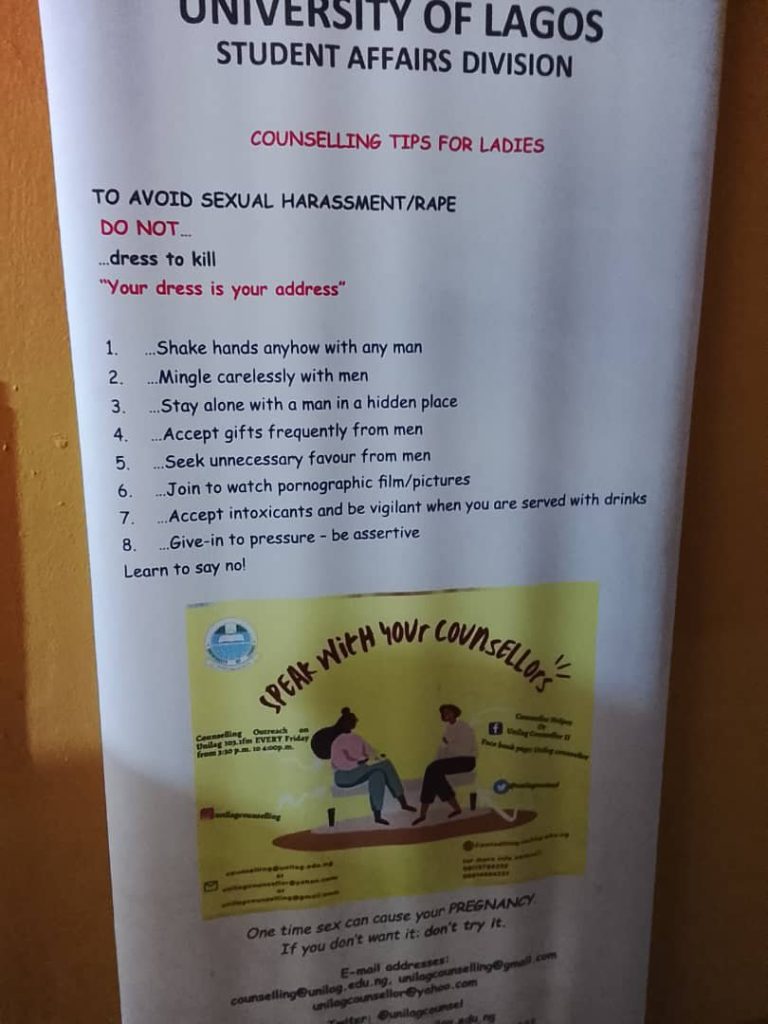
Sure, we know that Nigeria is the land of anyhowness, and that we can’t be shocked anymore, but this is just bizarre. That it’s coming from a higher institution is batshit crazy.
Anyone and everyone knows that victim-blaming is the biggest weapon in a sexual abuser’s playbook. They know that society, being so unfair to women, would always find a way to blame them for their own abuse, so they bank on it.
Victim-blaming is so dangerously effective that even a dead victim of sexual abuse is not exempt. In many cases, people go as far as questioning the deceased victim’s reputation to justify the assault.
In 2020, Vera Uwaila Omozuwa, a 22-year-old student of the University of Benin (UNIBEN), was raped, severely beaten, and subsequently died from it.
While many Nigerians called for her killers to be brought to justice, some tried to blame her by asking what she was doing in the church alone. They also suggested there might have been more to the story.
The university’s management wasn’t any better. In a statement released by the school, UNIBEN’s then-Vice Chancellor, Lilian Salami, condemned the attack and advised students to be mindful of the company they keep and the places they visit.
If you live in a glass house…
It’s one thing to reinforce victim-blaming as a university, and another to do so as UNILAG.
The Lagos State Government is currently prosecuting 53-year-old UNILAG lecturer, Samuel Obinna Ojogbo, on a two-count charge of rape and sexual assault of a 20-year-old student of the school.
At an April 2026 hearing, the student said the incident happened in Ojogbo’s office at the university’s Akoka campus.
In September 2023, another UNILAG lecturer, Kadiri Akeem Babalola, was accused and arrested for raping another 20-year-old female student in his office.
In 2015, a part-time lecturer of the university, Afeez Baruwa, was detained in Kirikiri prison for the alleged rape of an 18-year-old student.
In the BBC sex-for-grades documentary released in 2019, a UNILAG lecturer, Boniface Ighenghu, was taped sexually soliciting an undercover journalist disguised as a 17-year-old girl admission seeker.
From sex-for-grades to rape, the University of Lagos has had more than its fair share of sexual harassment scandals, so more than anything, that roll-up flyer should not be seen miles away from the school.
UNILAG has to do better
In response to the public outrage sparked by its flyer, UNILAG released a statement on Monday, July 27, saying it does not support the messages it bore and had therefore withdrawn the flyer.
Yes, statements are good, but the damage might already have been done. It is one thing to release a statement with all the right words, but it’s another to try to convince a female student currently undergoing sexual harassment that the school can get her justice.
It’s easy for the school to say the flyer does not represent its values, but it’d be harder to convince its students and the general public that none of the officials at its Student Affairs Division believes the messages on the flyer.
Nigeria has to do better
UNILAG’s sexual harassment advisory is everything that we shouldn’t be doing, yet it represents exactly how we as a society handle sexual harassment.
When a minor or adult is raped, her family, instead of seeking justice, conceals it or makes her marry her rapist so as not to “bring disgrace to the family.” And if it is reported to the Police, they are sometimes asked to settle it amicably.
From a young age, women are told to sit properly so as not to tempt a man, go out in the company of others so as not to be attacked, and say no when approached.
Knowing that these might not save them, women have still abided by them. Yet, when an abuser harms them, they are endlessly questioned. And when they are killed by their abuser, people wonder about their virginity before they can feel sorry for them.
Not that it needs to be said, but sexual harassment in all its forms has never been about what the victim was wearing, doing, or saying. Incident after incident has shown us that it’s always been about the victim.
From Baridapsi Needem, who was sentenced for raping his 14-year-old daughter, to Chika Adionye, sentenced to life imprisonment for raping two children, aged 7 and 8 years old, the evidence is clear for all to see.
Nigerian authorities issue statements every other day, vowing to root out Sexual and Gender Based Violence (SGBV), but nothing ever happens. In 2020, the governors of Nigeria’s 36 states declared a national emergency over rape and GBV, but six years in, it has remained an emergency.
In 2025, activists sounded the alarm and made the same call. Just recently, in June 2026, the chief statistician at the Federal Ministry of Women Affairs, Sunday Agbabiaka, revealed that reported cases of GBV have increased over the past four years, reaching as many as 29,000 in 2023.
The deaths related to these incidents have also seen a sharp increase, moving from about 520 cases in 2020 to over 1,300 in 2023, with only 4 per cent of perpetrators convicted.
Agbabiaka said the conviction rate is so low due to factors such as lengthy investigations, weak law enforcement, fear of stigma, and witnesses unwilling to testify.
We are not experts, but we can draw a straight line from the last two reasons to victim-blaming and the stigma it attracts.
Until the attitude of society changes, GBV numbers will continue to climb, and if our higher institutions, which should lead the movement, still promote backwards beliefs, where does that lead us?