The Nigerian experience is physical, emotional, and sometimes international. No one knows it better than our features on #TheAbroadLife, a series where we detail and explore Nigerian experiences while living abroad.
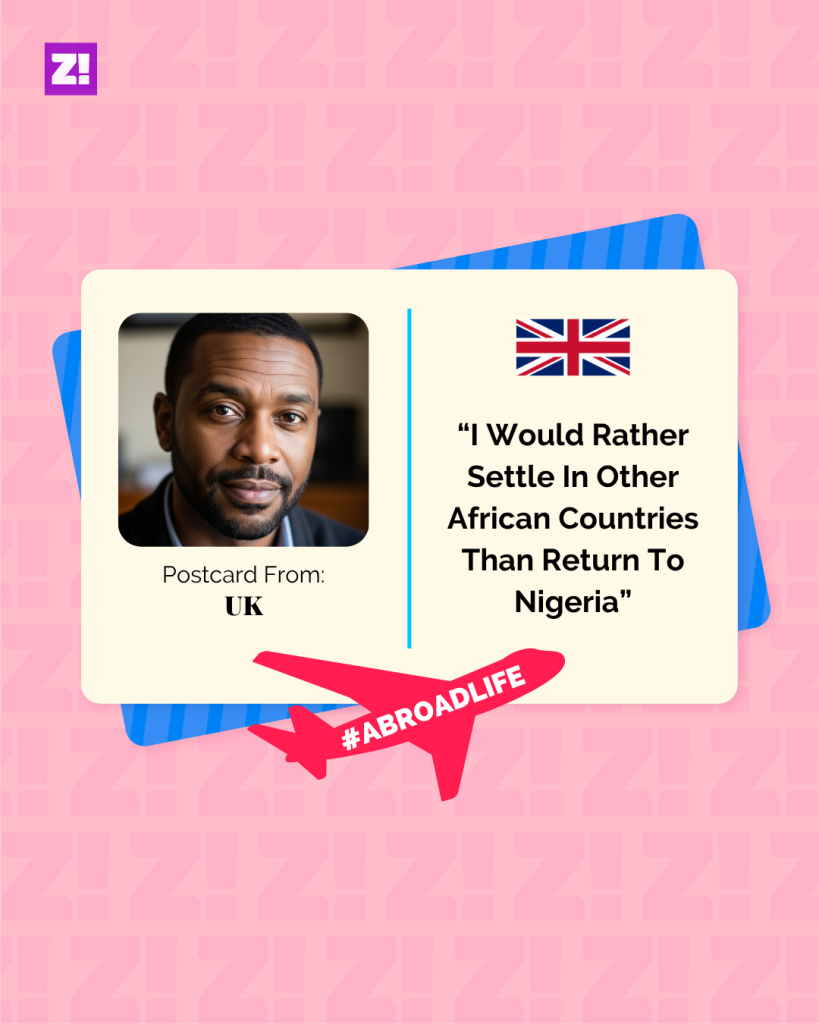
Ken (49) left Nigeria almost twenty years ago. In that time, he has lived through multiple waves of anti-immigration sentiment in the West. He shares how having a tough skin helped him navigate racist environments, and why he is not considering a return to Nigeria.
Where do you currently live, and when did you leave Nigeria?
I live in England currently, but I have also lived in other parts of the United Kingdom (UK). I left Nigeria in 2006, 19 years ago.
Was that your first time leaving Nigeria?
No. I used to travel around. I had been to the UK a few times for holidays and visiting friends, but 2006 was when I moved here permanently.
What inspired you to leave?
I just wanted more for my life, that is the truth. I got my first degree in Nigeria, and I felt like I had gotten a certificate but not an education. I wanted more than just that paper. I wanted global exposure. The idea of being a global citizen was really appealing to me.
What was life like for you in Nigeria?
It was okay. I made money, but it was not fulfilling. I worked in the banking sector, and I invested aggressively during my early days. So by the time I started thinking about moving abroad, I did not need my salary anymore. I was really comfortable, and my investments were yielding more than enough to take care of me.
So I thought, “Oh, I think I need a lot more for myself.” That was what pushed me to leave. I applied for a master’s in the UK.
I still remember when I got my visa. I got it in late October, and school had already resumed in September. I was almost too late to resume. After getting my visa, I had to get to the UK within 48 hours.
Wow. How did you make it?
I basically just left everything. I said to my girlfriend, “Look, girl, I am leaving. You can have my whole house to yourself with everything in it.” I changed my money. I think it was two hundred naira to a pound back then. Then I got on a flight to the UK.
What was the early experience like?
I was really focused on school and work. My master’s took about two years to complete. During that time, I had internships with some companies to get “UK experience” because the companies here do not recognise whatever experience you are coming with from Nigeria.
While I did not like starting from ground zero, I looked at it as coming in on a clean slate. So I just took on every opportunity to learn and relearn. I did not only do my master’s courses, but I also got some other certifications to make myself ready for the UK job market. About six months after I graduated, I got a job at EDF Energy.
Would you say the move to the UK has been a good decision so far?
Yes. It was a good move because of the professional exposure I have gotten. My move to the UK took me to a whole new level in terms of what I could achieve technically. I went to places I never imagined I would. Like getting to work underneath a nuclear reactor. I was doing stuff I never imagined I could. It was like my technical capabilities exploded. I was pushing myself beyond my normal boundaries because of the work I did, the people I met, and the opportunities I had.
But it was tough. It was not a walk in the park. There were good times and bad times, but overall, I would say it was a good move.
Sounds like you have had quite the career. What are you up to now?
Like I said, technically, I have pushed myself beyond my boundaries and achieved a lot of great projects in those companies I worked for. So I felt it was time for me to pivot and start doing things for myself. Right now, I consult on a contract basis.
We have talked about your professional life in the UK. But what about your personal life? What is your support system like?
My support system is my family. That is my wife and three kids. Due to my continuous travelling, two of my kids were actually born in the United States (US) during the time we lived there.
After my contracts in the US were completed, we moved back to the UK, and I have built a tight unit of friends who have the same mindset as me in terms of career plans and business, and also socially. So that is my support system.
Your girlfriend joined you in the UK?
No. I met my wife in the UK. My relationship with my girlfriend in Nigeria did not work out. We tried long-distance for a while, with me coming to Nigeria whenever I could, but it did not work out in the end.
After that, I met my wife in the UK. She had also come from Nigeria to study. We met at an event at a mutual friend’s house, and we started a friendship that eventually turned into a relationship. She initially wanted to finish her studies and go back to Nigeria. But after her studies, we got engaged and then married here in the UK.
She is more Nigeria-focused than I am, but I think along the way, she came to see the value of life in the UK. I think she is starting to see the UK as her home a lot more now, after all these years.
You mentioned your children being born in the US while you lived there. Where else have you lived?
Apart from the UK, I have stayed in the US, France, and Germany. Those are the countries I have lived in for work for long periods. I have been to many other countries for shorter periods, too.
Do you have a favourite?
I would say the US, Texas specifically. The environment just appeals to me. But my wife does not like it there because of the gun laws.
While we are talking about different countries, let us talk about Nigeria. Have you been back since you left?
Yes. I have business there from time to time, so that brings me back often.
Is there a possibility of a permanent return?
No, I do not think so. Not in the current state of things in the country. If I am going to retire permanently in Africa at some point, there are other countries on the continent I am considering.
There are other African countries that have much better situations economically, and in terms of security and safety, which is very important to me.
I get contracts to offer my expertise in many different countries. Nigeria is one of those countries. So for me, it is just a place to do business. Whenever I am done with business, I leave.
Does the current anti-immigration sentiment in the UK make you uncomfortable?
The immigrant journey is never a straightforward one. I see all this anti-immigration talk in Western countries now, but I have seen it play out before. Back around the time I first moved here, there were all these really frustrating policies imposed on immigrants for no just reason. I passed through all that.
Also, it was quite an expensive journey, and you find yourself having to depend on people and systems that make you compromise and endure certain things. You might be in a toxic workplace, and because you are an immigrant, you just have to endure it.
There will be positions you are qualified for and should get, but you will not because they are designated for British passport holders only. I was in a tough spot because my work involved a lot of travel, and that was really difficult when I first came here.
Documentation at the time limited my ability to travel. So there are a lot of limits to your opportunities as an immigrant, especially in the early periods. But you just have to get through those periods.
That has to be a little frustrating, right?
It is frustrating because I feel like they do not appreciate the value that immigration brings to their countries. And unfortunately, the Western media does not help because they feed them wrong narratives. Many people do not think critically and just swallow whatever propaganda they get fed, then run to the streets with it.
The fact that they do not reason critically, and it leads to this anti-immigration rhetoric being pushed around, is what makes me uncomfortable. But the truth is that they cannot do without immigrants. It is like they do not want us around, but they also need us.
There are so many occupations, roles, and parts of the economy that would collapse if they stopped immigration. They cannot do without it. So I would just say that immigrants coming to the West have to be prepared for what they are going to face. Do not allow yourself to be surprised by it.
With some of the new laws and policies making life really difficult, do you think immigrants are getting a fair deal?
What feels fair depends on each person and what they want and expect. You need to have a long-term strategy.
As I said earlier, I was comfortable in Nigeria before I came to the UK. I was financially independent, but I still came to the UK because I was thinking long-term. I looked at where Nigeria was, where it was going, and I felt my investments would not be able to sustain the kind of lifestyle I wanted while still being in Nigeria. That was why I decided to pack my bags and come to the UK.
So, talking about a fair deal, everyone has to think about what they are sacrificing and what the long-term benefit will be. You just have to think about whether or not the value you are getting is worth the pain you pass through as an immigrant.
Whether you are getting a good deal depends on what you want from the system. It depends on what you want long-term.
It could be tough, it could be hard, but if you have a long-term plan, you will be able to make the right decision for yourself and your family in the long term.
Can you remember some of the culture shocks you experienced when you first moved to the UK?
The first thing that shocked me was the structure of the UK itself. It is four countries: England, Scotland, Wales, and Northern Ireland. And each country has its own distinct culture, its own flag and currencies, even different languages.
I struggled getting used to the different accents. My goodness, in Scotland, the accent is not a normal English accent. And they have their own language too: Doric. I had to learn it because it is what the local people speak, and if you want to get along with them, you have to know it.
Let us talk about highlights and lowlights. What has been your worst experience as an immigrant?
My worst experience was at a time when there was a lot of anti-immigration rhetoric. This was around 2011, the Conservative Party was in power, and they were really clamping down on immigration.
It was a really bad time for me and my family. Every time you made the application to renew your paperwork, it would take almost forever. And that could affect your work placement. Luckily, my employers were quite understanding. But I have friends whose employers were not so understanding, so they had to stop work for a period of time. And you could not travel around while your visa was being renewed.
So it was a bad time for me because for almost six months, I was not sure if I would still be a resident in the UK or not. And my finances were also affected because I lost many opportunities for work that involved travel.
Added to that, the area I was working in was not a comfortable place for an immigrant. It was quite a toxic environment because of all the anti-immigration sentiment. I know some people would not stand what I did. They would have just left. But I realised that if you have tough skin, and you know what you are doing, you will pass through the tough time.
You mentioned being in a toxic environment. Do you mean racism?
Yes. In the UK, they are subtle about it, but it is there. You can feel it, you know when it is happening. And it is very difficult to deal with that in the workplace because your visa is tied to your having a job. So you just have to swallow it, shoulder it, and move on.
My friends and I had this inside joke based on the movie, Twelve Years A Slave. So whenever something happened, we would encourage ourselves by saying, “Do not worry, just do your five years of slavery and get out.”
That sounds grim. But it must have been good to have that support?
Yes. One thing that really helped me through that dark time was the support of friends, especially from the Indian subcontinent. So that is my Indian and Pakistani friends.
They are very resourceful, and they have a very strong community mindset. In that sense, they were actually more supportive than the Nigerian community in the UK. I found that Nigerians mostly did not know how to help, and those who did were asking for money. But my Indian and Pakistani friends just helped freely. They guided me through the whole visa process and never asked for a penny.
That sounds great. What has been your best experience?
I do not know where to really start. There have been so many great experiences. I really enjoyed my time working in the US. It felt like a really merit-based system there. If you work hard, you will be rewarded accordingly. That was my experience, so I loved it there.
I also made some long-lasting friendships there. I am constantly having to fly over because people keep inviting me to events.
I have become more financially independent in the UK to the point where I have dumped my nine to five and I am now doing my own thing. I have so much more time to enjoy new experiences.
So I will say I am still building my best experiences here.
That is amazing. Nineteen years is a long time. Can you sum up your journey?
If you have a plan or dream, you can make it come true. That has been my journey. Almost everything I have made up my mind to do, I have done. Not everything I wanted has happened, not everything has worked out, but I have hit a lot of the milestones I laid out in my plans.
Well, let us put a number to it then. How happy would you say you are on a scale of one to ten? And why?
I will say for me, in the UK as an immigrant after all these years, I will give it a seven point five.
It is not a higher number because of the weather. I hate the weather here. Let me put it this way: the rich people in the UK do not spend the winter and autumn here. Only poor people stay back. And the fact that I am speaking to you from the UK in the autumn shows I am still poor and I have some ways left to go in the things I want to achieve.
Do you want to share your Abroad Life story? Please reach out to me here. For new episodes of Abroad Life, check in every Friday at 12 PM (WAT).
Before you go, help us understand how you and other young people feel about the 2027 general elections by taking this 10-minute survey.
Click here to see what other people are saying about this article on Instagram