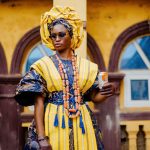
“Her work is her crown, and only she can tell you the weight of it.”– Tunde Owolabi
If you grew up in Nigeria or have spent any real time there, there is probably a woman you know without knowing it. You know her by what she sells. You have called her across a road by that name, flagged her down from a moving car, maybe sent your driver to find her on a corner she has probably occupied for years. In Lagos, for a certain class of working woman, the thing she carries on her head is her whole identity. She is Iya Elewa Agoyin. She is Iya Eleja. She is Mai Fura.
Tunde Owolabi wrote those names on his sculptures and gave them the titles of his work. That decision is not incidental. It is the exhibition’s quiet, devastating argument, stated plainly at the entrance: here are women you have spent your whole life seeing, and you never once thought to ask their names, because in your mind, they already had one.
Without Rest the Crown We Gain is now open at No Parking Lagos in Onikan, running through May 9th, and it is one of the more genuinely felt bodies of work to come out of Lagos in recent memory. Not because it is loud, but because it calls you to slow down. It does not demand your guilt. It simply asks for your attention.
This is Tunde’s fourth solo exhibition and perhaps his most personal body of work to date, a meditation on the informal economy, on labour as identity, and on the women of Lagos whose daily work holds entire ecosystems together whilst going largely unnoticed.
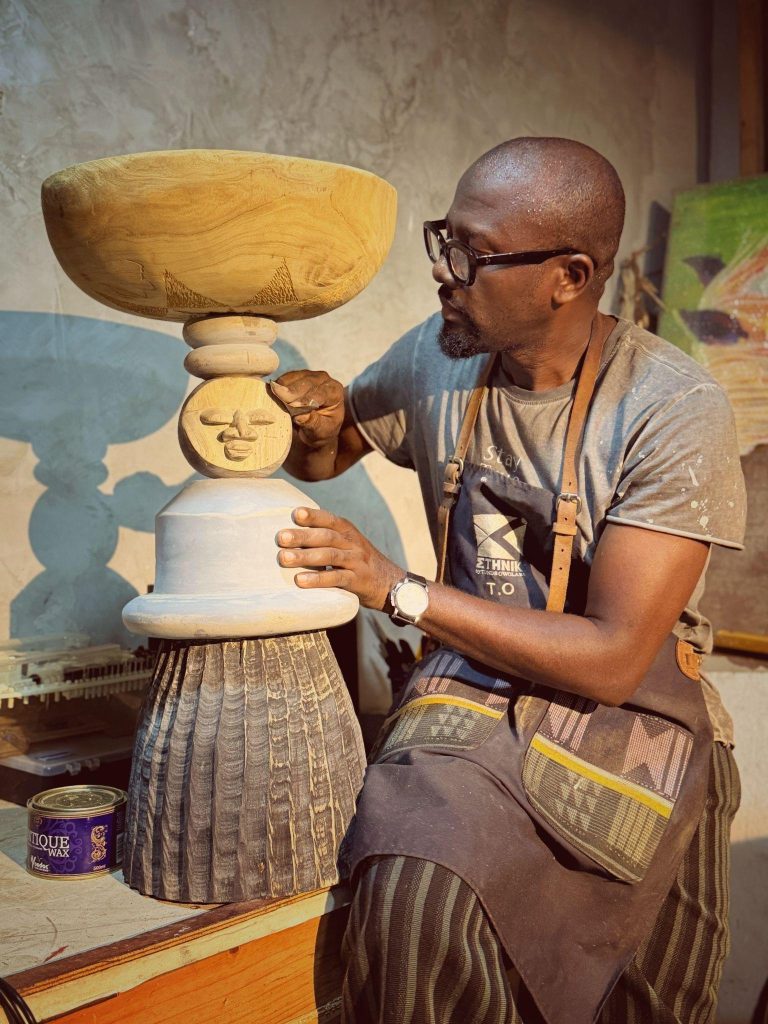
[Portrait of Tunde Owolabi in studio | Credit: Tunde Owolabi Studios]
The artist who practices the ritual of looking
Tunde Owolabi has always been an observer. It is probably his most essential quality as an artist, more than his facility with materials or his range across mediums. He is someone who tracks the angle of afternoon light between four and six, the hour when the Lagos sun finally relents. He is someone who will stop mid-conversation to read the direction a stranger is walking, calculate his position, and go find the composition before the moment closes.
He is a trained visual artist who spent time at The Research Studios in London under the legendary typographer Neville Brody and returned to Lagos to build a practice that refuses to be confined to a single category. His studio spans photography, painting, design, and now sculpture. In 2015, he founded Ethnik Afrika, the Afrocentric fashion brand that brought traditional Aso-oke into contemporary design, earning him international recognition, including a CNN feature. Commissioned works hang at the Hungarian Embassy and the Nigerian Stock Exchange. He has exhibited in London and Johannesburg. By any measure, an artist with serious range.
And yet the work that produced this exhibition began not in the studio but on the street outside it, from a ritual as ordinary as making coffee.
Every morning, Tunde makes his coffee first. Then he steps outside to the small garden at the front of his studio, sits under a tree, and watches. The birds, the butterflies, the street waking up. It started by accident. The cleaner, still finishing up one day, had him step outside to wait, and he discovered the quiet beauty he had been missing. He kept going back.
“That garden is a resting place for me.”
In a city where stillness is almost a foreign concept, he built himself a small daily ritual. That same stillness, turned outward, is how this exhibition was born.
The weight of what is carried
The title of the exhibition, Without Rest the Crown We Gain, is worth sitting with.
In Yoruba thought, and across much of West African cultural life, the head is not simply a body part. It carries spiritual weight. What you place on it matters. The image of a woman balancing a load on her head is ancient, running from the farm to the stream to the market through generations of African womanhood, sitting somewhere between the physical and the symbolic. “Philosophically and literally,” Tunde says, “her work is her crown.”
He arrived at the title through a woman he watched selling bread just outside his studio, day after day, in all weather, without complaint or applause. He noticed over time that she was also selling beans. That she had made herself indispensable to an entire micro-economy of construction workers, office staff, domestic workers, and early risers who needed something solid before the day began. That, without her, more people than she would ever know would start their mornings without breakfast.
“She is one person who has to go through all of this,” he says. “But she is not the only one who is going to enjoy the gains.” The informal economy she represents is vast, underestimated, and almost entirely female in its visible face. Her work is her crown. She just does not get to wear it anywhere official.
That observation became the spine of everything.
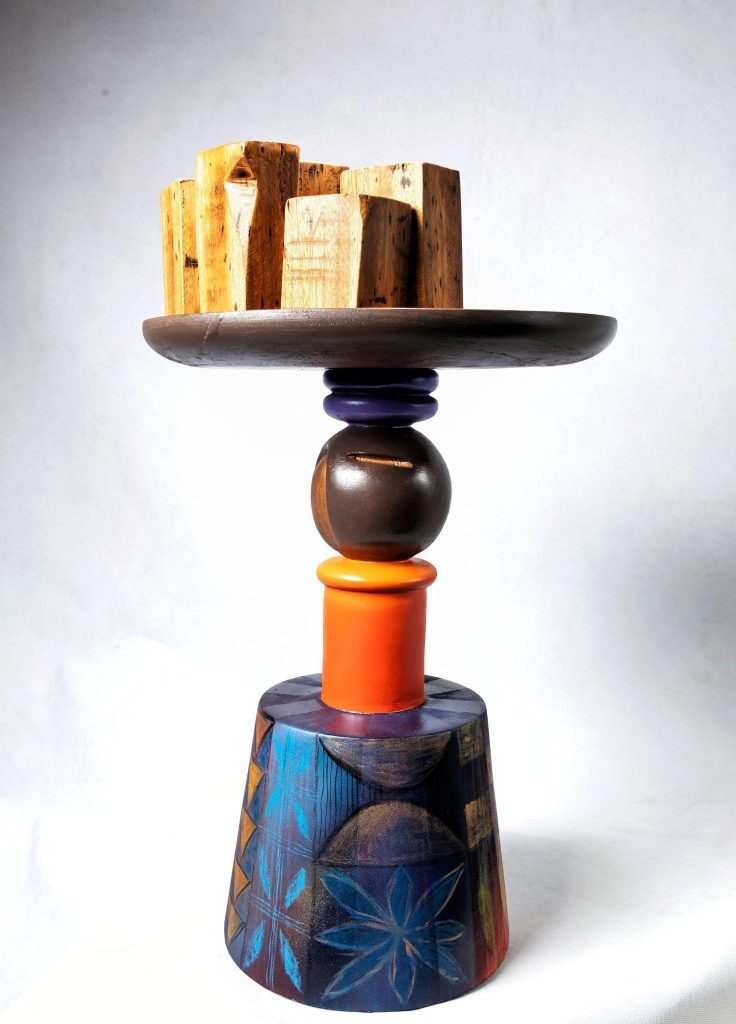
[Agege Bread | Sculpture | Mixed media, wood, and acrylic | Credit: Tunde Owolabi Studios]
The medium that does not forgive
This body of work marks Tunde’s first sustained engagement with wood sculpture, a medium he arrived at through the concept rather than any prior training. He did not start with a sketchbook. He let the art dictate the medium, which meant learning its language while simultaneously trying to say something urgent in it.
Wood carving is, technically speaking, a subtractive process. Unlike painting or photography, where you can layer, revise, and begin again, sculpture in wood asks you to commit. Every chisel mark removes material that cannot be returned. Mistakes are expensive. Precision is not optional.
“It taught me patience. And it taught me precision.”
There is a particular weight to hearing that from someone who has built a career on fluidity and experimentation. This medium pushed back. He had to meet it differently.
But the surprises were just as instructive as the discipline. The piece called Hadiza was designed with a specific pattern in mind. A chisel slipped, the mark it left was more interesting than the planned one, and rather than work around it, Tunde let it lead. On one of the photographic works, a coffee spill bloomed into a sepia wash across the surface of a print. He looked at it and left it exactly as it was. That warmth is now part of the finished piece.
“For every work there are moments of surprise,” he says. “Sometimes the material takes on a life of its own. Let go and let the collaboration between the material and the piece happen.”
There is a philosophy in that way of working that connects directly to the subject matter. The women in this exhibition do not get to move through their days in straight lines either. They adapt, absorb what the city throws at them, and keep going. The material and the maker are not so different from the subjects being made.
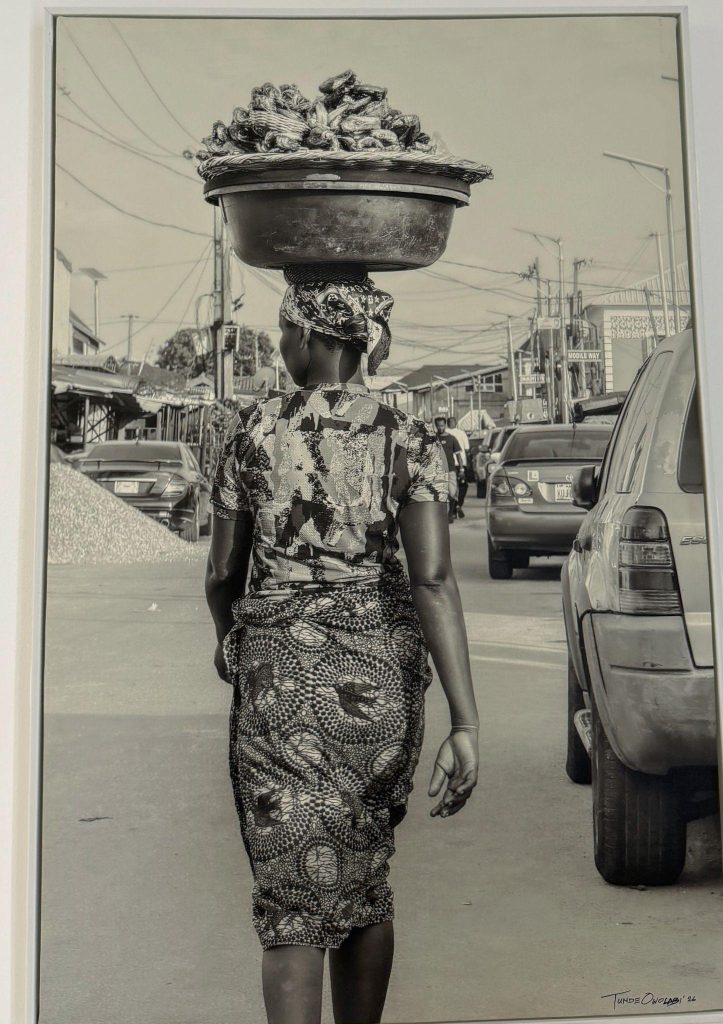
[Iya Eleja (Fish Monger) | Photographic print with charcoal | Credit: Tunde Owolabi Studios]
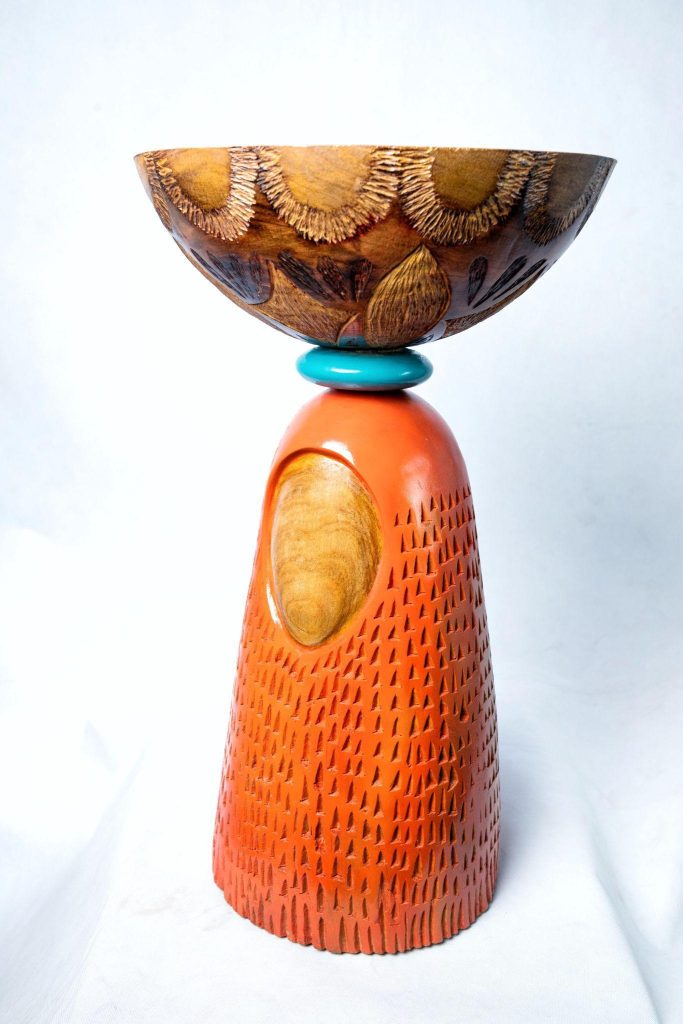
[Hadiza | Sculpture | Mixed media, wood and acrylic | Credit: Tunde Owolabi Studios]
Two dimensions, three dimensions, and the distance between them
The exhibition presents two bodies of work in dialogue. The sculptures, carved wood figures finished with acrylic paint and in some cases incorporating brass, clay pots, or aluminum, are abstractions. The human form is stripped to its essential geometry, a sphere for the head, a cylinder for the torso, the figure reduced to its most fundamental statement. What remains is posture, load, and presence. The load carried overhead becomes, on some pieces, a functional platform, which is how they came to be called stools, though Tunde is clear that they are first and foremost sculptures.
“It becomes a bridge between functionality and art,” he explains. “If you decide to use them as a stool, whatever you put on top of them becomes the load the person is carrying.” The form does what the concept asks of it: it makes you think about what is being carried, and what it costs.
Alongside the sculptures are photographic prints, some reworked in charcoal directly over the image, enhancing shadow, deepening form. They are the origin story made visible. Together they ask what good art has always asked: to look at the same thing twice and arrive somewhere different the second time. You see the photograph of a woman selling fish, then turn to find the carved wood figure she became, and in that distance between the living person and the abstracted form, the whole meaning of the exhibition opens up.
Tunde does not flatten these women into symbols. He appreciates them. He shows you the person and the idea, the shape and the load, all at once.
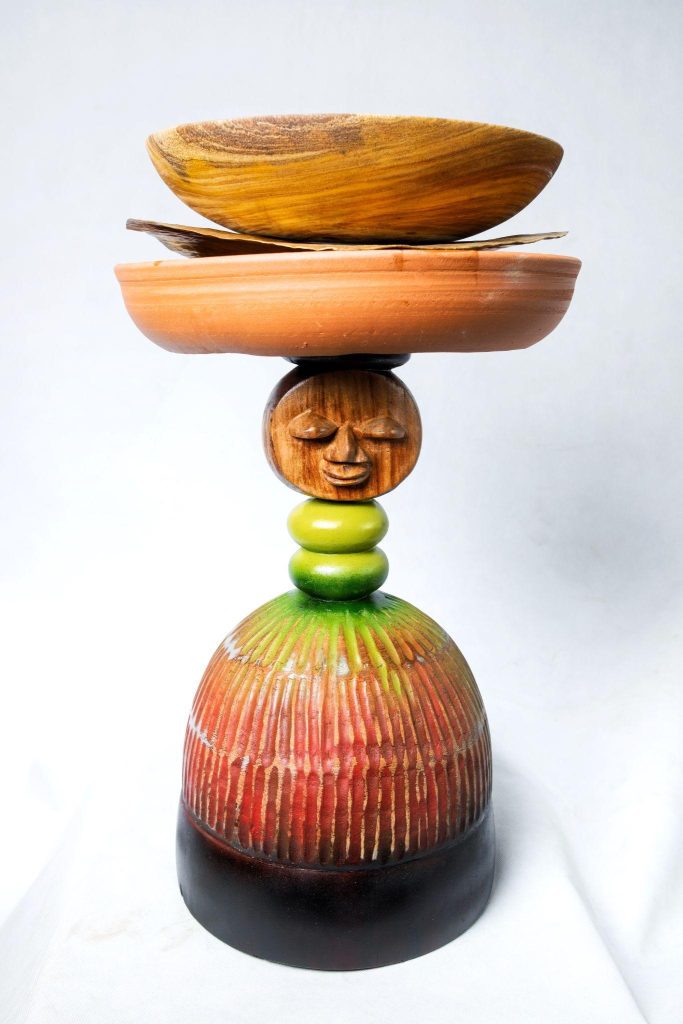
[Ki le n ta mama (Mama, what are you selling) | Sculpture | Mixed media, wood, and acrylic | Credit: Tunde Owolabi Studios]
What Tunde wants you to take home
Ask Tunde who this exhibition is for, and his answer is immediate and expansive. Art lovers, yes. Collectors, yes. But also the people who live the life he is depicting. The woman selling bread who might one day walk into a gallery and see herself rendered in wood, named, given dimension, and placed on a plinth. That possibility matters to him.
“It’s very easy to live our everyday lives seeing some people but also not seeing them,” he says. “This is also about making them feel seen.”
He is careful, too, about the framing of his own identity within this work. He is Nigerian, Yoruba, Lagos-made, and all of that shows up whether he announces it or not. But he resists the label of Nigerian artist as a definition, the same way he resists any single definition. “Humanity comes first,” he says. “I’m human before I’m Nigerian or Yoruba or whatever.” His inspiration comes from wherever he has been and whatever he has noticed, and he has been many places and noticed more than most.
What makes this body of work significant in his practice is not just the new medium or the scale. It is the specificity of the attention. He is not making work about womanhood in the abstract or labour as a broad theme. He is making work about the woman selling bread outside his studio. The fish seller. The bean seller. The woman whose day started before yours and will end after yours, and who will be back at it again tomorrow.
For someone experiencing his work for the first time, Tunde does not prescribe a reading. “Interpret it in your way,” he says. “For some, it may be nostalgia, for some resonance, for some beauty. Whatever it is, I hope it makes them feel alive.”
He is not in a hurry about what comes next. He wants to sit with this, to let the exhibition breathe and see what it brings back to him. “I plan on savoring these moments,” he says, “while I bring new ideas.”
In the meantime, Hadiza is on the wall. Mama Nkem is on the wall. Sisi Shalewa is on the wall. All those women who show up every day without waiting for anyone to notice are, in this gallery, impossible to miss.
About the Artist
Tunde Owolabi is a Lagos-based multidisciplinary artist, photographer, and designer whose practice moves fluidly across fine art, visual design, and brand identity.
Founder of Tunde Owolabi Studios and the acclaimed Afrocentric fashion brand Ethnik Afrika, his work spans painting, sculpture, photography, and graphic design, always led by concept and driven by a deep commitment to storytelling.
As a visual artist, Tunde has exhibited across Nigeria, the United Kingdom, and South Africa. His solo exhibitions include African Elegance at the Battersea Art Gallery, London (2009), AsoOke: The Woven Beauty (2014), and As We Were, As We Are at Cromwell Ngobeni Art Studio, Johannesburg (2022). Commissioned works of his are held at the Hungarian Embassy and the Nigerian Stock Exchange. He has also shown at Art X Lagos.
A graduate of Yaba College of Technology and alumnus of The Research Studios London, where he worked alongside renowned typographer Neville Brody, Tunde brings a rare cross-disciplinary depth to everything he makes. Without Rest the Crown We Gain is his fourth solo exhibition.
Without Rest, the Crown We Gain
Open through May 9, 2026 | No Parking Lagos, 15 Military Street, Onikan, Lagos
Presented by June Creative Art Advisory (JCAA)
hq@jcaalagos.com | www.jcaalagos.com | +234 817 983 0800 | +234 810 915 8656