Every week, Zikoko spotlights the unfiltered stories of women navigating life, love, identity and everything in between.
What She Said will give women the mic to speak freely, honestly and openly, without shame, about sex, politics, family, survival, and everything else life throws our way.
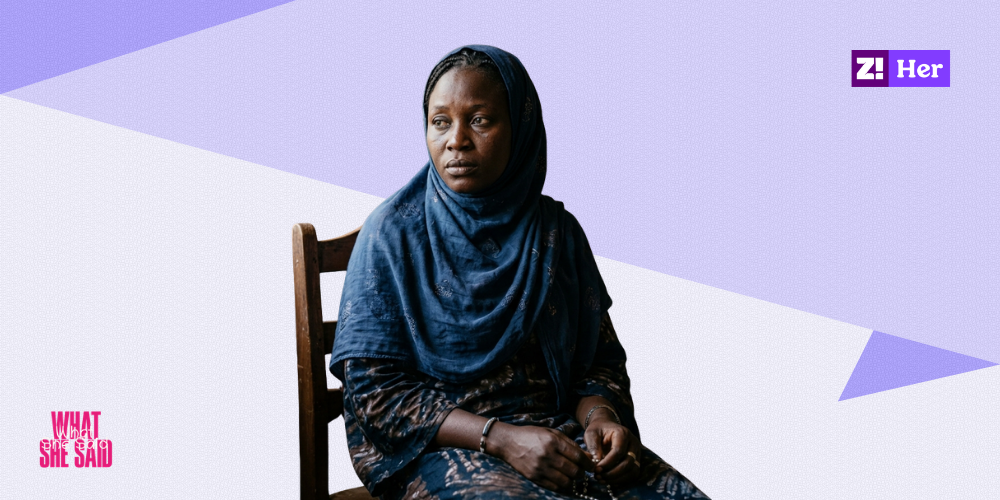
The subject of today’s #WhatSheSaid is Zima*, a 27-year-old mother of two based in Kaduna, Nigeria. She talks about years of proving herself at a non-profit that advocated for women’s rights, the subtle ways her workplace began to sideline her the moment she got married, and what happened when she got pregnant.
Can you tell me about yourself?
My name is Zima. I’m a 27-year-old mom of two children living in Kaduna, Nigeria. I’m a Northern woman, and I grew up here, so this is mostly the world I’ve known. Growing up, there were a lot of expectations around what a girl should be, especially when it came to marriage and family. But I’m grateful that my parents never made education a battle for me. They valued it, and that gave me the freedom to pursue my own career.
Before I got pregnant, I was a full-time advocacy officer at a non-profit organisation that worked to advance women’s rights. I had spent years building my career there, proving myself and doing work I genuinely believed in. Then I got pregnant, was sent on maternity leave, and was fired shortly after.
There has always been a gender bias attached to my work because I’m a woman working in the North. When I’m working late into the night, my male colleagues will always say, ” You should go home. Let this guy take over and finish up the task. Just go home.”
There’s this mindset that we are not equal. You hear words like, as a female, you’re not supposed to get involved. It’s a man who’s supposed to get involved. I’ve heard that several times at work. When we go for community engagement, only the guys are allowed to greet the village heads. We can’t. Which is ironic considering my line of work.
What was it like navigating that environment every single day?
Exhausting. Because you have to constantly prove that you belong there. You’re doing the same work, sometimes more work, but there’s always this invisible ceiling reminding you that some people in the room don’t fully believe you should be there.
I remember moments where I would complete a task, and the feedback would go to a male colleague. Or I would make a suggestion in a meeting, and it would be ignored, and then a man would say the same thing five minutes later, and everyone would nod. You learn to keep going anyway because you believe in what you’re doing. But it wears on you over time.
Did you ever try leaving?
I did not because I believed in the work. I was academically the most qualified person for that role, and I genuinely cared about the impact we were making on women’s lives. I thought if I kept showing up and performing, the bias would eventually matter less. I was wrong. It got worse when I got married.
What was the biggest thing that changed the moment you got married?
I never realised that my marital or motherhood status could change my life so dramatically. It started with my colleagues giving me a little more respect than before, which sounds positive, but wasn’t.
It’s just something I noticed over time. No one addressed me by my name anymore. I saw a shift from Zima to Mrs Ahmad, and I wasn’t cool with that, especially since that respect wasn’t given to my other female colleagues who weren’t married.
Then they started making comments like, Zima, you can’t go on this work trip because of your husband. And I have never given them any reason to think I need my husband’s permission to travel.
How did that show up practically in your work?
Sometimes, if I worked hard on a proposal and it was time to present it to partners who had requested it, another person was selected to do it because Zima is married. There was a time I worked hard on a proposal for three weeks. They found a single female colleague to present it, and nobody asked me whether I was comfortable with it.
Then I got pregnant, and somehow, things worsened.
How so?
There was a younger lady who was employed, but I had no idea she had been brought in to replace me. Thankfully, she was honest enough to let me know that was the plan.
At the time, I was working on a grant application for the organisation. A lot of work had gone into it, and the whole time, I had no idea that there were plans to replace me. It was so bad that even after the grant was successfully secured, nobody told me anything. I only discovered it by accident. Eventually, they notified me that they wanted me to hand over all the information about the grant and the project it was supposed to sponsor to the other lady.
All the months of work I put into securing thousands of dollars were dismissed and casually handed off to someone else.
What She Said: I Gave Up My Engineering Career and Re-Entered Pageantry at 30
What did that feel like, watching your work handed over like that?
It broke something in me, honestly. I could sense that they had lost confidence in my ability to lead, which is crazy because I had spent years proving myself. I was still the same person. I was just pregnant.
I loved that job. I loved the impact I was making. When funding started to dry up because of Trump’s restrictions, I even offered to work without pay because I cared that much. They never responded to that offer.
When did things officially unravel?
A few months later, I received an email from HR mandating that I go on maternity leave, and someone else relieved me of my duties. It was unpaid maternity leave because they said the organisation didn’t have money to cover the cost. In their words, they wanted to give me enough time to prepare for delivery. They said they wouldn’t want a staff member who is pregnant to be subjected to stress.
I said, “Okay, no problem.” Then I received another email from HR telling me I needed to have a one-on-one with her to address my expectations. At the meeting, I was asked to submit my laptop and my ID card. I did, and stopped going to the office.
Nigerian law grants women a minimum of 12 weeks’ maternity leave. During these 12 weeks, the minimum pay they are entitled to is 50% of their salary.
What happened next?
Surprisingly, I received an email from my work email, which was still functional, telling me I needed to work on the final reports for some projects they had given to someone else to take over. My friends asked me not to, but I worked on it anyway because I cared. Because I still felt responsible for what I had built.
During the process, I realised that they had more money for those projects than they had initially claimed. According to them, I didn’t need to know about the financial stuff. I had even used my personal funds to execute some parts of those projects. It was during the final closeout meeting with the donors that I realised how much they had hoarded. I tuned in for the phase-out delivery for those projects and went back on leave.
What happened after your maternity leave ended?
On December 31, HR reached out to me informally via WhatsApp, saying she had forgotten to tell me I would no longer be recognised as company staff.
So I went into the new year knowing that I was officially unemployed. They never even informed my colleagues that I had left the company. For months, all of them believed I was still on maternity leave. One of them still reached out recently to ask when I am resuming. According to her, HR has been saying that whenever they have a new project, they will call me back.
A WhatsApp message on December 31st! How did you receive that?
I remember the first time I saw that message, I cried. I didn’t want anyone to know. I walked into the restroom, called my husband, and I just broke down into tears.
It broke me down. Losing your source of income when you’re about to give birth isn’t something you can prepare yourself for. No one checked in. I was treated like I didn’t matter at all.
What has life looked like since then?
It has been an adjustment. You go from having a career you built over years, a title, a salary, a daily sense of purpose, to suddenly being at home with nothing confirmed about your future. And you’re also a new mother, which is its own enormous thing to navigate. The two things together are very heavy.
What made it harder was that I had given so much of myself to that place. Not just professionally but emotionally. I believed in what we were supposed to be doing for women in this country. So the loss wasn’t just financial. It was the loss of something I had genuinely cared about building.
It’s more painful to know that this was an organisation that advocated for women’s rights.
That is what stings the most. This is an organisation that swears it is fighting for gender equality, yet enforces unpaid leave on a pregnant woman. I was leading campaigns on breastfeeding, yet they had no private area for workers to breastfeed their babies. If you’re expecting women to resume work three months after birth, you are supposed to create an environment where they can easily breastfeed.
They created spaces for prayer inside the office, but a private space for breastfeeding is where they drew the line. During meetings, you’d hear them say things like, “We don’t discriminate. In this place, we don’t give any form of tribal or religious sentiments. We are all one”.
But you’re saying those things, and what I’m seeing is not what is happening. This company had only one woman in leadership. We cannot advocate for a better Nigeria while workplace issues like this remain acceptable.
Experts have recommended reforms to Nigeria’s parental laws to guarantee 16 weeks of fully paid maternity leave and at least 14 days of paid paternity leave, reflecting the modern demands of the corporate world.
What do you want women to take away from your story?
I think I accepted a terrible form of discrimination that no woman should ever have to deal with or accept. Pregnancy should not be treated like a character or professional flaw. I left that place feeling so defeated and powerless, but I think there is more that can be done instead of just accepting nonsense.
I hope more women choose to fight for the benefits they deserve.