In the fifth episode of Zikoko’s 100 Nigerians: Anatomy of a Marriage, we asked married Nigerians what it took to stay together despite their differences.
From couples navigating interethnic marriages to those learning to bridge religious and cultural divides, these stories paint an honest picture of the compromises and commitment it takes to make love work.
“Intertribal marriage had more challenges than I’d thought” — Amaka*, 34, F
I married a Yoruba man and our tribal differences weren’t much of an issue while we were dating. But after we got married, I spent the first few years of my marriage explaining myself, especially to his family. Our different upbringings led to a few clashes, and I also had a difficult relationship with my in-laws. Thankfully, my husband always stood up for me.
The hardest part has actually been our extended families. Nearly eight years later, relatives still tell me to behave “like a proper wife” according to their traditions. It’s irritating, but these days, I choose my battles.
“He wants our child to follow only his faith” — Aisha*, 39, F
As a Muslim woman married to a Christian man, I thought the difficult conversations would end after our wedding. Instead, it feels like we revisit the same arguments every year.
Before we had our child, my husband promised our kids would grow up learning about both religions. Now he’s changed his mind. He says he isn’t comfortable with the idea of our child becoming Muslim.
Those words hurt because I love my faith and I’m proud of the person it has shaped me into. In the end, we’re doing things his way. My son goes to church with his dad every week. I still try to read the Quran to him, but he doesn’t seem interested.
“I had to teach my husband to relax about money” — Tope*, 50, F
I grew up in a wealthy family, while my husband didn’t. We thought love would bridge that gap, but our different backgrounds created tension.
I was raised to spend money on the best and most convenient option. He grew up believing every naira should be stretched because his family genuinely struggled at times.
During the first few years of our marriage, we argued constantly about money. Not because we didn’t have it, but because we viewed it so differently. I had to teach my husband that he was allowed to enjoy life, especially with the money he’d worked so hard for. He’s still careful with money, but we definitely argue about it far less now.
“I learned it’s impossible to satisfy everyone” — Chinedu*, 36, M
I married a Yoruba babe, and the biggest surprise was how political naming our child became.
What should have been a joyful moment almost turned into a war over whose culture would be represented. The pressure from both families became so overwhelming that my wife and I quickly decided to name our child ourselves and deal with the consequences.
My mother still hasn’t forgiven me, but honestly, I’m okay with that. They were stressing us out. That lesson has repeated itself throughout our marriage. Sometimes, protecting your peace means disappointing the people you love.
“I didn’t know how lonely being the outsider would make me” — Hadiza*, 46, F
When I married into a family from a completely different ethnic group, I underestimated how lonely it could feel.
There were family gatherings where everyone switched to a language I couldn’t understand. Nobody was trying to exclude me, but I often felt like an outsider looking in. It took years before I truly felt like part of the family.
Looking back, I wish people talked more honestly about the adjustment period that comes with intertribal marriages. Love helps, but finding your place in a new family takes time.
“My wife pressured me for years to convert to her religion” — Pelumi*, 58, M
People like to encourage interfaith marriages, but I think they can be very stressful.
My second wife is a Christian, and she’s the one I’ve had the most trouble with. She converted a few years into our marriage, which I didn’t mind as long as she fulfilled her responsibilities as a wife and mother. But for a long time, almost every argument came back to my refusal to convert. It made me regret taking a second wife.
Things eventually settled after I got her a separate apartment. We still argue sometimes, though. A few years ago, she said she and our children wouldn’t eat Sallah ram anymore because of something her church preached about. That’s why I always advise people from different faiths to leave each other alone.
“It was difficult to change how I saw money” — Kemi*, 41, F
Women are always encouraged to “marry up”, but no one talks about how hard it is to shake certain beliefs about money when you come from a different social class.
My husband grew up in a wealthy family where money was always available. I grew up comfortable, but without many luxuries.
Even after we got married and became financially secure, I couldn’t shake the fear that everything could disappear overnight. He thought I worried too much. I thought he was too carefree.
It took years before I realised we weren’t arguing about money. We were arguing about the realities that shaped us long before we met. Understanding that changed everything. Now, when those fears creep in, I tell him, and he reassures me that we’ll be okay.
“I had to distance myself from my family for my wife’s peace” — Nnamdi*, 41, M
The hardest part of marrying outside my tribe was how my family treated my wife.
Her Itsekiri family welcomed me with open arms, but my own relatives made me feel ashamed. They did everything they could to exclude her whenever we attended major family gatherings.
Some of them still refer to her as “that girl”, even after more than a decade of marriage. I stopped tolerating it early on and distanced myself from them. We’re now one of those families that rarely attends extended family events. If they can’t accept my wife, they don’t get access to us.
What annoys me most is that they adore our children, who are half Itsekiri because of their mother, but still refuse to fully accept her. It’s sad, but I think keeping our distance has been the healthiest decision for my family.
“My in-laws’ wealth makes me feel inferior” — Fatima*, 29, F
I married a man from a much wealthier family, and nobody told me how insecure marrying up could make me feel.
In his family, people casually gift each other expensive things like it’s nothing. During our first Christmas together, one of his uncles gave us a present worth more than my annual salary at the time. I felt so embarrassed because all we gave him was a bottle of wine and some diffusers.
My husband doesn’t understand why I’m so reserved around his family but outspoken everywhere else. It took me a while to realise that I felt insecure because of their wealth. They’ve been nothing but kind to me, but I still sometimes feel like I don’t belong.
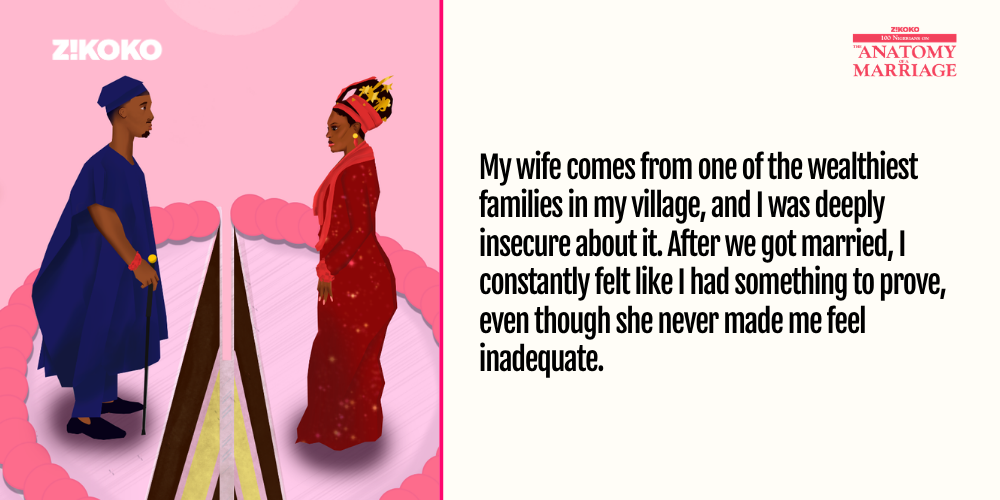
“For years, I thought I had to prove myself to my wife” — Dayo*, 63, M
My wife comes from one of the wealthiest families in my village, and I was deeply insecure about it, especially in the early years of our marriage.
Her family was one of the few in town that travelled abroad regularly and sent their children to top schools. They just seemed to move through the world differently. Meanwhile, I paid my way through medical school by doing menial jobs.
After we got married, I constantly felt like I had something to prove. The funny thing is, my wife never made me feel inadequate. She always reassured me, and her father remained generous to her, so we never lacked at home. Most of that pressure came from me. It took years before I stopped comparing myself to her family and started appreciating what I brought to our marriage.
“I don’t like the way his family jokes around” — Chioma*, 32, F
Marrying outside my tribe has come with its own challenges. I love my husband, but his family jokes around more than I’m comfortable with.
Every time my mother-in-law sees me, she calls me “Omo Igbo mi.” I don’t think she means any harm, but every time I hear it, I’m reminded that I’m not truly one of them.
These days, I remind myself that what matters most is that my husband respects and values me. That’s what keeps me grounded.
“After getting married, my friends pulled away from me” — Hauwa*, 35, F
Nobody told me I’d lose friends after marrying outside my religion.
I expected my family to oppose my relationship with my husband, but I never imagined my friends would slowly distance themselves too.
When I eventually asked some of them why, they said they assumed I’d converted to Christianity, even though I hadn’t. I didn’t expect that kind of thinking from people my age who claimed to be open-minded.
“My in-laws called me disrespectful” — Osas*, 31, F
My husband is Yoruba, and I’m Edo. I don’t know if it’s a cultural thing, but I’ve found that Yoruba people are more likely to use euphemisms than speak directly when correcting or disagreeing with an older person.
I’m naturally a very direct person, and that difference caused a lot of tension when I first got married. My in-laws thought I was disrespectful and stubborn. They were right about the stubborn part, but I never intended to be disrespectful. I simply disagreed and said what I thought.
My husband eventually pulled me aside and explained that wasn’t how things were done in his family. I had to learn to hold my tongue and let some things go to keep the peace with my in-laws.
“I converted for my husband, and my family hates it” — Maria*, 40, F
I converted to Islam so I could marry my husband. He personally had no problem with me remaining Christian, but his family, especially my mother-in-law, strongly opposed it. They insisted the marriage wouldn’t work unless I converted.
I agreed, but the decision damaged several relationships in my own family. Some relatives distanced themselves from me after my conversion, and a few relationships never recovered. For years, I carried a lot of guilt about that.
Eventually, I accepted that adults sometimes make choices other people don’t like or understand. My marriage has been worth it, but I wish people were more honest about the sacrifices that can come with choosing love outside familiar boundaries.
Read Next: Married Nigerians on Facing Crisis Together and Choosing to Stay