The Nigerian experience is physical, emotional, and sometimes international. No one knows it better than our features on #TheAbroadLife, a series where we detail and explore Nigerian experiences while living abroad.
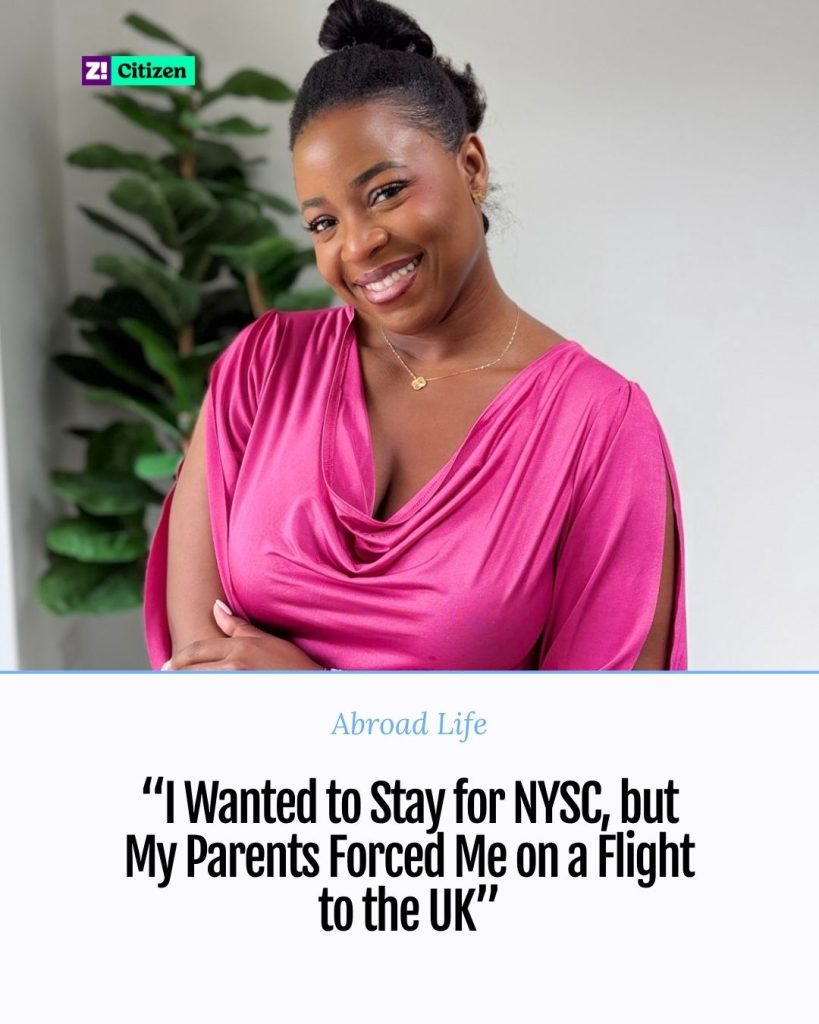
Elizabeth (33) has moved between Nigeria and the UK throughout her life. In this story, she shares some truly scary experiences she has had in Nigeria, explains why she can’t wait to leave the UK, and opens up about what it’s like connecting with Nigerians who see her as an outsider.
Where do you currently live, and when did you leave Nigeria?
I live in the United Kingdom, and I left Nigeria in 2019. I’ve moved between both countries throughout my life.
Tell me more about that.
I was born in the UK and grew up here, but I went to Nigeria for three years of boarding school, a month of A-levels, and then again for university.
Going to Nigeria for medical school was a way to connect with my culture. I had worked with Nigerian doctors in the past, and they were just built differently. They had incredible confidence and grit; they were resilient in a way that other doctors were not. I wanted to know how they were trained so I could be like them, because they truly inspired me. So, I chose a Nigerian university.
What inspired you to move back to the UK?
I wanted to stay in Nigeria for my National Youth Service Corps (NYSC) year. I was very into public health at the time, and wanted a chance to work in that area for service.
But my parents said, “Absolutely not.” They actually bought the tickets themselves and sent them to me. They insisted that Nigeria was not safe and that I had to come back home.
Let’s talk about life in Nigeria. What was it like coming here for school?
It was a rollercoaster. It’s the type of experience that makes you realise you’re not exactly like the people you think are yours. I came back believing I’m Nigerian and in my country, but people were very much giving me the vibe that I was not one of them. To them, I was “oyinbo.”
With time, I learned the mannerisms and the cultural nuances that make Nigerians, and things got better. For example, learning that “come and eat” is just something people say even when they don’t really want you to eat with them.
But medical school was a different experience altogether. It was very challenging by itself.
How so?
Sometimes your colleagues, senior students, lecturers, and doctors can have issues with you for intangible reasons. For example, when I was working in a state hospital in Nigeria before I left, a superior who was two levels above me at the time just really hated my accent.
I used to put on an intentional Nigerian accent in my attempt to blend in, but there were certain words that I hadn’t yet learned to say in a Nigerian accent, so my original British accent would peek through at times. Because of that, she used to make life horrible for no reason, just assuming I thought I was better than her. I would wonder, “How can I think I am better than you? You are my senior.” She just had it out for me and made sure I suffered whenever I worked with her, which was all the time.
I had to accept that people just wouldn’t like me because of their own preconceived notions of what I represent, even if I don’t actually possess those traits. It was a similar thing in boarding school, but it was worse there because they could physically beat you, and they did beat me a lot.
On the other hand, some people also just adore you because you came from abroad. They would talk to me just to hear my voice and accent. They didn’t really care about what I was saying; they just wanted to hear what I sounded like. For them, I was their first experience of someone from overseas.
So it was a mix of both—one half idolised me and the other half hated me. I never knew which it would be when I met anyone new.
How did that make you feel at the time?
It was hard. After completing Junior Secondary School, I went back to the UK. I remember deciding I was never going to go back to Nigeria again. I was completely over it. The experience was much harder than I expected because growing up in the UK, no one had ever disliked me for no reason.
But it made me stronger, because by the time I came back to Nigeria for university and encountered it again, I was a bit more prepared. I just didn’t like the concept of being treated as an outsider in a place where I’m supposed to belong. It was difficult because the whole point of going to university there was to connect with my Nigerian culture and not be an outsider.
Have you been back to Nigeria since you left in 2019?
Yes, I have been back for holidays, weddings, and to see friends.
What has been your best holiday experience in Nigeria so far?

I’ll say last year. I went to Abuja for a wedding, and then I went to Lagos and Ibadan, all within about 10 or 11 days. I got to see many places that I hadn’t seen in a long time, and visited spots I had only ever heard about on podcasts. The restaurants were good, the gym was great, and everything was fun.
Since it was a short burst of ten days and we kept moving across different states, the novelty stayed very much alive. If I had stayed longer, I probably would have started experiencing the typical fatigue that comes with the travel, transport, and infrastructure issues.
Do you see yourself settling permanently in Nigeria in the future, or is the UK home for you?
I hope to retire in Nigeria down the line, maybe when I’m like 70 years old. Of course, that’s based on the hope that the country doesn’t get worse by that time.
What has been your worst experience in Nigeria?
There are so many, but I can talk about the top ones.
Wow. Okay, go ahead.
So, first was a scary police encounter. I was in an Uber ride, coming back from the Island to the Mainland late at night, around 2:00 a.m. The police stopped the car near the Lekki Phase 1 gate and ordered us to get out of the vehicle.
My heart was in my mouth because you hear all these stories of what has happened to other people in those exact circumstances with the police. They didn’t physically harm us; they just made us get down and asked, “What do you have for us?” But the fact that they ordered us out of the car entirely made it much scarier than a regular checkpoint stop.
That’s always scary. Glad to hear it wasn’t worse than that.
Thanks. Next was a near-death experience at Tarkwa Bay. At the jetty, the boat wasn’t secured properly, so as I stepped off, it slipped, and I fell into the water. There was maybe only an inch between my head and the concrete wall as I tumbled all the way into the water. It was very close to being a completely different story.
Thank God I can swim. I swam up, and people from the shoreline and staff members ran over to pull me up because the jetty wall is quite high, and it’s hard to get out on your own. I still proceeded to do what I went to Tarkwa Bay to do before going home, because I couldn’t come all that way for nothing.
What could possibly top a near-death experience, though?
Getting sexually harassed by a senior doctor?
It was my very first night in the Obstetrics and Gynaecology department at the hospital where I was working. In between operations, while waiting for the nurses to prepare the next patient for the theatre, the senior doctor asked me to follow him to a separate location to copy some case notes.
We got into the room, and he locked the door behind us. When I asked what was going on, he said, “You know why we are here.” I replied that I only thought we came to write notes. Then he said something that infuriates me to this day: “You’re from London na.” As if there is some automatic correlation between being from London and being promiscuous.
I demanded he let me out or I would scream. He still wouldn’t, so I began counting down, “Three, two…” and then he opened the door. I was so afraid because he was a senior doctor who had been there for years; I thought people wouldn’t believe me.
I chose not to file a formal report because I’d experienced something similar before during my one month in a Nigerian A-level school. The authorities didn’t believe me over the maths teacher who’d worked there for years. Anyway, I told my fellow house officers. They were males, and they agreed to protect me by immediately offering themselves instead whenever that specific doctor tried to pick me as his house officer. Thankfully, about a week later, he was transferred out of the team entirely.
Sorry you had to go through that.
Thanks.
What about your best experiences in Nigeria?

I’ll start with winning the inter-house sports events at my secondary school three years in a row. I was a sprinter—I ran the 100m, 400m, and 800m—and I did cheerleading as well. Graduating from medical school was also a major happy moment.
It was also great randomly running into celebrities in Lagos. You could just attend a launch party for a drink brand and find yourself taking pictures on stage with celebrities.
What are your favourite and least favourite things about Nigeria?
My least favourite thing is the sense of helplessness within the country. There is a lot of helplessness about what can be done to improve or change things; people are demoralised, and while I can’t completely blame them, it is unpleasant to experience.
My favourite thing is the exact opposite side of that same coin: when given the right opportunity to succeed, Nigerians do incredibly well. It is very inspiring. That was the main reason I went there for university in the first place—seeing Nigerians who were doing super well globally. It is interesting how a Nigerian in one context can be so inspiring, yet in another context, the environment can be deeply demoralising.

The Naira Life Conference is returning on August 22, 2026, in Lagos! Come learn from finance experts and industry leaders, and partake in unfiltered conversations about building wealth and diversifying your income stream in a country like Nigeria. Real stories, expert advice you can actually use, and a community ready to build wealth together. Secure your spot here.
Let’s talk about life in the UK now. What is your typical routine?
My routine is quite simple. I get up, pray, go to the gym, come back, and get my baby ready for nursery. I take him to nursery, or my mum-in-law helps drop him off, and then I go to work.
When I get back from work, I pick him up and handle his evening routine. Then I take care of any additional administrative tasks that come home with me from work. On some evenings, I go to church for choir practice, and on others, I hang out with friends. I don’t go out on weekday nights, but I do on weekends.
What do you do for fun in the UK?
I schedule hangouts with my friends. We plan activities like pottery, painting, arts and crafts, or anything novel to us. During the summer, there are a lot more events, so we go to concerts, parks, and swim.
What are your favourite and least favourite things about living in the UK?
My least favourite thing is the tax. I pay 40% tax. I understand that it’s a necessary evil, but it’s still a lot.
My favourite thing is having most of my family here. I have my husband, my son, my parents, my grandparents, and my cousins, all here with me.
There’s a growing wave of anti-immigrant sentiment in the UK. What has that been like for you?
It is very sad to see because the UK depends heavily on immigrants to function across every single sector. It hasn’t affected me directly, but I do academic research on this topic regarding International Medical Graduates (IMGs). My research looks into how they are disadvantaged by the exam culture in the UK because they weren’t brought up in the same system, leading to higher failure rates.
On a societal level, it is very worrying. In 2024, the year I gave birth, there were major riots across the country with rioters trying to harm people of colour. The police put it down, but the sentiment is still there; there was another march just a few weeks ago. It makes you worry about who you are working next to and whether they are online, writing hate comments.
The political rhetoric claims immigrants are taking all the jobs, but it’s not true. For example, I have taken part in hiring processes here. By law, we have to assess all the British applicants first, and we can only look at international candidates with visas if those local options are exhausted. The right-wing media simply stoked the sentiment because it is an easy way to divide the country.
Have you encountered racism on a personal level?
The last time someone was overtly racist to me was on a bus in London, which is ironic given how multicultural London is. I had my headphones in, so thank God I didn’t hear the exact words she was saying, but it was an elderly white lady. I was sitting in a regular, non-priority seat, and she had plenty of options to sit elsewhere.
Instead, she stood right in front of me and demanded I give up my seat. I just kept playing my music and watched her face squeeze as her mouth moved. The passengers around us looked deeply offended by the horrible profanities she was spewing, but nobody stopped her. That is how the UK is—unless it is outright physical violence, people generally mind their own business.
I chose not to let it ruin my day or get offended, so I just kept my headphones in and remained seated until my journey ended. It didn’t make a difference to me.
On a scale of one to ten, how happy are you in the UK?
I’ll say seven. I still want a better quality of life than I can get here. So, I am actually hoping to leave the UK very soon. With the medical work that I do, I can get paid a lot more and live a much happier life in places like Australia, Canada, or even the United States. The time is coming for me to move somewhere else, and to be honest, I can’t wait.
Do you want to share your Abroad Life story? Please reach out to me here. For new episodes of Abroad Life, check in every Friday at 12 PM (WAT).
Click here to see what other people are saying about this article on Instagram