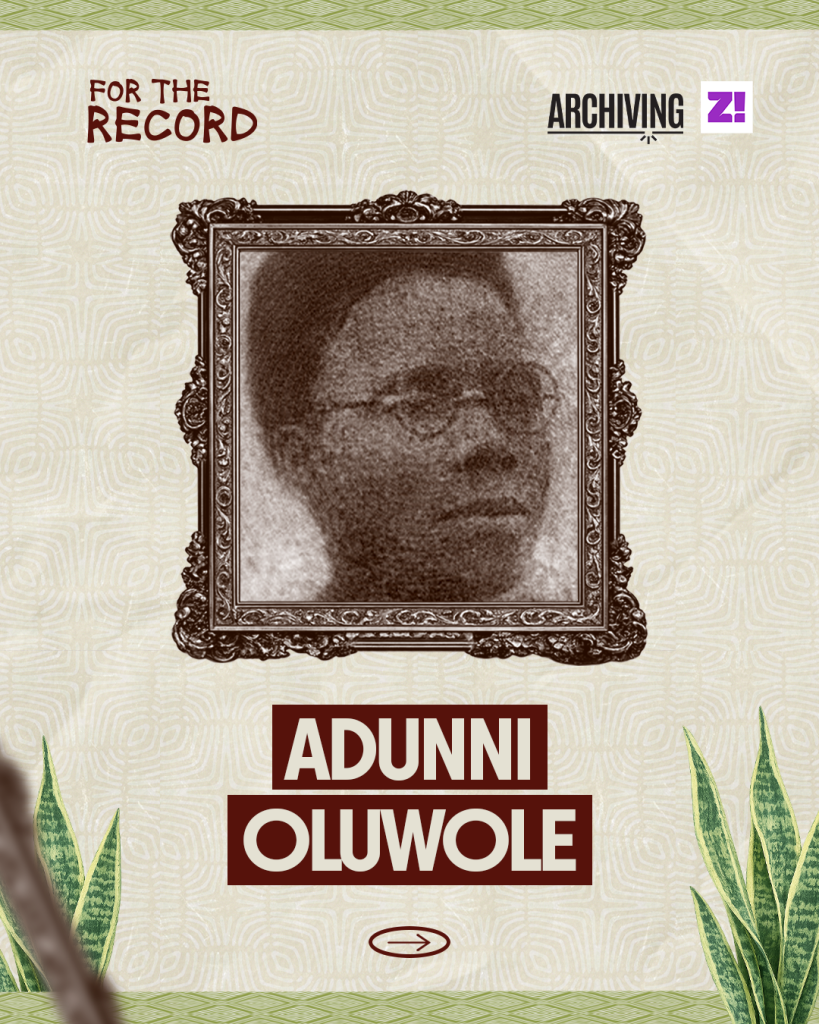
Adunni Oluwole does not fit neatly into Nigeria’s nationalist story. A preacher, performer, and political agitator, at a time when independence was the ultimate goal, she argued that the country was not ready, and that its future leaders might prove just as dangerous as its colonial rulers. Yet, she remained deeply embedded in that same struggle, defying both colonial authority and nationalist leaders while championing workers’ rights.
Born in 1905 to the family of a local warrior in Ibadan likely instilled in Adunni a fearless and fighting spirit. Family disputes would eventually cause her mother to relocate with the children to Aroloya, near St. John’s Church in Lagos. Here, Bishop Adolphus Howells became Adunni’s guardian, enrolling her in St. John’s School, where she completed primary education before returning to her mother, later immersing herself in church activities from 1925 to 1932.
During this period, she wrote a play for the Girls’ Guild, directed by the nationalist Herbert Macaulay, and went on to found Western Nigeria’s first female-owned professional theatre group.
Her theatrical talents and public speaking skills would set the stage for her career as an itinerant preacher who opposed church funerals for bringing the dead into the church because she believed that only the living should serve God. This focus on the living informed her shift to activism during the general workers’ strike of 1945.
Nigeria’s first major labor action, the 1945 workers’ strike, involved 40,000 to 200,000 workers who shut down the protectorate’s economy for 45 days. Beginning on June 3, unions led the strike, demanding higher wages as wartime inflation eroded workers’ purchasing power. Railway, postal, and public workers halted operations, resulting in millions in losses.
This event marked a pivotal turning point for Adunni, propelling her from a preacher to a national activist rallying women to join the strikers and marching alongside nationalists like Herbert Macaulay, Nnamdi Azikiwe, and Obafemi Awolowo. She donated her meagre savings to strikers’ families and used her oratory to boost morale, framing the action as a fight against colonial exploitation. Her efforts reached both urban workers and rural sympathisers, amplifying the strike’s grassroots impact.
The strike ended on July 17 after concessions by the colonial government on cost-of-living allowances. By then, Adunni’s ability to mobilise the masses earned her credibility as a defender of the common people and helped bolster her warnings against elite nationalists, whom she later accused of neglecting workers.
After the strike, Adunni founded the Nigerian Commoners’ Liberal Party alongside Fumilayo Ransome-Kuti and Oyinkan Abayomi on the basis of the intense dissatisfaction towards the performance of ethnic based political parties like Awolowo’s Action Group (AG) and Azikiwe’s NCNC. The party embraced an anti-independence, gradualist philosophy, reflected in the slogan, “Ẹgbẹ́ K’Óyìnbó má ì lọ” (“The Party That Does Not Want Whites to Leave Yet”), based on the argument that Nigeria was not ready for independence.
Her party attracted several criticisms as some people viewed the party’s ideals as antagonistic to the diligent efforts of the political leaders towards the attainment of independence. Despite heavy criticism, Aduni was unfazed, her determination evident through this quote in Tayo Agunbiade’s Untold Histories of Nigerian Women:
“My party is out to seize control in 1957 from both the AG and the NCNC and stop the oppression of the common man.”
During a presentation to Olubadan Isaac Babalola Akinyele in 1955, she was interrupted by NCNC’s Adegoke Adelabu, calling her a harlot. This exchange, alongside her confrontational nature and anti-independence messaging, would result in her banishment from Ibadan. She relocated to Akure, where she continued advocating for women’s inclusion in constitutional discussions and politics.
Adunni maintained that Nigeria’s leaders abused power, harbored corruption, and posed risks via ethnic divisions and minority fears. In an interview, she stated, “I am opposed to self-government in 1956, until any time practicable.”
She opposed the 1956 independence vote, advocating gradualism over a rush to premature self-rule to avoid elite tyranny. She warned that politicians would become African colonialists, a belief that would later be validated in the post-independence crises that saw corruption probes, the rise of ethnic parties, the 1962 census riots, and eventually, the 1966 coup.
Held in high esteem, she was part of the welcome delegation during Queen Elizabeth II’s 1957 visit. She died later that year, and her party folded soon after due to funding challenges.
Adunni’s legacy endures as a critic of elite power, her warnings later proven prescient by Nigeria’s turbulent independence era. Long overshadowed by patriarchal histories that favour male nationalists, she remains a symbol of grassroots defiance and a more complex, unromantic vision of patriotism.