It takes about 15 exhausting hours to travel by road from my hometown in Kaduna, Northern Nigeria, to the coastal city of Calabar in the South. I made that trip nearly a decade ago, leaving behind everything I knew in Saminaka, Lere.
I had done everything I was supposed to do. Having completed my secondary education in 2004, I went on to earn a National Diploma (ND) and subsequently a Higher National Diploma (HND) from a polytechnic. Like many Nigerians with similar qualifications, I expected that once school ended and I completed the National Youth Service Corps (NYSC), a job would follow.
It didn’t.
When NYSC ended in 2014, I returned to Kaduna and spent almost a full year looking for work. I applied everywhere I could, but nothing came through. During that period, I spent close to ₦200,000 trying to secure a job. By the end of that year, it became clear that waiting in Kaduna would not change my situation.
That was when I decided to pack my bags. I moved to Calabar to live with my uncle.
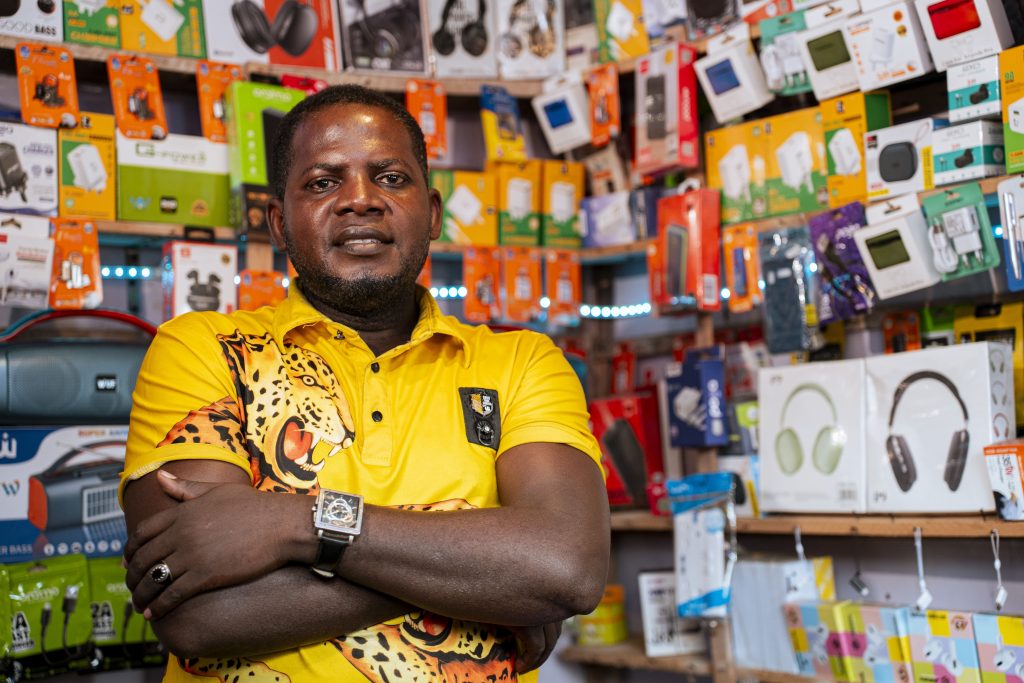
I didn’t arrive in Calabar with a big business plan. I just knew I needed to work, and I needed something that could generate a daily income. I settled in Bogobiri, a district known as the commercial hub for the Hausa community here.
I started my business sometime between 2015 and 2016. My uncle played a significant role in getting me on my feet. He bought a heavy-duty generator and hired a carpenter to construct a charging table equipped with multiple ports. That setup costs about ₦20,000. He also gave me ₦60,000 to purchase chargers and a universal charging unit.
That was it. With roughly 80,000 Naira, I started the business.
At first, the business was relatively small. I charged phones for a fee and sold basic phone accessories, including chargers, screen guards, pouches, and casings, and gradually expanded.
In the early days, we charged between ₦10 and ₦20 per phone for a full day. Over time, that went up to ₦50, then ₦100. Today, in 2025, we charge ₦400 per phone. Costs have risen, too. Fuel, which once cost me ₦200 to ₦300 per day, now costs between ₦4,000 and ₦5,000 daily.
At the beginning, charging phones alone brought in about ₦1,500 to ₦2,000 per day. I also sold recharge cards to supplement my income. The margins were small, but the cash flow was steady.
The business didn’t become profitable immediately. Every business has its risks; mine is no different. In the phone charging business, liability is the primary challenge.
For the first two years, we struggled. People didn’t know me. Trust takes time in this line of work. Phones went missing. Sometimes, I gave someone the wrong phone. When the real owner returned, and the phone couldn’t be found, I had to pay.
On average, I still replace about six to seven Android phones every year. I also replace more than 50 batteries annually. In the early days, it was worse. I hadn’t yet learned the systems that now protect the business.
Today, we use a card system. Each customer’s phone number and name are written down. Without the card, no phone is released. Experience taught me that structure is not optional. I showed up every single day. Slowly, people started to notice and trust the business.
Three to four years into the business, we finally became profitable.
I’ve never borrowed money to grow or expand the business, except for the initial assistance from my uncle. What I rely on instead is Adashe — a traditional Hausa communal savings system. I contribute between ₦1,000 and ₦1,500 daily. I’m patient with it. Sometimes I collect my contributions after three months. Sometimes I wait six months or even a year. When I collect, I restock the shop.
Most customers pay for our services in cash. Some prefer transfers, but cash is safer. During busy periods, it’s challenging to confirm every transfer claim. Fake alerts happen, and cash removes the risk.
On a typical evening, after a long day, we might have close to 100 people waiting to collect their phones. Cash, cards, phones, everything moves faster when it’s physical.
The business has grown significantly. What started as a one-man operation now employs two of my younger brothers. We work well together. The pressure has reduced as experience has increased.
I keep records. Every day, before and after closing, I write down various details, including income, expenses, credit extended, and repayments expected. It’s simple bookkeeping, but it protects me. I’ve never closed this shop for more than a day unless there’s an emergency.
What this business has given me, more than anything else, is stability. I come from a large polygamous family. My father had four wives, and between them, we are nearly 20 siblings. From my mother alone, there are eight of us. The business supports a wider family network. When there are problems such as school fees, food, or emergencies, I can contribute. I may not always have the money immediately, but I say so honestly and ask for time. Most of the time, I find a way.
This is the only business I have ever been involved in. Since I started, it has sustained my life and also carried a shared responsibility. It is proof that even a small enterprise, built out of necessity, can become a source of stability for many.
Despite being from a different ethnic group, I’ve never had issues living or working in Calabar. We communicate well with the locals. The area where I operate, Bogobiri, is known as a Hausa settlement. There is a Hausa emir here, and many of us from the north live and trade peacefully alongside the indigenous people.
I haven’t considered leaving Calabar ever since I moved. I haven’t tried to look for a job again either. This business became my job, slowly, relentlessly and out of necessity.
I travelled south to make a living, and I found my autonomy. In the activities of the Bogobiri market, I found my place in the Nigerian economy.
Murtala Garba is part of the millions of people who make up Nigeria’s informal economy. This is the second of a five-part series highlighting their stories. Moniepoint spoke to thousands of them and combined their stories with internal data from over 5 million business owners in a report you’ll find here.
Also Read: I Make Money From Fishing. But Never Enough to Save