When Elizabeth* lost a job opportunity because of her skin, she was feeling lost and resigned to her fate. But it wasn’t the first time acne had cost her something. She’d grown up watching her mother battle cystic acne, the same painful inheritance she’d carry into adulthood.
In this story, she tells us how years of shame, failed treatments, and quiet heartbreak led her to an unexpected cure and a new kind of confidence.
(*This is a Sponsored Article)
As told to Princess
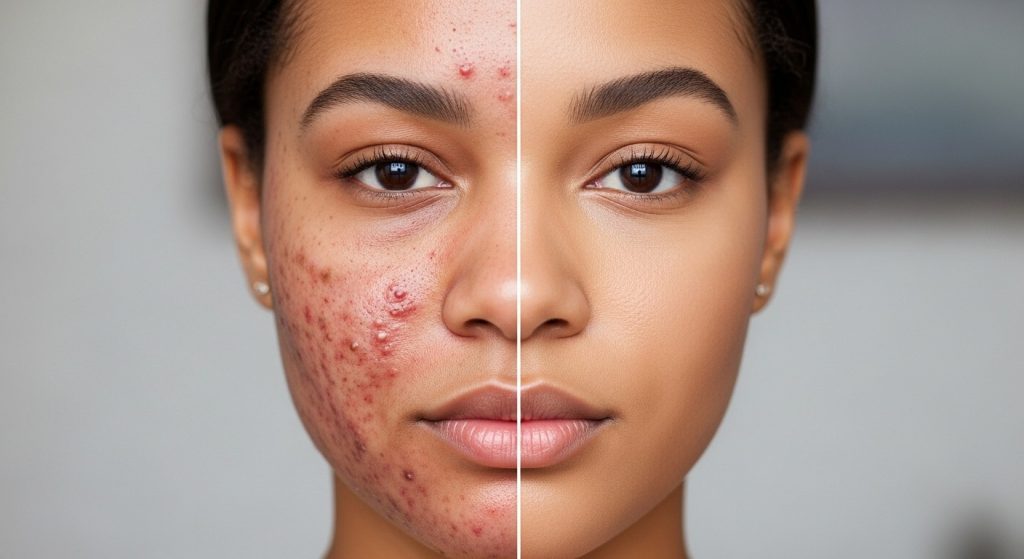
The email came on a Thursday afternoon. “We’ve decided to move forward with another candidate for the client-facing role. We believe they’re a better fit for our brand image at this time.”
Brand image. I read that line three times before I closed my laptop. I was 25, had all the qualifications, and had aced the interview. But I also knew what they meant. I’d watched my supervisor’s eyes drift to my cheeks during our last meeting, the way she paused mid-sentence. Two weeks earlier, she’d pulled me aside after a team call. “You know,” she said, her voice low and concerned, “maybe you should learn to wash your face properly. Basic hygiene is important in a professional setting.”
I wanted to tell her I washed my face four times a day. That I’d spent over ₦150,000 in six months on treatments, that cystic acne doesn’t care about soap and water. Instead, I smiled, said “Thank you,” then went to the bathroom to cry.
I’d watched my mother live with this my entire childhood. Her bathroom cabinet was a graveyard of half-used creams, prescribed medications, and expensive serums that promised everything and delivered nothing. She’d warn me, almost apologetically, “It runs in our family. Your grandmother had it. I have it. You’ll probably get it too.”
At 16, when the first painful bump appeared on my jawline, I thought she was being dramatic. By 18, my face had become a war zone. Deep, under-the-skin cysts that throbbed when I smiled. Scars that darkened and spread across my cheeks. And because I’m light-skinned, every mark, every active breakout, every bit of hyperpigmentation was on full display. There was nowhere to hide.
My mother kept saying I’d outgrow it. “It calmed down for me around 37,” she’d say, patting my shoulder. “It’s just how our bodies work. You have to wait it out.”
I couldn’t wait until 37. I was losing jobs at 25.
The job rejection was just the loudest echo in a chorus of humiliation I’d been living with for years. There were the relatives at family gatherings: “Ah ah, what is on your face? Have you tried washing it with salt?” The strangers at the market who’d lean in with unsolicited advice: “My sister used lime and honey. It cleared her face in one week.” The first dates that never led to a second, the men whose eyes would travel across my face with barely concealed disgust.
Once, a guy I’d been talking to for three weeks saw me in person for the first time and said, “Oh. Your pictures didn’t show… all of that.” He didn’t even stay for the drink he’d invited me out for.
Every morning, I’d stand in front of my mirror and apply layer after layer of concealer, colour corrector, and foundation. It took 45 minutes to create a face I could leave the house with. Video calls at work were torture. I’d angle my camera, adjust the lighting, and still catch glimpses of my colleagues’ eyes flickering to my skin, trying not to stare.
I tried everything. And I mean everything.
Dermatologists prescribed benzoyl peroxide—it dried out my skin so badly I looked like I was peeling. Salicylic acid made me break out worse. I did cortisone injections for the deep cysts. They’d flatten the bump, but three more would appear the next week. African black soap stripped my skin raw. Turmeric masks stained my pillowcases yellow and did absolutely nothing for my face. Aloe vera, tea tree oil, niacinamide serums, and retinoids that made my skin peel off in sheets. I went to medical spas, tried chemical peels, and spent ₦35,000 on a single facial that left my face inflamed for a week.
Nothing worked. At least, not for long.
There’s a specific kind of exhaustion that comes from trying to fix something that won’t be fixed. By my second job loss, this time I wasn’t even given a reason, just a quiet “We’re restructuring,” I’d stopped looking in mirrors unless absolutely necessary. I kept my head down at work, at parties, everywhere. I said no to every social invitation that involved meeting new people. Why subject myself to the questions, the stares, the advice?
My mother would call, and I’d hear the guilt in her voice. “I’m sorry I gave this to you,” she said once. I told her it wasn’t her fault. But some nights, I’d look at old photos of myself at 14, before the acne, and mourn the version of myself that didn’t know this was coming.
I’d given up. Completely. I kept a basic routine — cleanser and a gentle moisturiser — just to keep my skin from getting worse. But I stopped believing anything would make it better.
Next Read: The Broke Babe’s Guide to Skincare
The Soap I Didn’t Believe In
Last year, around March, a new colleague joined our team. Chioma. She was one of those people who brought energy into every room, always sharing things — snacks, hair ties, skincare samples from her cousin’s shop. One Friday, she came in with a bag full of small packages.
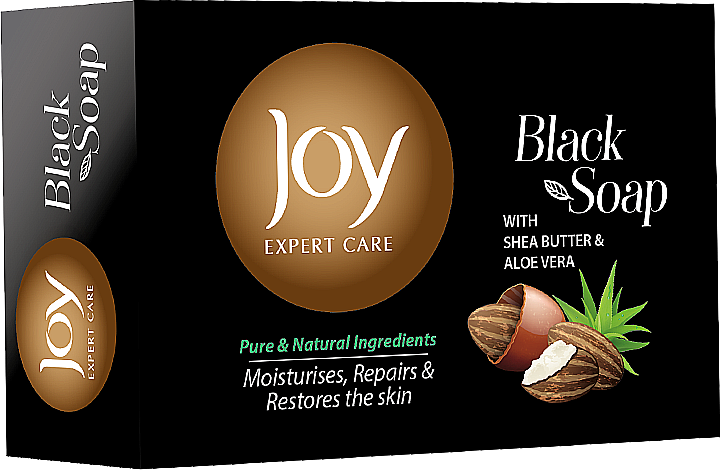
“My cousin’s shop is overstocked, I’m distributing the wealth,” she announced, dropping items on people’s desks. She tossed a wrapped bar of soap on mine. “Joy Black Beauty Bar. Have you tried it?”
I glanced at it. Brown packaging. Natural ingredients. Another soap. “No, I haven’t.”
“It’s good, oh. You should try it.”
I smiled, said thank you, and when I got home, I threw it in my wardrobe. Who didn’t know Joy? My mother had probably used it many years ago. What skincare product had I not tried at this point? This wasn’t going to be the one that changed anything. I didn’t even look at it again.
Two weeks later, I ran out of my regular soap. I was tired, it was late, and I didn’t feel like going to the store. I remembered Chioma’s soap sitting in my wardrobe. I figured I’d use it for a few days until I could restock.
It smelled different than I expected. Not perfume-y. Just clean, with a slight herbal undertone. It lathered well. My skin felt soft after, not stripped. But I wasn’t paying much attention. It was just soap.
I used it every day because I had it, not because I was expecting anything. When it was almost finished, maybe a month later, I finally dragged myself to the supermarket. I was standing in the skincare aisle at Bokku Mart, about to pick up my usual body wash, when I caught my reflection in one of those small mirrors they have near the shelves.
I stopped.
My scars. The dark marks that usually sat like shadows across my cheeks. They looked… lighter? Flatter? I leaned closer. It was subtle. The kind of thing only I would notice because I’d been staring at those same marks for years. But they were definitely less pronounced.
And, I touched my face; I hadn’t broken out in almost two weeks. No new cysts. No painful bumps forming under the surface. My skin just felt calm.
I stood there for five minutes, staring at my reflection, trying to figure out what I’d done differently. The only thing that had changed was the soap.
I went back to the Joy section and picked up three bars.
Also Read: Your Vagina is Not Supposed to Smell Like Flowers
The Slow Unfolding
I’m not going to lie and say it was magic overnight. It wasn’t. But by the time I finished the second bar, about a month in, I could see a real difference. The hyperpigmentation on my right cheek had faded enough that I needed one less layer of concealer. I wasn’t waking up to new breakouts every three days. My skin’s texture was smoother. I could run my fingers across my face without feeling the raised bumps and ridges that had been there for years.
I started paying attention to other things, too. I changed my pillowcases every three days instead of once a week. I washed my bedsheets religiously every Sunday. I started drinking more water—like, actually drinking the two litres everyone always talked about. I joined a gym because I read that blood circulation helps with clear skin and because I needed to move my body, to feel good about something. But all of it together? It started working.
By month three, my mother noticed during a video call. She leaned into her screen. “Wait. Your face. What are you using?”
“Just soap,” I said.
“What soap?”
“Joy Black.”
She laughed. “That soap? I used a Joy in university. Maybe not Joy Black but one of their products.”
“Yeah, well. It’s working now.”
By month five, people at work started commenting. Not cruel observations like before, but actual compliments. “Your skin is glowing,” (e me?) someone said in the elevator. Another colleague stopped me in the break room: “What facial are you getting? You look amazing.”
I didn’t know what to say at first. I’d spent so many years hearing the opposite that compliments felt like a language I didn’t speak anymore. But I started noticing it too. My skin wasn’t just clearer, it looked healthy. The dullness I’d accepted as permanent was gone. I had a glow. An actual glow.
I started wearing less makeup. Then even less. Some days, I’d go to work with just sunscreen and a light concealer on the deeper scars. The confidence that came with that, with not needing to hide, changed everything. I spoke up more in meetings. I stopped avoiding the camera on video calls. I went on dates and didn’t spend the entire time wondering if they were staring at my face.
A Year Later
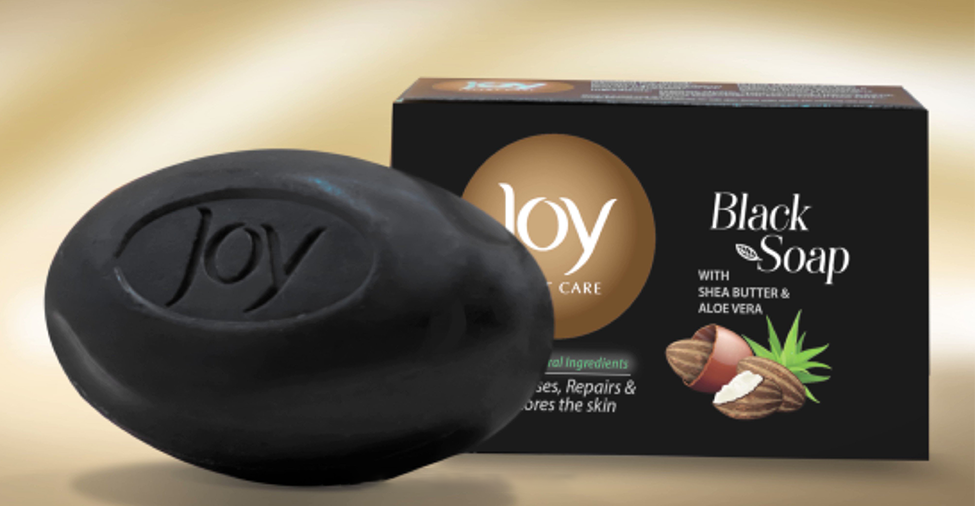
It’s been about a year and a half now since I started using Joy Black. I still have acne scars; some of the deeper ones haven’t completely faded, and I don’t know if they ever will. But you cannot compare my face now to what it looked like two years ago. I barely break out anymore. Maybe one small bump before my period, and it’s gone in a few days. My skin tone is more even. The painful cysts that used to throb under my skin? I haven’t had one in over a year.
People ask me all the time now: “What are you using? What’s your routine?” And I laugh because my routine is so simple that it sounds fake. Joy Black. Water. A good moisturiser. Sunscreen. That’s it. “It’s just Joy, oh,” I tell them, and they look at me like I’m hiding the real secret.
But that’s the thing, I’m not. The soap has shea butter, African botanicals, and all these natural ingredients that I guess my skin just needed. Maybe it really is an age thing, like my mother said. Maybe my body was ready to calm down, and the soap just helped it along. I don’t know. I’m not a dermatologist. I just know it worked when nothing else did.
My body glows now, too. I use it everywhere. My back, which used to break out almost as badly as my face, is clear. My arms are soft. I feel good in my skin in a way I haven’t since I was a teenager.
Last month, I got promoted. A client-facing role. My boss, a different one now, thankfully, told me I’d been doing excellent work and they wanted me representing the company. When she said it, I didn’t think about my face. I didn’t wonder if my skin was good enough. I just said yes.
I think about that girl I was two years ago, standing in a bathroom at work, crying because her boss told her she was dirty. I think about how I’d given up. How I thought I’d spend the next decade hiding.
I’m glad I was wrong.
Next Read: 15 Budget-Approved Buys Beauty Hut’s Founder Swears By