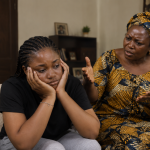
There’s no feeling as unsettling as realising you’re jealous of the person you love, especially when it forces you to confront parts of yourself you’d rather ignore. In this article, five Nigerians share the uncomfortable ways jealousy crept into their relationships and how they’ve learned to navigate those feelings.

“Motherhood has taken so much from me, but he’s unaffected” — Omotola, 43
Having kids reshaped Omotola’s* entire life, and watching her husband remain untouched by those changes became the root of her resentment.
“I haven’t felt good about myself since 2013, when I started having children. Three consecutive pregnancies changed my body. My face looked tired and drawn, and I constantly felt weak, sometimes struggling after the shortest walks. Meanwhile, my husband still looked fresh, moved around with ease, and never had to deal with the physical or emotional toll I carried.
What pushed me over the edge was the lack of support after each birth. Even my in-laws, who came to ‘help’, still sent me on errands. My husband would sit legs crossed, while I struggled to move around with a healing body. I often found myself wishing I were him. That was the start of a deep resentment I didn’t know I could feel.
Years later, I still haven’t found my spark. Earlier this year, a church member jokingly said my husband was ‘shining more’ than me, even though he’s older. They meant it as a harmless compliment, but I haven’t forgiven it. It’s hard to come to terms with how much motherhood has taken from me while he seems untouched in comparison.”
“She doesn’t know what it’s like to worry about money” — Nathan* 32
For Nathan*, dating a partner who’s blind to her privilege has been an experience that tugs at his heart.
“My girlfriend comes from a wealthy family. Her parents cover most of her expenses, but she still asks me for things. I’m doing okay for myself, but sometimes I wish I had the same safety net she grew up with because I know I’d use it differently.
What really gets to me is how she talks about the economy. She complains about cutting back on shopping while I’m stressing over savings and long-term plans. We’re clearly affected in very different ways, yet she speaks as if we’re experiencing the same struggle. I’ve tried to ignore it, but the frustration shows in small ways. Whenever she asks for something, my first instinct is to say I don’t have it. I feel like she’s used to being provided for and automatically expects the same from me, without considering my reality.
I don’t think she’s intentionally insensitive. Most of it comes from not understanding what it’s like to worry about money. Still, I don’t like these feelings and how they make me act. She’s a good person, so I’m trying to acknowledge my emotions and work through them so her privilege doesn’t become a barrier between us. If I can manage that, I believe the relationship will be much healthier.”
“I made her lose a job that would’ve paid her millions” — Lawal*, 41
Lawal’s* fear of losing control in his marriage ran so deep that it led him to stand in the way of his wife’s biggest opportunity.
“My wife is an accountant, but I helped her start a tailoring business while she searched for a proper job. Over the years, I’ve changed my mind about wanting her to get a corporate job; she’s shown me how bossy and controlling she can be. During arguments, she talks anyhow and hurls insults. So I convinced myself it was safer if I handled most of the financial responsibilities; at least that way, I still had some autonomy.
Last year, a close friend who works at a big finance company told me of an opening and asked if my wife was interested. I was shocked when I saw the salary ran into millions. I told him I’d send her CV, but I kept stalling.
We’d just had another fight, and the thought of her earning millions while I earned thousands scared me. I didn’t want more resentment between us, so I didn’t send the CV or told her about the opportunity.
When my friend eventually said he’d given the job to someone else, the guilt hit me. I told myself I did it to protect my home, but when I prayed about it later, I knew jealousy played a much bigger role than I wanted to admit.”
“He takes his parents for granted” — Uju*, 28
Uju* thought her tough upbringing made her immune to family wounds, until her boyfriend’s loving family made her see things differently.
“I grew up without parents and moved between different relatives’ homes. They didn’t maltreat me, but I never experienced the attentive care children get from their own parents. I thought I’d made peace with it and convinced myself it didn’t affect me.
Then in 2023, when I started dating my partner, I realised that part of me was still deeply wounded.
My boyfriend’s parents are very involved in his life. His mum travels far distances just to see him, cooks soups, stocks his fridge, and fusses over him with genuine affection. His dad also calls often to check in or pray for him. Yet he constantly calls them overbearing and even ignores their calls. Whenever he complains, it irritates me.
A year into the relationship, I got close to his parents myself. I checked in and tried to be as helpful as possible. But my boyfriend didn’t appreciate the gesture. He said it made him uncomfortable, adding that I was crossing boundaries and oversharing his private details with his mum.
He also said he no longer felt comfortable talking to me about family issues because I always redirected the conversation back to what I never had. He said I made him feel guilty for having parents at all. It hurt to hear, and I considered ending the relationship.
But after speaking to a few people, I began to understand where he was coming from. I realised many of my reactions were tied to a longing that turned into irritation whenever I saw him taking his parents for granted.
Now I’m more self-aware. I respect his boundaries and let him handle his family issues without inserting myself. Still, I always feel a certain way whenever he complains about them.”
“I felt inferior next to her” — Fiaza*, 30
Faiza* adored her girlfriend, but standing beside someone who commanded every room slowly built her insecurities.
“My ex-girlfriend is extremely attractive. She’s the kind of woman who turns heads everywhere she goes, and that was one of the first things that drew me to her. I, on the other hand, have always struggled with my body. I’ve been overweight for years, and after trying so many times to change it, I eventually gave up.
Whenever we went out, people compared us without saying a word. Men who didn’t know we were a couple walked up to her and flirted right in front of me. What hurt even more was that she never told them off. She mostly responded politely. Meanwhile, nobody ever noticed or approached me. Even my own friends commented on how hot she was, but never said anything sweet about me.
I was embarrassed to admit it, but I always felt insecure standing next to her. I’d shut down whenever we went out and sometimes avoided going out because I hated how it made me feel. She noticed the change and asked what was wrong, but I always brushed it off. We argued about my coldness so many times that it eventually broke us up less than a year into the relationship.
Looking back, I know jealousy played a big part. She didn’t deserve the weight of my insecurities, and I should’ve worked on myself.”
Read Next: I Was Barely 18 When He Abandoned Me With a Baby