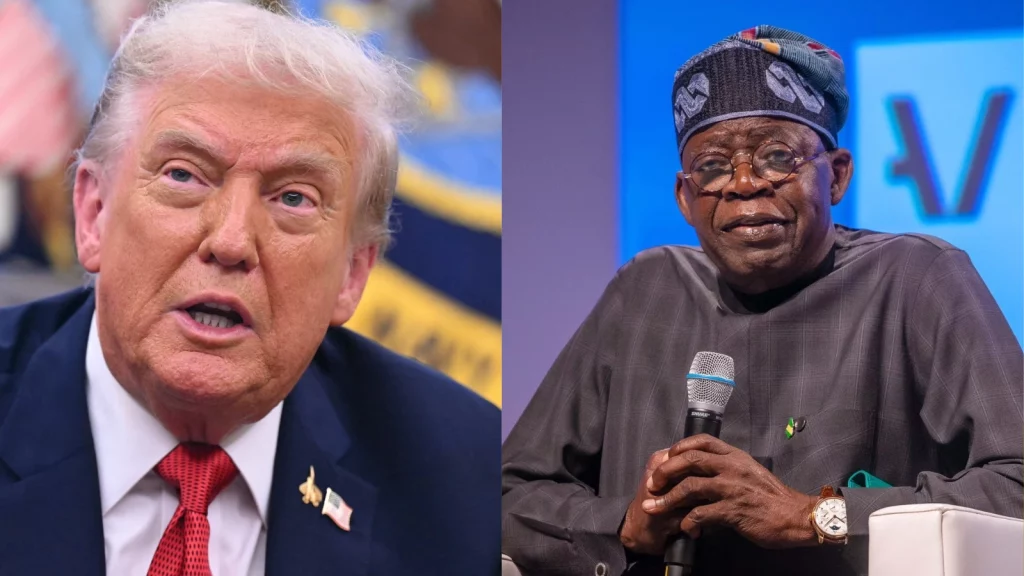
On Saturday, November 1, 2025, US President Donald Trump made a post on X, saying that if the Nigerian government failed to stop the killing of Christians by Islamic terrorists, the US military would come to Nigeria “guns-a-blazing.”
This is not some noble rescue mission. It is a violent threat aimed at every Nigerian, regardless of religion. And honestly, we should all be worried. More importantly, we must all push back.
In this analysis, we break down exactly why Nigerians need to take a step back to think critically about the attention we are getting from the US, how the APC-led federal government has allowed the situation to worsen through their inaction and what Nigerians can do about all of it. We spoke to public policy expert, Ebenezar Wikina, to help us make sense of it all.
The naughty list
The day before his threat, on Friday, October 31, 2025, Trump officially added Nigeria to the US “Country of Particular Concern” (CPC) list. Under US law, the CPC status is for countries with “particularly severe violations of religious freedom.”
That includes things like torture, detention without charges, forced disappearances, and other serious violations of basic rights. Once a country lands on the list, the US government is supposed to consider diplomatic responses like public condemnation, cutting off certain types of aid, and economic sanctions.
But “consider” is the key word here. Just because the US can apply sanctions does not mean it will. Trump actually put Nigeria on the same list back in 2020, but waived the sanctions. So things could play out the same way.
Still, Trump has now said he will “immediately stop all aid and assistance to Nigeria” if the government does not “MOVE FAST!” But what could it look like if he went through with it?
I sanction because I care
Unfortunately, the Nigerian government is a shameless beggar on the global stage. We rely heavily on loans to fund local projects.
Most of those come from international financial bodies like the International Monetary Fund (IMF) and the World Bank where the US holds serious influence.
The US is the largest shareholder of the World Bank and has the largest voting share in both the IMF and World Bank. This basically means the US has effective veto power over major decisions in both institutions.
For example, in the 1970’s the US blocked the World Bank from giving loans to Chile because they did not like the Chilean president, Salvador Allende.
If Trump decides to ask these financial bodies to cut us off, we could be in trouble.
The US is also one of our biggest trade partners. Just in the first half of 2025, Nigeria exported $1.34 billion worth of crude oil to them. If they stop buying what we are selling, our cash flow will take a serious hit.
Our current cash flow problem is driving Tinubu to invent new taxes everyday. What would happen to ordinary Nigerians if we lose such an important trade partner?
But the biggest risk is in security. And sadly, it is the most likely one. In 2022, the US sold Nigeria $997 million worth of military equipment. Then in August 2025, they approved another $346 million sale of bombs, rockets, and other military gear.
While the US might think twice before touching trade (they need our oil as much as we need their dollars), military support is a different story. They have paused it before, and they can do it again.
In 2014, the US blocked the sale of military helicopters to Nigeria because it accused the Nigerian military of human rights violations. According to the US, Nigerian security forces were not doing enough to prevent civilian casualties in their fights with terrorists.
If they stop military support again, things could get very messy. Our military is already stretched thin, fighting terrorists, bandits, and kidnappers. Losing access to weapons and US support would only make a bad situation worse.
According to Ebenezar Wikina, a public policy expert, “sanctions are never good for anyone.” He explained that it is bad for the economy and for our security. He said, “if we lose access to the weapons we need to fight terrorism, how do we win?”
So, economic sanctions will only make life harder for ordinary Nigerians. And military sanctions will make things even more unsafe than they already are. We are struggling to see the love the US wants everyone to believe it has for Nigerians, because all their “solutions” seem to come with more harm than help.
Who you epp
US foreign military intervention has a long, bloody history. And we are talking about the blood of the locals. Afghanistan, Iraq, Libya—try finding one country the US invaded that ended up better off.
“Historically, US invasions have never worked,” Wikina said. “They have always had unintended outcomes. It is not an option we should even consider.”
In 2001, the US stormed into Afghanistan to kick out the Taliban, who were unarguably the bad guys. What followed was a 20-year war that killed thousands of civilians and displaced so many people that Afghans became one of the largest refugee groups in the world.
Over 240,000 people died. More than 71,000 of them were civilians. The UN estimates nearly 6 million Afghan refugees are scattered across the globe.
When the US finally packed up in 2021, they left behind over a million pieces of military equipment. The Taliban picked those up, used them to crush Afghan security forces, and took back the country.
Then there was Iraq. In 2003, the US invaded, claiming Saddam Hussein was hiding weapons of mass destruction (WMDs). By the time they left in 2011, over 200,000 Iraqi civilians had died. But the WMDs never existed. The whole thing was a lie.
The US has shown it is willing to cook up stories to justify invasions that end in chaos and mass death.
Which brings us to the much debated “Christian genocide” in Nigeria.
Is there really a Christian genocide in Nigeria?
This was the question on our minds three weeks ago, and we took a deep dive into the situation. The most accurate answer is that what is going on in Nigeria is complicated.
The security situation is messy. Yes, there are religious fanatics who think violence is the best way to spread their beliefs. But violent extremism is not unique to Nigeria. Even the US is battling right-wing white supremacists, who are behind about 75 per cent of domestic terrorism deaths in the US.
What makes Nigeria’s terrorism problem worse is the widespread multidimensional poverty. More than half of the population live below the poverty line. That is a lot of people with very few options.
Islamic extremist groups—from Maitatsine in the 1970s to Boko Haram and its many splinter groups today—have always used money to lure recruits. When the terrorist group Lukarawas popped up in early 2025, they were offering ₦1 million to anyone willing to join.
Then there is the concept of takfir. It is part of the ideology these religious terrorists follow, and it pushes them to attack Muslims who, in their eyes, are not Muslim enough. By their twisted standards, we are all targets.
Further south, the farmer-herder clashes mostly affect Christian-majority communities. But again, it is more about economics than religion. The herders and their cattle are being pushed further south by desertification caused by climate change. In July 2025, the Ministry of Environment reported that 43 per cent of Nigeria’s land mass has already been affected by desertification.
And the farmers are simply trying to protect their crops and livelihoods from being trampled by cattle. It is a sad situation that needs urgent government action. Nigeria needs stronger climate resilience policies and structures.
And most importantly, when violence does happen, law enforcement must step up. Their failure to bring attackers to justice has created feelings of unfairness and suspicion. That only leads to more retaliatory violence.
For Wikina, it does not matter. He believes the government has been “playing politics” with human lives which is what encourages debates about who is being targeted more between Christians and Muslims like it is a competition.
“Is it muslims? Is it Christians? It doesn’t matter. It’s human beings that are being killed,” Wikina said.
Cherished Christians
When Trump announced that Nigeria was being added to the Country of Particular Concern (CPC) list, he claimed Nigeria had the highest number of Christians killed in the world. According to him, 3,100 out of the 4,476 Christians killed globally were Nigerians.
He did not say where the numbers came from or what time period they covered, but it is likely from a report by the Christian advocacy group Open Doors, released on January 15, 2025. That report claimed 3,100 Nigerian Christians were killed in 2024.
The number of Christians killed in Nigeria is not proof of a Christian genocide. What it does show is that Nigeria is a dangerous place to live—full stop. We rank 148 out of 163 countries on the World Peace Index. That is not a Christian problem. That is a Nigeria problem.
Yes, our security situation is a mess. And yes, our government deserves serious criticism for how badly it has handled things. But we also need to ask questions about this “Christian genocide” narrative the US is pushing.
In his social media post, Trump called Nigerian Christians “our CHERISHED Christians.”
Western media, especially in the US, has a bias against Muslims. We can see it in how they report on and support the genocide of Palestinians by Israel.
In our analysis, we noticed something very convenient. US Senator Ted Cruz, a loud supporter of Israel, started pushing for Nigeria to be added to the CPC list just days after Vice President Kashim Shettima told the UN General Assembly that Nigeria supports a two-state solution to the Israel-Palestine conflict.
We must not fall for the idea that one life matters more than another because of religion. Nigeria has been fighting terrorism for decades. The idea that only Christian deaths deserve international outrage is not just unfair, it is dangerous.
Where does this ranking of human lives end? If Christian lives are more valuable than Muslim lives, then what next? Is a white Christian more valuable than a black Christian?
Arise o’ compatriots
On October 1, 1960, Nigeria became an independent nation. Or did we?
Between the 1950s and 1970s, a wave of African countries broke free from colonial rule. But let us not pretend; the Western imperial powers never really left. They just switched tactics.
Only recently, several West African countries formerly colonised by France have kicked out French military forces. They are finally stepping into full sovereignty. Meanwhile, some Nigerians are entertaining the idea of taking such a huge step back.
A foreign military coming into your country uninvited is not help. It is an invasion. It spits on the idea of independence. It makes a mockery of sovereignty. If it happens, it will prove that Nigeria is not a country. Just another colony of the Western world powers.
Wikina told us, “The US does not have the right to invade Nigeria on this issue.”
He believes Nigerians should speak out against it. But more importantly, he believes the president should not leave his job for the citizens to do. He said he wants to see Tinubu leading diplomatic engagements with the US to find a solution.
“There needs to be a solution,” he said. “But invasion is not the solution.”
It can always get worse
So, both Muslims and Christians are dying.
That is exactly why we need help to end all the violence.
The US wants to take our resources.
That is fine. I will gladly exchange them for safety.
Everywhere the US has gone, thousands of civilians die.
Thousands of civilians are already dying. How much worse can it get?
That is the question many Nigerians are asking. We are tired. We are hurting. And when you have been hurting for so long, it is easy to think nothing could be worse.
There are so many ways a US intervention can hurt us, but how much worse can it be than what we already have here? But the truth is that it can definitely get worse. So much worse. As hard as that is to believe, it is the fact.
See, we get it. How do you tell someone who is starving not to eat the only available meal because it might be poisoned?
You remind them it is not the only meal.
Democracy diet
If we are not afraid of the devastation that could come with a US invasion, why are we so afraid of participating in our own democracy?
Within hours of Trump’s threat, the official accounts of President Tinubu and the Nigerian Army suddenly came alive, posting updates about Nigeria’s security situation.
That it takes a threat from a foreign power to make our government act accountably shows we have been slacking on our civic duties.
The president of Nigeria should not be accountable to the president of the US. He should be accountable to Nigerians. And for that to happen, we need to grab our power as citizens.
Young people across the world are doing just that. In Kenya, Peru, Morocco, Nepal, young people have taken to the streets to hold their governments to account. And they are facing resistance—violent resistance—but they are still showing up. Because really, how much worse can it get?
Our frustration should not push us to invite foreign invaders to fix our problems. It should push us to find our own solutions. By ourselves.
How much worse can it get if you go and get your PVC?
How much worse can it get if you actually show up on election day?
How much worse can it get if you vote?
How much worse can it get if you take to the streets to protest bad governance?
It cannot be worse than what we are dealing with now, can it?
It cannot be worse than the US carpet bombing entire cities.
If we get serious about fixing our country ourselves—if we become active citizens—how much worse can it get?
What can you do?
- Do not share or repost harmful propaganda and misinformation on any platform.
- Use whatever platform you have—including social media—to share well-researched data, facts, and figures that refute these narratives.
- Be an active citizen. Get your PVC and vote.
- Hold your leaders accountable. Call your representative in the National Assembly (NASS). To find the contact of the lawmaker representing your constituency at NASS, click here.
- Stay engaged and informed. Help others do the same by sharing useful information, posts, articles, anything that helps.
NEXT READ: Can Nigerian Youths Still Make A Stand Against The Government?
Before you go, help us understand how you and other young people feel about the 2027 general elections by taking this 10-minute survey.
Click here to see what other people are saying about this article on Instagram