What She Said is a Zikoko series spotlighting the unfiltered stories of women navigating life, love, identity, and everything in between — in their own words. From Lagos to London, Nairobi to New York, it’s striking how much our experiences echo one another. Every Wednesday, we give women the mic to speak freely, honestly, and without shame about sex, politics, family, survival, and everything else life throws our way.
This surrogacy story marks the official return of What She Said, our flagship HER series. After a long break, we’re back — with even more honesty, vulnerability, and intention.
If you missed the announcement, catch up here. But in the meantime, settle in for the first story in our comeback lineup: a 39-year-old UK-based Nigerian woman shares how lifelong health struggles made pregnancy unsafe, and how surrogacy helped her become the mother she always wanted to be. It’s tender, raw, and the perfect reminder of why What She Said matters.
When did you first feel like you wanted to be a mum?
I think, deep down, I’ve always known. My mum was everything, intentional, present, sacrificial. She gave so much of herself to raise me, and watching her made me understand the kind of mother I wanted to be. Even now, as a mother myself, I still lean on her.
I’m 39, and I was born with a congenital heart defect so bad that the doctors thought I would not survive infancy. Hospitals were like second homes. I’ve had surgeries on my heart, liver, and throat. My lungs collapsed more than once. It was a lot and still is. The doctors made it clear that carrying a pregnancy would be too risky. It could cost me my life.
But I still wanted a child. So, I had to plan for one.
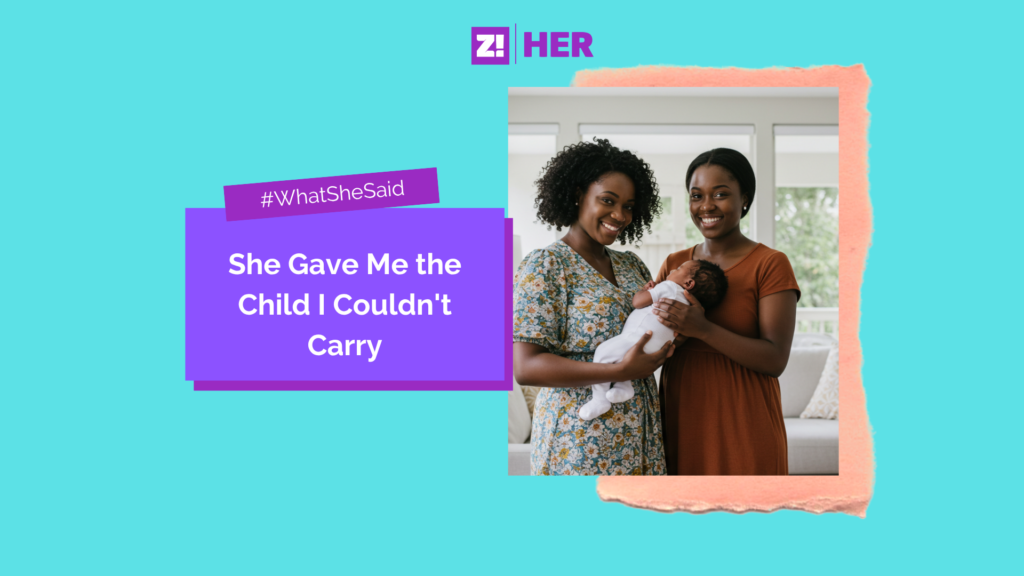
It took a little more than a decade, but my son is biologically mine — my egg, carried in another woman’s womb. But she’s not just a surrogate. She is the woman who gave me the child I couldn’t carry. And that will always mean something far deeper than words can hold.
When did that knowing shift into something actionable?
I’d always loved and wanted children, so when the doctor finally confirmed that the multiple surgeries over the years had weakened my system to the point where I could not carry a pregnancy to term, I was heartbroken.
But the sadness couldn’t eclipse my desire, which quickly turned into resolve. I had reached a place in my life where I was stable in my career; I own and run multiple businesses in the UK, where I was born, and I felt emotionally ready to take the steps to have a biological child, even if I couldn’t grow him inside me.
My mum standing by me and helping me through every step was the best support I could ever ask for.
What did grieving, not being able to carry your child yourself, look like?
There were dark days. I had tried fertility treatments, survived a miscarriage, in addition to my repeated surgeries. Every attempt chipped away at my hope.
Eventually, I had to face it. It broke something in me. I cried. I raged. I felt guilty that my own body was the reason I couldn’t carry my baby. It was a constant pain I had to live with.
Was adoption ever an option?
Briefly. My sister is adopted from Nigeria, and I have deep respect for that path. But it didn’t feel like mine. I wasn’t looking to carry on a legacy or tradition; it was more internal. I needed the connection and experience of knowing the child was biologically mine.
Adoption didn’t feel like my story or path. Besides, I am privileged to be able to afford a biological child of my own, without carrying one. When that is an option for me that I can take, why wouldn’t I?
Fair point. So, surrogacy became your path. How did it come into focus?
It wasn’t a miracle fix but more like a final hope. I didn’t enter it with joy or certainty. I was drained, emotionally and physically. But over time, as I leaned into the process, it started to shift. Surrogacy stopped being a clinical solution and became something deeply emotional. It redefined motherhood for me. It required me to surrender control and embrace vulnerability.
What did you think surrogacy would feel like, and what surprised you?
I thought I could stay emotionally guarded: a few updates here and there, some scans, a call when the baby arrived. But it was the opposite. I felt everything. Every message, every scan photo, every heartbeat meant the world. I wasn’t detached. I was deeply invested in the baby, the process, and the woman carrying him.
I remember getting a voice note after a scan where she casually mentioned that the baby had started kicking, just a quick, “He kicked today,” and I couldn’t stop crying. I played it over and over, trying to imagine what it felt like from her side, wishing I could’ve felt it myself. Another time, she sent a short video from the clinic, and you could hear the heartbeat, steady and strong. I sat on my bedroom floor, just holding my phone to my chest. I started keeping a private photo folder with every scan image, even the blurry ones, and wrote little notes beside each one.
When she had a headache and mentioned it in passing, I called the clinic immediately to check in and make sure she was okay. It was a little silly in hindsight, but that’s how close it all felt, like every moment, every shift in her body, lived in my body too.
Your surrogate was in Nigeria while you lived in the UK. What was that like?
At first, it was scary. Being in slightly different time zones, under different healthcare systems, and a lot more. But we built a rhythm: voice and video notes, texts, and photo updates. The agency and clinic facilitated communication, but I reached out directly too. It was important that she felt supported and that I stayed connected. We weren’t just going through a process; we were making a human.
How often were you able to visit?
Not nearly as often as I wanted. Work, financial constraints, and visa logistics made frequent travel hard. But I was there for the embryo transfer, and I made it for the delivery.
In between, as I mentioned, I stayed present through calls, messages, and voice notes. I was always one message or call away.
Did the financial aspect complicate things?
It was layered. There were medical expenses, legal fees, coordination costs, and her personal care: transportation, maternity needs, and more. It was never just “paying a surrogate.” I was supporting someone who was doing something extraordinary for me. I was also aware of the power imbalance, living in different countries, different circumstances. I approached it with empathy and respect. It felt fair, but it was never simple.
If you’d like to be my next subject on #WhatSheSaid, click here to tell me why
Tell me about her — the woman who carried your child.
She was remarkable. Calm, kind, and emotionally present. The agency introduced us after I completed the initial paperwork and health screenings. They sent her profile: a short bio, a photo, and a few notes about her background. I remember reading that she was already a mother, and that she was doing this not just for the money, but because she genuinely believed in helping others experience the joy of parenthood. That stuck with me.
Our first meeting was over a video call arranged by the agency. I was nervous. I didn’t know what to say or how much to share. But the moment she smiled and said hello, something eased. She was warm, grounded. We talked about her kids, my health journey, and how the process would work. It wasn’t long or overly emotional, but it felt right.
From there, we built something real. She updated me after every appointment, checked in on how I was coping emotionally, and always reminded me that my baby was doing fine. Her calm steadied me. Her selflessness moved me. We didn’t just exchange updates, we shared stories, fears, and small joys. She became a part of my life, not just the woman who carried my child.
NEXT READ: What She Said: I Am No Longer Pursuing Conception Anymore
Can you give me a breakdown of how much this surrogacy journey cost you and how much the surrogate was paid?
The entire process was handled through an agency, and I paid about $7,500 in total. Out of that, the surrogate received $5,000 for her role. But that figure doesn’t capture the full scope of everything. There were so many additional expenses along the way — transportation, medications, check-ups, vitamins, food — and honestly, I stopped keeping track.
I just didn’t care about the cost in that way. She was carrying my child. Her comfort, health, and peace of mind were non-negotiable for me. If she needed something, I made sure she got it. There was no spreadsheet, no budget, just the deep knowing that I wanted her to feel supported every single day.
How would you describe the emotional weight of it all — the waiting, the distance, the hope?
It was a lot. Overwhelming, really. Some days, I felt light, full of hope, imagining the future I was building. The soft mornings, the first steps, the birthdays. But other days, I was paralysed by fear. What if something went wrong? What if I was loving too early? I remember getting a scan image once. I smiled at first, told myself I was okay, and then spent the rest of the day crying.
The ache of not being there, not seeing it happen in real time, was unbearable. But then came the voice note with his heartbeat. That small, strong rhythm playing through my phone, just for me. I just sat there, frozen, crying. Not out of sadness, but relief. It gave me permission to believe. That sound anchored me.
Tell me about the birth.
I flew to Nigeria with my mum a few weeks before the due date, determined to be there for his birth. I was in the delivery room when he arrived. I can’t tell you much because I was filled with so much worry and anxiety. I just remember when I heard him. Everything inside me cracked open. I broke down. That sound, so raw, so alive, was the moment everything became real. I saw him, and every difficult step that brought me here made sense. It was overwhelming and surreal, but in the best way possible.
Was it what you imagined?
Yes and no. In my mind, I always pictured being there from start to finish. Instead, I’d spent months being a presence from afar through messages, photos, and updates. But the moment I saw him, none of that mattered. The love, the awe, the gratitude, it all came rushing in. It wasn’t the perfect image I used to hold in my head, but it was mine. It was real. And it was enough.
Did you feel an instant connection?
Yes, but maybe not how you mean. It was quiet and gentle, like a warmth slowly spreading through me. I felt fiercely protective right away. The love was there, immediate and intense. But the bond, the kind of connection that wraps itself around you, grows with time. With every sleepless night, every feeding, every look that passed between us. When I finally held him, I felt something inside me settle. Like I’d found my missing piece.
What do you wish someone had told you before this began?
That you can feel both joy and grief at the same time, and that it is okay. You can mourn what you didn’t experience and still celebrate what you gained. Biology and carrying a baby in your womb don’t define motherhood. The path to parenthood might look different than what you expected, but it’s still yours and it still matters. I wish someone had said, “This will be hard, but it will also be worth it.”
For more stories like this, check out our #WhatSheSaid and for more women-like content, click here
You’ll Also Enjoy Reading: I Was 20 When I Sold My Eggs to Pay Bills. It Altered My Life Forever