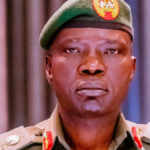
Nigeria’s Chief Of Army Staff, Lt. General Taoreed Abiodun Lagbaja has passed on.
Lagbaja, aged 56 died in Lagos State on the night of Tuesday, November 6, due to undisclosed illness.
The late Chief of Army Staff (COAS), whose military journey began in 1987, is named to have played key roles in military operations, such as Operation ZAKI in Benue State, Lafiya Dole in Borno, Udoka in Southeast Nigeria, and Operation Forest Sanity across Kaduna and Niger States.
His long career peaked when he became Nigeria’s Chief of Army Staff in 2023, following President Bola Ahmed Tinubu’s appointment.
Confirming his death in a statement released on Wednesday, November 6, President Tinubu’s adviser on information and strategy, Bayo Onanuga, relayed the President’s condolences to his family and the Nigerian Armed Forces.
Before his death on Tuesday night, the late COAS had been ill since October and was abroad where he received treatment. During that time, the chief of policy and plans (Army), Maj.-Gen. Abdulsalami Ibrahim carried out his official duties on his behalf.
At this time, Lagbaja’s role is temporarily occupied by Olufemi Oluyede. President Tinubu appointed Oluyede as Nigeria’s acting COAS on October 30, 2024.
This is a developing story.
On the night of December 3, 2023, Nigerian military drones “mistakenly” attacked a village called Tundun Biri in Kaduna State. This horrible incident in which the Nigerian Army bombed civilians isn’t the biggest news in the country right now. But it should be, so we took it upon ourselves to compile everything to know about it.
An Eid-el-Maulud celebration
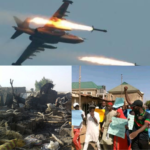
It all started when locals of Tundun Biri village came together to celebrate the birth of the Holy Prophet Muhammad. According to the National Emergency Management Agency (NEMA) North-West Zonal Office, the bombing started around 9 p.m. Observers recounted that the first bomb ended over 30 lives on the spot. As people raced to help the injured and dead, a jet dropped another bomb.
Image source: X.com
The death count
As of December 5, NEMA has the official death count at 85, with 66 injured and receiving treatment at the Barau Dikko Hospital. However, an anonymous officer revealed that the army received at least 126 dead civilian bodies.
Tinubu speaks
President Bola Tinubu is currently at the COP28 Climate Summit in Dubai, but he conveyed his condolences through his spokesperson, Ajuri Ngelale, condemning the drone attack. He also called for a thorough investigation into the “bombing mishap”.
The Nigerian Army’s response
The General Officer, Commanding 1 Division of the Nigerian Army, Major-General Valentine Okoro, admitted that the attack came from the Nigerian Army. As the commander of the division that caused the mishap, Okoro gave a statement to Samuel Aruwan, Kaduna’s Commissioner of Internal Security and Home Affairs. Apparently, it was an error made while the drone operators were on a routine mission against terrorists. The Army spokesman, Brigadier General Onyema Nwachukwu, said the aerial patrol troops mistook the celebration for terrorist activities.
Image source: X.com
On December 5, the Nigerian Chief of Army Staff (COAS), Lieutenant General Taoreed Lagbaja, visited the village to commiserate with the families of the deceased and apologise to the village. He also promised to cover the hospital bills. But who will answer for the bombing of these innocent people?
CAN, Amnesty International and other NGOs
The Kaduna chapter of the Christian Association of Nigeria (CAN), Amnesty International, Arewa Youth Consultative Forum (AYCF), among other non-govermental organisations, have condemned the military’s mishit. The chairman of the CAN Kaduna chapter, Reverend John Hayab, said they’ll continue to pray for the government, while the AYCF National President, Shettima Yerima, charged the government to launch an investigation.
Not the first bombing mishaps
In 2023, there have been three bombing mishap cases. The first happened in Niger State on January 24. The second killed over 40 herders in Nasarawa State two days later. According to research, at least 425 Nigerians have perished due to military “error” bombing between 2017 and 2023.
The Nigerian Air Force denies involvement
Although the Nigerian Air Force is behind the first two cases of bombing civilians by mistake this year, it quickly disassociated itself from the Tundun Biri incident. On Monday, December 4, the Nigerian Air Force (NAF) released a statement through its Director of Public Relations and Information, Air Commodore Edward Gabkwet. According to him, NAF had nothing to do with the attack and hadn’t operated in the state or its surroundings in a while. “The NAF is not the only organisation operating combat-armed drones in the Northwestern region of Nigeria.”
Citizens protest
On December 7, protesters marched to the National Assembly and demanded the immediate resignation of Badaru Abubakar, the Minister of Defence. In Zaria Local Government Area, Kaduna State, a group of youths took to the streets to protest the brutal bombing.
On December 7, 2022, Reuters opened a new can of worms about the Nigerian Army — the mass abortion programme for victims of Boko Haram.
With the testimony of 33 victims, five health workers and nine security personnel alongside military documents as evidence, there’s a record that the military has managed to abort 10,000 pregnancies among women and girls since 2013.
Investigators found that most of the abortions were conducted without the women’s consent or even their prior knowledge. Some of them got abortion-inducing pills or injections that were supposedly medications to boost their health or combat diseases.
How did the Nigerian Army react?
As usual, the Nigerian Army didn’t own up to the act and blatantly denied the accusation. The military defense chief, General Lucky Irabor, even mentioned that he’ll “not waste his energy on such things.”
Sadly, this isn’t the first time the military would be accused of heinous crimes. We’ve made a sad list of the various sins of the Nigerian Army since the end of the last military government in 1999.
The unlawful detention and torture of 10,000 people
Amnesty Internationalreported that at least 10,000 victims — many of them children — died in military detention and thousands more were arrested from 2009 to 2020 in the Nigerian Army’s fight against terrorists. This mostly happened due to the massive displacement of people who escaped from jihadist groups like Boko Haram and the Islamic State West African Province (ISWAP).
Another Amnesty Internationalreport indicted the Nigerian Army of the maltreatment of female victims of the jihadists from 2016 to 2018. Soldiers subjected the women to a horrible trade by barter system — sex or rape for food and other basic amenities.
Destruction of villages during raids
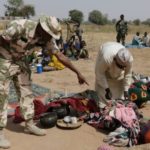
In January 2020, the Nigerian Army displaced over 400 people by burning their villages in their search for Boko Haram insurgents in Borno State. This forced many villagers into Internally Displaced Camps (IDP).
This destructive behaviour isn’t limited to the North. When rioters killed a military commander during a peacekeeping mission in Cross River State in 2022, soldiers retaliated by burning down houses in the community. Their attack caused the death of 10 villagers.
A history of massacres
The Nigerian Army is regularly involved in the killings and massacres of Nigerians that it’s become a trademark. Here are some of the most gruesome we’ve seen so far:
Odi massacre, 1999
On November 20, 1999, the Nigerian military invaded and killed hundreds of civilians in Odi town in Bayelsa State. President Olusegun Obasanjo reportedly ordered the attack in response to the killing of 12 policemen and an ambush of soldiers by a militia that used Odi as its cover.
Baga massacre, 2013
On April 16, 2013, 200 civilians were killed and over 2,000 houses were destroyed in Baga, Borno State. The military blamed Boko Haram insurgents for the massacre. However, Baga residents said angry soldiers raided the town in retaliation for the killing of their colleague.
Zaria massacre, 2015
On December 12, 2015, the Nigerian Army killed hundreds of Shia Muslims who were members of the Islamic Movement in Nigeria (IMN). The military accused the sect of blocking the path of the then chief of army staff, Lieutenant General Tukur Buratai.
More than 300 IMN members died during the military’s crackdown. Soldiers tried to cover up the massacre by burying the bodies in shallow graves. The commanding officer in charge of the operation, Adeniyi Oyebade, and other senior army officers faced a judicial panel’s indictment in 2016.
Rann bombing, 2017
On January 17, 2017, a Nigerian Air Force (NAF) jet bombed an IDP camp near the Cameroonian border in Rann, Borno State. 115 people, including six Red Cross aid workers, died and more than 100 people were injured.
Irabor, who ordered the airstrike, called the bombing a “disturbing mistake.” He said he’d ordered the strike on the location due to intel that Boko Haram militants were gathering there. President Buhari’s spokesperson also called it a “regrettable operational mistake.”
According to the Igbo Civil Society Coalition (ICSO), the Nigerian Army killed more than 180 people and injured more than 200 others in the Army’s “Operation Python Dance 2” in 2017.
The Lekki Toll Gate massacre, 2020
On the night of October 20, 2020, members of the Nigerian Army attacked unarmed EndSARS protesters at the Lekki Toll Gate in Lagos.
As usual, the Nigerian Army first denied the shooting, and even called viral video evidence “photoshopped”. But officials later admitted to a judicial panel that soldiers deployed to the toll gate had live and blank bullets. Despite the panel’s conclusion that soldiers killed at least 11 protesters, the Nigerian Army refused to take responsibility.