• Teachers are the architects of the future, shaping minds, building confidence, and sometimes, leaving scars that last a lifetime. Their influence can make or break the students who pass through their classrooms, which is why their job is so important. 

    We spoke to five Nigerians who shared their experiences with the teachers who either changed their lives for the better or left them with wounds they’re still healing from.
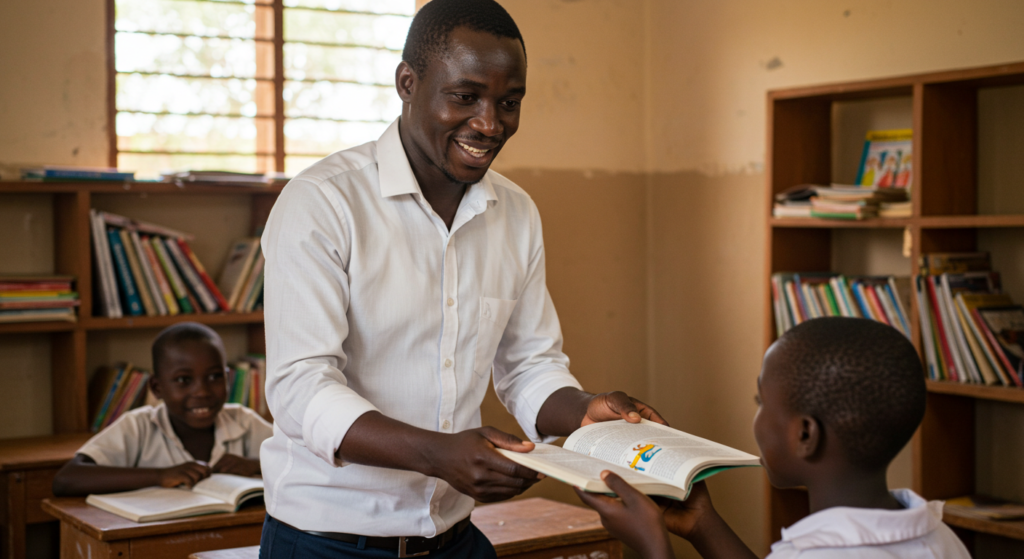
    “She has inspired me to get a Master’s degree” — Kai*, 25, F

    Kai was used to lecturers who taught their material half-heartedly until she attended a class that reignited her passion for language and its social effects.

    “The name of the teacher who changed my life is Dr Vivian*, and she was my lecturer in 200 level. At that time, we were doing so many courses at once. I was tired and frustrated, and nothing was making sense to me until her class. 

    First of all, she was one of the most beautiful women I’d ever seen. Secondly, she was so kind. She spoke like she knew what she was teaching and that she enjoyed it just as much. She taught us about how language evolves as society changes. She talked about feminism and how it has impacted language use. 

    When she brought up gay people, I was prepared for the worst, but she was so open about it. She talked about how queer relationships have impacted language use and the evolution of language to accommodate queerness. I was in awe.  A progressive Nigerian lecturer? I thought I was losing it.

    After the class, I followed her to her office and asked to speak with her. She pulled up a seat and asked me to go ahead. I spoke to her about nonbinary people, pronouns and modern language. She listened, asked questions, and helped me interrogate my own theory. She also asked me if I was gay, and I denied it heavily, but she just laughed like she knew but didn’t want to say anything.

    She was the reason I got obsessed with language and society, and I dedicated my final year project to her. I’m going to get a master’s in sociolinguistics because I want to make her proud. I want to become a teacher one day because I want a student to feel the same way I felt in Dr Vivian’s class.”

    Get More Zikoko Goodness in Your Mail

    Subscribe to our newsletters and never miss any of the action

    “He told me I was a dunce and I believed him.” — Tola*, 30, M

    Tola shares how a primary school teacher whittled at his self-esteem, and how he’s trying to heal that deep wound.

    “When I was in primary four, my class got a new teacher. I wasn’t the strongest student in my class academically. It would take me years to discover I am dyslexic, and that was what made school so difficult for me. Anyway, he called on me to read something on the board, and I couldn’t so he dubbed me ‘dunce boy.’ For the rest of the year, he never called me by my name, just ‘dunce boy’. I didn’t tell anyone at home because I felt like I deserved it since my grades didn’t improve, no matter how hard I tried. 

    It got to a point that everyone in my class also called me ‘dunce boy.’ I tried to shake it off, but it had a big effect on my self-esteem. I thought I would never do well in life since I couldn’t find my way around academics. I became a troublemaker and stayed that way for most of my secondary school experience. It was my older cousin who was talking to me during the long break before senior secondary school that made me realise I was dyslexic. 

    That day, he told me I was smart and he didn’t understand why I was behaving the way I did. I tried to explain to him that I was a dunce, I was bad at school, and that was why, but he disagreed with me. I tried to read something to him to prove that I wasn’t smart, and the words scrambled while I looked at them. That was when he figured I had a learning disability and told my parents. That literally changed my life. I got tutors and a therapist, which really helped me and my grades improve. School was still difficult, but this time, I had a way to fight back. 

    I hate that teacher till today because I still catch myself thinking that I’m stuck in primary four being a dunce boy instead of the accomplished web developer that I am today. Learning positive self-talk has been invaluable, but I would have preferred if he never dealt me that blow in the first place.”

    “My teacher made me feel like anything was possible.” — Mariam, 28, F

    Mariam was inspired to reach for the stars by the physics teacher in her secondary school, even though she was an arts student. 

    “My secondary school Physics teacher is one of the best people on the planet. I wasn’t even a science student, but it didn’t matter. Regardless of the issue, he was always willing to speak with you and advocate for you if you got in trouble.

    Once, he gave a talk at the assembly, encouraging the SS2 and SS3 students to take the SAT exam. I remember him saying that he believed every single one of us was capable of passing with flying colours and getting scholarships. I went to speak with him afterwards and asked him to help me convince my parents to let me write the exam. 

    He did, and I started studying for my SATs. He let me use his office for hours of studying and practice, and he encouraged the other teachers to oversee my work and make sure I was studying properly. His support was invaluable. 

    I got a 70% scholarship because of his support, and I was able to go to America for my undergraduate studies. I look back and I’m so grateful to him. His support opened my eyes to the reality that I could accomplish far more than I initially thought.”

    [ad][/ad]

    “My teacher was a terrible person.” — Tina*, 29, F

    *Trigger warning, this response contains mentions of CSA and sexual assault.

    Tina was preyed upon by her teacher, whom she thought she could trust, and he damaged her ability to trust or feel safe with people.

    “My teacher was an awful man. When I was in primary five, I attended a very small school. This meant that my class only had four students, and we got a lot of attention from our teacher. I saw him as my big uncle, but he exploited that relationship by molesting me for the entire year he spent working at my school.

    I felt disgusted after the things he did to me, but even years later, I still feel the adverse effects. Physical touch is difficult for me to enjoy, and I hate kissing. I never fall asleep at sleepovers because I don’t feel safe. When I went to visit my parents for the Christmas holiday two years ago, I ran into him at a neighbourhood store, and this man greeted me as if he hadn’t done anything wrong. I ran out of the store without saying a word to him. I hope only bad things happen to him.”

    “My teacher paid my school fees when my father couldn’t afford it.” — Bolu*, 62, M

    Bolu was a promising student, but his family couldn’t afford to keep him in school. His teacher made sure that he completed his studies by extending a hand of kindness to him.

    “In 1977, my father told me I wasn’t going to go back to the little school in our village. He wanted me to help him on his farm because he couldn’t afford to pay the fees any longer. 

    When school resumed, my teacher noticed I wasn’t there and came to my house to ask why. When my father explained that he couldn’t afford it, my teacher immediately offered to take on my fees. I remember he said I was a bright student and going to school would improve my chances of doing well in life.

    If not for him, I don’t know how my life would have turned out. I passed all my exams with flying colours and went on to complete my ND and HND. I started a business in Ibadan that has taken care of my family. 

    I kept in touch with him even after I left school, and when he passed away in 2010, I cried bitterly. His kindness set me up for life. He made me see the importance of an education, and I have passed that down to my own children.”

    See what people are saying about this article on Instagram


    If you enjoyed reading this, you should enjoy: “He Slept With My Ex” — 6 Nigerians on The Friend They Love But Don’t Trust
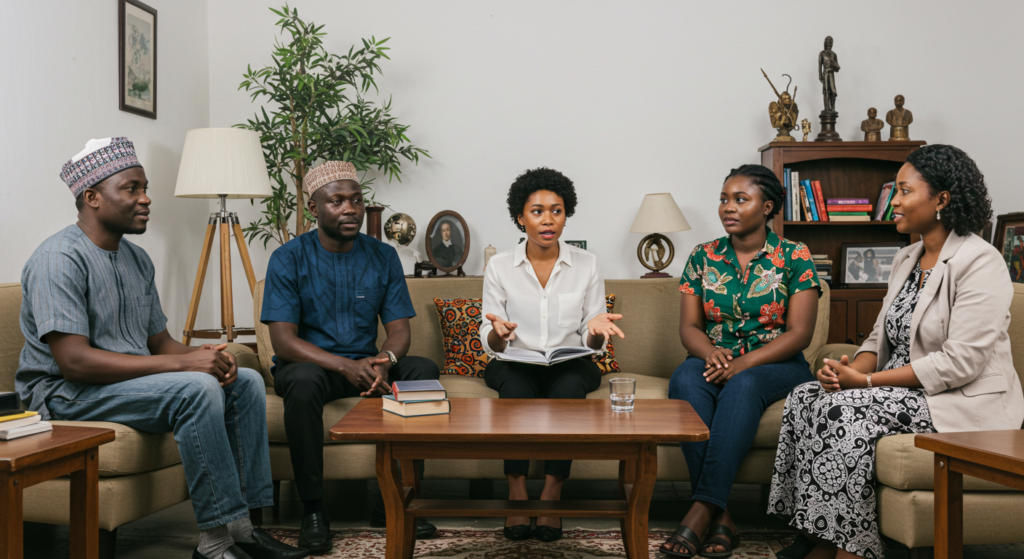
  • A few weeks ago, the Nigerian public was stunned by a video of a teacher, Stella Nwadigo, at Christ-Mitots School, Isawo Road, Ikorodu, Lagos, aggressively slapping her three-year-old pupil, Michael Abayomi.

    The teacher has since been arrested and arraigned in court. But her action is hardly an isolated incident.

    We spoke to five Nigerians who bravely shared their stories of being bullied by their teachers. From the ridiculous to the heartbreaking, these stories highlight the lasting impact teachers bullying students have on their mental health, self-esteem, and overall educational experience.

    We’re not here to villainise teachers (we know many amazing ones out there!), but to shed light on the often-overlooked issue of teacher bullying in Nigerian schools and possibly spark a necessary conversation about the power dynamics in our educational system.

    Joseph*

    My first experience of bullying in university was with a professor, a quite religious person too, who I looked up to in my department. She taught us a political science course, and she had an arbitrary rule that if you missed the first class, you’d have to forfeit the course and register for other electives. That wasn’t in the school’s regulation, but hey, it’s a public university—a lecturer’s word is law. Unfortunately, I missed that class due to some family matters, which I explained to her after I got back. She gave me a condition: I must attend her church every Sunday and submit to her written reports of the things I learnt in the service. Upon hearing her condition, I knew I couldn’t do that. So, I forfeited her course. I wasn’t the only one; some other people did too.

    Tobi*

    JSS2 must have been the most humiliating period of my life. My Business Studies teacher, under the guise of being a disciplinarian and moralist, would make us slap each other in class. For context, this woman had issues with sporting waves; any sight of shiny, well-groomed hair is a sign of “big boy”, and that was considered an influence of joining bad gang in her book.

    On the particular day of the week that Dagrin died, some of my classmates and I were sad about his death. We sang his songs during break time, and I wrote some of his lyrics on our chalkboard. When the break was over, Business Studies was our next class. This woman came in and saw the chalkboard. She realised they were “secular” lyrics and got angry. She asked the class who wrote it. We were all silent for a while, but when her tone got stronger, some people pointed at me. I stood up and went to meet her in front of the class. She pulled me closer and slapped me. Then she told me to wipe the chalkboard clean. I picked up the duster, she said, “Ugh, ugh. No. Use your shirt to clean it.” She meant my school uniform. That meant taking off my tie and unbuttoning my shirt and taking it off. By the time I took it off, students from other classes were already watching the incident. I didn’t wear a singlet under my shirt. I was unclad, and some people laughed at me because I had big breasts as a guy. It wasn’t new knowledge that I was fat. Everyone knew that, but some still made jests while I hastily, under fear and humiliation, cleaned the board with my shirt. By the time I was done, my shirt was dark and dirty. She made me wear it again and sat through her class as she rained insults here and there.

    It’s crazy that it happened in a missionary school. It was even crazier that I was scared to report what happened to my parents at home and to the school principal because she was fearsome. I hate the woman, man. I don’t think anything will ever cancel my hate for her out of my heart.


    If you or someone you know is being bullied, here is a link to helplines they can call.


    Francis

    While we prepared for valedictory service and graduation in my school when I was in SS3, a Computer Science teacher, who was a popular irritant amongst students, showed that she could go lower and be vile. The school’s graphic designer presented what he had made for our yearbook to us, the principal and teachers. This woman flared up upon seeing my photo on the front cover. She began to shout that, no way they would have my photo there, and that I was a bad kid. People were confused and surprised that she did that, but I wasn’t. It wasn’t her first time bullying and taunting me in her classes and on the assembly ground. My confidence and outspokenness disgusted her. If she caught me laughing loudly with friends, she’d either insult and call us “class hooligans” or even punish us (her way of getting us busy since we had time to laugh). It was a long back and forth, because I stood up to her and insisted that the design remained the same. I could talk because I facilitated how we got the photographer that took photos of the graduates and literally worked as a prop man for the photographer on that day. I wondered how someone who was old enough to be my aunt and who was supposed to be my teacher hated me so much. Eventually, the principal told the designer to leave the design as it was.

    Osaze*

    I have always been charismatic, even as a teenager. I was the boy every girl had a crush on. There was a teacher who hated my guts because he hated the fact that one of the students he was attracted to liked me. This is a grown-ass man hating a teenager for pulling another teenager. One day, he got his chance to act on that hate. I got to school late, and then he called me to his office and flogged me till my uniform was soaked in blood. I can’t even call this flogging because the wounds were so bad that I was hospitalized for days. When my mom came to pick me up, she couldn’t believe her eyes. She got the teacher arrested, but he was eventually bailed out. Till today, I still have scars from that day. I never went back to that school.

    Adijat

    I was the class captain in SS3 and it was my duty to go call the teachers whenever they were late for a class they have to teach. Our maths teacher was late and when I went to his office to notify him that he was running late, he expected me to stay back a bit, chatting and making jokes with him. But I didn’t. I told him he was as sharp as I could be and left the office. I think he caught an attitude from that and kept it to heart.

    When he got to the class, one of my friends saw something funny during his teaching and laughed. That distracted me, and I looked back to see what was happening. Before I turned my neck back, the teacher suddenly called me to stand up and accused me of being a nuisance, disturbing his class. He told me to go kneel outside the class.

    While I was outside, kneeling, my guardian saw me and asked what happened. I told him, but the maths teacher overheard and rushed outside to say I was lying. He then added to the punishment. He told me never to come to his class again and instructed me to wash plates at the dining hall every morning while his maths class went on. That was washing plates four times a week. Thinking the teacher didn’t mean it, I attended his math class the following day. He sent me out. I missed math class and washed plates every math period for two weeks. Even on days that I pretended that I was sick, he didn’t give a damn. I had to call my mom to tell her the situation. My mom told me to beg him. I begged him for four days, and my guardian interceded for me before he considered accepting me back to his class.


    If you want to know if you or someone you know is being bullied, here is a link to useful resources.


    10 Nigerians Share their New Year’s Resolutions for 2025

  • Every week, Zikoko seeks to understand how people move the Naira in and out of their lives. Some stories will be struggle-ish, others will be bougie. All the time, it’ll be revealing.


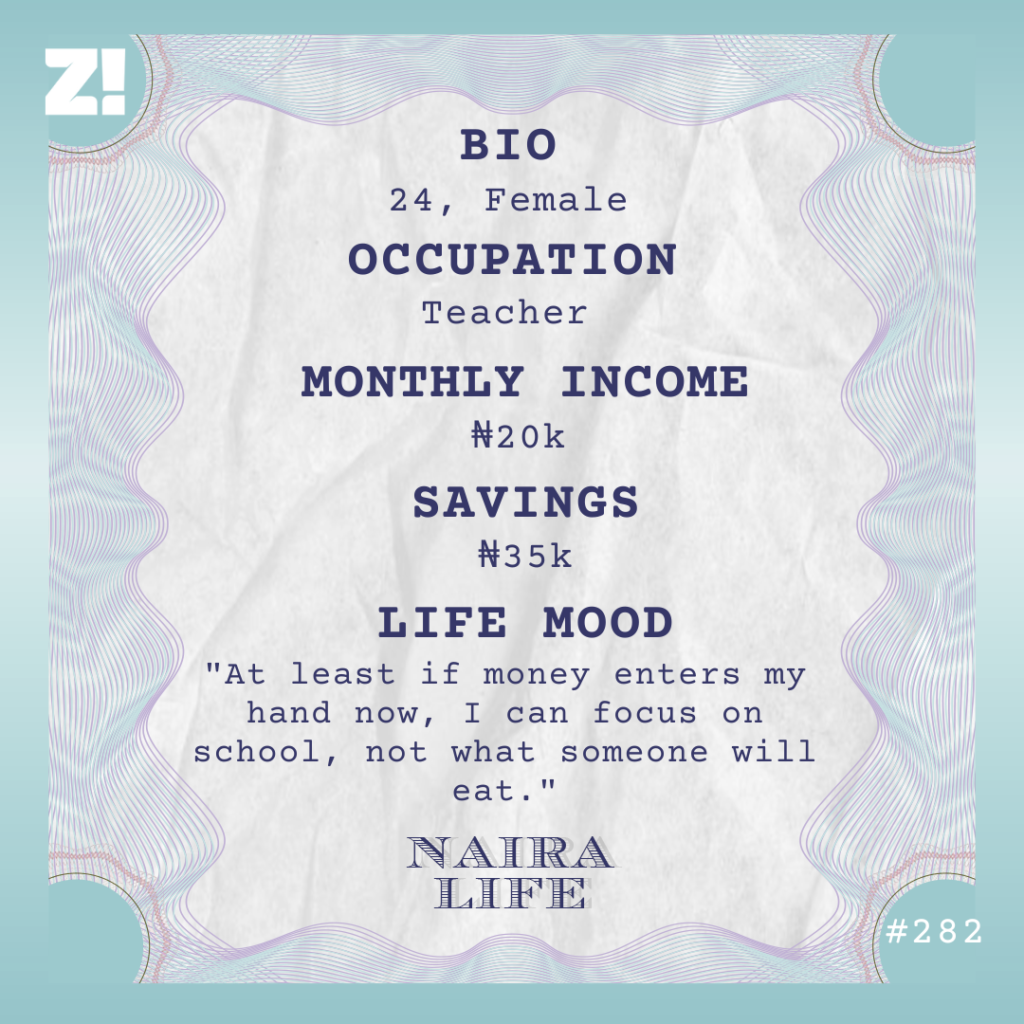
    Nairalife #282 bio

    What’s your earliest memory of money?

    It’s the time I “took” ₦150 from my mum’s purse in Primary 2. I knew it was bad, but I did it. If she found out, she never confronted me.

    Why ₦150?

    My school had this thing called a check test. It was a type of midterm exam, and each child was to pay ₦150. When I told my mum, she said she didn’t have money. So, I had to collect it myself.

    Was “I don’t have money” a regular phrase you heard growing up?

    Not at first. My dad used to travel internationally to buy materials for his plumbing business, but he stopped and started doing local trips around the country instead. I never found out why.

    I was small, but I noticed the changes. I remember starting primary school in a private school and suddenly withdrawing to attend a government school.

    My dad gradually stopped bringing gifts from his trips, too. Then I started hearing, “I don’t have money.” Sometimes, he’d leave the house and not return for a long time. 

    My mum also moved from being a housewife to selling fruits at a major market in Onitsha, where we lived. I was used to seeing her at home whenever I came home from school, but she, too, started returning late. This was around 2006/2007.

    I’d just started adjusting to our new reality when my mum passed away in 2012. My dad also started having issues paying rent, so he sent me and my siblings to live with my grandmother in the village.

    I’m so sorry about your mum

    Thanks. I was in JSS 2 and continued my secondary school education in the village. When I finished in 2017, there was no money to further my education, so I had to start working.

    Sales girl jobs were the easiest options for secondary school certificate holders where I lived, and I found one at a provision store. My salary was ₦6k/month, which I used to fend for myself and provide for my sisters. I’m the second-born, but my elder sibling stayed back with an uncle in the city, so I became the oldest to the rest of my siblings.

    I worked at the provision store for a year. Then, I decided to return to the city.

    Why?

    I was tired of living in the village and wanted to try going to university. My dad thought I was joking when I told him until I appeared in his one-room face-me-I-face-you apartment. I even left my sisters behind.

    I told my dad I wanted to resume school, and his response was, “Hmm.” That clearly meant, “With which money?” I had to resort to looking for jobs if I hoped to make my school dream come true.

    Did you find a job?

    Yes. I found one as a marketer at a microfinance bank in 2019. Basically, we did esusu contribution (thrift collection), and my job was to enter the market and convince people to contribute with us. My salary was ₦15k/month, more than double what I made back in the village.

    However, I could only save about ₦1k-₦2k monthly because my dad wasn’t doing great financially. He worked as “oso afia” — a middleman. You know those men you see standing around in the market and asking passersby what they want to buy? Then you tell them, and they take you to the person selling it. That’s what my dad did. 

    He made money from small commissions. His income wasn’t enough for anything, so I had to contribute to the home expenses. 

    I also sent about ₦5k monthly to my sisters back in the village. The rest of my salary went into my toiletries and transportation to work. I worked there for a year before I left in 2020.

    Why did you leave?

    The pressure was a lot. The bank expected me to bring people who could drop ₦1m in fixed deposits. But my customers were market people who used their money to trade, and I always missed my targets. 

    My bosses kept telling me to “apply pressure” and do what others were doing. When I asked the others what they were doing, it was that some of them were using their bodies. Me, I couldn’t do it, and I was also in a relationship. So I quit before they used pressure to wound me. 

    My sisters also moved to the city to manage with me and my dad around that time. Responsibilities increased, and then the lockdown happened. Omo, as soon as it was over, I had to look for another job. This time, it was as a sales girl at a clothing store. 

    How much did it pay?

    ₦15k/month. I was determined to write JAMB that year, so I started evening tutorial lessons. I told my uncles before I started because I knew I’d need their financial help. They told me to go ahead, and I paid ₦4,500 for the three-month tutorial. I paid ₦5,500 for the JAMB exam itself, and I scored 177.

    Uni was out of the question, so I processed admission to a college of education and got in. But I deferred the admission because my uncles gave me stories when I called them to ask for money to pay the ₦8k acceptance fee.

    It pained me that I didn’t have any money saved up, or I’d have paid it myself. But then again, the school fee was ₦65k. Where would I see the money for that?

    Right

    Thankfully, I was still working at the clothing store. But I also left after working for a year in 2021. I was tired and needed space to think about my life. I decided I wouldn’t look for another job. I’d use the time to find a handiwork to earn so I could make something of myself. 

    But that decision only lasted like three months. Things were so hard at home. My dad would go out and come back without money, and my siblings had to eat. Even if I wanted to close my mind to my own needs, I couldn’t just watch them starve. I was getting a little pocket money here and there from my boyfriend, but it wasn’t enough for us all. 

    So, I found another job in 2022 at a hospital. I was like an administrative assistant. 

    Was the pay any better?

    Still ₦15k o. That’s the general salary for SSCE holders in my area. Only jobs in the state capital or major cities pay like ₦30k/month.

    Fortunately, some of my siblings had started doing small small things to make money, so I could save about ₦6k/month. When we were really lucky, our dad would have enough money to feed us for two or three days, so we shared responsibilities like that. Sometimes, if everyone was broke, we slept hungry.

    I actually loved my job at the hospital. I asked questions a lot and joined the other staff to do tests and prepare for operations. I even learnt to read lab results. The doctor was a gynaecologist, and I gained experience in things concerning women, like pregnancy and prenatal drugs.

    Ironically, I discovered I was pregnant in 2023. I had to leave the hospital.

    Did they ask you to leave?

    No, but I was ashamed. The staff knew I wasn’t married, and nurses gossip a lot. I didn’t want to be at the centre of anyone’s gossip.

    I only knew about my pregnancy in the third month. I typically see my period for five days, but I saw it for only three days during the first two months. I thought it was an infection, so I started saving money for treatment. One mind just told me to do a pregnancy test even though I was sure I used contraceptives. Alas, the baby was there.

    I ran to my aunt’s place in confusion.  Then I sent my dad a text to inform him about my condition. After that, I switched off my phone. When he finally got through to me, he asked me who was responsible. He knew my boyfriend, so I told him. He said, “So, what is he saying?” I responded, “I don’t know,” and he ended the call.

    Was your boyfriend actually saying anything?

    When I told him, he said, “It’s not true.” Then he said he wasn’t responsible. Then he accepted, but he grew distant. At one point, he stopped calling and taking my calls. I think the whole thing contributed to the mental breakdown I suffered.

    My aunt took me to a psychiatric hospital for tests because I kept talking to myself and crying. I don’t even know if they found anything wrong; I was just in my own world. 

    I moved to an uncle’s house in January, and that’s when I started to feel like myself again. The neighbourhood is quiet, and I feel at peace. I had my baby two months ago, and I’ve not returned home since. My dad comes to visit me here. My baby’s father calls once in a while, but he doesn’t send money. I stopped asking when he kept posting me.

    Does your uncle support you financially?

    He provides most of what I need. I have a roof over my head, and I don’t have to worry about food. In February, I got a ₦15k/month teaching job at a school close to his house. I was seven months pregnant then. The salary is small, considering how expensive things have gotten, but I don’t spend money on transportation and food, so it works.

    You have a baby now. Does your salary still cover your needs?

    For now, yes. I don’t buy baby formula because I breastfeed. My mum’s family also gifted us thrifted baby clothes and diapers, so I won’t have to worry about new ones for a while. There are also immunisations for my baby, but those don’t cost much. I’m trying to save as much as I can because I know the time will come when my baby’s needs will double.

    Oh, my school’s principal also increased my salary to ₦20k in May. I explained to her that I needed more money for my baby before I went on my six-week maternity leave, and she increased it when I returned. That woman really tried for me.

    That’s nice. Let’s break down your typical monthly expenses

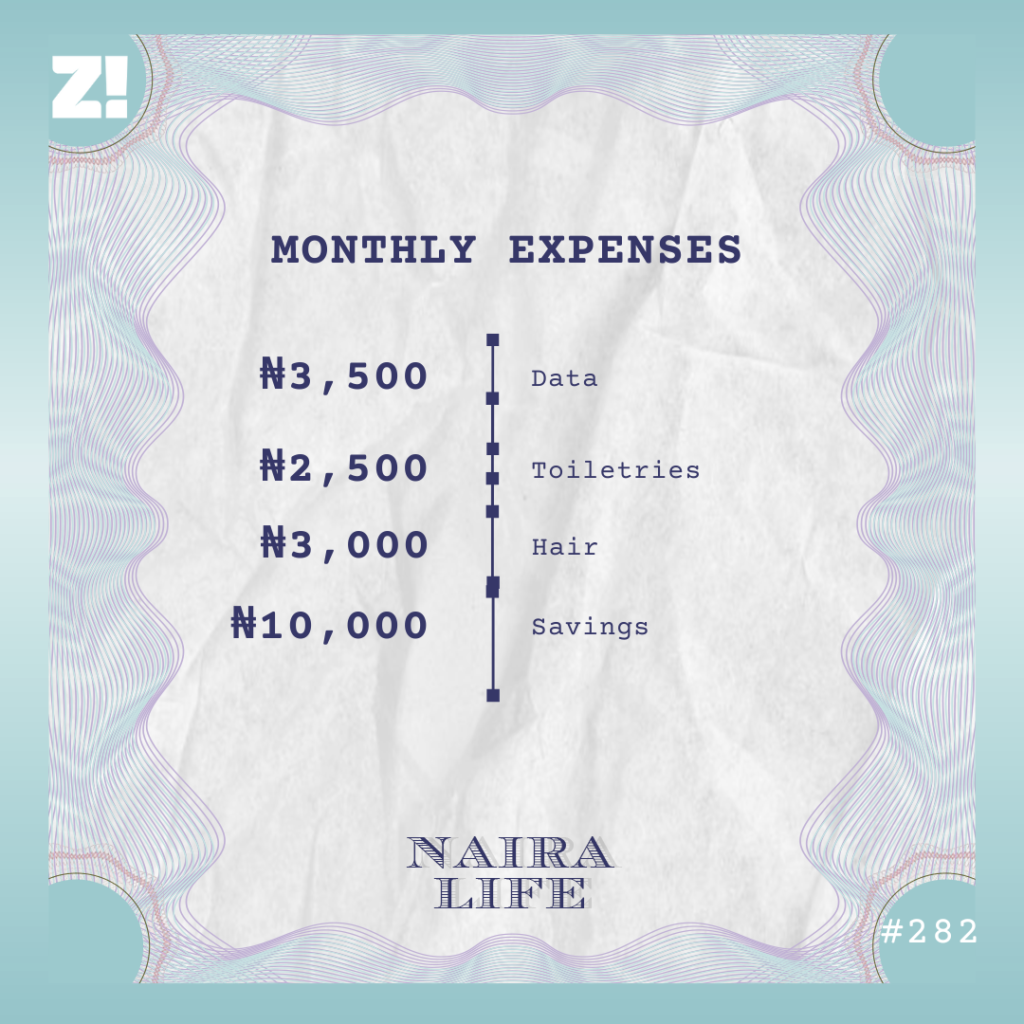
    Nairalife #282 expenses

    I have ₦35k saved up right now, and I plan to save more so I can learn how to make money online. I’m considering affiliate or digital marketing before the end of the year. The people I’ve asked told me I’ll need like ₦30k to start affiliate marketing. Then, I’ll still need to look for where to learn content marketing and social media ads as additional skills.

    Why affiliate marketing?

    I heard people are making money with it. I’d still like to go to the university for my degree, so I can grow and stop earning ₦15k -₦20k. But I need money to make that happen. I hear I can make up to 50% commission with affiliate marketing, and if I make enough sales, I can make ₦100k – ₦200k in a month. That’s really good money.

    You mentioned you hadn’t been home since learning you were pregnant. Do you plan to return at any point?

    I don’t think I can go back there again in this life. Apart from the fact that neighbours will use gossip to finish me, I don’t have to worry about feeding anyone here.

    The pressure to provide for everyone was too much and was part of what pushed me to my baby’s father — he was giving me small small money at the time. Now, see where that’s gotten me. I’m okay where I am, please. At least if money enters my hand now, I can focus on school, not what someone will eat.

    I’m curious. Do your siblings still call you for money?

    No one calls me o. I guess they pity me now. They know it was the pressure that made me vulnerable, so the highest they bill me is ₦200 recharge card once in a while

    Is there anything you want right now but can’t afford?

    I learned that I need a laptop and steady internet connection for affiliate marketing. I don’t know what a steady connection means, but I assume it means my ₦3,500 monthly data won’t be enough. That’s why I plan to save until the end of the year. Hopefully, it’ll be enough to cover what I need.

    Rooting for you. How would you rate your financial happiness on a scale of 1-10?

    1. I would be in a different position now if billing wasn’t so much. Between February and now, I’ve saved ₦35k. Imagine what I could’ve had if I didn’t have so many responsibilities. I’m grateful that my pregnancy was smooth, but I still regret some of the steps I took. 

    I now ring it in my siblings’ ears that no one should carry burdens the way I did. Everyone should fend for themselves.


    If you’re interested in talking about your Naira Life story, this is a good place to start.

    Find all the past Naira Life stories here.

    Subscribe to the newsletter here.

    [ad]

  • Japa season is here again, with young and middle-aged Nigerians uprooting themselves from all they hold dear to start life afresh in the U.K. Some have had to pay through their noses for expensive master’s courses that, in all honesty, they don’t even need.

    This Is How You Can Get Paid to Teach in the U.K.

    But do you know you can catch a flight to Papa Charles’ U.K. for free and still get coins for it? Here’s all you should know about a new japa pathway for those who love teaching.

    What is it?

    The U.K. government has announced the International Relocation Payment (IRP), a one-time payment of £10k to non-UK teachers of language-related subjects and physics. The payment covers visa fees, immigration health surcharge and other relocation expenses.

    How does it work?

    The scheme covers three categories of individuals: fee-paying trainees, salaried trainees and teachers.

    Fee-paying trainees

    This category caters to individuals who have secured a fee-paying place in a teacher training course in the U.K. The course must lead to a qualified teacher status for the 2323/2024 academic year. People in this category don’t need to apply for the IRP. The training provider will inform them if their chosen course qualifies for IRP and pay the IRP directly to their accounts.

    Salaried trainees and teachers

    This category of applicants have either started a teaching job in the U.K. or secured their place in a salaried teacher training course. These applicants can directly apply for the IRP from the Get Into Teaching website.

    When to apply

    Applications opened on September 4 and runs until October 31, 2023. After that, applications will reopen in January 2024.

    When will the £10,000 be paid?

    Eligible applicants will be credited by January 31, 2024.

    What are the general criteria for applicants?

    Teachers

    To be eligible for the IRP, non-UK/international teachers must have secured employment in the U.K. from an English state secondary school. The teaching contract must be valid for at least one year from September 1, 2023, to August 31, 2024.

    You must also be:

    • a physics teacher
    • a general or combined science teacher – you must teach the physics element of these subjects
    • a language teacher – any language is eligible except English

    Fee-paying and salaried trainees

    Non-UK/international trainee teachers must’ve secured a place in a U.K. teacher training course from a trainer accredited by the U.K. government. Applicants must be training to teach the following subjects:

    • Physics
    • Any language(s) except English language. This includes courses combining language(s) with another subject, as long as language(s) make up at least 50% of the course content
    • Any language(s), including courses combining language(s) with English language, as long as the non-English language(s) make up at least 50% of the course content.

    What are the general visa types issued under the scheme?

    • Skilled Worker visa
    • Youth Mobility Scheme
    • Family visa
    • UK Ancestry visa
    • British National (Overseas) visa
    • High Potential Individual visa

    For more information on application processes, check the official U.K. government website.

    Sign up here to be notified when ticket sales begin.

  • Navigating life as a woman in the world today is interesting. From Nigeria to Timbuktu, it’ll amaze you how similar all our experiences are. Every Wednesday, women the world over will share their experiences on everything from sex to politics right here.

    This week’s #ZikokoWhatSheSaid subject is a 31-year-old Nigerian woman who has seen shege as a teacher trying to make a change. She talks about deciding to pursue the profession NYSC forced on her, being bullied by students in a private school and considering teaching in South Korea instead.

    Photo by cottonbro studio

    How long have you been a teacher?

    Four years and a few months now. Although I studied history and international relations in uni, I thought I’d change the world by teaching the leaders of tomorrow.

    What inspired this interest?

    NYSC. In 2017, I was posted to a private school in Ogbomoso. To my surprise, it was just as run down as I would’ve expected a government school to be. The whole school had five teachers, and the 100+ children were learning nothing. The management was unserious, the classroom facilities were poor, there were barely any teaching aids or books, and there were no computers. The parents of the students were just getting by. They didn’t know how to hold the management accountable.

    The state of the school made me so scared about the quality of people we were pushing out into society as the next generation. I was sad, angry, and I wanted to do something about it.

    What did you do?

    I decided I’d teach and gain enough skills, experience, and eventually, the funds to either start my own school or an education-focused NGO. At first, I thought I’d enter the civil service so I could help at a more universal level. But I discovered early the amount of politics it took to even get into the system. I also needed to earn enough to actually make a living.

    RELATED: What She Said: I’ll Run For Office in 2027

    Do private schools pay better?

    Well, they’re easier to gain employment with. I got my first job easily because the school management was even surprised I’d want to work for them given my credentials — I graduated with a first class from a top private university. Even my friends and family were shocked; everyone thought I was making a big mistake. But I honestly couldn’t sleep well at night knowing most children were getting poor education even though they were attending school. I just felt so worked up about it; it’s not something I can readily explain.

    What was your experience at this first job?

    I was given a wake-up call very quickly. 

    It was a private secondary school in Yaba, and I was a teacher’s assistant — I didn’t have a teaching license or certifications. I also needed to have taught the curriculum for a year before I could be a full teacher. My NYSC experience didn’t count even though I performed the responsibilities of a full teacher during that time. 

    From the beginning, I was constantly shut down when suggesting ideas to management. I wanted to push for a more empathetic approach to dealing with the students. But in hindsight, I can see how having a newbie act like she knows it all in just over a year of being a teacher could be annoying. 

    How did they react?

    One day, the school administrator sat me down and said, “Look, we like how you’re trying to make everything nice and good-looking, but we didn’t hire you for rebranding work. There’s no room for that here. The parents are barely able to pay school fees, you’re talking of giving their children special treatment.” I was mum. 

    This was seven months in. I left the next month, but I grew up a little. I wasn’t going to make a change overnight. I’ll probably never even make a change.

    Don’t say that. What kept you going then?

    Everyone involved was so resistant to change. And the truth is I didn’t know what I was doing. What did I really have to offer? Just good intentions?

    But stubbornness was what kept me going. I needed to prove myself and everyone wrong. Also, I truly cared about these students. I wanted them to get the type of education I got in this same Naija. It’s unfair that a greater majority of Nigerians don’t have access to a basic standard of education because of their parents’ financial circumstances.

    If you’d like to be my next subject on #WhatSheSaid, click here to tell me why

    True. So what happened next?

    After staying home for about three months, I got a job at a better quality school. But believe me when I say the parents were paying a lot of money — not as much as popular elite schools, but it was a lot — for just fine wall painting and uniform. Their children were learning nothing. The teachers were nonchalant, using handwritten teaching guides that were at least a decade old. 

    If most parents knew how ill-prepared their children were to compete in the future world of works, they’d be shocked.

    Were you at least able to make a difference there?

    Yes and no. I stayed for about two and a half years, and I was able to get through to members of management to some extent. I was moved into administration and operations six months in, only taking special classes in speaking and diction once or twice a week. As deputy administrator, I was able to enforce annual review of the teachers’ notes to make sure they stay relevant. The teachers resented me for this. 

    To be honest, I didn’t feel like I was making real lasting change because I was sure they’d ignore all my policies as soon as I leave the school, and they filled the role with someone more laid back. However, the changes I may or may not have made weren’t the most memorable thing about my stay in the school.

    What was?

    The bullying. I’m sure you think I’m referring to student on student, but no. I mean, students bullying teachers. It was rampant.

    RELATED: What She Said: My Friends Were My Bullies

    Please, tell

    The students had no regard for the teachers at all. This isn’t new to me as I saw it happen when I was in secondary school, but this was a whole other level — maybe because I was now on the receiving end. The senior students would talk down on teachers, make fun of them, and sometimes, humiliate them. And they were encouraged by the negligent school management and overindulgent parents. 

    When you say humiliate—

    One time, a teacher seized a student’s drink — La Casera — but later found out that the teenage boy had emptied the bottle before class and replaced it with urine.

    No way!

    Yes o. Then the other students started encouraging the poor man to drink it. He didn’t, but it wasn’t until when he got to the teacher’s hall that he discovered it was urine. Can you imagine?

    Another time, I was taking the non-academic speech and diction class when the whole session turned into a conversation about my marriage. A group of male students started verbally attacking me about my decision to use a Bible as a symbol of my marriage instead of an engagement ring. 

    They made it a whole thing about my husband being too poor to afford a ring. I was so triggered because it was a religious choice — my sect doesn’t believe in wedding rings, and we hardly wear jewelry. I was close to bursting into tears, so I had to rush out of the class. And these students started laughing. That day, I cried ehn.

    It was one of my few firsthand experiences. Don’t get me started on the female students. They were all so unruly.

    That honestly sounds traumatic. How did you stay there for more than a year?

    I couldn’t get another job early enough. But also, I didn’t want to ruin my CV with too many moves. I didn’t have to deal with the students directly so much though. I guess I could pretend it wasn’t happening, but the teacher turnover was staggering. When I finally left, I told the owner she had to do something to rein in the students and their parents. I don’t think anything will change there though, like almost everything else in this country.

    Hmm. So what was your next move?

    My family sponsored me to start taking standard teaching courses and certification exams to improve my qualifications. As an aftereffect of COVID, there was a huge demand for online schooling. I transitioned into giving tutorials for higher education early in 2021, preparing online students for JAMB, TOEFL and IELTS. In 2022, I registered with the British Council, so I now teach English to students all over the world, particularly Indians and other Asians.

    But what happened to your dream to improve the quality of secondary school education in Nigeria?

    It’s still there somewhere at the back of my mind, but I’ve partly given up on it. I’m disillusioned. The gravity of the problem is too much for me to even wrap my head around. My parents are visibly relieved. The plan now is to get a master’s in the education line in UK and work with NGOs there that focus on education in Sub-Saharan Africa. There are a couple of them.

    There’s a clashing possibility of moving to South Korea to teach English with my British passport. I’m ashamed to say this because of my initial declaration that I’m determined to make a change, but I’m entirely in love with the K-culture and the Korean government is on a recruiting spree for English language teachers, so why not help a society that’s actually willing to develop?

    Have you started working towards any of those plans?

    For sure. The UK master’s plan is the major reason I had to transition into freelance teaching. I’m earning a lot more now, enough to actually save for a UK education. And on top of that, I’m getting the kind of experience that will be useful in my statement of purpose application essay. The South Korea plan will work seamlessly once I get that UK degree.

    You mentioned being married. Is your partner making japa plans too?

    He’s a banker. Bankers and health workers are always the first to jump, so he’s way ahead of me on that. He was working on a move to Canada through PNP and Express Entry before we got married in 2020. COVID was a huge set back for him, but now, we’re putting the money together so he can come with me when I go for my master’s. The plan is for him to work full-time while I study and work part-time.

    So you’ll never go back to teaching in Nigeria?

    If I can help it, never. It’s the absolute worst. We need to check on our teachers o. I understand now why they do the barest minimum. They’re overworked, underpaid and get very little motivation. In private schools, their interests are belittled in favour of the rich students and their parents. I feel guilty most times because I’m privileged enough to choose to take a step back from that path, but most aren’t. They’re going through serious financial and psychological stress. 

    Then again, who isn’t seeing shege in Nigeria?

    Our leaders clearly aren’t. They are the ones showing it to us.

    READ THIS NEXT: What She Said: A Voice Told Me To Teach

    For more stories like this, check out our #WhatSheSaid and for more women like content, click here

  • The japa trend has taken Nigeria by storm in the past couple of years, as students, families and professionals are fleeing the country for greener pastures. 

    According to the United Nations Department of Economic and Social Affairs, the number of international migrants from Nigeria in 2020 was about 1.7 million. With the recent announcement by the United Kingdom’s Department for Education, it looks like this figure will climb even higher in 2023. 

    What did the UK say?

    So, via a publication on their website, Nigeria was listed among the African and Asian countries whose citizens are eligible to apply for teaching jobs in the UK come 2023. 

    Japa UK Teachers Nigerian

    The other eligible countries are Ghana, Hong Kong, India, Jamaica, Singapore, South Africa, Ukraine and Zimbabwe. 

    The programme will begin on February 1, 2023, and applicants must have a Qualified Teacher Status (QTS) awarded to them by the Teaching Regulation Agency (TRA). The interesting thing about this process is you don’t need formal teaching training. What you’d need are: 

    • An English and Mathematics qualification the same standard as a grade 4 General Certificate of Secondary Education (GSCE). This is equivalent to a C in your West African Senior School Certificate Examination (WASSCE) or National Examination Council (NECO) Certificate. 
    • A Bachelor’s degree
    • A minimum of two years teaching experience

    What does this mean for Nigeria?

    More brain drain

    This year, we witnessed the mass exodus of our health professionals leaving the country with an average ratio of one doctor to 10,000 patients. And with this opportunity, we may soon see this calamity replicated in our already dilapidated education system. Public schools are already overwhelmed with the number of students they have to deal with, and this situation may get even worse in the coming year.

    Japa UK Teachers Nigerian

    Poor quality of education

    If a brain drain happens in our education sector, it’ll do more than increase the ratio of educators to students. The quality of any education system depends on the quality of its intellectual pool. Last month, the registrar of the Teachers Registration Council of Nigeria noted that over 260 teachers migrated to Canada this year. If our number of qualified teachers continues to dwindle, it’ll eventually affect the quality of students produced.

    Retarded economic growth

    It’s important to remember that applicants for the UK teaching jobs don’t need formal teaching qualifications. However, they must have a Bachelor’s degree, meaning they’d be skilled in other areas. If we lose most of our skilled labour to migration, our economic and technological development will remain in the trenches. 

    Japa UK Teachers Nigerian

    A good way for the country to manage this situation would be to increase the incentives for the academic staff across all public schools, provide more job opportunities with attractive salaries for graduates, and make the work environment and culture more conducive. 

  • 1) The Lazy Teacher

    The one just comes to class to read their note to you. They won’t explain shit. If anybody asks a question, they’ll immediately give it to the class as an assignment. No one knows if they don’t know shit or do know shit but just don’t give a shit. They give off “Aired. DFKM” vibes.

    2) The Oversabi Teacher

    This one will teach you so much shit They will ensure you buy 12 different textbooks for one subject. If you think having all these textbooks will save you from copying notes, you’re wrong. They will come to school on public holidays, days that there are strikes, and will even risk their lives during riots just so they can come to teach. They are the simultaenously the best and the worst.

    3) The Teacher that just likes to beat people for no (and any) reason.

    This asshole teacher comes from home with their own assortment of canes. They will find ANY reason to flog people. You will even catch them helping other teachers flog. They are masochists in disguise.

    4) The Joker

    This one will come to class and crack jokes instead of teaching. All they do is crack terrible jokes the whole time and the students have to sit there and laugh because not laughing means failure.

    5) The Fashionista

    This is that female teacher that comes to school everyday dressed like she just left the club. Short tight mini dresses/skirts, insanely high heeled shoes and the kind of insane makeup you only seen in Lady Gaga music videos.

    6) The one that thinks she’s a fashionista but really isn’t.

    This teacher tries too hard to be stylish but ends up serving homeless chic realness. Even her fellow teachers know her fashion sense is shit and laugh at her behind her back.

    7) The Ashewo

    That one teacher (male or female) who keeps trying to hook up with other teachers. If you walk into the staff room, you’ll most likely catch them saying wildly inappropriate stuff.

    8) The Snitch

    That teacher who (forgets that snitches get stitches and end up in ditches and) runs to the Principal’s office to report any small thing that happens.

    9) The Storyteller

    This one will keep interrupting the day’s lesson to tell the class a story about that time they lived in India or some other boring shit. The worst thing about this is that half the time, they’re lying.

    10. The Ghost

    This one NEVER comes to class throughout the term and is somehow be able to pull this off without the Principal finding out. Eventually they’ll emerge, 3 days before exams, and quietly tell the students the exam questions they’re going to set before vanishing again.

    [donation]

  • If you’ve ever taken an online course, then you know how hard it can be. And this is you as an adult who knows the importance of these things, let alone a child who just wants to watch Nickelodeon in peace.

    Curious about how learning has been outside a classroom, I asked Nigerian teachers how the experience has been.

    Kola – 28.

    “The major challenge has been the novelty of passing information via a screen. This is not even about using computers and all. It has been difficult to pass knowledge because this is a new technology for both the teachers and the students in these parts. Most times, we use some measure of fear to make the students sit still and focus, but that effect is not the same over a screen.”

    Alex, 26.

    “A major challenge is timing. The student that had the longest attention span was 1 hour. Over time, they got tired because they are also affected by what is happening. To them, the fact that they are not in the classroom gives them the idea that they are meant to be relaxed. Not having to dress up and get into traffic makes them feel like they are on holiday. So, if you tell them that they have to come online at this time, and they have to do that every day, what happens is that they lose interest.

    So, it’s not as effective as them showing up physically everyday. They don’t get the chance to be tired if it’s physically. They may be tired but they have to see it through.”

    Bode, 24.

    “I run a private tutorial center and it’s a bit more expensive to run an online class than offline. There are many factors. Firstly, we are making lesser money per hour online because of reduced hours. Students are only taking 30 mins to an hour lesson as compared to 2 – 3 hours of lessons.

    Secondly, parents are not ready to pay as much as before because they are cutting costs. So, lesser revenue and increased expenditure.

    Thirdly, internet and power are such a big issue that sometimes you wonder why you bother. It’s so easy to give up after the tenth “can you hear me?”

    Kehinde, 27.

    “I tutor IELTS and since the exam got suspended, students haven’t been coming. Many of them think the world is ending and IELTS won’t matter again. So, I haven’t had any students in a while. It has been a tough couple of months as this is my main hustle. I am just grateful that my wife has a job because it would have been terrible for us.”

    Biola, 27.

    “I run a tutorial center for WAEC and JAMB in Mushin. My business model is a large crowd paying small money so I can make a turnover. I optimize for one thousand students paying N1,000. But now that Government has said we should lockdown, I have been losing money everyday – No crowd.

    I thought of going online but the students can’t even afford data to watch the videos. I am confused about how to help them. At this point, it’s not even about the money, it’s about helping kids who are already at an obvious disadvantage. I feel sitting at home may widen that disadvantage compared to their richer counterparts who can afford online home tutorial.”

    Tosin, 23.

    “I am happy oh. Thank God for COVID so I don’t have to show up in any useless school. I don’t know why NYSC sends graduates to teach. I don’t think there’s any NYSC teacher that enjoys teaching. Let them lock us down till this foolish NYSC is over.”

    You should totally read this next: We Asked 5 Nigerian Students How They Dealt With Failing A Course.

  • You’re eight. Yet to suffer the indignity of a fellow student politely asking that you slide out dubs wedged between their ass crack during the nerve wracking JAMB examination (true story). Or needlessly having to learn the many ‘rax’es of a cockroach for WAEC. Oh no, your biggest worry is maneuvering the many shaped world of Quantitative and Verbal reasoning textbooks. But — imagine you couldn’t even manage that; not owed to any real shortcoming of yours, but rather because your teacher at the time, took the ‘teaching’ portion of their job description to be a passing suggestion, rather than the mandate it very clearly is.

    For the hapless students of Kaduna State, which had a whopping 21 780 teachers fail to pass a Primary 4 level competency examination in 2017, this was no doubt their reality.

    What.In.The.Hell.Happened?

    iguodala confused

    According to Governor Nasir El-Rufai, the state, in partnership with the Nigerian Union of Teachers, decided to evaluate the competency of public school teachers. They just wanted to make sure those charged with making sure the formative years of young minds aren’t completely shot to rubbish, were actually capable of doing so.

    33 000 teachers were tested. But rather than give grown teachers, I don’t know, anything but pre-pubescent level questions to answer, the state government decided to test their reasoning skills, using questions that ideally, shouldn’t have phased a regular reasoning Primary 4 pupil.

    As it turned out, my estimation was a little too presumptuous, as 66% of the teachers failed to get at least 75% in the test questions posed.

    You need to understand that these teachers actually headed classes, and gave tests and somehow also wondrously set examination questions for students year in and out. By failing to hit that 75% floor, the reality is, even they couldn’t manage an A in classes they were personally handling.

    How.In.The.World.Was.This.Possible?

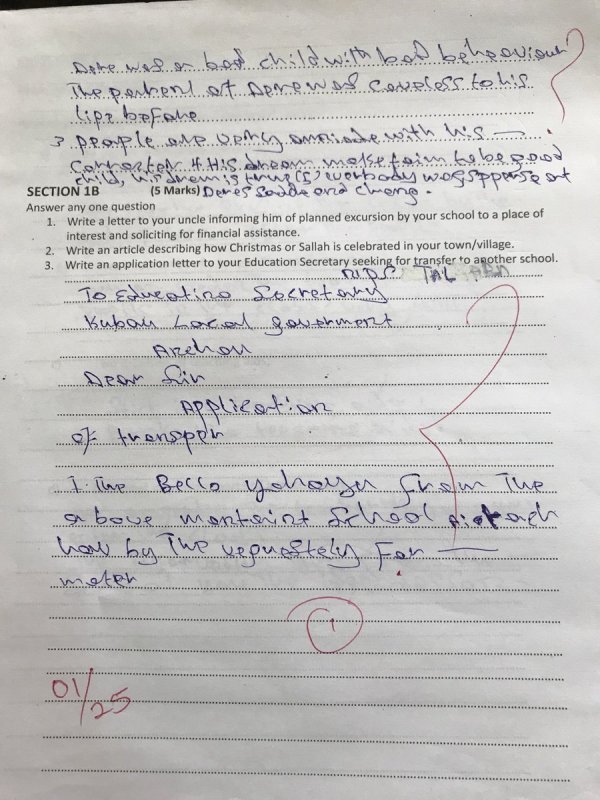
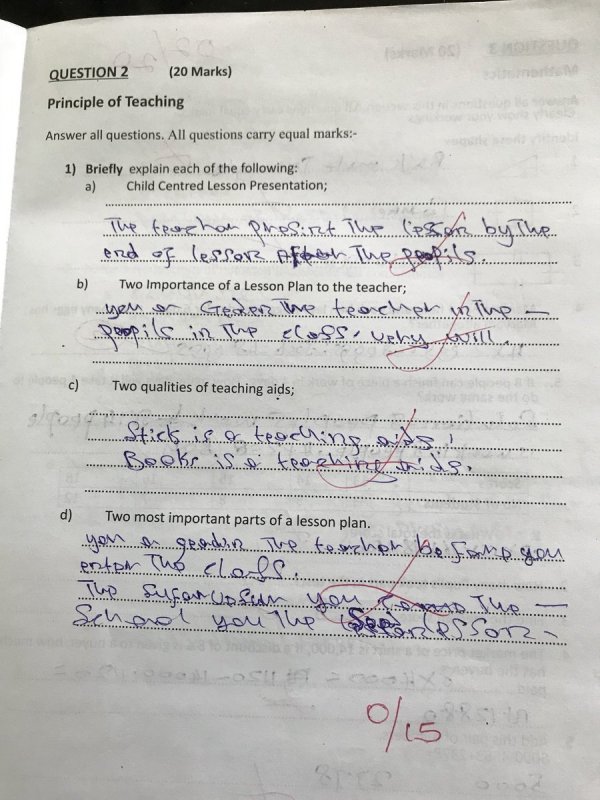
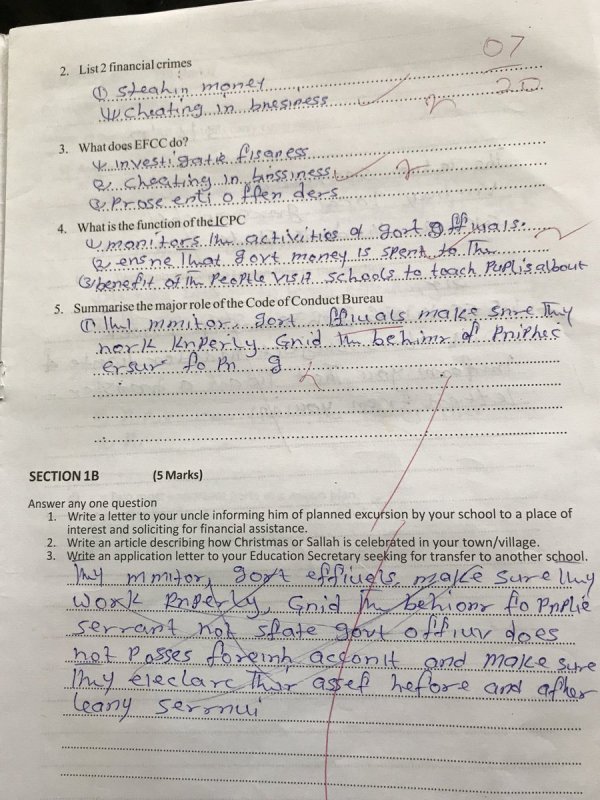
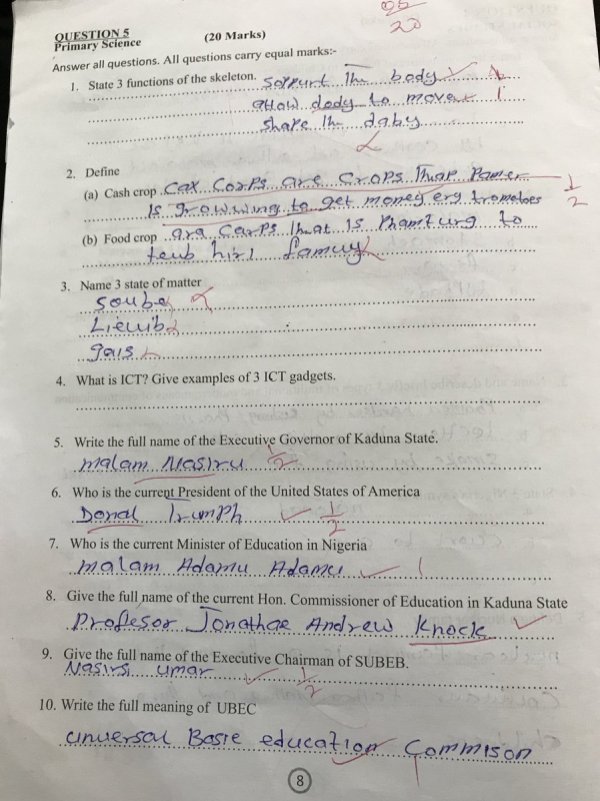
    Well, proving there is no where Nigeria’s three headed nepotism monster won’t rear its ugly head, the appointment of the Kaduna State primary school teachers had for a time, been a largely politicised affair. With sorely unqualified individuals posing as teachers, answers like these were only to be expected:

    Understandably, this led to the dismissal of the erring teachers. All 21 780 of them.

    The People’s Response

    Far as I’m concerned, anything less than symbolically asking for the heads of the teacher- hiring committees or whoever was directly responsible for their appointments, was an undeserving response to the situation.

    But would you know it, that expectation was a little too lofty for how things really played out.

    Earlier on, it was mentioned that the competency examination was carried out in conjunction with the NUT. This body, somehow operating under the missguided notion that individuals unable to properly list the three states of matter were teachers, withdrew support for their mass dismissal.

    According to the Chairman of the State Council of the NUT, Audu Amba, their withdrawal was based on the fact that 60% was taken to be the cut-off mark and not 75%. Somehow they thought saying this out loud sounded intelligent.

    Also vocal about his displeasure at the teacher’s dismissal, Senator Shehu Sani, whose well-educated children would probably mistake a public-school classroom for an above-ground dungeon of sorts, decried the sack of the near illiterate teachers, citing it as “the height of lunacy”.

    He also had this to say about the situation: “Incompetence is not a reason but an excuse to sack thousands of teachers owed salaries for months”. This sentiment  was shared by a host of other people.

    What Happened Afterwards?

    I want to say the state hired more competent teachers and the primary school students read their times tables and lived happily ever after, but this story is yet to have a happy ending.

    To deal with the mass exodus of about 22 000 teachers, the state government resolved to employ 25 000 teachers in batches,  to replace them.

    In April of 2018 however, following the recruitment of 15 897 teachers, the government was forced to sack 4 562 of them, following their failure to write out a decent acceptance letter.

    Guess we should be grateful they hadn’t magically discovered internet templates in the year of the Lord, 2018. They had found their ways into the state government’s service through dubious means, as the State Commissioner for Education, Alhaji Ja’afaru Sani stated.

    The remainder of 11,335 teachers which included degree and master-degree holders, were deployed to 4 000 schools.

    In December of 2018, the State Government recruited an additional 13 606 teachers to make up the 25 000 teachers required to turn the State’s education system around.

    Here’s hoping we’ve heard the last of incompetent teachers in Kaduna State.

  • 1. First, we need to thank the internet for being the best teacher ever!

    2. This really rude teacher.

    3. Maybe his teacher was pregnant sha.

    4. Her English teacher had craw-craw.

    https://twitter.com/YemiThatIsCray/status/783759423202291713

    5. Why were Physics teachers so mean?

    6. When your daddy is your teacher but you’re an olodo.

    7. French class was the worst.

    8. This lecturer is bae!

    9. The days of Queen Premiere English.

    10. This person’s bad belle lecturer.