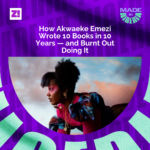
• In just 10 years, author Akwaeke Emezi has written 10 books — including The Death of Vivek Oji, Dear Senthuran, Freshwater, and their latest, Somadina, published in Nigeria by Masobe Books.

    After they signed with the Wylie Agency, Emezi dropped out of Syracuse University’s MFA writing program and published their debut novel, Freshwater. The book is a critically acclaimed exploration of African spirituality. It follows a young girl who grows up to discover she has multiple spirits living within her.

    Years later, Emezi hasn’t stopped writing about spirit worlds — sort of. In Somadina, they tell the story of a young girl who ventures into the Sacred Forest and then across unknown lands to find her twin brother, set in a precolonial Igbo village full of magic, myth, and ancestral power.

    In this week’s #MadeinNigeria, Emezi opens up about the struggle of writing long books (“ I was so annoyed”), believing in God (“It’s just more efficient to surrender”), and why they’d happily let Freshwater be adapted into a Nollywood film.


    This interview has been edited for clarity and length.

    What drew you to Somadina?

    I started writing Somadina in 2012, before Freshwater. It was the first book I ever wrote. I wanted to draw on the Biafran War, but ground it in a precolonial cultural setting. I call it my “village girl fantasy” — the main character isn’t royalty. She’s just a village girl, and her father is a farmer.

    I loved writing a magical world rooted in my culture. I grew up in Aba, and we’d return to our ancestral home in Umuahia often. In most fantasy, magic revolves around royalty. But in Somadina, it’s in a rural world that feels familiar.

    I grew up watching Tales by Moonlight — that kind of storytelling shaped me. It’s an indigenous reality where gods and spirits are real, where deities like Ala exist.

    But with Christianity, those beliefs are now seen as evil. That’s colonisation — when white people show up and say your culture is backward. A big part of my work is about re-centring our indigenous cultures — not just as folklore, but as valid ways of understanding reality.

    When did you decide to become a writer?

    When I was five, in Primary One, at a private school in Aba, as soon as I could write, I started writing stories. My principal gave me blank jotters — if I filled one, she’d give me another. I still have a bio I wrote at seven: “I am a writer. My hobby is writing. My goal is to be a world-famous artist and writer.”

    But life took detours. I studied veterinary medicine, then got a Master’s from NYU and worked at a nonprofit. I had writer friends in Brooklyn, was blogging on Tumblr, and people told me to pursue writing seriously.

    I applied to about 60 residencies a year. Most rejected me. Eventually, I got into an MFA. Teju Cole told me, “It’s fully funded — they’re going to pay you to write.” So I quit my job and joined the program.

    I ended up dropping out — I had already written Freshwater in the first year, which caused tension. They wanted me to wait till the final year. Faculty discouraged me. The program stopped supporting me.

    But by then, I had agents. Binyavanga Wainaina passed my manuscript to the Wylie Agency. Before I even signed, they told me, “We don’t make authors, we make careers.” Now we’re on book ten. They weren’t lying.

    Why did you leave the MFA program?

    Two reasons: why I left, and how I was able to.

    I had a green card through my mom, who moved to the U.S. for work. That’s class privilege. I didn’t need the MFA for immigration status — I had the freedom to leave.

    Spiritually, I was called to write Freshwater. I didn’t want to — I was still Christian — but the call was clear: if I was obedient, I wouldn’t fail.

    I wrote the book early, went to residencies, and signed with Wylie. When the MFA faculty discouraged me from publishing, a friend explained, “If you publish now, it proves the institution didn’t make you.” I didn’t want the degree or to teach — I just wanted to make money writing books.

    When I quit my nonprofit job, I tattooed my hands so a corporate job wouldn’t hire me again. I eliminated Plan B. I was broke, couch surfing. Friends said, “Get a job.” I said, “Never.”

    I got the Miles Morland Scholarship and used it to write The Death of Vivek Oji. Freshwater hadn’t even come out yet. I said, “Let me write book two now.”


    Get More Zikoko Goodness in Your Mail

    Subscribe to our newsletters and never miss any of the action

    ALSO READ: Akinola Davies Jr. on How to Make Successful Arthouse Nollywood Films


    That’s a very permissionless move. Where does it come from?

    Partly from being Nigerian — we’re raised to take up space. But I’ve always been like this. As a child in Aba, I’d talk to strangers: “My name is Akwaeke. My daddy is a doctor…”

    I’ve always known I was a writer. My school principal encouraged me. My parents bought me books. When I ran out, we’d go to the secondhand market to swap more.

    At nine, I published silly poems in the school magazine. Seeing my writing in print made it real. So later, when I said I was quitting everything to write, my family wasn’t surprised.

    I’ve had insecurities, but never about my work. That came from being affirmed early — and from privilege. I was in the “fast class” and treated differently because I was mixed. Teachers touched my hair, helped me cheat in Igbo because “their mother is oyibo.”

    I didn’t think I was pretty — my best friend looked white — but I knew I was gifted. Not in an arrogant way. Just fact. Many people are, but not everyone gets support.

    By 27, I was independent and could write full-time. When I left the MFA, I had no job, no backup plan — but I had committed to Freshwater. Spiritually, the agreement was clear: if I followed instructions, I’d be fine.

    That’s faith. Not Christian faith — I’m not Christian. But faith in something divine. The church and God are not the same.

    And when you don’t obey spiritually, you get dragged. For me, it’s more efficient to surrender.

    What kind of research did you do for Freshwater?

    Freshwater is completely autobiographical. It’s all true. We published it as fiction because no one would’ve bought it as nonfiction.

    I interviewed my parents. My mom told me, “You used to crawl like a snake.” She put a pottu on my forehead to protect me, because she said people acted too hungry around me, like they wanted to consume me.

    The research started spiritually. I read Malidoma Somé’s Of Water and the Spirit, which said colonisation didn’t just affect our language and cultures — it colonised reality. That changed everything.

    I was suicidal for most of my life. I made art, self-portraits as an ogbanje. I didn’t know what it meant then. I kept saying, “I want to go home.” I didn’t realise “home” meant the spirit world.

    When I researched my name, my father said it meant “precious.” It actually means “python’s egg” — and the python is Ala’s avatar. That changed how I saw myself.

    I started asking: what if an Igbo man prays to a white God, and an Igbo deity answers?

    Some critics said I misrepresented Igbo spirituality. But I’ve been to the shrine and I’ve spoken to Ala. So when people say I’m selling culture, that’s their business. I did the work. The deity and I understand each other.

    While writing, spiritual revelations came and were later confirmed by research. It felt like madness, but that’s what happens when you shift from colonised thinking to reindigenization.

    According to the scholar Ann Daramola, in the West, truth comes from verification. In indigenous systems, truth comes from revelation. God told you — and that’s enough.

    I went to Lagos and consulted traditionalists. They said, “If the deity calls and you don’t obey, you’ll suffer.” I was already suffering, so I obeyed.

    Writing the book was brutal, but I finished it in eight months. Freshwater saved me.

    What does it mean that the ogbanje was shut out of the spirit world in Freshwater?

    Freshwater isn’t just a novel — it poses an ontological question in Igbo cosmology: If I’m an ogbanje, why can’t I die? I want to go home. You want me home. Why isn’t it working?

    The answer, which I didn’t realise until after the book came out, is that for the deity Ala, suicide is taboo. So what happens when a spirit meant to die is claimed by a deity who won’t let them go?

    In Freshwater, the deity wins.

    Even now, when I reach out to my spirit cohort, they say: You’re not leaving until someone else releases you. A higher force said: This one stays. They have work to do.

    I didn’t like that. I said, Did I ask for this? Let me go back.

    In 2019, I attempted suicide. It was a tantrum — me throwing hands at God. Even during it, my cohort said: You’re going to die anyway. Be obedient.

    That word stayed with me. I tattooed it on the last bare knuckles of my hand: obedient. A reminder: You’re here. Stop fighting it.

    The gates are closed. God shut them. I have to stay and finish what I came to do. But the peace is in knowing: the gates always reopen.

    How did you write 10 books in 10 years?

    The MFA gave me space to write Freshwater, and then the Miles Morland Scholarship gave me time to write Vivek. I had Pet and Vivek ready before Freshwater even came out.

    I wrote Pet because I was broke. A YA offer came and I said no, but then I ran out of money and asked if it was still open. I wrote it in two months while couch-surfing. I had practised finishing. Writing isn’t hard — finishing is.

    The sale of Vivek changed everything. Riverhead bought it and Little Rot for half a million dollars.

    People say Freshwater is about mental illness. It’s not. It’s about a spirit who also has depression. Spirits get depressed, too. I use terms like DID because they help me access care. But as a friend once told me: “You don’t have DID. You just have multiple spirits inside you.”

    There’s a spirit in Freshwater who causes a split — and wasn’t named. Years later, a friend said: “That’s the spirit who wrote Freshwater.”

    That’s the secret to my writing. The spirit mutes fear, hunger, sadness — and just writes. Great under capitalism, terrible for the body.

    Eventually, I developed a neurological disorder. I couldn’t hold a pen. I dictated Bitter edits over Zoom. That was the turning point. Just because I can write a book in two months doesn’t mean I should.

    Now I write like a human. Two hours a day. The rest is life.

    Most of the writing happens in my mind — like when I was a child, daydreaming. I close my eyes, watch the characters move, and let them tell me the story.

    I still follow the spirits. But I don’t let them break me anymore.

    What was it like writing Somadina, which is very long?

    Nobody talks about how annoying writing can be.

    I used to say, “I write short books.” I loved that. But now I’m writing fantasy. And you can’t write short fantasy. You’re building worlds — you have to explain everything.

    Son of the Morning was supposed to be 70,000 words. It ended up at 100,000. The last book? I aimed for 80k. It became 165k.

    The world writes back. That’s why fantasy books are huge. Not because we’re showing off — the story demands it.

    Still. Very annoying.

    When is the Freshwater series coming?

    Freshwater was optioned by FX but didn’t get a green light. The rights came back to me around 2021. I wasn’t surprised. The market wasn’t ready for spiritual West African storytelling.

    None of my Nigerian-set books have been adapted. I’d love to see Vivek as a Nollywood film. But it won’t happen because everyone is too gay in that book.

    “As I write this, the world is burning at the hands of the greedy and the cruel. It is an old, old story made painfully new by the way it is live-streamed through our phones now.” Tell me about that line in Somadina.

    With the genocide in Palestine, many people woke up. That surge of “I need to do something” — I felt it myself at first. But when I asked what I could do, the answer was: I’m already doing it.

    Since Pet was published in 2019, I’ve said the same thing: the world is violent, and we must build something better.

    Each of my books is part of that liberation. Even when they upset people, they serve a purpose. I’m grateful to God for that clarity, that assignment.

    What does a literary agent do?

    Agents sell your book, pitch to editors, negotiate contracts, and advocate for your interests.

    Some agents edit. Mine don’t for me — my books are usually submission-ready. But they do more than sell.

    When Freshwater came out, it overwhelmed me. We cancelled three book tours because I was suicidal. I was drowning in emails and press. Everyone saw the success, but I couldn’t feel any of it.

    One day, my agent sat me down as I was crying. She said, “We can take care of all your correspondence.” I said, “Please. Take it.” They did.

    Now they handle everything. They schedule interviews. They shield me.

    No one gets direct access unless it’s time to talk. Some people think I’m difficult. I say: “You weren’t there when I was in the hospital. My agents were. My family was. That’s it.”

    They’re not just agents. They’re my buffer. In a world like this, you need protection. Some people think I’m a bitch — just because I don’t talk to them directly.

    You say, “Please speak to my reps” — and suddenly it’s, “Oh, you think you’re too big now?”

    Here’s the truth: the publishing industry nearly killed me.

    When I was in London during the Freshwater tour, I was in chronic pain and deeply depressed. I was supposed to attend the Caine Prize dinner and sit at the Miles Morland Foundation table. I couldn’t make it for health reasons.

    The next day, I received an email accusing me of lying about being injured. The tone was nasty, sarcastic. It came from Miles Morland himself. He’d seen a video of me dancing on Instagram — not knowing I was popping muscle relaxants to get through the day — and weaponised that moment against me.

    I posted it (anonymously) on Twitter. Some well-known African literary people in the UK emailed me privately in support — until they found out it was Miles Morland. Then they vanished.

    It was a classic act of ableism and entitlement. Because I was a young, African writer, they thought I owed them my presence — that my pain could be questioned or mocked and dismissed. 

    For context: the Miles Morland scholarship has a clause demanding 20% of all your future earnings from that book — including adaptations, forever. It’s not legally enforceable. They call it a donation “on honour.” Why? Because they don’t want to pay taxes on it. So they pressure you into giving them a cut of your success, forever.

    When Morland’s foundation kept trying to email me directly — insisting “we prefer to deal directly with authors” — I just forwarded the emails to Wylie.

    Where do you see yourself in five years?

    So, for me, I already knew that. My tarot reader predicted that my career hasn’t peaked yet, and probably won’t for another… at the time, she said six years. So, like, five years now.

    So I think in five years, I’ll hopefully be out of debt, have paid off my student loans. These are the dreams we have under capitalism now — pay off my student loans.

    To have built a good community around myself. To have healed — to not be in chronic pain. Everything I’m doing is healing. I’ve been on this big healing journey for the last six years. So to have reached a certain point and met some of my healing goals, and also to be more spiritually protected.

    I’m not worried about it. I’ll be telling stories. I’ll be doing the same thing I’m doing now — hanging out with the people I love, telling stories in the middle of a world that is on fire. Because the world will probably still be on fire.


    Get More Zikoko Goodness in Your Mail

    Subscribe to our newsletters and never miss any of the action

    ALSO READ: This is How Fisayo Fosudo Makes His YouTube Videos

    [ad]

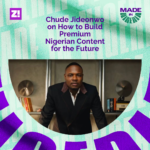
  • For over 25 years, Chude Jideonwo has been at the vanguard of Nigerian media. As a teenager, he published his first novel, His Father’s Knickers. He went on to work on talk shows like Celebrating Jesus (MBI), Inside Out with Agatha, and Funmi Iyanda’s New Dawn.

    With his friend Adebola Williams, he launched Red Media Group, the parent company of brands like YNaija, Red Media Africa, The Future Awards Africa, and StateCraft. After surviving a period of depression, he stepped away from his full-time role leading Red Media and later started his show, #WithChude. Joke Silva, Funke Akindele, and Onyeka Onwenu have all been guests. Subscribers pay $9 a month. #WithChude is now under Joy Inc., the company he founded to build “happier, flourishing young Africans.”

    On Sunday, he will host #WithChude Live, a live version of the podcast. Guests include Akindele, author Chimamanda Ngozi Adichie, pastor Jerry Eze, the comedian Bovi, and rapper Falz.

    In this week’s #MadeinNigeria, he opens up on why he is doing #WithChude Live, the roots of anti-introspection in Nigerian culture, YNaija’s relaunch (next year), and the future of Nigerian media.


    This interview has been edited for clarity and length.

    Why is this live show, #WithChude Live, important?

    There’s a way poverty takes quirks and makes them ugly, and that has happened to the culture in Nigeria. I never blame victims of a system for what they’ve become because of that system. We have an entire culture that sometimes feels airless — no space to breathe, exhale, or rest — it’s all about the hustle, all about “all die na die” and survivalist ideologies.

    It’s understandable, but it’s cooking us as a people; we need cultural interventions that allow us to breathe and see ourselves differently — that’s the point of my work with Joy Inc. and #WithChude. How do we fall in love with ourselves, even if we’re noisy, loud, brash, or hustling?

    Nigeria’s cultural landscape has lacked that kind of emotional connection, and that’s part of the outcomes I hope for with the work that I do. Over the past few years, Nigeria has had an intense gist culture — and there’s nothing wrong with gist or emotional revelations, but the difference is in how we do it.

    On #WithChude, we don’t bully our guests into revelations; we try to present the best version of people, even breaking journalism conventions to ensure guests only answer personal questions if they’re comfortable. All of these things bring a gentler tone to our shared reality, and with #WithChude Live, I want to blow that up to the biggest size. There are many important things happening politically, but let’s also let something beautiful — not just escapism, but something deeper — capture our attention.

    I want us to have events about our minds, hearts, and spirits — about wellness and wholeness — where celebrities come, not to talk about beefs, but about emotional health, spiritual life, and overcoming adversity. These conversations often happen in Europe, America, and Cape Town — but we deserve them too; we are humans in the same world. We deserve to have those experiences and to see ourselves in that light.

    This is just a small contribution toward shaping the culture into something more wholesome.

    Has anti-intellectualism stifled the conversations we have? Why are we here?

    There’s anti-intellectualism, which I sometimes call the “abeg-abeg” culture, or the “it’s not that deep” culture. But there’s also anti-introspection. And I think it’s a consequence of poverty — a scarcity mentality — where people believe, with good reason, that the ultimate aspiration is to get as much money and power as possible.

    Poverty breeds poverty; economic poverty often brings poverty of thinking. People don’t give themselves the space to feel, to reflect, to respond. Someone once said, “I’ve never seen my mother cry. Any time she’s about to, she holds it back.” That’s not strength — that’s performance, because it’s human to cry. Hillary Clinton and Barack Obama have cried in public, and when someone sees tears as weakness, it shows the performance culture we’ve adopted. One of my guests told me, “In Nigeria, everyone is running for their lives. If you fall down and don’t get up quickly, people will step on you.”

    You don’t need to be rich to experience the beautiful emotions of life; in fact, if you have nothing else, that’s when you should reach for what money can’t buy. When people say poor people can’t be happy, I say that’s not true: a man can love his wife even if he’s poor; a sister can trust her brother even in poverty. Emotions don’t depend on physical reality — emotions are in our control.

    People are dying of cancer and still find meaning in their suffering. But because of the survival mentality, most of us don’t know there are options — that we can live with grace, with dignity, that we can find meaning in our journey.

    Spirituality is supposed to help us, but poverty has infected our spirituality too, so even our spirituality now enables the hustle. We don’t know there are other ways to live this life. The conditions haven’t been created to allow that kind of message to thrive.

    That’s why I feel it’s the responsibility of people like myself — people who believe others should know these things — to sell the message, and hope people will buy it.

    Is the audience ready to buy this message?

    I always remind people — I’m a co-founder of a successful group of media companies. If money were the thing I wanted to focus on, I would’ve continued being the CEO of the Red Media Group.

    But something shifted for me. #WithChude comes from my own personal experiences — dealing with depression and everything I learned through that process. So for me, there’s a sense of mission. There’s a reason I’m doing this. And because of that, I want it to succeed.

    If you can spend ₦50,000 to drink fake wine at a club for one night — which will wear off in one day — you can spend $9 to watch something that affirms your spirit for a month. That’s what I want people to realise: this is just as important, if not more important, than that.

    And if I fail at this? That’s okay too. Because I tried.

    My show was inspired by an interview Oprah did with Brené Brown. Oprah is doing her work in America, and it inspired a young person in Nigeria. In the same way, Ken Saro-Wiwa — and I’m not comparing myself to him — can lose his life in the pursuit of something meaningful, and that leads to the Ogoni cleanup 20 years later. One thing I learned from Barack Obama is this: our job is to do what we most believe needs to be done and then pass the baton whether it succeeds or not.

    In my case, I’m lucky. #WithChude is a viral success. People are buying tickets for #WithChude Live. But I would’ve been just as comfortable trying and failing. Because I believe it’s important. A conversation that will change your life is worth the investment.


    Get More Zikoko Goodness in Your Mail

    Subscribe to our newsletters and never miss any of the action

    ALSO READ: Akinola Davies Jr. on How to Make a Successful Arthouse Nollywood Film


    You tweeted that Governor Babajide Sanwo-Olu of Lagos would attend the event. Why was that important?

    We had a whole call about it. Should I post this? And then I thought, “Why are we even having this conversation?” Of course, people are going to criticise me. But we went ahead, because for me, my sense of mission is more important than political noise.

    I’ve been doing #WithChude for five years now, and very deliberately, I haven’t invited politicians on my show. It’s not that I don’t have access — I have relationships. I’m literally one degree away from almost any political official in this country. But I chose not to invite them. Why? Because politicians are rarely vulnerable. And if you’re not going to be vulnerable, I don’t need you on my show. I’m trying to do something important. If you’re not ready to participate in that honest exchange, then there’s no need.

    That said, politicians do watch the show. They text me after episodes — “This inspired me,” or “That really touched me.” And it’s the same thing happening with #WithChude Live.

    Now, Governor Sanwo-Olu wasn’t a guest on the platform. But he is a part of the show. It says something when the most powerful person in the most populous city in Black Africa takes a show about the mind, the heart, and the spirit seriously.

    That matters — especially to young people who see power as the ultimate aspiration. If they see someone that powerful taking this work seriously, it tells them, maybe this is worth paying attention to. So to me, that long-term message is more important than the short-term backlash from people saying, “He shouldn’t have been there because of X, Y, or Z.” As long as I’m not compromising on my mission, it’s worth it.

    You’ve had very strong friendships over the years. How do you handle and sustain them?

    The easiest hack to forgiving others is knowing that you also need to be forgiven. Once you recognise your own irrationality, it becomes easier to extend grace to someone else. Because you know, they would have forgiven you, too, at some point. 

    I’ve learnt that I’m not a perfect person. That should be obvious, but it isn’t because we look at life through the lens of our own experience. Once I made that mental switch, my friendships became so much easier. I always say this: I haven’t quarrelled with a friend in over five years. Have we had hard conversations? Absolutely. Sometimes I’ve said, “I didn’t like what you did,” or “This hurt me.” But it never escalated into conflict.

    That’s partly because I now prioritise peace. I’ve learned to value it. And also because I’ve become very comfortable with myself. I realised that the most important relationship I’ll ever have is the one I have with myself. So, I don’t depend on anyone else for my emotional well-being. One of my idols, Iyanla Vanzant, said, “Whatever it is you’re bringing to me, I’m blessed to have it—and I’m sufficient if I don’t.”

    The second part is accepting that I’m flawed. I make mistakes. And if I want grace extended to me, I must extend it to others. That’s what a loving relationship is — a flow of forgiveness, of empathy, of understanding.

    Also, I’m an introvert. I have limited emotional energy — and no desire to increase it. It’s actually strategic for me to maintain my relationships, because I have no intention of making new friends. So it’s in my best interest to hold on to the good ones.

    I’ve also never experienced betrayal from my close friends. Not once in over 20 years. I’ve never said something to a friend and heard it repeated outside. And that means everything to me. If you talk about your friend in public and then go back to being friends, I don’t understand that. To me, a friendship without trust isn’t a friendship.

    What does your relationship with your mother mean to you?

    My mother is tailor-made for me. If I didnt love my mother, I wouldn’t talk about her. I don’t do that performance people do. My mother has been a pastor with Mountain of Fire and Miracles Ministries since I was around 21 or 22. But when I turned 18, she said to me, “You’re old enough now to choose your own church. I want you to go to MFM, but you should choose your own church.” That moment was massive. One of the reasons I still have faith today is because my mother allowed me to find it for myself. She didn’t impose it. She gave me space to explore and choose.

    When I was 15, I wanted to study Mass Comm. She sat me down and said, “I think you should study law — but of course, I won’t force you.” And then she explained: “If you study journalism, you can’t practice law. But if you study law, you can still practice journalism. Why not give yourself more options?” It was such a reasonable and strategic argument. That’s why I chose law.

    There’s another moment I’ve never forgotten. I was about 7 years old. My mother called me and said, “I’m going through a really difficult time in this marriage. But I will not leave — because you are such a sensitive child. And if I leave you for another person to raise you, they’ll break you.” She made it clear she wasn’t staying for appearances or tradition. She stayed because of me. That kind of love — sacrificial, intentional — it stays with you forever.

    That’s the kind of relationship I have with my mother. There are no secrets between us. Even when we disagree — and we do disagree, especially on the Bible — I trust her completely. I remember once, as a child, I did something she considered shameful. She caught me. I could have lied my way out of it, but I didn’t. I thought to myself: if there’s anyone in the world who would still love me after this, it’s my mother. Why lie to the one person who loves you the most?

    She means so much to me.

    What would you say to someone who has no faith?

    I think that’s completely fine. My book, How Depression Saved My Life, will be published by Narrative Landscape in August; it’s a memoir and essay collection that proposes a particular Africa-centred philosophy of the world.

    There’s a chapter called “Spiritual” that explains this in detail, but I’ll summarise it: if you really read the Bible (which I have, cover to cover, twice), you notice something — you don’t need to find God for God to find you. Samuel just heard a voice at home; Moses was a murderer and fugitive who found God while walking — meaning all the performance (preaching, coercing) is often a misreading of faith, because Jesus said if people aren’t interested, move on.

    If you truly believe in the power of your God, you won’t panic when someone says “I’m not interested”; you’ll trust that God can find anyone, in their own time, in their own way. In 2016, during a period of deep depression, I wanted to become an atheist — I read Why God Is Not Great, The Australian Book of Atheism, and more — but by the end, I found God. I met an experience that went beyond logic, that I love and connect with, and even while honouring the brilliance of atheism and agnosticism, I have faith; both things can exist at once.

    What happened with YNaija?

    I tell people that the YNaija franchise began vertical culture in media in Nigeria because, at some point, YNaija was the mother brand, inspired directly by Gawker.

    We had Tech Africa for tech, Enterprise54 for business, The September Standard for fashion, and TeenY for teenagers, but I lost my nerve.

    I was doing something so original that I didn’t have models for it, we didn’t have funding, advertisers didn’t understand it, and I felt like this crazy idea nobody cared about, not realising I was pioneering a model the market was about to respond to.

    The media content business was dragging the profitability of the group, and an incident — when I published a controversial article for open debate and got backlash — made our clients call and created internal doubts about my leadership.

    At some point, I lost my nerve, thinking the culture wasn’t ready and I was prizing my desire to build a complex brand over success, and I always tell young people: don’t assume the people before you know what they’re doing — listen to your gut after examining the data.

    If I were going back, I’d have had the confidence to know I was building something beautiful, but the focus on Red Media Africa, StateCraft, and The Future Awards had its benefits: Red is a top PR company, StateCraft works with development organisations like UNDP, and The Future Awards remains the premier youth recognition platform.

    Now, there’s a CEO of YNaija, my former assistant Abiola Williams, doing a great job, and we’re in a two-year-long reinvention of the brand that will be unveiled next year — taking our time to find YNaija’s unique place in the culture, building out a team, and returning to take our place without me, because I have other priorities.

    The news media business is moving away from advertising to audiences paying for subscriptions and event tickets. What do you think?

     I think it’s beautiful — and it’s exactly what I’m doing with my brand. When I was talking to my promoters — and I’m very grateful to them for investing — they suggested I reach out to my sponsors, since I have a wide network. But I said no. That would make us lazy. If I get a sponsor to fund it, I won’t understand how to connect with the audience. I won’t learn how to sell to them. I won’t build a deep connection. We’d be obese with money and dependent on sponsors forever.

    We have already had thousands of subscribers for #WithChude for years— an audience we discovered and nurtured over the years. If you find a way to speak to the audience, they will respond. Maybe we get it right, maybe we get it wrong, but this is the future of media: speaking directly to people.

    If sponsors want to come, fine. But our energy must go into getting people to buy those ₦20,000, ₦50,000, ₦150,000 tickets. That’s what I want to pioneer. That’s what we are pioneering. There is a real market. We talk too much about Vice, BuzzFeed, Vox, and Call Her Daddy — and too little about Instablog, Tunde Ednut, Linda Ikeji, and Funke Akindele.

    Instablog is a legitimate media institution. They may not describe it in fancy terms, but just because they don’t sit at conferences explaining complex business models doesn’t mean they don’t have one. We haven’t spent enough time in Nigeria understanding how the audience decides. But year after year, Kayode Kadum, Toyin Ibrahim, Jade Osiberu do it for films.

    The Nigerian audience is difficult — it’s easy to give up. But if you don’t, there are great rewards.

    Where do you see yourself in five years?

    My campaign hashtag for the year is Oprah’s first son, because Oprah isn’t just a billionaire or media icon, she’s a spiritual icon whose sense of mission inspires me deeply.

    I want to create an army of independent content creators across Africa and the world — not telling African stories to the world, but for Africans, for people who want to stay in Mombasa, Malindi, Hermanus, Burkina Faso, and tell native stories to each other.

    Over the next five years, I’m collaborating with creators to build an independent media model that tells organic African stories, and we’ve already partnered with CcHub in Nigeria and Kenya, with work expanding to Senegal, Mali, and Burkina Faso.

    It’s hard to crack the African content market, but I believe independent creators can do it, and I’m putting my money where my mouth is by investing in content from across the continent.


    ALSO READ: This is How Fisayo Fosudo Makes His YouTube Videos

    Get More Zikoko Goodness in Your Mail

    Subscribe to our newsletters and never miss any of the action
    [ad]

  • Akinola Davies Jr. will be the first to admit it — he was late to the party.

    After working shifts at call centres and bars in the UK, he started assisting photographers, artists, and filmmakers at the age of 26. Starting late meant there was a lot of catching up to do. So, he became indispensable. He made himself reliable. He worked hard.

    In the beginning, he shared the work he helped make on his blog. But one of the creatives he was assisting saw the site and pulled him aside: “These aren’t your images,” they said. It was a turning point. From that moment on, Davies committed to making his own work. First came the opportunity to direct a music video, then more followed.

    Then came the pandemic — and with it, Lizard. A short film he directed, inspired by his childhood in Nigeria, Lizard was released in 2020 and quickly made waves. In 2021, it won the Grand Jury Prize for Short Film at the Sundance Film Festival, launching Davies into the global spotlight. That same year, it was nominated for the Best British Short Film at the British Academy of Film and Television Arts (BAFTA) Awards.

    Now, his first feature film, My Father’s Shadow, written by his elder brother, Wale Davies (one half of the rap duo Show Dem Camp), is one of the Cannes Film Festival’s Un Certain Regard official selections, the first for a Nigerian film at the festival. It follows two sons who spend a day with their estranged father as Nigeria conducts its first democratic election after years of military rule in 1993. Sope Dirisu, the British-Nigerian actor famous for Gangs of London, plays the lead.

    In this week’s #MadeinNigeria, he opens up his secret for making successful arthouse films, why he calls himself a Nollywood filmmaker and what being selected for Cannes means for the future of Nigerian films.


    This interview has been edited for clarity and length.

    Why did you decide to make My Father’s Shadow?

    The genesis of how it came together was that my brother and I made a short film called Lizard in 2020, just before the pandemic. We were in lockdown when it went to Sundance, and it ended up winning an award. We knew we had a good film, but we didn’t know how well it would do.

    When the time came to choose a feature-length project, I decided it had to be quite meaningful because I always approach things like they’re the last thing I’ll make. I want to create things with a sense of urgency. My brother Wale had already written it as a short story, which eventually became the feature-length script—In My Father’s Shadow—about two boys spending the day with their estranged father. 

    We were unfortunate enough to lose our father quite early on. I was 20 months old, just shy of my second birthday, and Wale must have been four or five. It was this question that resonated with us: like, if we could spend a day with him, what would that entail? What would that relationship be like? How would we respond to him?

    So a lot of our interests—even similar to Lizard—come from the psychology of what it is to be a Nigerian child, or even just an African child. A lot of the things that are maybe a bit more permissible in Europe or America—in terms of psychology, or how children are treated, or dealing with trauma or grief, or even just being on the spectrum, or having special needs—are things that I’m quite obsessed with, and my brother has an interest in too.

    A lot of the work we think of or hope to make is just to be in service to our community.

    When did you start to think of yourself as a storyteller?

    Not till fairly recently—somewhere in the last nine years. I used to assist documentary and fashion photographers, some filmmakers too. I was like a camera operator, assistant producer, or doing production design, even helping out with the costume team. So I wasn’t necessarily anticipating that I’d become a director. I just wanted to work in film, but not necessarily in a role I was familiar with.

    I guess from working with those creatives—watching their process, understanding what they do, what it’s like to be on set, speaking to clients, coming up with ideas, being collaborative—I just saw that, yeah, I can do this. I’m Nigerian, and part of our fabric is to be sociable. To engage with people and just be really communicative.

    After a while, with the main people I used to assist, my voice started to grow louder. I became more vocal about what I thought we should be doing creatively. And I think, at that point, they just got fed up with this kid always trying to tell everybody what they should do. So they kind of encouraged me to go and try to make some stuff of my own.

    I would put the work I’d made with them on my blog at the time. And I remember one of them seeing it and saying, “Realistically, that’s not your work. You were definitely part of the production, and you get a credit, but it’s a bit disingenuous to be putting that on your blog or website as your own. You should make your own stuff, and that way you can stand by it.”

    That was around 2015, 2016, and that was when I realised I had the means to tell stories. I made a video for a Nigerian artist based in the UK at the time. I made her a sort of music video-type film, and from then on I just started getting more and more recommendations. The backend of creating that bit of work helped me realise that this is something I can actually do. And the way I pulled people together to make it happen made me say, yeah, I could probably be a director.

    I didn’t start doing anything film-related until I was like 26. I used to work in service, in bars. I worked in retail, call centres—just trying to make ends meet. I didn’t start my journey assisting until I was 26, at which point I already assumed I was pretty late to the game.

    I was very focused. Whenever I’d assist someone, I’d end up becoming their main assistant because I knew I was late to the party. I was just really diligent about the work, and I made sure I was dependable. I didn’t really make excuses. Whatever they needed, I’d move hell or high water to be there.

    How did you receive the comment from that person that you shouldn’t put their work on your blog?

    At the time, I was a bit shocked because I obviously knew I was involved in those productions. That particular person—I mean, we didn’t really delegate roles as such, but he definitely came up with the idea. He was definitely the director. He edited it. I was just more like his assistant, just kind of helping him out. So I thought it was fine to put all those things on my website.

    He said it in the nicest way possible, but he was just kind of like, “It’s really my work. Because if people see it and they don’t go and read the details of what it is, they might just assume it’s yours. So it’s a bit disingenuous.”

    And I get it. I understand how people should be credited for their work. I agreed with him. But obviously, it pained me a bit—because I was like, if I remove all this stuff from my site, I’m not gonna have anything there. So like, 100%, it hurt my ego. 

    But it motivated me to go and make my own work. Because it’s very easy to hide behind somebody else’s work and say it’s yours, even though you’re a collaborator. But ultimately, the person coming up with the work, putting themselves out there, coming up with the creative—that’s really the owner.

    It wasn’t my favourite conversation. But it helped in the end.

    What’s In My Father’s Shadow about?

    I can’t tell you what it’s about because it’s not out yet. But it’s ultimately about two young boys who spend a day with their father. He takes them on a day trip to Lagos, and they witness him dealing with life, trying to navigate things as an adult in that moment in time. There’s the aftermath of an election, and he has to get them back home.

    It’s a story about nationhood, fatherhood, grief, and promises that were never delivered on. But it’s also about motherhood—because the way our fathers are positioned in our lives often comes from the commitment and steadfastness of our mothers.

    It’s just a family film.

    How does this film interrogate the father-son dynamic?

    Ultimately, we just wanted to try and create the most honest portrayal of what it means to be a Nigerian man, especially in this period of time. Obviously, our character is this father figure, but we’re not trying to paint a perfect image of him. I don’t think anyone is perfect.

    You grow up as a kid thinking your parents have all the answers, but realistically, they’re just kids who’ve grown up as well. They make a lot of mistakes. They’re insecure. They don’t necessarily have all the answers. They’re also a product of their parents—their nurture determines how they nurture you, and how you’ll nurture your own children. All those things are connected.

    I think being human is complex. Being Nigerian is even more complex. We’re not necessarily trying to glorify fatherhood—we’re just trying to give the audience an honest portrayal of a character within a story. It’s semi-autobiographical, but there’s a lot of creative license there. It’s not a like-for-like depiction of my father.

    Being a man, especially coming from a traditional patriarchal society, might seem one-dimensional, but there are multiple dimensions to it. Even though Nigeria is quite patriarchal, my mother ran the household. At every gathering I went to, my aunt ran the household. The male presence was kind of authoritative, but also just in the background. I just hope that my film encompasses all of that.


    Get More Zikoko Goodness in Your Mail

    Subscribe to our newsletters and never miss any of the action
    ALSO READ: CJ Obasi on What he Really Thinks of Nollywood


    What does it mean to be a man in the ’90s?

    I can try to describe it within the context of the film. In 1993, Nigeria was in the throes of one of its first democratic elections at that point in time. And I think there was a lot of excitement—people who loved their country probably thought this was going to be the catalyst for real change.

    In the context of our film, it’s just a working-class man trying to do the best for his family, but also anticipating that change will come—that it will provide him with the kind of infrastructure he needs to continue doing better for them.

    Obviously, I wasn’t a man then, but I know that even now, being a man in Nigeria means you have to jump through a lot of hoops. For better or worse, the country is the way it is, and there’s just a lot of bureaucracy and systems in place that maybe seem a lot simpler in other environments.

    Why is this film selected for the Cannes Film Festival important?

    No one has seen the film yet, but when everybody does, they can answer that question for me. In the interim, what I will say is that it kind of contextualises the fact that our stories are important. We’re a country of multiple ethnic groups, and there’s something of interest in every corner of that. It kind of validates that.

    As a filmmaker, I’ve spent much of my adulthood in the UK, and I could’ve gone down the route of telling Nigerian stories in the UK. But my first priority is telling stories about Nigeria and making work that reflects Nigeria. Because when I met people from around the world, they all wanted to come to Nigeria. They’ve all heard of Nigeria. And I’m like, “Nigeria is one of the most chaotic places in the world!” But I don’t want to romanticise it—it’s just what makes us unique. We create in the chaos.

    Against all odds, people are creating—and that’s far deeper in our DNA. We are storytellers. We’re creative people, artisans, nurturers. We come from very astute, important cultures. I just feel like a lot of those stories have not been projected to the world in the way I’d like to see them. I want to keep those stories not just arthouse-oriented, but authentic to who we are.

    I just hope it lets people know that our stories are important. It’s crucial to find a way to tell those stories that doesn’t rely on stereotypes or outsiders coming to tell them for us.

    What was working with Sope Dirisu like?

    I saw Sope in a movie called His House—it’s on Netflix. It’s made by a director named Remi Weekes. It’s a really incredible film about the psychosis that happens through forced migration. I didn’t even know Sope was Nigerian when I saw the film—I just thought his performance was incredible.

    I remember seeing Sope in a stage play years ago, and I just loved that play. Sope played Muhammad Ali. It used to be on my Instagram. It was one of the most electrifying theatre performances I had seen because it was all Black actors. They made a film out of it called One Night in Miami. When it came time to think of casting for our film, we were considering a lot of the guys we’ve seen in Nigerian movies.

    I think Gangs of London had just started, and I remember sending his picture to my brother and saying, “I think this is our guy.” We needed someone who could embody a particular stature, strength and sensibility—just from the way they carry themselves—and Sope was the guy.

    I can’t give him enough credit because I haven’t made a feature film before. My idea was that I’d tell him what to do, he’d act, and everything would go well. But while making the film, I took in a lot of information and spoke to people all the time. I didn’t get to spend as much time with the cast as I had anticipated. Sope was acting with leads who hadn’t acted before, but every time I looked, he was literally fathering those boys, giving them advice, encouraging them. He was just being a father to them, which is not what I had anticipated.

    Is this a Nigerian film?

    When you see it, you’ll be able to tell me if it’s a Nigerian film. I mean, it’s shot in Lagos and Ibadan. Half of the film is in English, the other half is in Pidgin and Yoruba. About 80% of the crew are Nigerians working in Nollywood or making music videos. I’m Nigerian. I grew up in Nigeria until I was 13. I have a Nigerian passport. My brother’s Show Dem Camp is in Nigeria. He works and lives there. He wrote the film.

    If you ask me, “Is it a Nigerian film?” I’ll say unequivocally, it can’t be anything but a Nigerian film. But if you’re asking me if the finances determine where the film is from, then 100%, we have people who believe in me as a storyteller, as someone who can communicate emotion and feeling onto the screen. They invested in me to tell the stories I want to tell.

    That’s just the makeup of the films we watch. Whether you’re watching The Boy Who Harnessed the Wind, Black Panther, or Mati Diop’s Atlantics, the way films are financed is international. And if Nigeria wants to consider itself part of an international community, that’s how some films might get financed. The process of filmmaking is collaborative, both in the actual act of filmmaking and in financing and development.

    I’m sure there are better filmmakers than me in Chad, the Central African Republic, or Gabon who could probably tell better stories than I can. But if you’re not in a position to exploit the privileges that life has presented you with to make what you want to make, not many people might end up seeing that. So I’m really grateful to our collaborators.

    Do you consider yourself a Nollywood filmmaker?

    I do, quite honestly. Because Nollywood exists, that’s the delusion that gives me the right to believe I can be a filmmaker. If I’d never seen anybody from where I’m from make a film, it might have been harder to conceive the idea of making a film myself. 80% of our crew works in Nollywood on a daily basis.

    We might not be considered the localised Nollywood, but I still feel like the arthouse film we’re making is similar to Eyimofe or Mami Wata (even though he doesn’t agree that he is a Nollywood filmmaker). We’re making arthouse Nollywood, and that doesn’t take away from what Nollywood is. I can’t borrow all the collaborators and then say, “This is not Nollywood.”

    How does one make a Nigerian film that travels?

    I can only talk about my own circumstances, which are unique to me. I have dual citizenship, so I have access to film funds and support, which, granted, might be different for others in Nigeria. Not everyone is on the same level playing field in film. But I think the foundation of everything comes from writing. If you’re a good writer, then there’s a chance to make a good short film, a good long-form, and a good TV show. Everyone needs to be ambitious in terms of their hopes and dreams. If you get through the quagmire of writing a good story and believe it can be shot, then you need to approach a production company like Fatherland. If they take a chance on you, you get the moment. Once you start getting money from people, you have to entertain their opinions. In some instances, maybe you just have to make that thing to be able to make the next thing. But it’s been really collaborative. 

    And I’ll say there needs to be a certain understanding of what film festivals can do. I was like, “I just want to put Lizard on YouTube.” But my producer was like, “We’re not going to do that. We’re going to go the film festival route because that will put you in front of other producers and companies interested in films for cinema purposes.” There’s content creation, and then there’s cinema. People need to understand where their work fits. If I just put it on YouTube, it’s considered content creation.

    You also have to study your industry and know who does what. I’ll give you an example. Potboiler Productions made Lizard, and Potboiler made Half of a Yellow Sun. I only worked with Potboiler because they made Half of a Yellow Sun. I knew they had experience working with Nigerian filmmakers. Element Pictures hadn’t worked in Nigeria, but my producer, who made Lizard, Rachel Dargavel, had gone to Element, so it made sense to go with them. They had more resources, and they believed in her, and they really believed in what we were trying to do. She’s been to Nigeria.

    I don’t want to bring Europeans who come to Nigeria with a sense of entitlement. I want someone who will work with us as equals and see our stories as just as important as any other story.

    Does arthouse film have a future in Nigerian cinema?

    I watched a Nigerian film at Berlinale two years ago, and the number of people who went to see that film was incredible. It was a fairly controversial topic in Nigeria—about two guys potentially falling in love. The film is called All the Colours of the World Are Between Black and White. I’d say that is super arthouse—very minimal, self-contained. I don’t know how they shot it in Nigeria, but the number of people who came to watch it was amazing.

    I’d say that, just on that basis alone, arthouse cinema has a massive future in Nigeria. The difference between arthouse and commercial is that arthouse leans more into the art, trying to do something above your station. I’m not saying commercial films can’t do that, but commercial films tend to try to fit the needs of the status quo, whereas arthouse leans into the sentiment of what the artist is trying to convey. And in the Nigerian population, there are millions of artists.

    How do you direct a film?

    I want everybody to enjoy what they’re making and feel like they have the opportunity to voice their opinions, because I believe two heads are better than one. Also, as a man, I might not always see things from a woman’s point of view, so I really welcome everyone’s opinions to create a more rounded, fuller story. I’m very collaborative.

    I try to take the burden of pressure off people by creating an environment that’s jovial and light-hearted. We’re not performing brain surgery; we’re telling stories, and I think we should enjoy the process. If people are enjoying what they’re making, it will show in the work. It’s all about being encouraging and finding middle ground.

    There are things you want, but maybe the costume design hasn’t provided that yet, and you have to problem-solve. Being a director is about problem-solving. Some people find shouting effective; I don’t. I’ve never been in an environment where shouting brings out the best in people—it only creates fear.

    I believe I’m emotionally intelligent enough to understand when someone is struggling. I try to put my arm around them and figure out how to alleviate some of their feelings. That might come from my experience as an assistant. I’m very aware of my collaborators, their limitations, and what they’re dealing with. I still push them when I can, but I’m also realistic about what we’re trying to achieve.

    There’s a saying that if you write a script and you manage to get 50% of what you’ve written on the screen, that’s a success. I’m just trying to get that percentage higher and higher by being a soft dad, a supportive presence, knowing when to push and when to berate people if necessary. It’s all about being attentive to the needs of everyone you’re collaborating with.

    What do you mean by berate people?

    Sometimes, you have to really push people. I’m not someone who shouts all the time, but sometimes you need people to focus. If you set a precedent where everything is too cordial or jovial, it might come back to bite you.

    One day, we were shooting on the beach in Tarkwa Bay. It was a hard day to shoot because, obviously, there’s no shade at Tarkwa, and we were trying to shoot some scenes in the water, but the waves were crashing, and it was a stressful situation. I was feeling a bit disheartened, and the crew was enjoying themselves a little too much. I was like, “Guys, we’re not getting our stuff together. We think we’re just on a jolly at the beach here.” I was frustrated.

    Afterwards, I spoke to the producers and said, “It’s not working.” And my producer just said, “Sometimes it’s not going to work. Let’s shoot the way you want to shoot, just to be safe.” By the end of the day, we got everything we needed, but I was still upset. The next day, I had to push everyone. I remember a scene where my cameraman, a poor Jamaican guy, was running on sand, and I could see how exhausted he was. But I said, “Let’s go again.” They were like, “We’ve got it,” but I was like, “No, let’s go again. We need to get the energy back up.”

    I don’t want us to feel like we’re just having fun, forgetting that we’re here for a purpose. I don’t shout at anyone, but sometimes you have to have those tough conversations. That’s what I mean by berating people.

    How do you create?

    I consume a lot of content from the internet. When I’m reading the script, I can tell you exactly what I see. When I’m moodboarding for a scene or doing the treatment, I’m always collecting images—folders and folders of images. It’s like when I’m making a music video, I’ll just listen to the music and go through the folder, thinking, “This image, this image.” And then I’ll make an edit, another edit, and I’ll say, “This best fits the mood of what I’m trying to create.”

    With features, it’s a bit different because I’m working with other people, so there’s a collaborative element to it. But it’s also just being observational. I’m very observational. We were doing a recce one day, looking at a location, and there was this guy playing with a puppet. And I said, “This guy has to be in the film. He just has to.” I couldn’t really tell you why, but we dressed him up, and he ended up being perfect for the scene.

    I love nature and observing nature in Nigeria. There’s a scene in the film where they show logs being transported from the Lagoon to Makoko, and one day we just pulled up, and there were a lot of kids jumping into the water. I was like, “Guys, we need to film that.” That’s why I love Nigeria and Lagos—everything is cinematic for me.

    I just like to watch. I’m just so curious. I just want to know. My camera doesn’t need to do somersaults to be creative. I just point at something. The fact that I’m showing you that thing means I’m giving you a sense of levity. It might not be an important shot, but it might just be something subconscious that the viewer picks up on. Music is also a crucial thing for me. I’m obsessed with manipulating people’s emotions through sound design and music. That’s like my kink—if I had one. I just want you to watch the film and feel it in your body.

    What’s your favourite Nollywood movie of all time?

    Lionheart. It might sound like a cop-out, but I absolutely love Genevieve Nnaji. I love Lionheart. I also enjoy films like Osofia in London. I think Lionheart is special because, ultimately, it was a big moment for Nigerian cinema—it was going to be Nigeria’s entry into the Oscars. I watched it, and it’s a good story, not set in Lagos, dealing with family dynamics. If I had to pick, I’d say Lionheart. I’d love to collaborate with Genevieve one day.

    Where do you see yourself in five years?

    I just want to continue in my craft, doing what I love, and continue putting out work. Whatever is in God’s plan is where I’ll be in five years. I hope to be with my loved ones, collaborating with the people I’m collaborating with, and telling more Nigerian stories.


    Get More Zikoko Goodness in Your Mail

    Subscribe to our newsletters and never miss any of the action
    ALSO READ: Bisi Alimi on How to Tell Queer Nigerian Stories in Nollywood

    [ad]

  • Twenty-one years ago, Bisi Alimi came out as a gay man on national television. The backlash was intense. A rising career in Nollywood was abruptly cut short, and he became a pariah. In the years that followed, he wielded the attention from that backlash to bring visibility to the plight of queer people in Nigeria.

    In 2025, Alimi is still doing the work. He has launched a production company, Vengiance Production Studio, driven by a desire to seek justice for what happened to him. Their first project, a short film titled Shall We Meet Tonight, is written and directed by Wapah Ezeigwe. Uzoamaka Onuoha is in it. Goodness Emmanuel plays the lead. Shall We Meet Tonight tells the story of two women who fall in love in southeastern Nigeria and must make a difficult choice.

     In this week’s #MadeinNigeria, he opens up on making good trouble, why he advocates for queer rights and why he has no interest in telling stories “where everybody is shouting and screaming at each other.”


    This interview has been edited for clarity and length.

    Why are you telling this story?

    There are three reasons why I’m telling this story. The first — and I say this unapologetically — is about the money. And what do I mean by that? Over the last five or six years, I’ve taken the time to really study Nollywood — and not just Nollywood, but the African film industry as a whole. I’ve looked at its market share in the global cinematic landscape, and one thing is clear: queer content is missing.

    When I compare that to Western film industries — from Brokeback Mountain to Paris Is Burning, Priscilla, Queen of the Desert, and many others — it’s striking. These films are not only critically acclaimed, they’re also commercially successful. Then you look at streaming platforms and the global reach of queer content — it makes me wonder: are we missing a major opportunity in Nigeria by ignoring queer stories? And if there is a market for it here, what would that look like? Who is the audience?

    Through my research, I’ve seen just how untapped this space is. There’s a curiosity about queer African stories — both within and outside the continent — that no one’s really talking about. But when you see how these stories are welcomed at international film festivals, it becomes clear: now is the time to start telling them.

    The second reason is representation. For me, it’s incredibly powerful. That idea of if I can see it, I can be it — it means everything. In a world where your existence isn’t reflected, all you can do is imagine yourself into being. But when you see people like you — on screen, in stories, living and loving and being — it’s magical.

    And the third reason? Four years ago, I watched a film called Country Love by Wapah Ezeigwe, and I absolutely loved it. I made a mental note then: if I ever had my own production company, I’d want to work with him. So when I started working on Vengiance, I didn’t look back. I reached out to him and asked if he had a story. He gave us a feature-length script, but we could only raise enough money for a short — and that’s what we produced.

    It is a love story and not as tragic as we see with queer stories from Nigeria. Was that intentional?

    It was very intentional. It’s so easy to equate queer stories with sad stories — and honestly, it works. Globally, there’s a narrative that African queerness is always rooted in tragedy and trauma. But that road is not for me.

    I grew up in Lagos. Of course, I’ve had my fair share of sadness, but I’ve also experienced love — deep, joyful love. I fell in love in Lagos. I was in a relationship for four years before I travelled. I have friends who’ve been in relationships for eight years or more. They live together, they’re happy together. Sometimes, their families know and support them.

    But we don’t tell those stories. And that silence creates an illusion — the idea that this kind of love, this kind of life, only exists when you leave Nigeria. But it’s happening right here, under our noses.

    When we bought the script, the original story was set in Enugu in the 1980s. And we were very clear: we were going to shoot it in Enugu. That decision was intentional too — to ground it in a real Nigerian place and time, and to show that love has always existed here.

    How did you navigate not creating Nigerian queer stories through a Western lens?

    This film was funded by the British Council and the British Film Institute. But from the beginning, we were very assertive about the kind of story we wanted to tell.

    I feel incredibly lucky to have worked with a director and writer who has a strong sense of pride in his work. There’s so much Igbo language woven into the film — it was important to us to communicate our love, our culture, in our own words. It’s an Igbo love story, and we didn’t want to dilute that.

    When the film premiered at the BFI Festival, we were nervous. We didn’t know how people would receive it — if they’d understand it, or connect with it. But when it ended, there was non-stop clapping. In that moment, I knew we had done something special. You never really know what the world wants until you give them what you have.

    You say there is a demand for queer Nigerian stories. Where is it coming from?

    The demand is coming — especially from Nigerians who are looking for something alternative and want a broad spectrum of stories to be told. The demand is also coming from the international community that want to see the other side of Nigerian stories beyond the normative stories we tell.

    You’ll see the people that have really capitalised and made money from it are the South Africans. There is rarely any South African film that doesn’t have a gay character in it. They know that it sells. Even though it is annoying and can be caricatured, it is still there. It’s sad that the most lucrative film industry on the continent is so insular in a way that we still create content that starts and ends with Nigerians, and we don’t see the bigger market outside Nigeria.

    We are just 200 million people. Only 10 per cent of that will watch it. With the story that we tell, we can tap into the bigger market outside.


    Get More Zikoko Goodness in Your Mail

    Subscribe to our newsletters and never miss any of the action
    ALSO READ: This is How Fisayo Fosudo Makes His YouTube Videos


    The film is about two women and not two men, which would have angered Nigerians even more. Was that intentional?

    There have been films like Ìfé, and it was interesting how Nigerians reacted to Ìfé compared to stories that have two men. Nigerians have problems with two men falling in love with each other. I don’t understand it, but there is a fantasy around two women making out. For us, it was just that there are fewer stories of women in love than men, and we wanted to tell that story.

    I’m expecting an exciting reaction for the film when it has its Nigerian premiere in Nigeria. We’re hoping the reception will be great. What I think we should note in this film is that a woman made a choice — which Nigerians are not used to: women taking control of their lives. And I think this film is going to get the manosphere in Nigeria tied up in their knickers. If there’s anything I love doing, it’s annoying Nigerians.

    What is your production company Vengiance Production about?

    I started Vengiance because I started out in Nollywood myself, and that didn’t last long — because I came out on TV and my career ended immediately. I still have so many friends that continue to struggle to survive. They exist in a society that judges them by who they love rather than what they bring to the table. It reduces the potential of the average Nigerian to live up to their fullness.

    So we wanted to create a company that welcomed them. We are going to accept you as you are. This is also why we decided to make a production company that focuses on queer content.

    Nigeria is not our only focus. We have a script in development now from South Africa, for which we will work with a South African crew. Our next production is by a UK-Nigerian writer. We are looking at some French scripts. But at the core of the stories we tell is the queerness of the people involved in it. I was contacted by a friend of mine from BFI. They were going to Nigeria with the UK trade mission. The leader wanted to meet queer filmmakers, so I came to Lagos with them.

    We met with queer filmmakers, actors, and people who are interested in telling queer stories — and I gave BFI my recommendations, including the need for a bridge between the UK and Nigeria in talking about queer stories.

    Years later, I was just chatting with that friend and they wanted to know what the fruits of that meeting were. They said maybe I needed to start a production company. I spoke to a friend, and we started.

    I wanted it to be a kind of revenge on Nollywood, which is why I have the bastardised spelling — because it’s time to take back. I was kicked out of the industry. I’m still angry. It’s been 21 years. But I can do something productive with my anger.

    How can a young filmmaker without access get funding for a film?

    I’m not going to lie — access is important. Access is the difference between the person that succeeds and the one that fails. This is something I came to understand. I grew up in Mushin. Boys like me don’t have access. My father was a retired police officer. My mother was a cleaner. Nigeria is based on who you know — and class.

    I find it interesting when Nigerians are asked to share the secret to their wealth, and they say it’s Jesus Christ. That’s bullshit. Because they know that the deal they got, the opportunity, came because somebody believed that something would come out of it for everybody. The UK is different, because access is about what you can become — the possibilities. It still happens in the UK too, but to an extent, more people have opportunities.

    So I’ll say to someone trying to break free: broaden your network. Try to know people.

    How do you attain financial success with these stories?

    The financial success is not just for Vengiance — it’s for everybody. When we were paying cast and crew in Lagos, they were like, “This is huge money.” For me, it’s very important that the creative industry is not seen as a poverty industry, but as a business. You do that by making quality things.

    I don’t want to make a film where everybody is shouting and screaming at each other, then it goes to the box office and makes money. There’s a market for that — and the data shows it — but it’s not for me.

    You go to film festivals, and you win awards. The more visibility you get, the more you’re in talks with distributors. We are in talks with distributors in the UK to get the film on streaming platforms or sell it off. The more money we make, we’ll reinvest it into making more films.

    Many in Nollywood will say the Nigerian market is not ready for these types of films. Do you disagree with them?

    I disagree with that. This is the problem with Nigerians. The idea that Nigerians are lazy and lack the intellectual capacity to consume things is misguided. We are dogmatic, and there’s a lot of stereotyping that we do. We’re not really saying, “Let’s tickle the curiosity of the people and see how they’ll react to things.”

    I have friends in the UK, and they say if it’s not Nigerian food, they’re not interested. And I just tell them, “You know what? This is why you’re never going to grow. You ought to be curious. You won’t die from eating mashed potatoes, vegetables, and grilled salmon.” We need to train our curiosity. Art can open people’s minds.

    The first time might not work, but the second or third time could. One of the reasons Netflix left is that they were telling the same stories. The Yoruba epic ones are starting to feel like the typical Nollywood films. You watch the first episode and can predict what’s going to happen. It doesn’t tickle your curiosity the way a show like Money Heist does because you don’t know what’s going to happen next. Creators of art should be bold and shock the audience.

    What was producing this film like?

    The writer insisted that he would direct, and we agreed. He also told us who he wanted to act in it, and we had no problem with that. Then he said he wanted to shoot it in Anambra. But the UK government had issued a no-travel advisory for Anambra because of the unrest, so we had to look for the nearest state, which was Enugu. There’s so little you know about Nigeria in practical terms when you’ve lived in the UK.

    The film was set in the ’80s, but we couldn’t bring that element into the production due to the cost. However, we still wanted to carry some of those elements, which is why the cinematography isn’t contemporary. Everyone in the film is very good at what they do. We didn’t want to take any risks. We shot in four days, but editing took over six months. It was hard work because we were working with the British Film Council, which insisted on maintaining quality.

    Aside from film, what other projects are Vengiance working on?

    We are building the concept for our podcast, which will cover themes like lifestyle, love, relationships, and crime, with a focus on queerness across the continent. One of the projects we have, which will be my first as a director, is about queer crime in Nigeria, and it will shoot this year. We also have a story from South Africa that explores queer people growing old and feeling lonely.

    Our podcast will look at how queer people meet and fall in love, just like straight people do—through social media, dating apps, and friends of friends. It’s not like we’re saying, “At midnight, all the homosexuals come out for hookups, and that’s how you find the love of your life.”

    My partner in the business is very interested in reality shows, so she’s working on a documentary and a YouTube reality show. At the end of the day, we’re venturing into entertainment to tell and entertain through queer stories.

    What keeps your activism going?

    The first part is, I love trouble. But legacy is something that’s very important to me. I always ask the people I mentor what they want to be remembered for. We’ve been taught that being selfish is a bad thing, but it can also be good. You need to understand what it means to take care of yourself before you take care of others. That’s why hurt people hurt people.

    I want to live in a society where I’m not seen as a criminal, where I can say to my husband, “Let’s pack our bags and spend the weekend in Lagos,” without having to hide. I’ve realized I have to make that happen.

    I do what I do because I’m tired of seeing myself as a crime, as demonic, as someone who isn’t fit to live. I need to accept the fact that I’m good enough for love.

    Do you see a future where queer people have rights in Nigeria?

    People ask me these questions, and if you’re not Nigerian, I’ll call you racist. That’s because you’ve lost hope in the ability of Black people to live in a way that affirms their humanity. You’ve lost hope in our ability to be free and share freedom with one another.

    Change is inevitable. In five years, I don’t think so, because we have a president’s wife who thinks that a woman demanding her right to be heard is arrogant and needs to be humble. So, I don’t think this current crop of politicians has hope for themselves. But still, change is inevitable.

    How do you live your best life in Nigeria?

    I go to the cinema and attend events, but I’m not a very social person. I’m the opposite of what you might see on social media. However, I’m crazy in my own space. You’ll always find me having friends over, watching TV, or hosting movie nights with my friends. I also love doing karaoke with them. Cooking is something I really enjoy, so I do a lot of it.

    Where do you see yourself in five years?

    I imagine being in a beach house, either in space, Italy, or Greece, with a five-bedroom apartment overlooking the ocean. Sitting in the jacuzzi with friends, reminiscing on life and how fabulous we’ve become—making deals and impacting people’s lives.


    ALSO READ: Emmanuella Samuel on Being a Child Star

    Get More Zikoko Goodness in Your Mail

    Subscribe to our newsletters and never miss any of the action
    [ad]

  • YouTuber Fisayo Fosudo had to frantically retrieve his SIM card after using a phone he was reviewing for his YouTube channel, where he has over 746k subscribers. He had formatted the phone and shipped it back to the owners, leaving his SIM card inside. “The work is a lot,” he said. “We have eight projects we’re currently working on.”

    Over the past eight years, Fosudo has been making videos on YouTube, ranging from gadget reviews and deep dives into the economy to interviews with U.S. Secretary of State Antony Blinken and Don Jazzy. Although he studied economics, he started designing at an early age, which led him to edit videos at church and later, at the University of Lagos, where he studied Economics. Eventually, he bought some gear and began creating tech review videos.

    In this week’s #MadeinNigeria, he opens up on how he makes his videos, his experience as a housemate with travel YouTuber Tayo Aina, and why he has the most subscribed tech channel in the country.


    This interview has been edited for clarity and length.

    When did you start making content?

    I’d say since I was about 17, I really wanted to make content. But if you’re a 17-year-old Nigerian who doesn’t have a lot of money, it can be really difficult to achieve your dreams in that sense. I had this dream of making super high-quality videos—cinematic and all of that. But I didn’t have the means.

    My mum had an iPad, so it was just easier to use that. I used it to record a video at church and edit it. It was horrible—like, really bad. But people loved it. They were like, “Oh my God, this is amazing.” And I was like, “It’s not!” But that’s where the love started.

    At the time, I was a user interface designer. I took courses on typography and design, and I was really good. I think I was in my second year at university when I started designing properly. In school, I got into graphic design and went all in. I did a lot of work for my department. I even became the social director—though I’m not really a social person. But they saw the value I brought.

    Eventually, I got to work with this amazing startup called MAX. I did social media and design there, and all of those skills kind of came together and led me to start making videos. I began making content consistently after my NYSC. I was able to acquire some gear.

    In my head, I kept thinking, “I want to bring quality. I want to make the kind of videos I would want to watch.” That thought was always there, even if the quality at the time wasn’t the best of the best. But it was something.

    I reached out to TECNO, and they really liked what I did. They invited me to their office and actually gave me a phone. I left there with a phone I didn’t pay for. I made a video with it, and I think it got over 20,000 views. That was a big deal for me. I was like, “Wow, people actually find value in this.” And I just kept going.

    I’m really grateful to Chef Fregz, too—I got to work with Samsung Nigeria through him. Then, more brands started coming. We’ve worked with over 100 brands now. I’ve used over 150 smartphones. But that’s where it really started. I knew that if I wanted to get the kind of partnerships I was dreaming of, I had to start making the kind of videos those brands would actually want to work with me on.

    Being a YouTuber was not very lucrative in Nigeria in 2017. How did you power through those years?

    I always say that I was going to quit making content after four years and 100,000 subscribers. It wasn’t making any sense anymore. It was just not making money.

    The funny thing is that YouTube is the only platform that pays Nigerians, at least from direct ads. On platforms like Instagram, you don’t get paid. Unless you work with a brand or are just putting stuff out there because you love it, that was it for me. I just really enjoyed it and liked tech. So I was like, you know what, I will stick this out.

    That was when I started making videos about finance. I have an economics degree, and I really make visually engaging and appealing content. I just mixed that knowledge with research and give people amazing content about the Nigerian economy.

    And all of a sudden, people were paying way more attention. It took us four years to get to 100,000 subscribers. We got 100,000 more subscribers in a single year.

    That was because we added a new category. We interviewed the Deputy Governor of the CBN, Kingsley Obiora. Making content about finance was something that I had always wanted to do because I really like economics. If you check the comment section, you’ll see people saying things like, “Ooh, I wish my lecturer taught me like this.” That was my goal—to make something of a very high quality that people can understand.

    With everything we do, we want people to understand it. Break it down to the simplest form and make it visually appealing and very engaging so that people will watch it and benefit from it.

    We recently made a video about the data tariff. It is one of the best videos you can watch to explain the tariff situation because the animation is on point. My animator, Timi cooked in that video. My economics researcher on the team, Kabiru Sodiq went to UNILAG, and I also did my research.

    When did you build a team?

    When I started, it was just me. Then, we had Agbaje-Daniels O join the team. He is so good. Right now, he is so blown. He has hundreds of thousands of views. He was with me for a while. He developed the set of presets that we still use today. That is what we use to edit our videos.

    Then there is Tony Bankole Akinbile—he is our Head of Short-Form Content. We have a senior editor. She does our unboxing videos and helps to write stuff as well. We have a researcher and our animator, Timi. Then, there are the people who help with communications.

    It’s not a large team, but everyone is so good now. Better at things than me.

    When we first started, in my head I knew that we were not there yet. But we were going to invest in training. We were going to take courses and get better. The team takes a lot of courses. When we are not working in the studio, they are learning — watching videos or taking a tutorial, learning colour grading.

    And everybody is better than me in colour grading now. Kayinsola Salami is the head of unboxing. She does all our unboxing videos.

    Where did the idea of building the team come from?

    The work is a lot. We have eight projects we are working on currently. I don’t have time. Unfortunately, I put my phone on DND throughout the day, and I just see missed calls.

    We had no choice but to bring more people. Kelechi Nlemibe is our senior editor, and he creates all the long-form videos. Then we have research. We have a dedicated person for economics research. He gets quality data and information. Then, we refine and debate what makes sense, distilling it into value for people. That is how a video is created.

    How much does it cost to make a Fisayo Fosudo video?

    That depends. We’ve done five renovation videos. One was a school renovation, and in the last one, we built the house for the person. Those videos cost ₦4 million to make, just for production. We did it in partnership with Fouani Nigeria and LG. The building project is way more than that. We don’t make any money from those videos. But our regular long-form videos typically cost ₦2 million on average.

    When did the focus on excellence start?

    From the beginning, I could not afford to buy a high-end camera, so I got the next best thing, and I learnt how to light and do all of those things. I’ve always wanted to create cinematic content that people will like. Very early on, I invested in motion control equipment. So, I use an app to control the slider and the head module to move my camera automatically without me moving it myself.

    I did that very early when I started. Other motion control equipment was added, such as automatic sliders and pan-tilt focus modules. Essentially, this is me getting a robot to move my camera. That’s how I’ve always been.

    How do you decide the topics to tackle in your videos?

    For the finance and economics videos, we focus on current occurrences — helping people make sense of what is going on. We don’t make a lot of those because, personally, I just really like tech a lot. And also, I don’t want to change the focus on the channel. We are a tech channel.

    For the tech videos, because we typically get smartphones sent to us now, fortunately, it’s a case of, “This is about to launch, before it launches, let’s make our video.” That’s how the content goes. The rest of the team is thinking about what people will care about. The goal is, “Why should people care about this thing?”

    When did you first make money from your videos?

    The first brand we worked with was a company called ARM. They have an app called Payday Investor, which is very cool. We featured it in an app review video, and it did like 80,000 views. We charged them ₦250,000. It was in 2018.


    Get More Zikoko Goodness in Your Mail

    Subscribe to our newsletters and never miss any of the action

    ALSO READ: Made in Nigeria: Izunna Dike on How to Cook Creamy Pasta with Crayfish


    Why do your videos stand out?

    There is the personal branding element of Fisayo Fosudo, his turtleneck shirts, and his saying “FodaAdu” all the time. There is also depth in our videos. We like to cover all the bases when we are reviewing something. We go into everything about the phone. We try to verify everything. Our thinking is that people who are watching this video are people who want to buy the phone or recommend it to someone.

    I thought you were private. Then I saw the house tour. Do you live there?

    I bought a house, and I live there. It was cool to do a partnership with LG, and that was amazing. It just made sense that I would work with them for the house. It’s always, in a way, motivating. I watched a lot of people I admire talk about their houses and stuff, and in my head, I felt like this was something that could motivate someone. I bought the house two years before I shot that video. Never said anything about it until it was done. It was just a way to say, “Guys, it’s possible.”

    I think it’s only a few people your age for whom that is possible.

    You have a point there. Something I always like to reference is Mastery, the book by Robert Greene. Before you enter an industry, you kind of already see somebody that you want to be like. For me, entering this space, I was looking at Marques Brownlee. And I was like, “This guy is the leader in this space.” I’ve been following him from the beginning, and I just really like that somebody can build something like that. In any industry, there’s someone that you can look up to, and I hope that it’s me for technology in Nigeria. We are the most subscribed tech channel in Nigeria at the moment.

    For me, that’s where I was coming from with the house tour. I have seen all of this, and I know that there’s some inspiration that can come from visualising something that is possible. I don’t have two heads. You can also do it if you really put your mind to it and try and be unique in your own way. It doesn’t have to be tech videos. Everybody has something that they are doing.

    We’ve gravitated into the era of personal brands. There’s that shift, and many people want to create content and have a voice on the internet. Some people don’t like it, and I can’t blame anybody for that. We’ve always been working as a species, and so many people have done things. My goal is for those who want to visualise this to use me as their case study.

    What’s your relationship with the “role model” label like?

    I think I am very weary of that whole “role model” label. I used to be a very shy person, so I always liked to keep to myself. My work is my priority. That is something I want people to see. When you think of Fisayo Fosudo, I want you to think of the tech videos, finance videos, the podcast, and explainers. I just want the focus to be on the work that we’re doing, not necessarily about me. I don’t think I am that interesting. The focus should be on the work and its impact on the space.

    I’m always trying my best to grow things, not just people but also an ecosystem. I do a lot of work in private. I probably get zero thanks for it, but I don’t care as long as people are better off. That’s just how I think.

    How did you overcome your shyness?

    I still have a bit of shyness. With shyness, you have to have some confidence. Confidence will come in the form of competence. If you know your stuff and you’re good at something, it’s just easy to be confident about it, and you cannot be shy about what you know. My years of experience has helped me as well. I can go to any room and talk to anyone. I interviewed the Secretary of State, one of the highest-ranking people in the American government. There is just a lot of ease that comes with being good at what you do, and that has just helped me overcome that shy aspect.

    You were housemates with Tayo Aina. What was that like?

    That was interesting. It wasn’t just me and Tayo Aina. There was a third person, Mohammed Agbadi. If you check his channel, he’s one of the biggest in this country for art. He makes art content and doesn’t focus on the Nigerian market; he focuses on the international market. We all love content, and I’m so grateful that our worlds collided because we were all like-minded people. We influenced each other, and then we were able to create such large audience bases, reach more people, and be synonymous with quality.

    What advice would you give a new creator?

    I always say prioritise value. Value is the exchange of something for another thing. Why do brands reach out to creators with large audiences? It’s because they want to get seen by those people’s audiences. That is value. They want you to show their products or services to your audience.

    One thing about us is that we will never use a product that we don’t like. We’ll never talk about something that we don’t like. Whether you’re making entertaining content or not, you really want to know the value that you’re giving your audience first of all. And know that once brands are reaching out, they’re reaching out because of the value in terms of trust that these people place in you. Focus on that, and not necessarily money in the beginning. Money is nice to have, but the focus on that can distort the other thing. So you need to prioritise the value first, and then the money will follow.

    Anyone who wants to start out in this space should first think about how the thing they’re doing is beneficial to the people who will watch them. Then, think about how to maintain a consistent feel. Consistency is not just about putting out stuff. It’s about the look and feel. And then building your community. If you want to make content that people will pay you for, you want to start making the kind of content that people will pay for.

    Walk me through how you make your videos.

    There are different kinds of videos. There are the ones where we sit and talk to the camera, and then there are the ones where we go out and talk to people. The process is similar to the in-studio stuff. We sometimes modify the space to fit the content, but we have a somewhat semi-permanent setup for the talking headshots. If we are doing a Reel, the main person for Reels is supervising, but someone else might be shooting. If it’s a short form vidoe, the main person does their thing and handles the short form. In the end, I do the post-editing that needs to be done and then publish. You want to make sure there are no errors.

    The brands we work with don’t typically have any influence on what we say. Our opinions don’t change. We put out what we want to put out. I’m just very fortunate that I’m able to do this as a job because many years ago, I didn’t think it was something that people would imagine as a job.

    Where do you see yourself in five years?

    I don’t know. I guess I want to make a shit ton of money. But for real, I would like to have influenced the creative space in Nigeria in a major way. I want to build solutions that will help people make money and get seen. I’m bullish on the creative community because we are so good. That is where my mission is sort of leading me.

    Will you ever not live in Nigeria?

    No. I really like Nigeria, and I want Nigeria to succeed. If everyone of value leaves Nigeria, who will build Nigeria? Nobody will help us change our country but us. Unless we are saying, this country is a lost cause, which it is not. We have what it takes to really take our destiny into our own hands. The people who will change this country are going to be selfless people who don’t want to make gains for themselves. We need to do it. I think leaving the country is one of the easiest things you can do, but it’s not the easy in terms of finances.

    What are you most hopeful for?

    The creative sector of Nigeria.


    ALSO READ: Justin Ug and Ini Cash on How to go Viral Online Without Selling Controversy

    [ad]

  • When Justin “Ug” Ugonna joined Vine, the short-form video site, he found a world of content creators making dance videos and “African parents be like” skits. Not too long after, he started making similar content. In those days, being a content creator was not as lucrative. There were no travel vlogs and no For You feeds. Ad agencies didn’t dedicate millions to online marketing. Creators made content just for the fun of it.

    That was when he met Inioluwa Olu-owotade, who later became famous as Ini Cash. Ini Cash liked his content and followed him. Later, he also became a creator, making rant videos and skits. After years of being online bros, in 2017, they met up to shoot a short film together. Soon after, they became flatmates.

    Their careers have complemented each other for years. Justin Ug is a DJ. Ini Cash hosts parties. They both held 9 to 5 until last year, when they decided to focus on their careers as creators squarely. Ultimately, they want to be actors. 

    This month they launched a YouTube show, The BroBants Show that they hope will show their range. Primarily it is a podcast. But before the podcasting starts, there is a sketch where they do some acting. 

    In this week’s #MadeinNigeria, they open up on how they go viral without selling controversies, the lessons from their bromance and why they are sure there are group chats where people orchestrate plans to cancel them.


    This interview has been edited for clarity and length.

    How did you two meet?

    Ini: We met each other online. He’d been making content before me, so I was like, “I like what this guy is doing,” followed him, and that was it. We just became friends. We linked up in New Jersey, and he had a short film, and I was part of it. When I came back from deployment, we just moved in together.

    Justin: The short film is High School Chronicles. I made it in 2020. That was the first time we worked together, and the first time I met him physically. I just had the script and was thinking about who would be able to play the role. I sent it to him, he liked it, and then we shot it in New Jersey. I didn’t pay him—it was more about creators supporting each other.

    What do you like the most about working with each other?

    Justin Ug: Seamless. You don’t have to think about it too much. Once we start working we just keep going. We don’t have to be like, “Oh, let’s change it this way.” Even if we need to change something, it’s nothing crazy—it’s stuff that can be done ASAP.

    Ini Cash: Even writing the script for the show, we just bounce ideas. He might start writing the script, and I take it from him. It’s just too easy—it’s like a cheat code.

    How do you handle conflict?

    Justin Ug: We both understand our threshold. Most of the time, we both know we’re joking, so we don’t necessarily take things to heart. If there’s ever anything wrong, we’ll actually be like, “Okay, let’s pause.”

    I don’t think we’ve even argued before—that’s how crazy it is. The friendship is just very fluid. You don’t have to think about it too much; it doesn’t feel like you’re stepping on toes. Even if you say the wrong thing, it doesn’t feel like you’ve said the most outrageous thing.

    It’s one of those things where issues get squashed before they even happen. There’s no one waiting to bring up something from ten years ago. But honestly, we don’t even have situations where things need to be squashed—it just flows.

    Ini Cash: Nothing has really come from a bad place, like a salty place. It’s usually just jokes. It’s in the name of the show—it’s just bants. Thankfully, it has never gotten out of hand, but even if it does, we’ll just talk about it and keep it pushing.

    Why did you decide to make a podcast:

    Ini Cash: Personally, it was just people seeing us in a new light. I’ve never seen a podcast that looks like this before—one that blends sketches and a pod together from Africans. I think it’s a really dope idea.

    A lot of people say it just feels like hearing two friends gist, and that’s exactly what we wanted it to be. A lot of podcasts these days thrive on controversy, but we just wanted to keep it on a banter level. It’s just two friends gisting, yarning, having insider jokes, and bringing their audience along. That’s what we created.

    Justin Ug: How we converse on the podcast is not so different from how we speak in person. We’re not looking for any major moment, but if a major moment comes out of our conversations, then so be it.

    Is controversy a good or a bad thing?

    Ini Cash: It can be both. A lot of times, when I see clips from people’s podcasts, it’s usually controversy. And it gets me thinking, “Oh, what’s my opinion about this?” But I feel like a lot of people do it on purpose. People call it click farming—you already know it’ll bang and get people talking. People don’t care because it’s good for ratings.

    But from the beginning, we already said, “Hey, obviously, we’re human, and people won’t always agree with our point of view, but our podcast is not solely based on that.” It’s more about joking. That’s why we have the sketch on the topic we discuss on the podcast. It’s just adding comedy to the topic and acting as a forewarning that this is just bants.

    How then do you achieve virality?

    Justin Ug: I don’t think I make skits with the hope that they’ll go viral. It would be nice if they did, but I’m making something I just feel like people will like. I’m not necessarily creating content just to go extremely viral.

    Even with the podcast, we just want to make something we can watch five, eight years from now and say, “That was a good show.” The conversations are actually good, nothing cringey, nothing forced. But when you start thinking about virality, you start thinking about what to say and how to say it just to click-farm.

    When you go in with a clean slate, you just want to make something good. If virality comes from that, then great. At least, at the end of the day, you know it was just you being yourself.

    We do want to go viral—that’s the goal—but we want it to happen by just being ourselves.

    Do you ever delete posts?

    Justin Ug: I delete things that people are taking out of context. If I post something and see a certain comment, and I’m like, “Yeah, someone is about to take this out of context,” I delete it.

    I can post a skit, and after an hour, I might feel like, “I’m not really feeling this,” and take it down. Most times, when you’re making a skit, you kind of get a feeling about the video even before you post it.

    Does the analytics guide what you create?

    Justin Ug: If I’m being honest, the only time I really check my analytics is when a brand asks for it. I don’t go there at all—it’s not something I need to see. Content creation now is way different from what it was in 2009 when I started. Back then, during the Vine era, people were making content just because they loved doing it. Nobody was thinking, “How do I get on the For You page?” They were just creating.

    That’s how I got into content too—I was doing it just because I enjoyed it. I’ve been very careful not to give in to the pressure of curating content a certain way, like, “Oh, you have to say this at the beginning to catch viewers.”

    I’m just making my videos. If they catch your attention from the start, great. And fortunately for us, it’s been working. I don’t think there’s any need to change the formula.

    Ini Cash: The thing is, even the most ridiculous content still has an audience. It’s just about finding who resonates with what you’re making and sticking to that.

    If you get tired of making that kind of content, you move on and create something else—that’s why we’re creatives. Regardless, if you stay true to whatever you’re doing, you’re always going to find your crowd. Virality is just a plus.

    How do you plan your content?

    Ini Cash: The main thing is finding the raw idea. Writing the script is, for me, the hardest part—bringing the conversation together.

    The last one we did was about getting dragged, and we were like, “Alright, let’s make it a therapy session.” We imagined if all these people getting dragged actually realized they had a problem and decided to seek help in a meeting. We’re just taking it to the extreme.

    Both of us write the script. I can start writing, and Justin comes in to edit and add his own ideas, and vice versa.

    What’s your structure for making the show?

    Justin Ug: The production team believes in our writing abilities. They know that they can leave this task to Justin and me, and we’ll deliver a good script. So all we have to do is write the script and send it to production.

    Based on the script, production might come back to us with feedback. Sometimes, they ask us to change things because they’re unsure if we can get a specific location or achieve a particular shot. That’s when we go back to the drawing board, think about it, and come up with a solution. It’s not like we’re having long meetings to structure the script—it doesn’t take us long to put together.

    Right now, we’re working with a production company. We also have our director of photography and two executive producers. That’s the whole team.

    Get More Zikoko Goodness in Your Mail

    Subscribe to our newsletters and never miss any of the action
    ALSO READ: Izunna Dike on How to Cook Creamy Pasta with Crayfish


    What conversations do you hope to elevate with the show?

    Ini Cash: We talk about everyday topics—anything and everything. We also bring in our skits and turn them into actual conversations.

    Personally, I stay away from politics because I’m in the army, so I don’t think that will ever come up on the podcast. But as long as it’s not too controversial, we talk about it. At the end of the day, it’s just bants—we keep it as light as possible.

    That said, we do have some topics that go deep. When I say deep, I mean they’ll make you think—they’re more intellectual. But even with those, we still try to keep the comedy in it.

    Is this podcast for men?

    Ini Cash: We’re guys, so it’s always going to be from a guy’s perspective. But we’re bringing some female guests on the show because we can’t speak from a female perspective ourselves.

    Justin Ug: That wasn’t the goal when we started—to strictly have a male perspective. When we feel like a topic needs a woman’s point of view, we bring in guests for that. We’re not out here trying to tear things down or anything like that. We just wanted to create something people can look forward to.

    What do you hope people take away from the podcast?

    Justin Ug: I just want people to have a breath of fresh air. A lot of people have talked about the bromance we have, and if that makes others look at their own friendships and think, “This is a really good example, I want to emulate this,” then that’s great. But at the end of the day, it’s just banter. It’s not a physics class where you’re expected to take notes. Though, with some of our topics, you might actually take something home because we do plan to explore conversations like that.

    Ini Cash: We’re trying to push conversations around entertainment—movies, TV shows—while also giving people a different perspective on how two Africans live in America. A lot of people don’t really understand that experience. When we share our stories, some people are like, “Oh, I never thought about it that way.” At the end of the day, though, it’s just a comedy show.

    Justin Ug: There’s this segment on the show that we plan to do once every season called Therapy Session. We ask each other questions tied to what he just spoke about. When you listen to us, you’ll see that as men, it’s cool to have emotions—that’s why we include the therapy segment. It dives deeper into different scenarios men go through. We cover topics like talking stages, which I’ve done a lot of skits on. So now, instead of just making skits about it, we actually talk about our experiences—how we went through it and how we navigated it.

    How do you attain financial sustainability as full-time Nigerian creators in America?

    Justin Ug: We’re not homeless yet, and that answers the question. Because at the end of the day, how often do you get a DJ gig or an event to host? That’s the thing with not having a consistent source of income—you’re living life on an “if” basis. This month, you could make a certain amount, and next month, it’s way lower. But at the end of the day, we’re not homeless yet. Hopefully, by the next time we do this interview, we can be more assertive—like, 100%.

    How do you make it work currently?

    Justin Ug: We’ve got good management that makes things work. But I do relate to other creators who say you need a 9-to-5 because, at the end of the day, having that constant source of income is a beautiful thing. You know exactly when you’re going to get paid, and that security helps with things like rent. It’s a good feeling. But once you step out of that zone, you have to push yourself to work even harder just to get back to the level of stability you had when you had a steady paycheck.

    Ini Cash: We’re lucky to have good management, but that’s not always the case for content creators living in America. A lot of incredibly talented African creators here struggle because things don’t always work out the way they hope. The reality is that bills in America are often higher than income, and not everyone can afford to take the risk of fully dedicating themselves to what they love.

    You said on the podcast that people who drag you are in a group chat. Do you believe that?

    Ini Cash: I definitely believe they have a group chat. There’s a space where they drop things and say, “Look at this nonsense,” because you’ll just see them swarm all at once. They think alike, they have their own community, and once something gets posted there, they all go crazy.

    That’s what the internet is—herd mentality. People might not have been rocking with you before, but once something picks up traction, they all jump on the bandwagon.

    Justin Ug: People are easily influenced. Let’s say you have a close friend on Twitter, and that friend thinks something someone posted is absolute rubbish. You might not have thought it was rubbish at first, but because your friend does, you start questioning yourself—“Why shouldn’t I think that way too?” Before you know it, you find yourself attacking someone, even when you’re not entirely sure you believe in what you’re saying.

    What do you think of cancel culture?

    Justin Ug: At the end of the day, it’s God. Man can say whatever, but if God hasn’t cancelled you, then you’re good. That’s my dead-ass answer. Sometimes, you’re just like, “What now?” But most times, everything sorts itself out without you even thinking too much about it.

    It’s almost inevitable if you’re in the limelight. For a very long time on the internet, I never got into any wahala. I really try my best to avoid it. If there’s something I think about, it’s that part—I really do not want to get into any issue. But it has happened to different people. At some point, people are going to try and find a way.

    Where do you see yourself in five years?

    Justin Ug: Honestly, for me, this show should have taken off by now. We want to act—that’s our end goal. So hopefully, we’ll have a couple of major films out, and things will be way better than they are now. And we’ll also have been able to help other people who are in our position as well.

    Ini Cash: I just follow what God says—I’m a big believer. But acting is definitely one of my top interests. Before that, though, we can keep building our show, which already has acting in it, so people can see what we can do.


    Zikoko readers are currently giving feedback about us this year. Join your voice to theirs by taking this 10-minute survey.


    ALSO READ: The Couple Behind THIS IS US on What It Means to Create Sustainable Fashion in Nigeria

    [ad]

  • It was 10 AM in Vancouver, and Izunna Dike still hadn’t slept. He had spent the night editing a video for TikTok and Instagram, where he had nearly 500K followers. For the past few days, he’d been sharing a series called Nigeria Diaries, documenting his last visit home. But just as he was about to post his latest video, TikTok flagged the sound for copyright infringement, forcing him to re-edit with a new song.

    This kind of late-night grind has become routine for him. Over the past few years, as he’s carved out a space for himself in the world of Nigerians filming their cooking journeys online, he’s learned to adapt, improvise, and keep creating.

    In this week’s #MadeinNigeria, Izunna talks about how he got into food, why he puts crayfish in creamy pasta, and why he believes X is a dog-eat-dog space.


    This interview has been edited for clarity and length.

    When did you leave the country?

    People don’t know that I’ve lived in the UK before. So when I tell them I left in 2021, it sounds like I seem a bit too foreign for someone who just left that recently. But actually, I schooled in the UK and lived there for a while. When I came back to Nigeria, I like to say it was for NYSC, but the truth is, I was homesick. I was also in love, and NYSC just happened to be available at the same time, so I did it as well. I went to Anglia Ruskin University.

    I studied architecture. I did a one-year foundation course at the same university, which was originally founded in Cambridge. I was in Cambridge for a year before moving to Chelmsford, Essex, for the main course.

    What is the giveaway that you’ve been abroad for longer with people do you find?

    The first thing is probably how I navigate diaspora living. Take my platform, for example—I’m always sharing resources on ingredients and their alternatives. For someone who has only been living here for a few years, it might seem like, ‘How do you know all these things?’ It can come across as if I’ve gathered a lot of knowledge about the struggles of living in the diaspora in a short time. Another thing is probably how I talk—it doesn’t give ‘newcomer’ vibes. I don’t think my accent is anything special. But interestingly, here in Canada, people mistake me for British, which I find funny because there’s nothing British about my accent. Still, some people say they can hear a bit of British in it.

    Yesterday was a statutory holiday, but in the UK, they call it a bank holiday. So when I come into work, I might say, “Did you enjoy your bank holiday?” or something like that. Using “bank holiday” is a giveaway that I’m from the UK.

    Do you work full-time?

    Last year, I left my full-time job. I was working as a climate resilience planner, focusing on climate action and preparing for the negative effects of climate change. My work was primarily related to buildings and carbon emissions. For example, we had clients—let’s say, in a Nigerian context, Ikeja Electricity—who would come to us as consultants and say, “We want to reduce our carbon emissions.” We would then research their buildings and locations and provide recommendations on how to make them more sustainable. We’d also assess potential environmental risks. For instance, we could create a flood risk map and tell them, “Based on our projections, your Ikoyi branch could be underwater by 2050, so you need to prepare for that.” We have databases we use to reference this information before reporting back to clients.

    Get More Zikoko Goodness in Your Mail

    Subscribe to our newsletters and never miss any of the action
    ALSO READ: Emmanuella Samuel on Being a Child Star


    Why did you leave?

    I left on mutual consent, which is just a way of saying I was laid off. I decided to put all my focus on content creation for now.

    Does monetising your content sustain you financially?

    There are different factors involved. Content creation should be enough to sustain me, but unfortunately, I’m in a system where my cultural background and being a person of colour come into play. When it comes to brands paying creators, they often lowball me compared to what they’d pay a white Canadian counterpart with a smaller platform. So, there are always challenges. I’m still in the early stages of figuring it all out. Right now, all I can say is that things aren’t great, but I hope to navigate this space, grow, and eventually become a point of reference for others who want to take this path.

    I think about financial security and peace of mind a lot. Being a content creator is almost like being a freelancer, and in Canada, TikTok doesn’t have a creator fund like in the US or the UK. So, Canadian creators don’t get paid directly from TikTok, unlike their US counterparts, who can actually sustain themselves solely from it.

    Why don’t you do YouTube?

    I’m not a YouTuber, but I should be. I feel like I was built for YouTube. I need to work on long-format videos, but it feels like a lot of work. I know I should immerse myself in YouTube because of my vlogs and recipes. My content really requires longer videos because short-form doesn’t always do it justice. Right now, I have to trim everything down to fit into one-minute clips. But there’s a big audience asking me for more in-depth recipe videos and vlogs that I don’t have to cut up so much. I see vlogging as a huge part of my platform’s future because I aspire to be a food and travel vlogger—if that makes sense.

    I really want to explore West African food. I want to be the face of West African cuisine, the same way you have people representing Middle Eastern cuisine or British cuisine. We need that kind of representation. I feel like there’s a real opportunity for me to dive deep into it. When I started this, I didn’t have a long-term vision—I was just vibing. But as I’ve found myself in this space, I’ve begun to realise that there are opportunities and spaces where someone like me, with my interests, charisma, and talent, can actually be of value.

    Will you say your food tastes good?

    I like to believe my food is good. I know it is. The only problem is, most of the time, I’m the one tasting it. It always tastes good to me. I mean, if I cook nonsense, I’ll know I cooked nonsense. If it’s not up to my standard, I’ll know. But normally, when my food meets my own standards. I’m confident that anybody should like it. Anybody. And I think that confidence comes from knowing good food when I taste it—I’m very strict with what I enjoy.

    Honestly, part of the reason I started cooking was because I felt people were cooking rubbish—no offence. I’d go to a restaurant, and I just wouldn’t be satisfied. I’d think, “This food could be better,” and then I’d go home and make something better. So, I think I’m a good judge of good Nigerian food, especially when I taste something that’s not great. 

    Some people might think it’s alright, but when I give my constructive criticism, they often agree. For example, if I tell someone, “I think this fish didn’t cook as long as it should have,” I’ve had moments where they admit, “Yeah, I was actually a bit impatient.” Everyone else might be eating it fine, but I’ll feel like it could’ve been crispier. It’s the little details that make a difference.

    You broke against the convention when you put crayfish in creamy pasta.

    The conversation around crayfish is funny because people still try to be shady or sneaky about it. And I’m like, excuse me—this is a shrimp dish, what do you think crayfish is? Crayfish is just an intensified shrimp flavour. It’s like shrimp on Pro Max. It’s a dried shrimp flavour.

    One time, I made creamy pasta, and it tasted good, but something was missing. It was slacking. And from my gut, everything in me said, “This thing needs crayfish.” So I sprinkled a bit on it, and when I tasted it again, everything came together. What was a six became a solid eight. I always tell people, when you cook, just make a small batch and add crayfish to it—see how it tastes. But I get why people don’t understand it.

    I’m not even the biggest fan of crayfish in certain dishes. In my video with Justin Ug, he put crayfish in his jollof rice, and I pointed it out because he didn’t even realize it’s not standard to put crayfish in jollof. I’m Igbo, and even I go against my fellow Igbo people sometimes—especially Enugu people.

    Even me, talking now—I grew up in a home where we put crayfish in jollof rice. On regular weekdays, my sister and mom used to cook jollof with crayfish, and it used to piss me off. Sunday jollof was different—no crayfish. But that everyday jollof? They always put it inside.

    But I’m going to admit something I’ve never admitted before—sometimes, you crave that native-style jollof. The one cooked with a little base of palm oil, smoked mackerel, and a bit of crayfish. It’s a nice dish, and it’s not complete without the smoked mackerel. I used to eat it at my uncle’s house. My cousin used to cook it, and I think it’s one of those rice dishes that they slow-cook, so it comes out firm but not sticky.

    You’ve also been in the thick of the “Igbo people are in Rivers” debate.

    I’m Igbo. And I’ve been in the middle of that debate very aggressively recently because I feel like some people pushing that narrative are doing it for malicious reasons. It erases the identity of Igbo people in Rivers State.

    The idea of Igbos in Rivers State shouldn’t be up for debate—it’s a very visible population. Even if you take the Ikwerre people aside, there are other Igbo groups, like the Ndoki people, which I am part of. We are very present in Rivers State.

    The whole conversation is nuanced, but it has become trickier than it should be.

    When it comes to the identity of Igbos in Rivers State, there are certain areas where we identify as Igbo. This whole recent argument of whether we are Igbo or not is a new phenomenon—it was never a thing before. Ikwerre people have decided to identify as Ikwerre, and I can respect that. What I don’t like is when they push the narrative that there are no Igbo people in Rivers State.

    Ikwerre people should have their identity respected, but at the same time, Igbo people exist in Rivers State. Some accept this, and some oppose it.

    Why do you think your content has resonated so much with people?

    I think I was bringing something very new to the Nigerian food space. For a while, Nigerian food content wasn’t entertaining. What I brought was entertainment—my humour, my organic and somewhat unhinged energy. The thing is, before I became a creator, I was a consumer. I really consumed content. I know what good content should be like. I know what people will see and think, “This looks good.” And when I make good content, I know I’ve made good content as well.

    How did you start out as a creator?

    It actually started with me posting food pictures on Twitter, and people would be like, “This looks good.” But at the same time, I already had a Twitter platform that wasn’t really food-related. I had maybe 4,000 followers, and I had tens of viral tweets—just funny, unhinged thoughts.

    So I started thinking about it. At the same time, people were telling me, “Izunna, have you thought of being a content creator?” And this wasn’t even about food content; it was just about me being on the internet, making my unhinged and quirky jokes. And I thought, “Maybe if I can put these two things together, it will be something.” So I did. I started pushing both for a long time.

    When I moved to Canada, I was studying disaster management. And I told myself that after my program, I was going to take content creation seriously. So when I was done, I had no excuse.

    At first, I was just doing it for the vibes, and I noticed people were really messing with what I was doing. It picked up on Twitter, and from there, I started pushing my Instagram and TikTok. Everything just grew at the same time. Twitter was my first big platform. When I had 13,000 followers on Twitter, I still had just 5,000 on Instagram and 3,000 on TikTok. Then, all of a sudden, I was looking at 15k, 30k, 40k—and Twitter, which used to be my biggest platform, became my smallest. And I liked it that way.

    I think I deliberately didn’t grow my Twitter account as much as my Instagram because I wanted to maintain a space where I could still be unhinged. I didn’t rebrand it into a “Cook with Izunna” page. I just remained Izunna Dike.

    I have seen them drag you a couple of times.

    That’s actually one of the reasons I didn’t want my Twitter page to get too big—because even as small as it is, it already feels too big. I think everyone just wants a place where they can be normal.

    For a long time, I was very anti-burner account, but I realised that if I had to say it in secret, then there was no point saying it at all. It wasn’t that I was saying wild things—I was just being honest. But like someone once said, “Twitter is not a school of philosophy where you exchange knowledge and have discussions. It’s a place where you support your guy and wish the other guy death.” It’s a dog-eat-dog space. 

    Sometimes, I bring up conversations, hoping people will engage with opposing views in a respectful way, but instead, people just attack me, and then I go at them too, and it gets chaotic. I haven’t done that in over a year now. I’m still a little mischievous sometimes because I can’t completely let go of the banter, but I don’t say anything that’s problematic or deliberately provocative anymore.

    There are some topics I see and just skip. Like when it comes to conversations about women and abortion, I remind myself, “Izunna, you’re a man. Just skip.”

    Do you see yourself living in Nigeria full-time?

    I would love to live in Nigeria, but I don’t think the country offers me the security I want. When there’s inflation here in Canada, you’re not too scared because the people in charge are sensible enough not to let it get out of hand. But when things start getting bad in Nigeria, you just don’t know how bad it can get. Living in Nigeria means living with uncertainty. And then there are other forces, like landlords. Look at what’s happening in Lagos. Even when I convert my dollars to naira, things are still expensive. The amount you pay for an Uber in Nigeria sometimes feels like you’re paying more in Canada—but for a less comfortable ride.

    Where do you see yourself in five years?

    I really hope to have a flourishing YouTube show where celebrities cook with me. It’s like a podcast, but we’re cooking. The concept is that we go grocery shopping together, plan and cook a meal, and while we’re cooking, I ask them questions. We just have a conversation. That’s more of a long-term vision for where I see myself.

    But ultimately, I see myself travelling to understand different palettes around the world so I can bring that knowledge back to Nigeria and say, “This is something you’ll love.” I really want people to trust my taste so that when I say something is good, they believe me and enjoy it too.


    [ad]

    ALSO READ: CJ Obasi on What he Really Thinks of Nollywood

  • Oroma Cookey-Gam Itegboje founded her first fashion brand, Alali, during her NYSC in 2010. She sourced deadstock fabrics from the markets to make contemporary fashion pieces, but as the brand grew, it became increasingly challenging to build a business based on that model. Eventually, she stepped away, returning to law at Shell before moving on to roles at Ermenegildo Zegna and Alara.

    Osione Itegboje, a multidisciplinary artist, took a different path. Though he studied marketing and economics at Baylor University in Texas, it was his early interactions with GQ magazine that sparked an interest in style and fashion, leading to his first foray into fashion in 2009 when a friend asked him to help with the launch of Haute Fashion Africa, an African Fashion magazine.

    Both naturally drawn to the arts, they met, pretended friendship was all it was (as one does), fell in love, and decided to build something together. That something became THIS IS US—not just a fashion brand, though their T-shirts have become staples among photographers, artists, and other people who don’t dress as boringly as most of us do. Instead, they envisioned a lifestyle brand dedicated to producing made-in-Nigeria goods, from clothing to furniture and even film.

    To ensure consistency, they sourced a local fabric they could always access—Funtua, a Nigerian-grown cotton. Oroma took on the role of Creative Director, while Osi became Art Director.

    In this week’s #MadeinNigeria, they reflect on the significance of fashion shows, the challenges of sustainable fashion, and why the world is suddenly paying attention to Nigerian designers.


    This interview has been edited for clarity and length.

    Why are fashion shows important in the Nigerian context?

    Oroma: A fashion show is always important because presentation in fashion is crucial. We don’t typically do fashion shows, mainly because, from the start, we’ve never positioned ourselves as a fashion brand. Even today, I’d love to argue that we still aren’t—but at this point, I don’t know if I can make that argument anymore, so I won’t bother.

    That said, we haven’t followed the typical route of a fashion brand. But in general, a fashion show allows you to fully present a collection and immerse the audience in the world it’s coming from.

    In the Nigerian context—and honestly, in any context—a fashion show is important because it’s the first opportunity to define who the clothes are for and the kind of people they’ll attract. The makeup choices, the personalities on the runway—these elements all play a role.

    Abroad, there are so many other steps in the chain—trade fairs, markets, different industry events—but in Nigeria, we don’t have as many of those. Fashion shows are one of the few ways a brand can present itself in a complete way. With the runway, the music, and the atmosphere, a brand gets to create its own little world for 15 minutes, and that helps define its identity.

    Also, if you think about it, the people who attend these shows are the first influencers. Not everyone gets to see the show firsthand, but these early adopters are key—if you make an impact on them, they’ll want your pieces. The magazines, the fashion insiders—they all play a part.

    So, at the end of the day, it’s just an important step.

    I asked that question because, in Nigeria, it’s sometimes hard to see its utility. Sometimes, the clothes have been in the public domain for a while. But also, I’m not sure it translates to sales or even meaningful feedback from the local media.

    Osi: I think fashion is usually a vision of the future. Designers are constantly defining what tomorrow will look like—what we’re going to wear, how trends will evolve.

    Even when certain pieces don’t end up in stores, the ideas are still planted in our minds. The imagery stays with us, shaping how people look and dress. That’s why runway shows are so important—you see the models wearing the clothes, you see how they move, and sometimes, you get a coherent story.

    If you tried to tell that same story in another format—like a documentary or a film—it wouldn’t have the same effect. 

    Oroma: You can do a film but maybe only five pieces would make it into the entire movie. But a fashion show allows you to present the whole story of the collection.

    When you look at how one piece transitions into the next, you can almost see how the designer’s mind was working—how their ideas developed and took shape. You get to see the full vision all at once.

    And in just 15 minutes, you’ve lived in that world.

    I think the timing of fashion shows is crucial to how the industry works. The schedule dictates when trends are introduced, how they trickle down, and when they reach consumers.

    The timing of fashion shows is crucial to how the industry works because they bring everyone together. You have London Fashion Week, New York Fashion Week, Milan Fashion Week—all these events where buyers, influencers, media, and magazines gather, usually twice a year.

    Everything is organized in a way that allows the entire industry to be part of the moment. And right after the shows, the buying process begins. Once buyers have seen the collections on the runway and feel gingered, they head to the showrooms in the following days to purchase what they liked for their stores. It’s all interconnected.

    After that, the pieces go into production, followed by the sales cycle. Once that cycle winds down, the next collection is presented, keeping everything moving in an organized and structured way.

    Another reason you sometimes see things on the runway but not in stores is that the runway allows for the creation of strong, image-driven pieces. These are often exaggerated, extreme versions of a designer’s vision—not necessarily meant for everyday wear, but designed to make a statement and solidify the brand’s aesthetic.

    These pieces exist primarily to convey the mood and identity of the collection. They might not make it to stores, but they serve a purpose in defining the designer’s vision. You might see them again at major events like the Grammys, but they’re not the kind of pieces you can just walk in and buy. Still, they’re crucial for shaping the overall image of the brand.

    Why did you decide to use Funtua cotton to make the pieces from THIS IS US?

    Oroma: We didn’t start THIS IS US with the intention of creating just another fashion brand. Like I mentioned before, I’ve always seen the brand differently. Before this, I had Alali, but after a while, I stopped because I wanted to learn more about both fashion and its business. That led me to Milan, where I spent a couple of years immersed in a culture that values craft and heritage. Naturally, I absorbed a lot while I was there.

    Even before Milan, I had already started feeling disconnected from the way I was working with textiles. With Alali, I was sourcing deadstock fabric from the market—essentially leftover sample fabrics that couldn’t be reordered once they ran out. While that approach had its advantages, I didn’t feel connected to the fabrics themselves. It felt like I was piecing together my designs using textiles that weren’t truly mine, borrowing from someone else’s creative process rather than shaping my own.

    So, I paused. When I came back, I was working in oil and gas, and at some point, I had the idea of making a white shirt collection. I love shirts, and I started to toy with the idea of Alali again.

    But I wanted to source my cotton locally. I assumed it would be easy—just walk into the market and ask for plain white cotton, right? But that was far from the reality.

    I didn’t want the usual sample fabrics; I wanted something I could use consistently and reorder when I needed more. But every time I asked for local cotton, the vendors would pull out Italian, Moroccan, or Turkish options. When I pressed further, it became clear that local cotton simply wasn’t part of the equation. They kept insisting, “This is the best we have.” It was like the idea of Nigerian cotton didn’t even exist in that space.

    So, when I kept asking for local cotton in the market, the vendors would just direct me elsewhere—sending me on a wild goose chase. I’d go where they suggested and still find nothing. At that point, I thought, “Okay, maybe local cotton exists, but I just haven’t found it yet.”

    At the time, Osi and I were friends—or were we? Yeah, we were friends. “Wait… were we?” No, actually, we were dating. For sure, we were already dating. I remember sharing my frustration with him, and he was just as shocked—he couldn’t believe there was no local cotton available. So we started brainstorming, trying to figure out what was really going on.


    ALSO READ: With “Dream Count,” Chimamanda Ngozi Adichie Shows Us How Wild Our Imaginations Can Run


    At some point, I started considering taking a trip to Turkey or Morocco to source cotton directly. I didn’t want to deal with the stress of using something I couldn’t consistently find. If I was going to build something, I needed to know I could always access the materials. So we started planning that trip… and then I got pregnant.

    So yeah, we were definitely not just friends.

    Around that same time, though, we had already started researching local cotton. Osi spoke to a designer friend of ours, Niyi Okuboyejo of Post Imperial, and he told us that the cotton his dyers use is called Funua cotton. He thought it came from somewhere around Osogbo and suggested we visit his dyer there to learn more. It seemed like a long shot, but since we hadn’t found anything in Lagos, we figured, “Why not?”

    So we took a trip to Osogbo. That’s really where the journey started. I had already come into this process with a mindset of wanting to use something sustainable—something I could always access. So we were ready to go deeper into the search for a textile that made sense for us.

    Looking back, it’s funny because this wasn’t even a serious business venture yet. It wasn’t like someone told me, “Oh, if you make this white shirt collection, you’ll make $500,000.” It was just a project I wanted to do because I felt drawn to it. But, of course, this wonderful man humoured me, and off we went to Osogbo in search of cotton.

    That trip set everything in motion. We eventually found some cotton in the market and started asking, “Where does this come from?” We kept following that trail—questioning, searching—until it led us all the way to northern Nigeria, still trying to track down the source.

    When we finally found the source of the cotton, the next question became: “How do we process this in a way that’s beautiful and true to us?” Yes, I initially wanted it for white shirts, but when I saw the fabric in its raw form, I knew people wouldn’t just wear it as it was. It was undyed, untreated—not like the polished Italian cotton you’d find in high-end stores. It needed something more.

    The cotton was gorgeous, but it still had specks in it—it wasn’t perfect. It had a raw, natural look, which I personally loved and would wear as a shirt, but we had to think: “How do we process this if we want to use it at scale?”

    That question led us to Kano. I remember Googling and coming across the ancient dye pits, and I thought, “This looks really interesting—if this exists, it’s definitely worth seeing in person.”

    So, we took a trip to Kano. That’s where we discovered natural indigo dye—made from plants, crafted through a centuries-old process that has been passed down for over 500 years.

    It was such a beautiful and perfect story. We couldn’t believe something this rich in history and tradition still existed.

    Get More Zikoko Goodness in Your Mail

    Subscribe to our newsletters and never miss any of the action
    What is the process of refining the cotton?

    Oroma: That’s a good question, but honestly, it’s quite sad. Right now, Nigeria’s textile industry is at an all-time low. Farmers are still growing cotton, but there aren’t many places left to refine it.

    We found one mill—one of the only ones still operating today. There may be others producing things like Ankara prints, but the full process of refining cotton is rare now. Traditionally, you take raw cotton from the plant, gin it, spin it into soft cotton wool, turn that into thread, and then weave it into fabric.

    This process has been part of Nigeria’s heritage for centuries. Nigeria was known for cotton production and exports for years, which is why so many of our indigenous textiles—like adire—are made from woven cotton. It’s deeply woven (literally) into our history and culture.

    Unfortunately, this tradition is fading. But it’s still there, and that’s why local dyers continue using cotton—it’s the foundation of what we wear.

    Now, about indigo—indigo is a plant. When fermented in a vat with ash and other natural materials, it produces that deep blue colour. The way dyers work with it is incredibly sustainable: they create an indigo vat, and it can last anywhere from six months to five years.

    It’s cost-effective because once you invest in making a vat, you don’t have to keep remaking it. The dye is reused over and over, and when it’s no longer effective, they burn the remnants and start fresh with new plants.

    This method has existed for over 500 years. The indigo dye pits in Nigeria date back as far as 1498. It’s a tradition that has stood the test of time.

    You said earlier that THIS IS US didn’t start out as a fashion brand. What was the plan?

    Oroma: When we started, we really wanted to explore different materials. Our process has always been research-driven because, in Nigeria, we have so much, but we don’t always realize what we have. The information isn’t easily accessible. There are countless artisans and crafts, yet people rarely stop to ask where things come from. For example, growing up, many of us had those leather poofs in our homes, but no one really questioned who made them or how they were made.

    From the beginning, our approach to design was rooted in deep research and collaboration with local craftspeople and materials. That was our starting point—we weren’t necessarily aiming to create multiple fashion collections. But as we explored textiles, we realized how vast and rich the field was. Nigeria has so many different fabrics, each tied to a specific culture or region. Even within the North alone, there are woven textiles, hand-dyed fabrics, and more.

    So, we stayed in textiles, continuously researching and discovering new things. And naturally, as we experimented with these materials, we started using them in clothing. One thing led to another, and we found ourselves making more and more fashion pieces. That’s how we became a fashion brand.

    But the reason I often say we’re not just a fashion brand is because our real goal was never strictly about fashion. What we truly wanted was to create a model for sustainable production in Nigeria. We wanted to craft things that Nigerians could see and instantly recognize—pieces that would make them proud because they were deeply connected to our heritage.

    And we wanted to do this with Nigerians, for Nigerians, and for the rest of the world. That vision wasn’t tied to fashion alone. It could have been expressed through film, furniture, ceramics—anything, really. Fashion just happened to be the medium that took shape for us.

    Osi: We just wanted to create in a certain way—using local materials, local craftsmanship, and local talent. And from there, take that and share it with the world.

    Would you call THIS IS US a luxury brand?

    Oroma: I won’t say it is, because there are many traditional codes of luxury that we don’t follow. I think the art of indigo dyeing itself carries a sense of luxury—it checks some of the boxes for what luxury should be. But I wouldn’t call this a luxury brand, no.

    I think people might look at the pricing and say this is a bit too high.

    Oroma: From the start, we knew we couldn’t afford to price ourselves too low because of what goes into making the clothes. We’ve always followed a consistent pricing model—the only thing that has changed over the years is the cost of materials.

    For example, a shirt that cost ₦25,000 or ₦30,000 in 2017 is now around ₦50,000 or ₦60,000. It’s a really big shame because salaries aren’t increasing at the same rate, which makes it even more challenging.

    But for us, paying people fairly has always been non-negotiable. There are so many different hands involved in the process, and everyone deserves to be compensated properly. It can be tempting to look at what other brands are doing, but not everyone follows our methods.

    Indigo dyeing, for instance, is an incredibly slow craft. You can’t mass-produce it. One batch can take up to eight hours to dye properly, so there’s no reality where we’re churning out products like a factory in China. That naturally means we can’t sell at a low price, nor should we, because the work itself is premium.

    So, while I wouldn’t call this a luxury brand, I would say the art of natural indigo dyeing is a luxury in itself. It requires patience, skill, and time. What we create is definitely premium—premium materials, premium craftsmanship, premium design.

    At the heart of it all, we’ve always wanted Nigerians to feel proud wearing our pieces, to truly enjoy them. And that hasn’t changed. Nigeria is still our biggest market because this clothing is made for Nigerians. When you wear one of our dresses, you feel it—it breathes with you, keeps you cool in the heat. Honestly, it makes you wonder why anyone wears anything else.

    And beyond that, it lasts. There’s real value in that.

    Made-in-Nigeria fashion is becoming trendy globally. What would you say is behind this?

    Osi: There are many factors at play—it’s hard to attribute this growth to just one thing. But I think Nigeria, as a country, is increasingly on the international stage. There’s a growing demand for Nigerian culture, and you can see it across different industries, especially music.

    Over the years, Nigerian artists have made huge strides, not just locally but globally. And beyond music, Nigerians are incredibly influential wherever they go. We’re great representatives of our culture, whether it’s through film, food, or fashion.

    You also have different players who’ve taken the time to build and evolve these industries. And importantly, we have a market in Nigeria—people who actively consume and sustain this culture. That domestic demand keeps things alive, while the diaspora also plays a big role. Nigerians are good at making noise and drawing attention to what we do, and that visibility drives even more global interest.

    It’s only natural that fashion is experiencing the same boom. But if you examine each cultural sector closely, you’ll see that there are unique forces at play. Take fashion, for example—Lagos Fashion Week has been a major force in shaping the industry. And from that, we’ve seen the rise of other platforms like GT Fashion Weekend and Arise Fashion Week, which have also made their mark internationally.

    At the same time, individual brands have done exceptionally well. We’ve gained some international attention, but we’re part of a bigger movement. There are brands like Dye Labs and Obida pushing boundaries, and those that came before us—like MaKi Oh and Kenneth Ize—who have had great international moments.

    Then there’s media influence: features in Vogue, key industry moments, and influential Nigerians making their mark in global fashion conversations. All of these factors come together to shape the industry into what it is today.

    Oroma: Nigerian fashion isn’t just about the fabric; it’s about style, attitude, and how we put things together. But when it comes to exporting culture, it makes people reflect on what’s truly theirs. What is uniquely Nigerian? What do we have that others don’t? That shift in perspective is why so many designers are now looking inward.

    At the same time, Nigerians have always had a way of taking things, making them their own, and elevating them. We don’t limit ourselves to just local materials because Nigerians, by nature, are global fashionistas. They have access to the best fabrics, the most premium materials, and they want variety. If you’re designing for that kind of person, you have to offer them what they’re used to while still infusing something uniquely Nigerian.

    That’s why a lot of Nigerian fashion brands still use imported materials. But again, it’s not just about fabric—it’s about how we dress, how we style, how we innovate. Nigerian fashion is bigger than textiles.

    As for why more brands are embracing local materials now, a few factors are at play. First, we all grew up surrounded by these traditional fabrics. When it comes time to create something authentic, it’s natural to look inward and use what we have. That’s what’s happening in fashion, just like in film and music. We’re still influenced by global trends, but we’re finding ways to reinterpret them using our own indigenous elements.

    Another major reason is cost. The price of importing materials, especially in dollars, is extremely high right now. That financial pressure has actually worked in our favour because it encourages us to source locally, invest in our own artisans, and keep the money within our economy. If we’re paying local craftspeople to make textiles instead of importing them from China or elsewhere, it’s not just cheaper—it’s also more original.

    Do you see a future where the demands for these local fabrics are met and Nigerian designers can now export large quantities?

    Oroma: The future is even closer than you think. For instance, we’re already selling indigo fabric to international brands—that’s local Nigerian indigo, Nigerian textile—so this future is not just approaching; it’s already happening.

    When you start seeing Nigeria on the global fashion stage that Osi is talking about, it normalizes these elements, and the demand for them increases. I believe we can meet that demand, but it’s crucial to put the right structures in place now.

    Nigeria has a massive population, and fashion exists on many different levels. There are pieces that go for ₦20,000 and under, ₦40,000 and under, ₦60,000 and under—everyone has their segment. There’s enough room for everybody.

    That said, I do believe there’s still a lot of foundational infrastructure that needs to be put in place. We need to reinvest in craft systems instead of just taking from them. Proper structures must be set up to support actual craft communities—ones that can stand the test of time, maintain quality, and scale up production.

    It’s possible. Countries like India and Mexico have already figured out how to modernize and sustain their textile industries while staying true to their craft. Nigeria can do the same, establishing a fashion ecosystem that is both globally competitive and locally rooted.

    In the West, there are many debates around the commercialisation of these local methods of textile making. Do you worry that in a bid to meet the demand, we might lose these local techniques?

    Oroma: Scaling is something I think about, but it’s definitely not something I worry about. People always ask about scaling, but I don’t see it as a race to keep growing endlessly. You scale to the point that makes sense, and after that, you optimize. You refine. You don’t just keep scaling from 10 to 100, to 1,000, to 100K, to 1 million—where are you going? Who are you selling to? What’s the purpose of it all? Who are you creating for?

    I think the West created its own problems and is now trying to solve them. But in Africa—especially in our fashion and textile industry—we still have a chance to do things differently. This is where we need to put our thinking caps on and build our own systems. We don’t have to industrialize production to the point where we’re obsessed with making a million of everything. That’s not how our setup works.

    We have a tailor culture. How many pieces can a tailor realistically make? Our fashion industry isn’t built for mass production, and we shouldn’t distract ourselves by forcing it in that direction. Yes, mass production is good for business, but there should always be a cap. If we start putting excessive pressure on artisans to produce faster than they naturally can, everything will break down. Before you know it, chemical dyes will start replacing traditional dyes, and we’ll lose the authenticity of our craft.

    I don’t think this is our problem—yet. The reason people are screaming about sustainability is because everything is already falling apart in the West and parts of Asia. But our challenges are different. When people ask us about sustainability, we always say that Nigeria is already a very sustainable country. That’s what we tap into—the fact that we already have systems of making things in a way that is mindful and long-lasting. Instead of chasing unsustainable growth, we work with the sustainable methods that are already embedded in our culture.

    Where do you see the brand in five years?

    Oroma: I don’t know, it’s interesting. I see THIS IS US everywhere. I see it being a brand that isn’t in a rush—it’s one that will simmer, stew, and gradually embed itself into the culture. So in five years, I see THIS IS US being everywhere.

    Right now, we’re about to launch our first-ever Rewear Drive. We’ve reached a point where we’ve sold so many pieces, and from the very beginning, we’ve been conscious of what happens to our clothes after they leave us. When we launched, we had this philosophy: Wear it with love, get rid of it with love.

    We have always wanted to understand how people interact with our pieces in the long term. We make the kind of clothes that people love to wear over and over again—comfortable, everyday pieces, which is why we call them uniform wear. But beyond selling, we also want to see where these clothes go, how they’ve been worn, and how we can be part of their full life cycle.

    So for the first time, we’re asking people to bring back their old garments—pieces they’ve loved, or maybe haven’t even worn that much but no longer connect with. And in return, people will now have the chance to shop pre-loved THIS IS US pieces.

    I’m really excited about this for a couple of reasons. First, it makes THIS IS US accessible at a price point that makes sense for more people. I know some people love the brand but find it expensive, so this is an opportunity for them to own our pieces in a way that feels doable. Second, I’m excited to see the old pieces—how they’ve aged, how they’ve been worn, and how they’ve served people. I want to see if they’ve held up, where they’ve failed, and how they’ve become part of people’s lives.

    There’s something really special about seeing a piece of clothing go through different hands and stories. I can’t wait to experience that.

    Osi: Yeah, I’ve always imagined that our message would translate into other areas.

    One of the things that makes the brand strong is that we create our own way of doing things—our own approach. And as we move into the future, I see some of those approaches evolving into systems that others can adopt and follow.

    Beyond that, I see us using these approaches to strengthen different parts of the fashion industry’s value chain, but also the broader productive ecosystem of Nigeria.

    Oroma: I definitely agree with that. I see us becoming even more embedded in the ecosystem while also being more front-facing—engaging with customers in new ways, through collaborations and the different projects we’re putting out.

    THIS IS US is home, but it’s also so much more. Beyond the customer experience, I see us making a bigger impact on the value chain as well.


    ALSO READ: Nnamdi Ehirim on What It Means to Be a Writer’s Writer


    [ad]

  • In Nigeria’s guerrilla literary scene, Nnamdi Ehirim has managed to break through the noise. His debut novel, published in 2019, established him as a writer with the potential for remarkable global success. The book was reviewed in The New York Times, and he spoke at the Hay Festival and the South Asian Journalists Association (SAJA) Book Festival.

    Now, he returns with his second book, The Brevity of Beautiful Things, which explores modern relationships, childhood trauma, and the complexities of identity in an era of constant debates on sex and sexuality. His characters navigate polyamory, homosexuality, and various identities across “the spectrum.”

    In this week’s #MadeinNigeria, he reflects on what it truly means to be a “writer’s writer,” the culture of excusing bad behaviour, and whether Nigerian authors are catering to a Western gaze.


    This interview has been edited for clarity and length.

    What was the inspiration behind your latest book The Brevity of Beautiful Things?

    I hadn’t done a lot of writing in a while. I wrote my first book, Prince of Monkeys, then I went to do an MBA, started a business, and during that period, I didn’t write a lot of fiction. I had done a couple of essays, but not much in terms of fiction.

    I started writing The Brevity of Beautiful Things sometime in early 2020. Two things happened around that time—one, I had just gotten out of a relationship, and two, there were the COVID lockdowns. I was also transitioning between jobs, so I had a lot of time on my hands. I was living with my brother and two friends I went to school with, so a lot of my thoughts revolved around relationships—not just romantic ones, but close human relationships and friendships.

    The very first title I had in mind was The Human Condition because that was where my head was at. I wanted to explore every dynamic of personal relationships—friendship, love, what makes these bonds and what breaks them. That’s why, in the book, I touch on different kinds of relationships: male-female friendships, male-female romance, same-gender friendships, same-gender romance, and group dynamics.

    As I developed the story, I started thinking about the things that connect people in these relationships—the experiences and emotions that serve as bridges. That idea inspired the second working title, Bridges. What are the things that connect us in our communities of friends?

    I also wanted to explore how family backgrounds—whether positive or traumatic—shape the way people navigate relationships. For example, in the story of Kamara and Julius, they’ve gone in different directions in life, but there’s still a deep sense of loyalty based on their shared past. I wanted to explore that, as well as themes like betrayal and heartbreak in both friendships and romance.

    In “Plastic Flowers Bloom Forever,” I explored the experience of someone who feels left behind while all his friends seem to be progressing. He feels disconnected from the people who were once his closest companions.

    I’ve received a lot of feedback about the book, including comments from some readers who perceive it as highly sexual. That’s a fair interpretation, but I think it’s also a bit reductive. The book isn’t just about sexual expression—it’s about relationships in all their complexities.

    Reading the book I found it very jarringly sexual as well. But I think themes of open relations, which you explore in the book are becoming common among young people. 

    This is why I was saying that I don’t think it’s something any young reader would find unfamiliar. It’s not far removed from the type of content you’d see on the average person’s Twitter timeline, Instagram feed, or even on Joro’s blog. It’s very much a part of the culture.

    For me, it was important to write something that felt exploratory, and to some degree, authentic.

    Maybe not to the point that you have sex with someone else hours after your fiance proposes and defend that with “We have an open relationship.”

    That’s not far from the kind of things we read on Zikoko. I mean, I see things like this every week. 

    I feel like it’s peak douchebag behaviour, and she presents it like, “Oh well, you know me, you know the agreements we have.” But regardless of the agreements, doing this is just… I don’t know; it’s just messed up.

    So yeah, not a fan of Ufedo?

    I’m not a fan because she’s a horrible woman.

    But speaking to that, I think it was very important for me to have morally grey people in the book. I wanted to be honest about that. I think the way a lot of us move in the world today, there are very few people who are absolutely good. A lot of us do messed up things, and we do our best to justify them. In many ways, we convince ourselves, rationalize it, and then try to sell that reasoning to other people.

    And I think every character in the book has a bit of that. They did a lot of messed up things, but they also really believed their own bullshit.

    Take Murtala, for example—he stole someone’s exam script and had absolutely no remorse. Or Iman, in her own way, with Kamara. Everyone believed they had the right incentives or some level of internal justification, but they still did terrible things at different points.

    I also think that bad behaviour is being defended more so lately. People show up just awful and they say it’s not caring about likeability.

    I’d agree with that. And I think it’s something we can actually test. I also think there’s truth to the idea that morality isn’t absolute—there are no fixed “north stars.” People will justify and stand by almost anything if they believe the incentives are right. It would actually be really interesting to run a poll for readers, to see where they stand on the characters’ moral choices and just how divided the opinions are.

    Does morality not being an absolute justify the defence of the bad character we see?

    I don’t think it justifies anything.

    I think it’s a fair argument but not a justifying one.

    Something that’s really important to me—and something I tried to show in the book through multiple perspectives—is that just because someone has an internal justification for their actions doesn’t mean those actions don’t have real consequences on other people’s lives. That’s why I wrote certain events from different viewpoints—to show how the same moment can affect people in vastly different ways.

    When I say “fair arguments,” I mean ones that, if you tell 10 people without full context, they might say, “Oh yeah, that makes sense.” But that doesn’t mean those actions are justified or without consequence.

    For me, it’s like this—you have the freedom to swing your arms however you want. But the moment you hit someone in the eye or step on someone’s shoe, it stops being just about you. It becomes a moral or ethical issue.

    How do you balance full-time work in finance and being a writer?

    For me, storytelling is always in motion. Even when I’m not actively writing, I’m constantly thinking about stories, building characters in my head, taking notes, and reading things that spark new ideas. But I only do extensive writing when I have a long break.

    I wrote most of my first book during my final year of undergrad and my NYSC year. You know how NYSC is—you do some work, but there’s also a lot of downtime in the office. I used that time to write.

    With my second book, I did a lot of the writing during COVID when everything slowed down because of the lockdowns.

    Right now, I’m already thinking through a third book. But even though the ideas are forming, I probably won’t do any serious writing until I can carve out about six months with minimal distractions. That’s when I can really focus and get into it.


    ALSO READ: Daniel Oriahi on the Next Phase of Nollywood


    Can one be financially successful as a full-time writer?

    It depends—especially when it comes to novels.

    I don’t think we’re at a point where most novelists can afford to write full-time. Screenwriters, on the other hand, might have a better shot if they land the right projects. But with novels? Not really.

    If you look at most big African writers, very few of them write full-time. Even Chimamanda Ngozi Adichie, whose stardom has gone beyond literature, isn’t solely living off her books. She hasn’t published a novel in over a decade and is still thriving because her career has expanded beyond writing.

    Most novelists do something else alongside writing. Some, like Sefi Atta and Niq Mhlongo, teach. Others, like Helon Habila, also teach. Some work in PR, marketing, or other creative fields that complement their writing.

    Honestly, being a full-time writer is a luxury anywhere in the world. I went into this knowing that, which is why, as much as I want to be a successful writer, I also want to be a successful finance bro. Both are important to me. No matter how much success I find in writing, I don’t see myself leaving finance behind—and vice versa.

    What does it mean to be a successful writer?

    For me, the definition of a successful writer varies from person to person, but my personal yardstick comes down to two key things: cultural impact and critical acclaim.

    First, I believe that a successful writer is someone who, to some degree, defines and shapes culture. If you’re serious about being an artist, you need to not only capture what’s happening in culture but also move the needle—shifting conversations and perceptions in meaningful ways. Look at what Chimamanda has done with her literature, or more recently, how writers like Akwaeke Emezi and Eloghosa Osunde have carved out space for stories that weren’t as represented before. They’ve taken those narratives to new heights and influenced the way those stories are told. That’s the kind of impact I strive for in my work.

    Second, because I’m both a reader’s reader and a writer’s writer, critical acclaim is just as important to me. It’s not enough to have the bestselling book in Nigeria if my work isn’t being recognized by the institutions that matter. And when I say institutions, I don’t just mean global recognition—I want to be deeply embedded in local literary spaces too. I want my books to be a staple at Nigerian festivals and book clubs. I want local publications to engage with my work seriously and thoughtfully. And then, of course, I want that recognition to extend internationally as well.

    So, for me, those are the two yardsticks for success: cultural relevance and critical acclaim.

    What does it mean to be a writer’s writer?

    For me, a “writer’s writer” and a “reader’s reader” are essentially the same thing—it’s someone who is in it for the love of the craft.

    I enjoy writing and storytelling down to the smallest details. I care about things like sentence construction, rhythm, and flow, regardless of the subject matter. Even when I’m sending out emails at work, I’m not just trying to communicate—I’m crafting. If you catch me on the right day, I might even slip in some alliteration just for the fun of it. That’s how deeply invested I am in the mechanics of writing.

    Beyond that, character development is something I take seriously, and I approach all genres with the same level of appreciation. As long as a story is well-told and well-written, I’m fully in. I engage with writing as a nerd, and that’s why I consider myself both a writer’s writer and a reader’s reader.

    Just yesterday, the best thing I read was Ifeoma Nwobu’s piece in response to a TechCabal story. That kind of writing—sharp, insightful, and well-executed—is what excites me. “I get your argument. I agree with some points, disagree with others, but honestly, putting all that aside—these are really, really well-crafted sentences.” From a literary standpoint, I genuinely fuck with it.

    There have been debates about Nigerian writers telling stories for a Western gaze. Where do you stand in that debate?

    I wouldn’t say that I agree that people are writing for the “Western gaze.” If you’re posting something on Instagram or TikTok, you’re aware that we live in a more globalized world. People have global lives, and by default, we have global audiences.

    If people are conscious of that in the art they create, I don’t think it’s far-fetched. Some will be more sensitive to it than others, and that’s fair. If someone is Nigerian but has lived in Nigeria for only 10 years and spent the next 20 in three other countries, they’re naturally going to have a broader audience in mind. That’s just their reality.

    I think there are a good number of Nigerians with global perspectives, and their narratives are valid. Some of their takes on Africa and Nigeria might be warped, but those perspectives still exist. For me, the only time I draw the line is when someone insists that their interpretation is the ultimate truth.

    For example, if Tomi Adeyemi claimed her depiction of Nigeria was historically and anthropologically accurate—that it wasn’t fantasy but based on actual Yoruba traditions—I’d call bullshit. But if she says, “I took creative license, I pulled from different sources to create something new,” that’s fair. Nigerians might not connect with it the same way white audiences do, but that’s still fair play.

    But in general, things like this don’t bother me because I know there’s a ton of solid Nigerian storytelling out there.

    Your first book, Prince of Monkeys, gained considerable traction in the US. How did that affect its sales performance?

    There wasn’t a huge marketing budget. I didn’t go to the US to tour or promote it, but a few publications reviewed it. The New York Times review, for instance, happened organically. It wasn’t my publisher who sent it to them. A reader wrote a review and pitched it to The New York Times, and they published it. That was his first time getting published by The New York Times as well, so it was organic on every level.

    Did that review impact book sales?

    Absolutely. Once the review was published, the needle shifted. I got invited to festivals like the Hay Festival (Spanish edition) and the SAJA Book Festival, which is the biggest book festival in Asia. The organizers read the New York Times review, bought the book, and decided to invite me. That kind of exposure drives sales.

    It did translate into a number of book sales. People buy books simply because they see them featured in The New York Times. Libraries in the US, which have a big book-buying culture, also stocked it because of that recognition.

    How did the book perform in Nigeria?

    Interestingly, the book was published in the US before it was published in Nigeria. The e-book also came out earlier. Even before its official release in Nigeria, people were telling me, “Oh, I saw your book on my friend’s hard drive” or “I got it from a WhatsApp group.” There was a fair amount of piracy.

    Piracy aside, I’ve probably sold more copies internationally, especially in the US, than in Nigeria. Given how little active marketing was done, I think a major reason for its success was the organic buzz from publications and festivals.

    How did you find a publisher?

    I was submitting my manuscript to publishers and agents for about two years with no luck. Then, Catapult magazine existed at the time, and I published a short story there. That story did well online, and I was chatting with the editor I had worked with. I mentioned that I had a manuscript sitting in my drafts for the last two years. He asked to see it, so I sent it over, and that’s how it got picked up.

    The publisher that eventually published my book was owned by the same group that owned Catapult magazine.

    Where do you see yourself in five years?

    In five years, I’ll definitely have a third book out. I think this current book is just picking up momentum. It’s an interesting book culturally, especially in how it discusses relationship dynamics. But I believe the third book will be even bigger.

    I want to explore how money—and the lack of it—shapes and binds relationships within a small nuclear family dynamic. So, bullet-pointing it:

    • There will be a third book.
    • It will be both a commercial and cultural success.
    • I will still be working in finance.

    Beyond that, I think writers don’t push the cultural needle as much as they could. Musicians and actors actively shape culture beyond their work, but writers tend to just publish their books and disappear until the next one comes out.

    Aside from writing and publishing, I want to explore other ways I can engage with media, use influence, and storytelling to shape culture. That’s an interesting experiment I want to pursue over the next five years.

    Nnamdi Ehirim

    What are you currently reading?

    I’m reading three books at once.

    1. The Most Secret Memory of Men by a Senegalese author, Mohamed Mbougar Sarr. It was originally written in French and later translated to English. Considering how good it is, I’m surprised it’s not getting more local press.
    2. Literary Theory in Depth by Colin John Holcombe—I didn’t study literature in school, so I’m trying to figure things out.
    3. Death of the Author by Nnedi Okorafor.

    ALSO READ: The Cast of “This Week Tonight” On How To Revive Late-Night Shows in Nigeria

  • Daniel Oriahi has always known that in Nollywood, anything was possible. But for him to achieve these multiple possibilities, he had to make compromises. After his 2015 hit, Taxi Driver: Oko Ashewo, was released, he spent the next decade directing a ton of Nollywood films with characters not fully formed, a moment in his career he says he is proud of. It was what the industry demanded for him to succeed.

    Then, in 2018, Sylvia, a psychological thriller, was released, and the world was once again reminded of his chops as a director who could compete globally. Last year, his thriller, The Weekend was screened at the Tribeca Film Festival, the first for a Nollywood film.

    In this week’s #MadeinNigeria, he talks about his love for Stephen Spielberg, how Nollywood can grow, and why we need a film market in Nigeria.

    Daniel Oriahi of “The Weekend” poses for a portrait during the 2024 Tribeca Festival at Spring Studio on June 09, 2024 in New York City. (Photo by Justin Bettman/Contour by Getty Images)

    This interview has been edited for clarity and length

    When did you first realise you wanted to be a filmmaker?

    Consciously, I was about 13 at the time. I grew up in a small town in Edo State, Nigeria. My dad worked for a German company that specialised in flour production—he was an engineer. We lived in the staff quarters, a beautiful place designed for foreign expatriates from different parts of the world. Because of that, we had access to satellite TV, which was a big deal in the late ’80s and early ’90s.

    That’s how I first experienced the world beyond my immediate environment. We had local channels, but I was mostly drawn to the foreign ones. Before it became DStv, M-Net was running this one-month celebration of Steven Spielberg, where they showed all his films—from his first movie Duel to Schindler’s List. This was around 1995 or 1996.

    I had always loved films, but what really fascinated me was seeing behind-the-scenes footage—those “making of” documentaries where filmmakers talked about how they brought their ideas to life. Watching Spielberg’s movies back-to-back, along with those BTS clips, was a game-changer for me. It was like a switch flipped in my head. I knew, without a doubt, that I wanted to be a filmmaker.

    That was the first profession I consciously chose for myself. 

    How did having access to those movies shape your approach to filmmaking?

    That was the major shaping I had when it came to my interaction with what film is and what film could be.

    Even though we had local channels, they had specific times for specific things—primarily news. And there was this interesting thing about local channels at the time because everything was in time slots.

    You could be watching a film, and suddenly, it’s 5 p.m., and they just take it off because they need to switch to the news or something else. That really sparked my interest. I never got to see those films to the end, but I stored that experience—watching something without knowing the title or the ending, but engaging with it for a short period of time. And yeah, when Nollywood started, it felt very exotic to me.

    How so?

    Because someone would come home with a VHS tape and say, “This is a Nigerian film,” and you’d watch it. Compared to what we had been exposed to, it was very crude—but it was us.

    Most of the films we were watching before were predominantly Western—white cast, white-owned, white everything. It gave you this idea that for something to be a “real film,” it needed to have a certain look. 

    I have to mention a channel that popped up for a short time and showed a lot of African films—mostly Francophone movies. That’s how I first heard about Ousmane Sembène.

    There was this film called Xala—it had one of the most disturbing endings ever. It was a satire on one of the Senegalese presidents, and the actor playing him literally looked like the president. The character was impotent, had so many girlfriends, and was trying to, you know… It was wild.

    But what struck me was that these were Black films made with the same intentionality and structure as foreign films—unlike Nollywood at the time.

    Daniel Oriahi of “The Weekend” poses for a portrait during the 2024 Tribeca Festival at Spring Studio on June 09, 2024 in New York City. (Photo by Justin Bettman/Contour by Getty Images)

    What do you mean?

    Nollywood back then was very camcorder—very videotape. You’d watch a film, and you’d see those streaks of videotape lines on the screen. The staging, the lighting… I mean, now I can analyze it technically because I make films, but even back then, you could tell the difference. And of course, Nollywood films always had a Part 2, and they always ended with “To God Be the Glory.” It was interesting, but it never really made me go, “I want to make films.”

    I feel like, in the early days, Nollywood was all we had access to. But it was also something you could sit down, watch, and be really excited about.

    Well, I don’t know, but I think that’s because you’re recollecting it now. There’s a nostalgic effect, you know? But honestly, have you tried watching most of those films again?


    ALSO READ: CJ Obasi on What he Really Thinks of Nollywood


    I recently watched August Meeting, and it was watchable.

    It’s interesting you said that. So, my dad lost his job at that company in late ’97. By 1998, I was beginning to truly understand the realities of being Nigerian—living in Nigeria. There was no electricity for months, my dad was unemployed, and my mom had to carry the family on her back. We were basically at the mercy of the elements around us.

    That was also when I started getting more exposure to Nollywood films. I remember one filmmaker at the time who really fascinated me, Izu Ojukwu. What stood out about his work then was that he was making a conscious effort to elevate his films beyond the typical Nollywood production. You could tell he understood, to a large extent, the nuances of Hollywood-style storytelling. I really enjoyed how he used the camera and told bold stories. He and Teco Benson were making action films at a time when Nollywood mostly stuck to three genres: action, religious horror, or straight drama. It wasn’t until the early-to-mid 2000s that we started seeing overt comedies.

    But even as I got more exposed to Nollywood, I still made a conscious effort to watch foreign films. But then, there was one film that changed everything for me—Kunle Afolayan’s The Figurine. I remember coming across it and thinking, “Wait, Nigerians can actually do this?” A psychological thriller? And pull it off? That was a moment. The Figurine was the film that made me believe it was possible—that I could actually pursue filmmaking in Nigeria. 

    Over time, I’ve noticed that many aspiring Nigerian filmmakers naturally gravitate toward thrillers when watching foreign films. They love complex storytelling, non-linear structures, and layered narratives. But for the longest time, Nollywood didn’t attempt that. We stuck to genres we knew we could execute well—religious horror, drama, and comedy. But when it came to stories with twists and turns, with intricate character arcs, it always felt like something we just couldn’t pull off.

    We’ve had movies that tried to be ambitious and go against the grain. They didn’t do well.

    No, they did not. But let me bring you back to something you said. You mentioned accessibility at the time and for a lot of Nigerians. You can’t take away the fact that what they had access to were Nigerian films and Nigerian television. That has subconsciously shaped what they expect a Nigerian film to be.

    So even when a Nigerian film makes an effort to be something different, it’s often not seen as Nigerian. People say, “No, this is not Nigerian,” or, “Oh, you’re trying to be something else.” That’s because they aren’t aware that, for instance, film grammar isn’t something that belongs only to the Americans. Film grammar is a universal thing.

    If I’m exposed to film grammar and I use it in my storytelling, there’s a tendency that when you see my work, it won’t necessarily look like a Nollywood film. But in terms of approach—how you tell stories, how you use the camera, how you direct performances, how you utilize lighting, costume, and other foundational elements of film grammar—those techniques are universal. The question is, how do you use them to tell uniquely Nigerian stories?

    Also, the majority of Nigerians, over 80%, still live below the poverty line. Even with access to social media, their film preferences are shaped by what they’ve been exposed to over time. It’s not just about accessibility; it’s about familiarity.

    Daniel Oriahi of “The Weekend” poses for a portrait during the 2024 Tribeca Festival at Spring Studio on June 09, 2024 in New York City. (Photo by Justin Bettman/Contour by Getty Images)

    Films like Mami Wata and Eyimofe draw inspiration from world cinema—Eyimofe is influenced by Taiwanese cinema, while Mami Wata has elements of South American and European avant-garde styles. However, most Nigerians aren’t familiar with these references, which creates a gap in reception.

    Many Nigerian filmmakers aren’t cinephiles. True cinephiles explore cinema globally—not just Hollywood. They study filmmakers like Lars von Trier or Alejandro González Iñárritu. However, most Nigerian audiences aren’t exposed to these influences, making it difficult for them to connect with such films.

    Nigerian audiences are more accustomed to storytelling inspired by telenovelas and bootlegged Hollywood and Hong Kong films from the ‘80s and ‘90s. These influences shaped how people understand and engage with films. This is why films that succeed at international festivals often struggle in Nigerian cinemas. Even elite Nigerians don’t always engage with them because their exposure to cinema is still limited.

    A good example is Sylvia. It failed in Nigerian cinemas but later became a hit on Netflix because the platform initially catered to a more selective audience. As Netflix expanded, it had to include more mainstream Nollywood films because that’s where the mass audience was. The only way to shift this dynamic is for filmmakers like myself, Abba Makama, CJ Obasi, and the Esiri Brothers to keep making our kind of films. By doing so, we can build a following and create an alternative film culture.

    What’s needed is a dedicated distribution and exhibition outlet that focuses on alternative films. This would help build an audience that appreciates these films. Changing audience taste is crucial. If audiences don’t evolve, ambitious storytelling won’t thrive beyond niche pockets. Filmmakers need wider audience acceptance to sustain their work.

    There has been criticism of the hyper-focus on the glitz and glam at AFRIFF. Critics say its focus should be selling movies. But AFRIFF says it is an international film festival that provides a platform for African filmmakers to screen their work. What do you think of the debate?

    Take, for example, Surreal 16. It’s exposing Nigerian audiences to alternative films, showing them that beyond mainstream cinema releases, there’s a different set of Nigerian filmmakers making unique, interesting movies. It’s a niche festival, and that’s valuable because different types of film festivals serve different purposes.

    I’d say AFRIFF has done more than enough, and it continues to do a lot. Maybe it’s not its responsibility to take on film distribution. Maybe another festival should emerge with a clear focus on being a market-based event where films are screened and producers, distributors, and investors can connect in a structured way. I’ve attended TIFF – Toronto International Film Festival, Tribeca Film Festival, and Berlin International Film Festival (Berlinale). When I went to Berlinale and saw their film market, I was stunned. You see films from the most obscure parts of the world, each with booths where distributors and buyers can engage. Deals get made.

    Maybe that’s not what AFRIFF is designed to do. But Nigeria—considered the second or third largest film industry in the world—needs its own film market. A space where filmmakers, investors, and distributors can come together with a clear goal: to buy and sell Nigerian content.

    You have been critical of storytelling in Nollywood. What do you think is missing in scriptwriting?

    I’d say story development. There needs to be more time allocated for it. Right now, the timeline for filmmaking is too short. If you want to release a film in December, you start writing in February, shoot by June, and release by November. That’s not enough time to properly develop a strong story. Storytelling is one thing; writing a screenplay is another. When telling a story, you might not immediately think about backstory, character development, or narrative structure. But those are critical elements in screenplay writing.

    Unfortunately, we don’t always have the luxury of time. And it’s not just about money. If more people understood the importance of dedicating time to script development, producers would invest in that process. Writers would get paid properly for three months of work, knowing they’re developing a strong script rather than rushing one. The issue is that many of the highest-grossing films have weak storytelling. They have plot holes, but they still make money. So, if producers don’t see a direct link between story quality and box office success, they won’t prioritize investing in story development.

    Nollywood is built on speed. The system is fast, and you have to work quickly. I remember working on Taxi Driver—we got FilmOne involved around March or April, and by June, we had to start shooting for an October release. In May, we had a setback. Our original writer’s computer crashed, and we lost the script. We informed FilmOne, and they emphasized that we had to meet the exhibition date. It was a business decision—slots for film releases were already set. My co-producer and I locked ourselves in a hotel for a weekend and rushed out a third act.

    Even though Taxi Driver was successful, every time I watch it, I feel dissatisfied with the third act. It was rushed, and it shows. For The Weekend, we shot in 16 days. The only reason I pulled it off was because I borrowed a template from a film I had been developing for seven years. I already had an extensive script breakdown, shortlists, mood boards, and visual references. I just applied that prep work to The Weekend. The only way to improve Nollywood filmmaking is by investing more time. But right now, Nollywood films are made quickly—everything moves at high speed.

    Did screening at Tribeca help The Weekend in the long run?

    Yes, absolutely. The film is still travelling to festivals. Tribeca showed that Nigerians can create films with familiar tropes for an international audience. I don’t think any other Nigerian film has leaned so heavily into those kinds of storytelling structures while also gaining international recognition.

    Right now, The Weekend has been in over 20 festivals, and every week, I’m hearing about new selections. That’s a lot of exposure for one film, and it’s proof that well-crafted Nigerian stories can travel globally.

    Where do you see Nollywood in five years?

    If we can hack distribution, Nollywood will change drastically. For instance, Nile Entertainment is now taking Nigerian films to local theatres worldwide. If we start seeing strong numbers from those markets, Nollywood filmmakers will be encouraged to improve quality. It’s a numbers game—once producers see financial benefits, they will invest more in better scripts and production values.

    For filmmakers making films that travel internationally, there’s already a growing movement. A handful of us are pushing the narrative forward, just as it has happened in the history of cinema worldwide. Over the next five years, these filmmakers will get bigger opportunities, leading to more ambitious films making waves in global festivals and securing international distribution.

    Nollywood will evolve in two ways: mainstream Nollywood will expand within and outside Nigeria, and alternative filmmakers will continue making globally recognized films. I aim to be positioned in the middle—creating films with mainstream appeal that also earn international recognition.

    Daniel Oriahi of “The Weekend” poses for a portrait during the 2024 Tribeca Festival at Spring Studio on June 09, 2024 in New York City. (Photo by Justin Bettman/Contour by Getty Images)

    Where do you see yourself as a filmmaker in five years?

    I have great opportunities ahead. I’m definitely going to get signed by an international talent agency and work on a film backed by international companies. I’m already in talks with multiple people, but I’m taking my time to make the right moves.

    ALSO READ: The Cast of “This Week Tonight” On How To Revive Late-Night Shows

    [ad]