• Every week, Zikoko seeks to understand how people move the Naira in and out of their lives. Some stories will be struggle-ish, others will be bougie. All the time, it’ll be revealing.
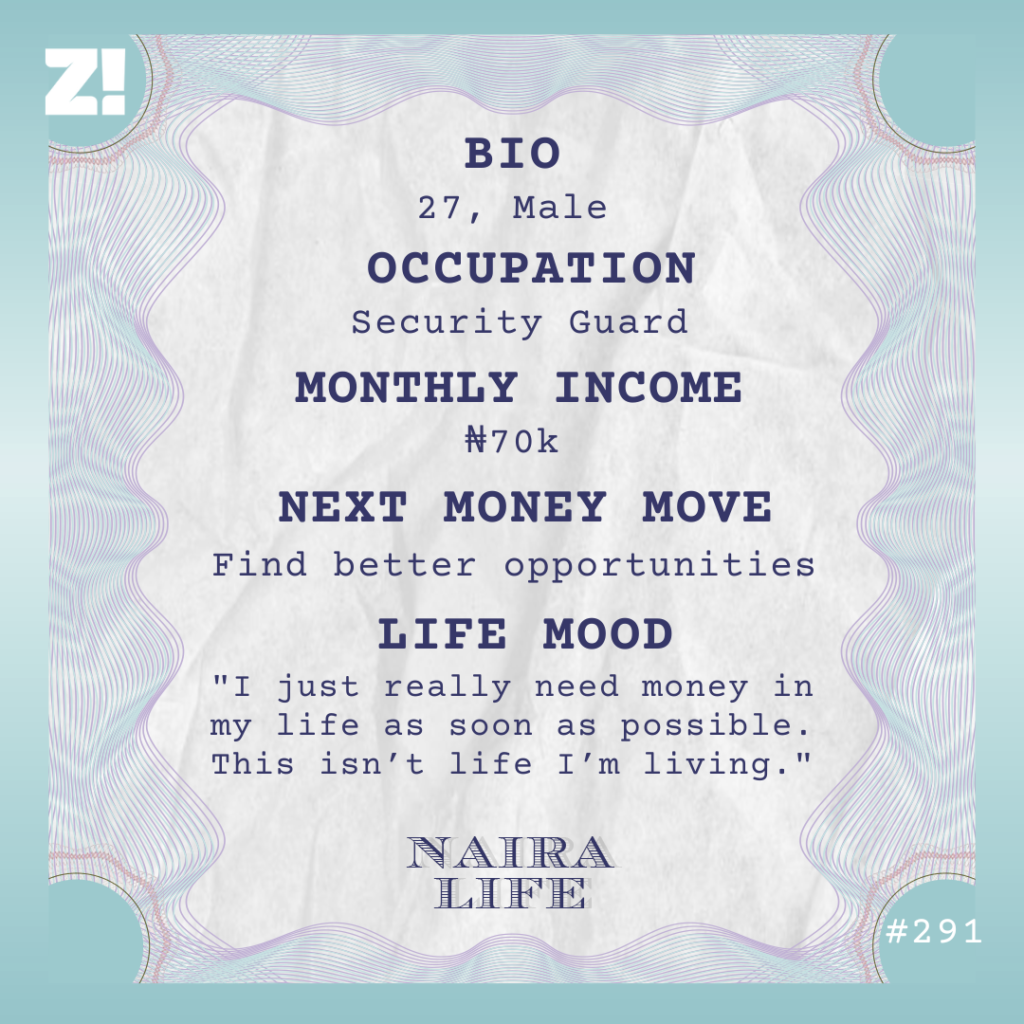

    NairaLife #291 bio

    How did you find yourself working as a security guard?

    Ah. It’s a long story.

    Let’s start from the top

    I’ve been hustling since I was around 12 years old. My father was a butcher who couldn’t provide for his three wives and 11 children. So, my mother used what she made from her provisions store to take care of me and my three biological siblings. She didn’t make much, so I mostly paid my school fees myself.

    How did you do that?

    Different things. For example, when I was in JSS 2, I learnt how to repair phones from a friend. I also got into online business around that time. This was around 2012/2013.

    What kind of online business?

    Actually, it was yahoo yahoo — another friend introduced me to it. I was pretending to be oyinbo on Facebook and Instagram and chatting with oyinbo people. Some people have luck with this online work, but I didn’t make much from it. The lowest I made was $100, and the highest money I got at a time was $400. 

    I didn’t make money regularly, and the dollar exchange rate wasn’t up to ₦200 then, so I didn’t make big money. But it was enough for me to drop small money at home for foodstuff and pay my school fees. 

    I also didn’t regularly make money from my phone repair business because I didn’t have a shop. I just had a spot where I worked after school with my tools. My pay depended on whatever fault my customer’s phone had, but it was usually between ₦500 – ₦1k. 

    When I got to JSS 3, I decided I couldn’t continue school.

    Why?

    School fees. I just know I couldn’t afford it again. Things were tight. 

    From 2014 to 2020, I survived on what I made repairing phones and some financial support from a brother who was out of the country. I still lived with my parents, so I didn’t have many responsibilities. But after I got married in 2019, I realised I needed to do something more to bring more money home. 

    How did marriage happen?

    It just happened. I’d been with my girlfriend since primary school, and getting married was the next step after she got pregnant. It wasn’t a proper wedding like that, more like an introduction ceremony. But a baby was coming, and I knew it’d increase my responsibilities, so I started looking for business ideas.

    Were you still doing the “online business”?

    I gradually stopped because it wasn’t really working. By 2020, I befriended one of my Facebook clients, and she also convinced me to stop. We became friends after she realised I wasn’t who I was pretending to be. I think she changed me. She said she didn’t want me to do yahoo anymore and even gave me $200.

    When I added that money to some money I’d saved up, it was up to ₦200k. I decided to use it to start a wholesale provisions business. 

    Tell me how that went

    I got a shop and made small sales here and there. But I really wanted to get a car. My major distributor was in a neighbouring state, and I always paid money to pick up the goods at the park. I figured that a car would allow me to drive down myself, cut out delivery costs and even buy more goods.

    I joined a cooperative so I could borrow money to buy the car, but that wasn’t a good idea.

    What happened? 

    First, I decided to get the car through my aunt. She said her husband knew much about cars, so I thought I was in good hands. Her husband initially told me the second-hand 1999 Toyota Camry would cost ₦1m. So, I took a ₦1m loan from the cooperative. But I got there and learned the car cost ₦150k more — the middleman was trying to add his own profit, but I didn’t have a choice. I had to borrow the balance from my aunt. 

    My biggest problem was that the car had issues. I didn’t know much about cars, so I didn’t notice until I started using the car. It was always one problem or the other, and I was just spending money repairing and repairing. I couldn’t even use it for the reason I bought it.

    Remember I still had the loan to pay off? The car was supposed to bring more profit to my business so I could repay the loan. But the car’s problems forced me to sell it off after seven months. Problem number two.

    People didn’t want to buy it?

    They didn’t want to o. I wanted to sell it for ₦1.150m so I could get the money I paid back, but people kept pricing it at ₦500k. I eventually sold it at ₦800k.

    I couldn’t use the whole amount to repay the loan  — which was almost ₦1.3m plus interest — because my wife gave birth around that time, and there were a lot of expenses. I also had to put some of the money into my business to restock the shop.

    Only half of that money from the car made it back to the cooperative. I had to repay the loan small small using both profit and capital from my business. It almost caused an issue with my aunty because she stood as guarantor for me and the cooperative people were on her neck, and she was on mine.

    It took me two years to repay the loan, but my business was totally run down by that time. To top it all off, my wife had given birth to another baby.

    Damn. So what did you do next?

    I started looking for money again. My search took me to an online chat platform where people post jobs. That’s how I saw one promising to pay up to ₦100k/month to work in a hair factory in Lagos. So I packed my bags, left my family in Delta state and moved to Lagos in 2023.

    Did you know anyone in Lagos?

    An uncle, but I didn’t know where he lived. I could’ve asked my dad for the address, but I wanted to struggle on my own. You know, so I’d be able to say I made it without relying on anyone.

    Anyway, the job wasn’t what I imagined. It wasn’t a fixed monthly pay job; the factory paid workers based on the number of tasks we completed daily. I’d work from 6:30 a.m. to 6 p.m. to make ₦700 – ₦800. They then recorded how much we made per day to determine the salary at the end of the month.

    They created a bank account for me to receive my salary, but I didn’t even wait for the first salary. I just stopped showing up at the factory after a few weeks.

    Just like that?

    Just like that o. The work was stressful, and I couldn’t cope. While I worked at the factory, I lived in a shared apartment provided for the workers. It wasn’t free o. Each person paid ₦2k every month to live there. I also paid, even though I didn’t stay there for up to a month.

    I made friends with a fellow worker before I left the factory. He was also a bricklayer, and he lived in Ogun state. So, when I left the factory, I began working and squatting with him. I don’t even know if squatting is correct. He didn’t have a house, and we lived on the streets.

    How did that work?

    We hung around looking for bricklaying jobs during the day and slept in front of shops at night. We used mats and our clothes as mattresses. Sometimes, we slept inside a church, mosque or whatever uncompleted building we worked at. We always woke up by 5 a.m., so we’d leave before people came. Of course, people occasionally chased us away. It was dangerous too. Ritual killing was rampant in Ogun state at that time, but thankfully, they didn’t get us.

    Back to working with this friend. I mixed cement and whatever else he told me to do for ₦3500/day. Money only came when we found a site to work on, so we went from place to place between Lagos and Ogun to find construction work. On some days we didn’t find work, I’d only eat biscuits and drink water.

    One day, I woke up and realised I couldn’t continue. The job was too stressful, and the money I made went into trying to survive. I still had a wife and two children back home to provide for.

    True

    I returned to the platform that introduced me to the factory job and found an advert for a security guard at a company on Lagos Island. This was in November 2023. My initial salary was ₦24k/month, but my employers started removing ₦1k after a month for uniform. 

    I knew ₦23k wouldn’t do anything, so I found another security job that pays ₦40k/month in December. I still do both jobs today. My first job increased my salary to ₦30k early this year, so my income has grown to ₦70k/month.

    How do you manage working two security jobs?

    Security jobs allow workers to work one day on and the next day off, and I’ve arranged it so that I’m always at one of the jobs.

    I work from 6 a.m. to 6 a.m. the next day, then move to the second job and resume at just a little after 6 a.m., too. Both workplaces are close to each other, so it works. 

    However, this arrangement means I work 24/7. I try to catch some sleep at night by sharing short four-hour sleep rotations with my colleagues while on duty at night. If one person is sleeping, someone else is awake. The work is stressful, but who will feed me if I rest? 

    Also, I don’t have a house, so there’s nowhere to “go home” to. I move from one job to another with my few things and make wherever I am my home. I haven’t even been able to visit my family since I moved to Lagos.

    I was just about to ask about your family. How do you support them financially?

    It’s just my children now. My wife left me in March this year and said she couldn’t take care of the children. Mind you, I sent her ₦25k – ₦30k monthly when I started working and paid the children’s school fees. I also took care of my family when I had my provisions business. But I guess that wasn’t enough.

    So, she dropped my first child with my father and took the second one. I reduced the monthly allowance to ₦10k since I had to send my dad at least ₦20k/month for my first child and pay school fees. 

    However, last month, my ex-wife went to collect my first child. My mum passed away in 2020, and my father remarried. So, my ex-wife’s justification was that my stepmother mistreated my child, which I don’t believe. That wouldn’t have been possible with my father living in the same house. 

    Also, it meant I had to change the child’s school again and get uniforms. I didn’t support that, but she just did her own. I’ve told her I won’t increase her allowance since she made that decision alone. I’m still sending ₦10k. 

    What do these expenses typically look like in a good month?
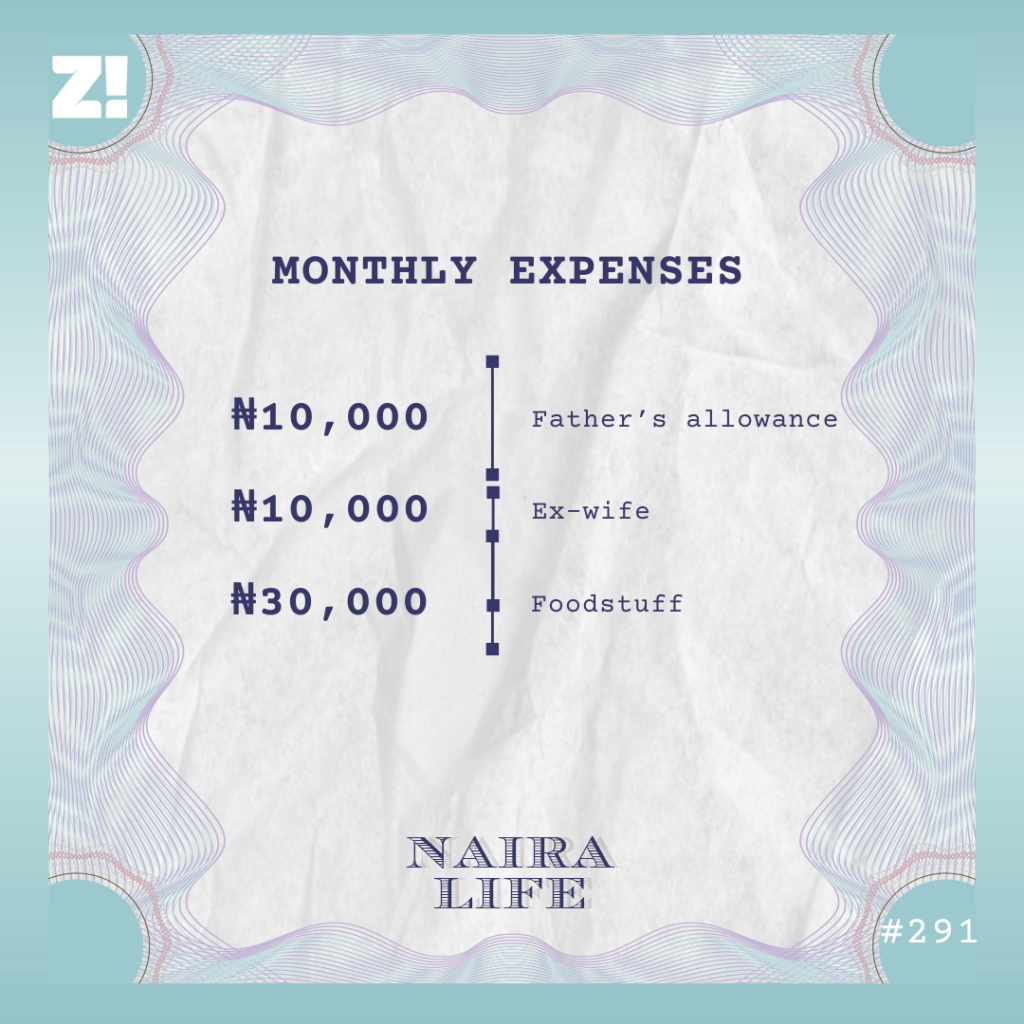
    NairaLife #291 monthly expenses

    I’ve reduced my dad’s allowance because my first child no longer lives with him. I hardly spend on transport fare since I walk back and forth between both workplaces. I also carry an electrical plate around to cook and save money on food. 

    I hold what’s left to see road, even though it hardly does anything with how things have gotten expensive. I also just started a ₦500 daily ajo contribution to save for emergencies, and I make the money I use for the ajo from tips I get while on duty.

    Do the tips come often?

    It’s just sometimes, like once a week. This security job is not easy. Nigerians look down on security guards so much. I’ve gotten several insults from people. 

    One of my workplaces is a club, and one time, a popular celebrity visited and dashed money to the hostesses, valets and bouncers. I told him, “Ah oga. Security sef dey here o,” and he replied, “Abi security dey craze? Who be security?” 

    It touched me, but I didn’t take it to heart. I know the job I do, so I’ll only take it as motivation to move forward in life and earn better.

    Is there an ideal amount of money you’d like to earn?

    If I can get two jobs and each pay ₦70k – ₦80k, it’d make sense. Ideally, I want to leave this security work and do business. I can’t sell provisions here because getting a shop space on the Island is so expensive, so my only option is to drive e-hailing cabs. 

    I pray to find someone who can give me a car on hire-purchase. At least, I can also sleep in the car at night and look for where to bathe in the mornings. And if I make enough money to rent an apartment, it’ll be even better. I just really need money in my life as soon as possible. This isn’t life I’m living.

    I hope it works out soon. How would you rate your financial happiness?

    5/10. I’m still homeless, but at least I’m no longer sleeping on the streets.


    If you’re interested in talking about your Naira Life story, this is a good place to start.

    Find all the past Naira Life stories here.
    Subscribe to the newsletter here.

    [ad]

  • Every week, Zikoko seeks to understand how people move the Naira in and out of their lives. Some stories will be struggle-ish, others will be bougie. All the time, it’ll be revealing.


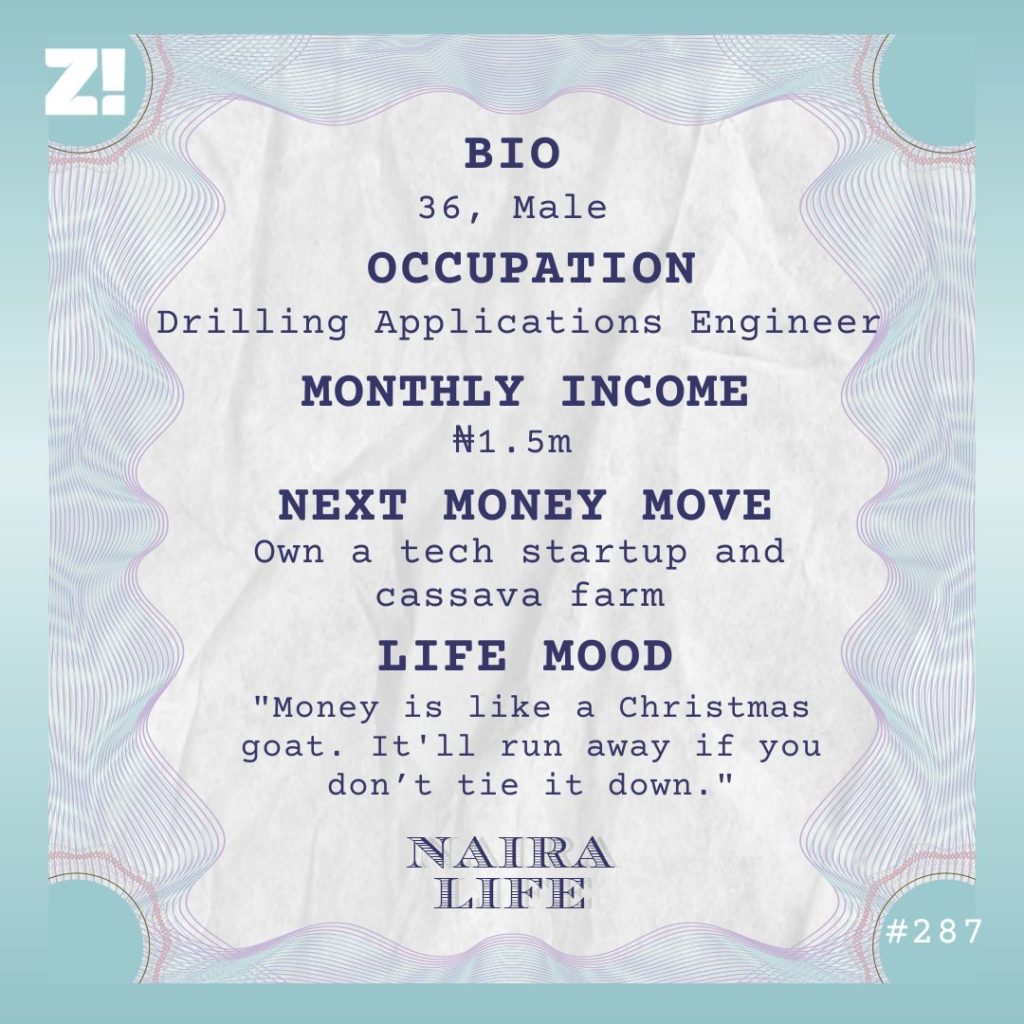
    Nairalife #287 bio

    What’s your earliest memory of money?

    In Primary 1, I sold my biscuits to my classmates for money. My parents gave me biscuits to school, but I preferred money. Money meant I could buy anything I wanted and not be limited to biscuits. 

    So, I sold the biscuits for ₦3 even though they were worth ₦5. Then, I spent ₦1 on sweets and saved ₦2. This was in 1993, so there were still ₦1 sweets. I did that till my elder sister found out after some weeks when she saw money with me and snitched.

    Yikes. Were you punished?

    No, but my parents held a family meeting. They wanted to understand why I sold my biscuits cheaper just because I wanted money. Like, what did I need the money for? 

    I don’t remember what I told them, but they started giving me ₦3 to school instead of the biscuits. I continued buying sweets and saving what was left. Every month, I’d give my mum what I’d saved and ask her to add money to buy me a shirt or anything that caught my interest. It was a good arrangement.

    Tell me more about what growing up was like, financially

    I was born with a silver spoon and lost it along the way. My dad was a big-time contractor and businessman; he had a printing press and a real estate business. My mum was a full housewife who also made aso ofi at home.

    Unfortunately, our fortunes started to change around 1995. My dad bought a German company that was exiting Nigeria without knowing the company was already going under. He told me much later that the deal had cost him ₦35m — big money back then — and he’d also taken some loans from the bank.

    When the company eventually folded up, we had to move to a smaller house, and my mum lost all her aso ofi customers. I must’ve been 8 when it happened, and I saw how we slowly went from wealthy to struggling.

    What were some of the things that came with this major change?

    First, we didn’t have a driver to take my siblings and me to school anymore. Then we started taking danfo buses. I also transferred to a nearby, less expensive school. 

    The Christmas clothes also stopped coming, and people stopped visiting us. Usually, during festive seasons, many visitors came to ask my dad for money, but that stopped.

    My dad didn’t get as many contracts as he used to. He lost some of his influential friends due to his bank debt. However, he managed to sponsor me and my siblings through school by selling many of the landed properties he’d acquired.

    Sounds tough. Do you remember the first time you worked for money?

    That happened after graduating secondary school in 2005. I couldn’t start uni immediately because two of my elder sisters were in the polytechnic, and my dad couldn’t afford to send more children to school at the time. 

    So, I picked up a ₦2500/month teaching job at a small private school. Apart from the salary, I made small change teaching after-school lessons. The school charged each student ₦20 daily for those lessons, and the proprietor shared the money amongst the teachers. Sometimes, I made ₦100 extra, sometimes ₦800. It depended on how many students paid per day.

    I worked at the school for two years until I started university in 2007. Because of our financial situation, I barely got an allowance from home. When the allowance came, it was between ₦3k – ₦5k for a month. So, I had to do several hustles to support myself.

    What kind of hustles?

    I joined the decoration unit of my university fellowship and often got small gigs outside the fellowship. They weren’t paid gigs, but I was fed before and after the job.

    Sometimes, I got actual decoration gigs that paid in cash, and I had to share the money with the unit members I took to assist me. My share at the end of these jobs was mostly ₦5k.

    When I was extra broke, I’d gather ₦200 each from a few friends and tell them to come eat in my room. Then, I’d buy foodstuff at the market and cook enough rice. It worked out because the portions I served were more than what my friends would get with ₦200 at the cafeteria, and I also got to eat out of the food.

    That was how I survived university till I graduated in 2011. 

    What did you do next?

    I worked as a manager at a clubhouse for six months, earning ₦12k/month before I left for NYSC in 2012.

    My place of primary assignment was a school, and I wasn’t paid a salary. However, the local government paid me ₦1500/month, while the state government paid ₦5k/month. Then there was the ₦19800 allowance from NYSC.

    I supplemented my income by transporting food items for fellow corps members. I served in the North, so whenever I was returning home, I’d ask them to give me a list of things they wanted me to bring back to the North— anything from beans and garri to gadgets. 

    Some of them even bought on credit and paid me in installments. I didn’t mind because I added healthy profits. I could buy a UK-used BlackBerry phone for ₦25k and sell it for ₦35k. I made ₦30k-₦50k monthly from that business.  

    Not bad

    I didn’t pay for rent as I lived in a lodge, so I saved most of my income after the food and travel costs. I also applied for a master’s program during this time. The plan was to start my master’s degree immediately after NYSC.

    I finished NYSC in 2013 and invested in a hire-purchase taxi business just before returning to school. I bought a local taxi for ₦320k and gave it to a driver who paid ₦15k weekly. The agreement was for him to pay ₦650k and then own the taxi afterwards. The weekly payment delivery essentially supported me through postgraduate school, which I finished in 2015.

    What happened after postgraduate school?

    I became a network marketer at a company that sold nutritional supplements. To work with the company, I registered with ₦36k. I had the option of selling the products or recruiting other people to join, and I chose the latter because I didn’t like the idea of selling products. 

    I earned ₦9500 for each person I recruited, and there were months when money didn’t come in at all. Then, sometimes, payments would come in quick succession, up to ₦100k. It was tough, but I had no other option, so I stuck with it. 

    The only positive thing about that job was that I learned to sound convincing and market anything to anybody. I also travelled a lot around Nigeria.

    But how did you survive if payment wasn’t regular?

    My fiancée had a job, and she often helped me out with cash. I also registered more accounts on the network company to increase my earnings through recruits; I went from having one account to 15, which helped the payments become a bit more regular.

    Then, in 2016, I joined MMM. I made a lot of money at first — I already knew how to canvas people and got great referral bonuses. Then, I got carried away and joined a few other Ponzi schemes —Twinkas, Helping Hands, Donation Hub, etc. Anyway, I received sense when I lost about ₦6.5m after the schemes crashed.

    Damn

    I lost almost all I’d made from the networking marketing job and all the profit from the Ponzi schemes. I lived in a ₦65k/year apartment, but I started owing rent because I couldn’t pay it.

    I tried to go into dog dealing to make money quickly, but I gave the dogs out after a few weeks. I was using all my money to feed the dogs, and I was starving myself. I decided it wasn’t worth it and focused on my job at the network company. Thankfully, I’d used some of my MMM money to rent an office space, so I decided to intensify my efforts.

    I made reasonable money for a while. I got a car, got married, and things were reasonably okay. But I started having second thoughts about the network company.

    What happened?

    I started questioning my morality. I was good at what I did; I could convince people to join. But then these people joined and didn’t know how to do the same, so they didn’t make money. 

    Once, I recruited someone who used his house rent to register after hearing me speak. Unfortunately, he didn’t make money, and the landlord nearly chased him out. Another did the same with his child’s school fees. I became uncomfortable with the whole system; it was starting to look a lot like MMM. So, I quit in 2018 even though I had no alternative. 

    That’s when sapa hit me full-time. I lost my dad earlier in the year, which affected me mentally, and I couldn’t think of business ideas. I became extremely broke, and then my wife got pregnant. Things went downhill from there. 

    The baby came, and I sold my car to handle the bills. After some months, I moved my family to my parents’ house when I couldn’t afford rent anymore. Nine months after we had our first child, my wife became pregnant again.

    Oh wow

    There I was — broke, owing rent and trying to survive with a baby and another on the way. Also, my wife had left her job because of the babies and the fact that we changed locations.

    I tried to make money from forex trading and crypto, but it was a series of ups and downs. I’d make money today and lose it the next day. I also had a stint driving cabs on an e-hailing app in 2019.

    In 2020, I moved my family to a friend’s family house. It was a four-bedroom house, but we had access to two. My friend lived in one of the rooms with his wife. I lived in another room with my family and another friend who was also squatting. My wife and two children slept on the bed, and I and the other friend slept on the floor. 

    Later that year, a family member moved us to Lagos and rented an apartment for us. My wife got a small teaching job, which sustained us for a bit.

    Were you still trading forex and crypto?

    On and off, but it wasn’t profitable. In 2021, I landed a government contract to supply bricks for a project in my home state. I got it through some friends, and it was supposed to change my finances.

    This is how these contracts work: the contractor funds the project and gets paid after different levels of completion. The contract was worth ₦40m, and I didn’t have money, so I borrowed it from a finance firm.

    Unfortunately, the engineer overseeing the project wasn’t happy with me. He’d expected me to give him a ₦2m bribe, and when I didn’t, he decided to frustrate my payments. I finished the project in 2022 and was in a ₦40m+ debt.

    Ah

    It was a terrible period. The interest on the loan increased every day, and the finance firm threatened me several times.

    At a point, the payments began coming in very small instalments. I had to involve a lawyer to retrieve the money when only ₦8m came in after several weeks. The lawyer’s fee sef was about ₦3m.

    It took a year to get 90% of the project payment—about ₦36m. Thankfully, the finance firm understood my plight after I explained and gave me time to repay. I paid the ₦4m loan balance myself in 2023. 

    How did you do that?

    I secured more contracts. I’m a restless person and don’t know how to sit back and watch, so I applied for several government contracts. In 2023, I got one to supply furniture to schools, made ₦2.5m, and used most of it to pay off some of the debt. 

    I got a job that same year and used part of my salary to pay off the balance until I cleared everything.

    Tell me more about the job

    The role was drilling engineer at a multinational oil company, a job I got by a stroke of luck. I was at a family friend’s event when someone randomly asked my wife if her husband needed a job. I sent my CV, got the interview invite and eventually got an offer — ₦1.4m/month, including bonuses.

    I got promoted a few weeks ago, and my average salary is now ₦1.5m/month. 

    Whoosh. To think you were ₦40m in debt just about a year ago

    It’s such a relief. My experience has taught me a big lesson: never give up. There were days I wanted to end it all, but I looked at my family and lost my nerve. Plus, I’m not a coward. I couldn’t run away from my problems. 

    However, there were days I tried to run. One evening, when I was still squatting with my friend, my baby was crying out of hunger, and there was nothing I could do. I just told my wife I was coming and walked out of the house. I switched off my phone and kept walking. I slept in a church that night. 

    I raised some money from a few people before I returned to the house the following morning. I found my wife crying, thinking something had happened to me. 

    Luckily, one of the guys we lived with borrowed her money that night so my baby could eat. I really felt terrible. As a man, I couldn’t feed myself, talk more of my family.

    I’m sorry you went through that

    2018 to 2022 were trying years for me, and I’m grateful they’re behind me now. I just kept telling myself that if I didn’t die during that period, everything would be fine. I also developed high blood pressure at some point. How many stories do I want to tell?

    I can imagine. Have there been any lifestyle changes with the new income?

    Well, I don’t owe rent again, and I can easily pay my kids’ school fees. My lifestyle hasn’t changed much except that I now invest heavily in different business ventures.

    Aren’t you worried that some of your investments didn’t exactly do great in the past?

    Nope. I face everything believing that I have God and no matter the outcome, I’ll survive. Moreover, business is in my DNA. I can’t do without it.

    I’m currently investing in a tech startup designed to connect people globally via digital cooperative societies. My team and I are still in the app development and compliance stage, and I’ve spent over $2k on it.

    I also leased some land to cultivate cassava and process garri in 2023, which cost me about ₦1.2m. I’d have started planting this year but couldn’t get farmers because I was busy with work. However, I intend to begin operations next year. 

    I also regularly pursue government contracts, which require constantly pumping in money. I have over ₦8m tied up in these contracts.

    That’s a lot of money tied up in investments

    I believe that money is like a Christmas goat. It’ll run away if you don’t tie it down, and your Christmas is gone. I’ll always spend money, so I think it’s better that it’s out there working for me.

    That’s pretty much my relationship with money. I don’t believe in holding money; I either give it out, loan it, or invest it. 

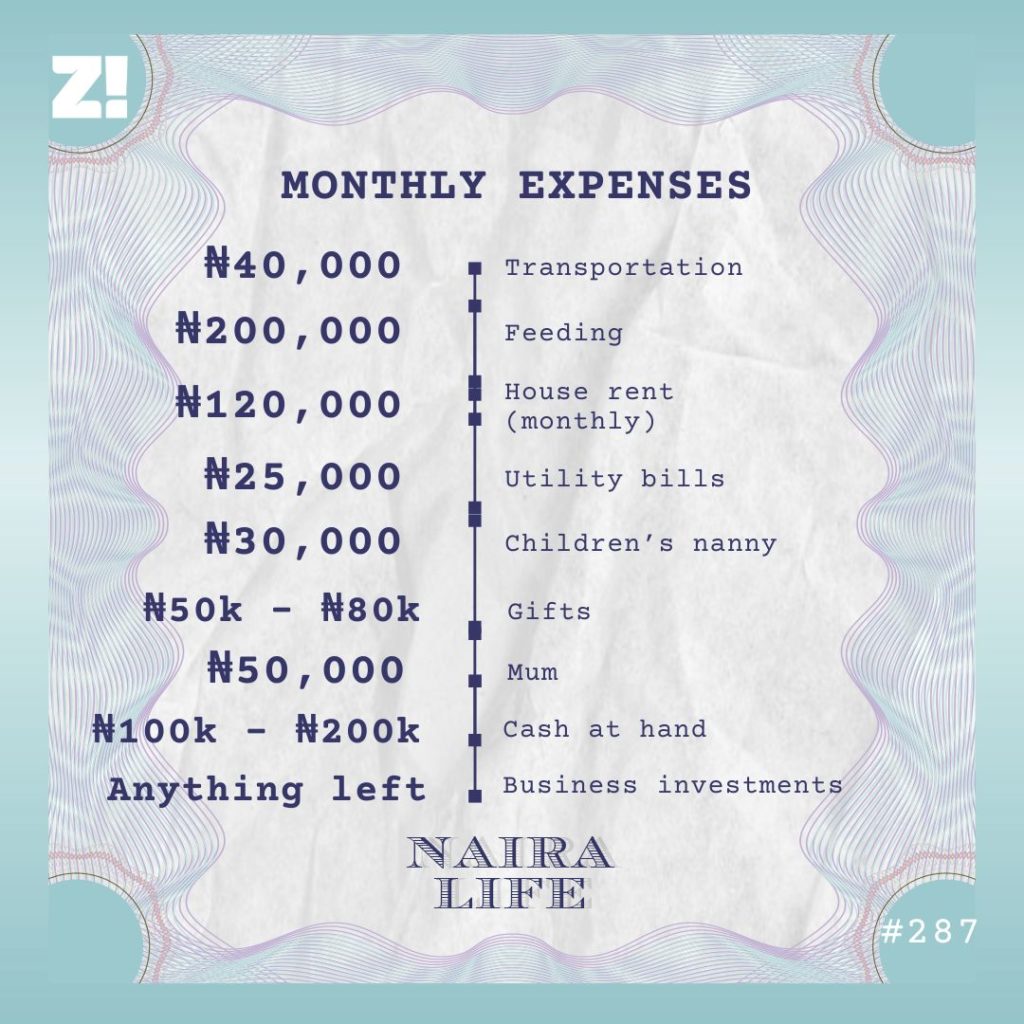
    Let’s break down your typical monthly expenses

    Nairalife #287 monthly expenses

    Is there anything you want right but can’t afford?

    “Can’t afford” is relative, but I want three things: to get my tech startup running, move my family abroad while I stay back to hustle, and build a house. I’ll need about ₦5m to get the startup fully functional, and japa will cost a lot more. 

    I estimate I’ll need about ₦35m – ₦50m to build a house. I can’t get that from my salary, which is why I’m always on the lookout for contracts and business opportunities.

    How would you rate your financial happiness on a scale of 1 -10?

    4.5. I’m grateful for where I am, but more must be done. I really want to influence society and help people, which is why I’m keen on the startup. It’ll help me reach as many people as possible and play a role in people’s lives.


    If you’re interested in talking about your Naira Life story, this is a good place to start.

    Find all the past Naira Life stories here.

    Subscribe to the newsletter here.

    [ad]