• Every week, Zikoko seeks to understand how people move the Naira in and out of their lives. Some stories will be struggle-ish, others will be bougie. All the time, it’ll be revealing.

    Over 5 million people trust Carbon to reach their goals without drowning in debt. Transparent terms, fast approval, and full control. Turns out, loans don’t have to come with pain. Click here to start.
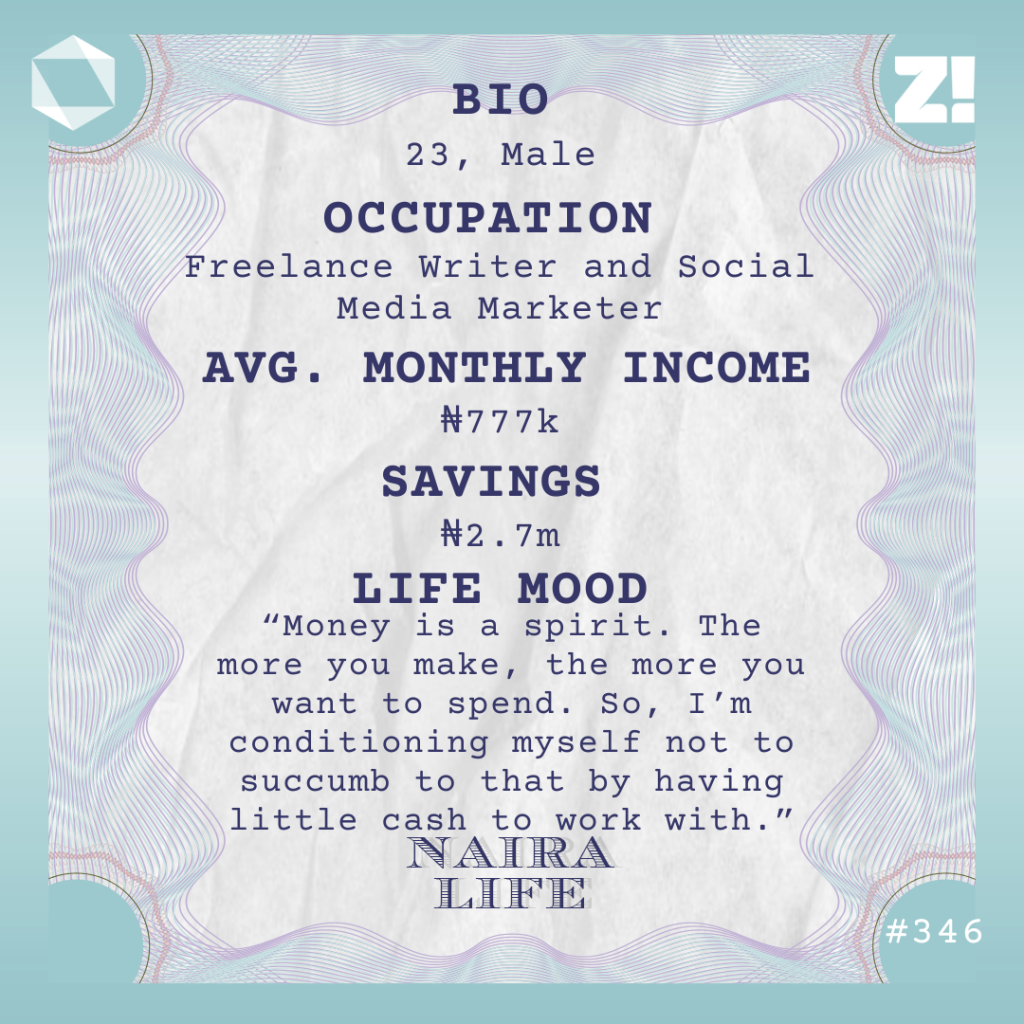

    Nairalife #346 bio

    When did you first realise the importance of money?

    In uni. I had a relatively easy childhood, and although we experienced financial difficulties from time to time, my parents provided me with everything I needed. At the very least, I ate three meals daily. 

    However, things changed when I started university in 2020. My dad said, “You’re on your own now. Don’t ask me for money.” 

    Omo, I suffered. Scarcity taught me the importance of money.

    No allowance?

    There was, but ₦10k/month was never enough. There was one day I drank garri throughout the day. After I drank garri again in the night, I just started crying and asking God why I was in that situation. It was terrible.

    Phew. Was there a reason your dad wasn’t open to billing?

    My parents are pastors, and the pandemic grounded a lot of things financially. We couldn’t hold regular church meetings, and even after lockdown, we found it difficult to restart service due to several factors. 

    My parents tried a few businesses to supplement our income, but things weren’t going great. We had to manage, and that affected what they could afford to give me for school. After the garri incident, I resolved to find alternative ways to make money.

    What did you do?

    The first thing I tried to do was sell clothes when I was in 200 level. I didn’t exactly have a passion for it; I didn’t even believe I was a businessperson. However, the popular stereotype about my tribe is that we should all know how to buy and sell. So, I thought it was a good idea. Also, I was desperate.

    So, I borrowed ₦20k from my elder brother and bought clothes from someone who imported them from China. The business didn’t last up to a month, and I barely sold anything due to my lack of interest in the whole thing. I didn’t know how to sell, nor did I have the energy to convince people to buy. I ended up giving most of the clothes away.

    Did you try another business venture after that?

    I didn’t. Instead, I turned to social media. It was initially an escape for me. I was bored and getting depressed because of my financial situation, so I became active on social media to take my mind off things. 

    Then, I started to read about opportunities such as writing, freelancing, and social media management. As I learned more about them, I felt they were things I could actually do. I’ve always known how to write, and I could easily learn the others. 

    In fact, I already had some community management experience from managing Christian Facebook communities. I had created those communities to make friends, and grew membership to hundreds of thousands. Facebook was hot in that 2020/2021 period, and the communities were very active. 

    My work with the communities and my writing skills pushed me to explore these new opportunities. Plus, if I couldn’t make money in the traditional way of buying and selling, I could acquire skills and earn money from the comfort of my house.

    How did you go about acquiring these skills?

    I took free courses in Search Engine Optimisation (SEO) and digital marketing on SEMrush and HubSpot. Then, I started building in public. I actively posted on Facebook, sharing my skills and my work experience. I also joined freelance platforms like Upwork and Fiverr and sent proposals back-to-back. My social media audience grew steadily, and clients began to come in. 

    I landed my first gig — $15 to write an SEO blog article — in 2022, about six months after I started taking those courses. That gig made me feel complete, and the whole freelancing experiment felt real. Like, finally, I’m earning my own money, and I could earn more with even more effort.

    Energy

    Subsequent gigs mostly came from Facebook and my school network. I had an audience on Facebook, and since I was steadily posting write-ups, clients came with their writing needs. I earned the odd ₦5k or ₦10k here and there. 

    The school clients were classmates who were too busy trying to make money to take school seriously. I told them I could write, and they paid me to handle their assignments and seminar papers. I charged anything between ₦5k and ₦15k, depending on the level of work to be done. Fortunately for me, the pandemic and multiple strikes had affected our school calendar, so we were constantly rushing. 

    The school authorities would condense a six-month semester into two months, and we always had a lot of assignments. So, I constantly made money from that. I even started a referral program, offering a 20% to 30% discount to people who brought friends and clients from other departments.

    What was your average monthly income from these gigs like?

    Initially, my income was quite irregular. However, as I became more consistent around 300 level, I built a solid reputation in school, and more people came to me. Between Upwork, Facebook and school gigs, I made an average of ₦100k monthly.

    My income peaked during my final year. I started writing final year projects for clients and charging up to ₦90k per project. I also got the opportunity to write for UK clients —people who had used my services in school referred me to their siblings studying in the UK. 

    These international students rarely had time for assignments and theses because they juggled school and work, so I did them on their behalf and charged well for it. In my final year, I comfortably made up to ₦400k monthly. 

    Not bad money for a student

    It was more than enough to cover my needs. I’m an introvert who hardly went out, so my money usually went to books and food. 

    When I graduated in 2024, I basically continued where I left off. However, I decided to pay more attention to SEO and social media marketing because the international student gigs were seasonal. They could go on holiday for like three months, and I wouldn’t make any income from that source. 

    Currently, I primarily freelance as an SEO writer and social media marketer. I still receive academic writing gigs from international students, but it’s not my sole source of income.

    Get More Zikoko Goodness in Your Mail

    Subscribe to our newsletters and never miss any of the action

    How do you get clients as a freelancer?

    I recently started cold outreaches using LinkedIn. I’d find the contact details of decision-makers in companies I believe need my services and pitch them. That works half of the time. The rest of the time, my clients come from word-of-mouth referrals and freelance platforms. The academic writing gigs are solely referrals; I don’t need to pitch for those. 

    I average ₦500k/month when my academic writing clients aren’t in session. When they are, my income can get up to ₦800k or ₦900k. Now, that’s just from freelancing. I also have a 9-to-5 job that pays me ₦200k/month, and I receive ₦77k allawee as a corps member.

    I feel like we’ve jumped a few chapters. When did the 9-5 happen?

    March 2025. I moved to a different state for NYSC, and my cost of living skyrocketed. It honestly came as a culture shock. As a student, I paid only ₦150k for a decent self-contained apartment. But moving here, the same apartment costs ₦600k. Transportation and feeding are also more expensive. 

    To make it worse, my income wasn’t stable when I first moved here. My international students were on holiday, and money wasn’t coming in frequently. That was when I even decided to focus on my other skills to fill the gap from academic writing. I also decided to take a 9-to-5 job to keep me grounded during periods when freelancing didn’t bring in as much money.

    I got a social media marketing job with a manufacturing company. They pay me ₦180k as salary and an extra ₦20k for data. The job is primarily for stability, and thankfully, it’s remote. At least I know, whether it rains or the sun shines, I’m getting ₦200k from somewhere every month. 

    So, it’s like your NYSC Place of Primary Assignment (PPA)?

    Actually, no. My PPA is at an NGO where I work in communications, but they don’t pay me. So, I told them they shouldn’t expect me to come to work every day. Instead, I work like a consultant for them. I help them with newspaper and magazine contacts when they need to publish press releases and offer communication advice, but that’s it. 

    Interesting. What kind of life does your income afford you?

    I live a comfortable life. I eat well, and I can afford data, good clothes, and live in a decent place. That said, I don’t think I live luxuriously. I have plans for my future, so I don’t overspend. In fact, 60% -70% of my income goes into my savings. 10% goes to tithe, and I live on whatever’s left to cover my cost of living.

    Tell me more about how you break down your savings

    This is how it works: I allocate 60% – 70% of my monthly income to two savings accounts. One is an emergency savings account that I can easily access if I’m stranded, and the second is under a lock feature in my savings app that doesn’t allow me to touch the money for at least a year. I put most of my savings into this feature. Sometimes, I also direct some of my savings to crypto and stocks, but that’s not regular.

    Right now, I have around ₦700k in my emergency savings and ₦2m in the locked account. I started this approach in 2024. 

    Is there a reason why you lock your savings for a year?

    Two reasons: The interest rate and financial discipline. I’m very liberal with giving, and it’s a way for me to caution myself. I intentionally make myself poor because if I earn ₦700k this month and keep the whole thing in my account, I’ll spend it when someone asks. So, I’d rather hold ₦100k so when they come, I can say, “I only have ₦100k. Take part of it.” 

    So, you live on about 20% of your income. Let’s break that down into monthly expenses
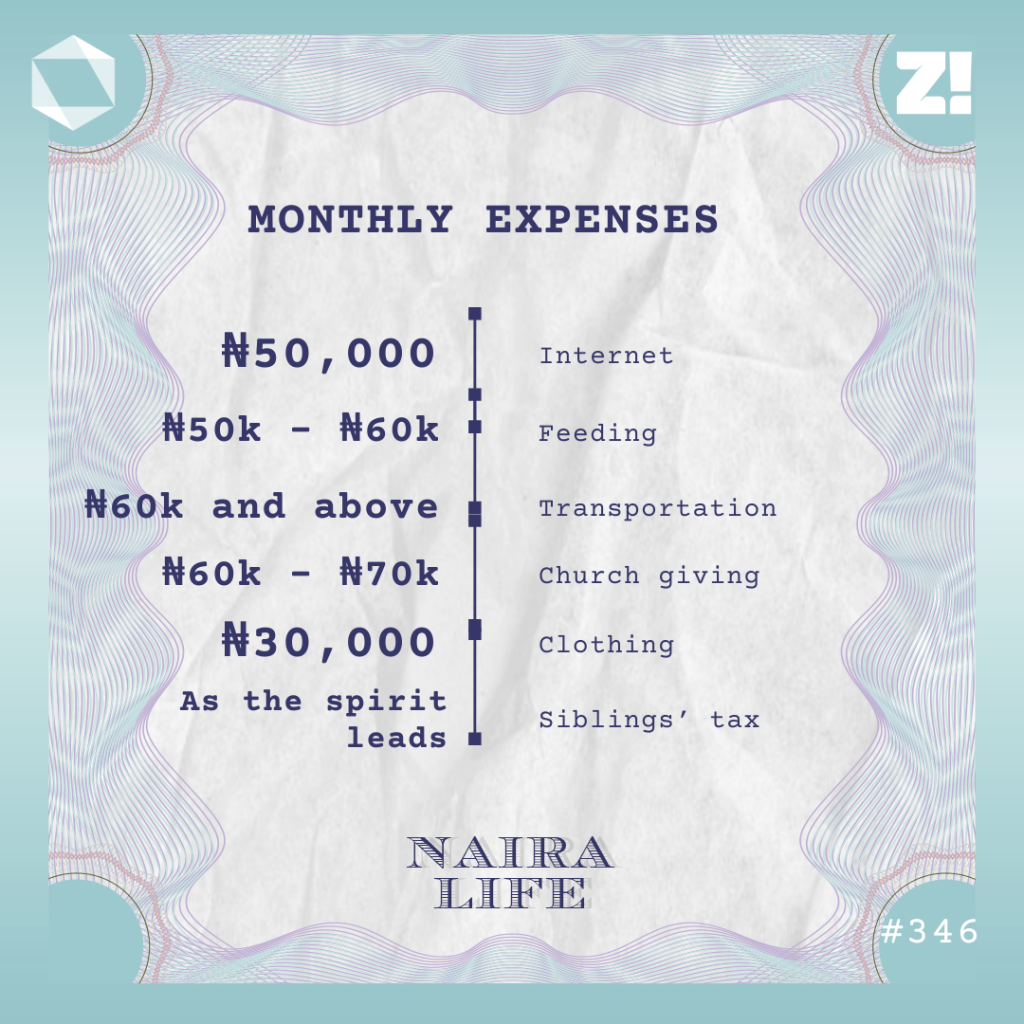
    Nairalife #346 expenses

    My feeding budget is that low because I’m a minister in my church, and we fast a lot. My church giving is exclusive of my tithe and offering, also because I’m a minister. I teach an age group in church, and I like to give them monetary gifts.

    I should also mention that I recently started channelling some of my savings into a real estate investment program. The program allows people to pay a deposit for land and complete payment in instalments. The land I bought costs ₦3m, and I initially deposited ₦700k. I’m supposed to complete the payment by the end of December. I’ve already paid around 70% of the money; what’s left is ₦1m, and I know I can complete it by then. 

    The person who introduced me to the program is a trusted church member. He’s already given me the papers and necessary documentation for the land. So, I’m already technically the owner.

    How would you describe your relationship with money?

    “Interesting” is the only word I can think of. My mum says I behave like someone who hates money because I’m almost always broke, even though I earn a lot of money. 

    It’s a paradox: earning so much and still being broke, only that mine is induced poverty. Once I get paid, I channel my money into savings and make myself broke because I don’t want to be extravagant. I’ve also learned that money is a spirit. The more you make, the more you want to spend. 

    So, I’m conditioning myself not to succumb to that by having little cash to work with. I was recently stranded and had to ask my sister to loan me ₦4k because some bank issues prevented me from sending money from my savings account to my regular account. And that’s normal for me. It may not be ideal, but that’s how I condition my life.

    I’m curious. Do you have a particular savings or investment goal?

    My investment goal is real estate. I want to buy multiple lands in developing areas and wait for them to become prime locations. I’m also looking to japa through the student route, and I imagine I’ll need to have sufficient proof of income. I don’t know how much I’ll need yet, but I’m saving with that in mind. 

    Is there an ideal amount you think you should be making?

    At least ₦1.5m/month. I want to get a bigger apartment closer to town, but I can’t do that on my current income. I also have a relationship and marriage in mind within the next two to three years, so I need to increase my earnings.

    What do future plans look like? Do you intend to continue freelancing?

    Definitely. It’s working for me, so I’ll keep at it. I also want to go into thought leadership and content creation. I recently started posting videos on my TikTok, and I’ve been getting decent views. I know I’m a skilled communicator who knows how to deliver speeches and offer advice, so I’m confident my content will resonate well. I just need to get content creation equipment because I mostly do selfie videos for now. 

    Besides thought leadership, I also plan to produce content focused on career tips and organise classes for people who want to transition into the digital space. I’ll probably start all these by the end of the year.

    Interesting. Is there anything you want right now but can’t afford?

    A car. I spend too much on transportation, and it’s a major hassle in my city. I might need about ₦20m for the car I want.

    How about the last thing you bought that made you happy?

    I bought a tie for ₦1500 a few weeks ago, and it’s gotten me so many compliments. In fact, I was so happy the day I bought it that I placed it on my bed, snapped it, and posted it. That tie makes me so happy.

    Love it for you. How would you rate your financial happiness on a scale of 1-10?

    6.5. I’m happy with where I am presently, but looking at my goals, I feel like I should be earning more. I can’t japa or start a family with my current financial status.


    If you’re interested in talking about your Naira Life story, this is a good place to start.

    Find all the past Naira Life stories here.
    Subscribe to the newsletter here.

    [ad]

  • Every week, Zikoko seeks to understand how people move the Naira in and out of their lives. Some stories will be struggle-ish, others will be bougie. All the time, it’ll be revealing.


    Kwakol Markets is a global broker that lets you trade multi-asset financial markets with ease. They aim to provide transparent and innovative technology that gives you a simple, secure and superior experience.  Start trading with Kwakol Markets today and create the future you deserve.


    Tell me about your earliest memory of money

    My uncle gave me ₦100 when I was 11 years old. It was the biggest money anyone had ever given me besides the usual ₦10 I got annually from neighbours and family during Christmas and New Year. Of course, my mum took the money to “keep it for me”.

    And you never saw it again

    I never did o. But sometime later, when I was in JSS two, I also started making my own money.

    How?

    A street friend introduced me to a man who made bulk dusters and chalks for blackboards. He provided the wood and rug materials for the duster’s surface, and our job was just to assemble the materials to produce a ready-to-use duster. 

    We worked after school, and he paid ₦1 for every duster. My friend and I each typically made an average of 50 dusters in the few hours we spent there every day.

    Were your parents aware of this?

    They were aware, but they didn’t know the exact amount I earned. They just knew I used it to supplement the ₦20 they gave me for snacks. The duster money helped because the ₦20 I got was only enough for a meat-pie, or at best, a plain plate of rice. With the money from my job, I could afford meat and the occasional FanYogo or Tasty Time drink.

    I stopped working with the man after a year — he started owing and defaulting even after several promises to pay. Imagine owing ₦1. 

    Anyway, I had to go back to managing the ₦20 from my parents.

    Omo. What did your parents do for money?

    My mum sold cement, and my dad was a police officer until he got wrongfully dismissed from the force in 2007.

    What happened?

    The Inspector General of Police at the time, Sunday Ehindero, had set up a task force to prevent police officers from collecting bribes. They’d randomly stop officers and search them. They even stipulated a particular amount of money expected to be the highest amount found on a police officer at any given time.

    While this was happening, my dad was assigned on special duty to guard a bank along with some other colleagues. The bank typically paid the officers a bonus for the protection. One day after my dad and his colleagues got a bonus payment, the IGP’s task force accosted and found the money on them. All efforts to explain the source of the money fell on deaf ears. It wasn’t the first special duty he’d done, and even the bank manager testified to making the payment.

    My dad and his colleagues were imprisoned for about three months before they were released and dismissed from the force.

    Wow. What was this period like at home?

    It was tough. My mum became the breadwinner, but she also lost her shop to a road expansion project. Although she moved her shop to a new location, sales weren’t great at the new place. 

    This happened after my dad’s dismissal, so things got tougher. We only had two meals a day and couldn’t afford new clothes or shoes. I’m the last born of five children, and I was still in secondary school. I remember always complaining about my tattered uniform and threatening not to go to school until she got me another uniform. I was 15 years old.

    Did your dad try finding work again?

    He tried his hands at other things. After the dismissal, he started buying multiple kegs of palm oil from our village and reselling them in Lagos. He did that for about three years, including some other side hustles. He also got rent from our tenants, and that was his primary income source around the time I finished secondary school in 2008, and WAEC became my stumbling block.

    How so?

    I wrote WAEC three times. The first one was a complete write-off. I decided to be serious the second time, but I didn’t make all my papers. The third time was the charm. That was in 2012. 

    I wrote JAMB the following year, passed and got admitted to study banking and finance at a Polytechnic. Then ASUP decided to go on strike for a year, and I didn’t resume school till late 2014.

    So it took you six years in total. What were you doing while you waited?

    Between 2008 and 2012, I sold newspapers. Every morning at 5 a.m., I’d leave my house at Ipaja and go to Oshodi to pick up the newspapers. By 7 a.m., I’d be back at my sales stand at Ipaja where I’d stay till I sold all the newspapers. This brought in ₦2,500/week.

    When I left in 2012, I went to work at a Coca-cola depot where I offloaded crates of drinks from the truck and occasionally attended to customers. I did this from 8 a.m. to 6 p.m. daily except Sunday — my day off. 

    My starting salary was ₦8k/month; then it increased to ₦9k after a month because they noticed I was hardworking. Funny enough, they hired someone almost immediately after and paid him ₦10k. I felt cheated and let them know. They tried to match the ₦10k, but I insisted on ₦12k, and they agreed. I worked there till I had to leave for school in 2014.

    A negotiation masterclass. What were you spending on?

    Mostly on feeding and clothes. I also paid my last two WAEC fees myself —about ₦6k each. My dad paid for the JAMB exam.

    Coincidentally, my dad and his colleagues got reinstated into the police force the same year I resumed school at the polytechnic. They’d been appealing the wrongful dismissal since 2007, but our judiciary system kept dragging it. They weren’t financially compensated, as far as I know, but my dad was able to take some exams two years after the reinstatement and got promoted to sergeant from his corporal cadre.

    Interesting. Did you do anything else for money in school?

    Not at first. My sister was also in my school, so I relied on her and the monthly ₦4k my dad sent me. It was just enough for feeding and nothing else. Sometimes I inflated my school fee figures, so I’d get extra money to buy textbooks.

    I was supposed to go for a one-year industrial training placement after I finished my National Diploma in 2017, but it didn’t work out.

    What happened?

    I heard a bank was paying trainees ₦40k, and I wanted that too, so I went to their Victoria Island headquarters to apply. They told me I needed a guarantor who was a senior staff at the bank. Because I didn’t know anyone, I went to the bank’s branch in my area and started begging the staff to stand in for me.

    Let me guess, they said no

    Of course. They didn’t know me from anywhere, and my promises to be a good boy didn’t work. 

    After trying and failing to get another job at a tomato paste-producing company, I abandoned IT and just resumed school for HND in 2018.

    What happened next?

    I started helping people to make school payments — school fees and acceptance fees — with my phone for a fee. When I was done with the payments, I’d print the receipts at a cafe, and hand them over to my client.

    I charged around ₦2,500 per person and had an average of 15 students at the beginning of each session. I did this until I left school.

    I also started getting paid to write during my HND.

    How did that happen?

    I often wrote for fun, and many of my friends knew this. One day, a friend reached out to me and told me I could make money from writing. 

    Subsequently, he introduced me to someone who paid me ₦10k to edit a 50,000-word novel. When I received the money, I was like, “Ah. This thing that I’ve been doing for fun all this while?” 

    I didn’t know it was possible. It opened me up to the potential of freelancing. Thankfully, I had a laptop, which my uncle had gifted me, so it made it easier. I started getting more regular gigs. One of them even paid ₦50k, and I used it to buy a new phone.

    Sweet

    I went for NYSC in 2020 and was part of the set that did most of our service at home due to COVID. So, there was more than enough time to focus on my writing gigs. The well-paying gigs worth ₦50k to ₦60k only came like once in two months during this time, but the small ₦5k 1000-word article gigs came more frequently.

    Where were the gigs coming from?

    I discovered that my main contact had a Fiverr and Upwork account. So, he was getting the jobs from clients and outsourcing them to me. Many of my other contacts also did the same thing. 

    What kind of writing were you doing?

    All kinds. Even if I didn’t know something, I never said no. One time a client asked if I could write a movie script. I’d never even seen what a script looked like before then, but I said yes and got the gig.

    I did my research, and downloaded movie script samples online to study before I even started the job. I delivered it and got paid ₦15k.

    How much were you making on average?

    ₦25k/month from writing, and ₦33k from NYSC, making around ₦58k monthly. Most of what I earned went into paying my portion of the rent for the apartment I shared with a friend, which was ₦100k. The rest went into buying a bed and other kitchen essentials in the house. 

    But I had about ₦300k saved up until I lost it all to a Ponzi scheme.

    Ah

    This was in February 2021. It’s not like I was greedy or looking for quick money. I just thought it was a legit investment scheme. Up until that point, I’d never invested in anything before. So when my girlfriend at the time introduced me to it, it looked promising.

    Unfortunately, it crashed soon after, and all the money I had saved up from my gigs, including my NYSC allowance for the previous three or four months, vanished. I almost got depressed, but fortunately, the gigs got frequent right after NYSC, and I didn’t have to mourn my losses for long.

    How often did you get gigs?

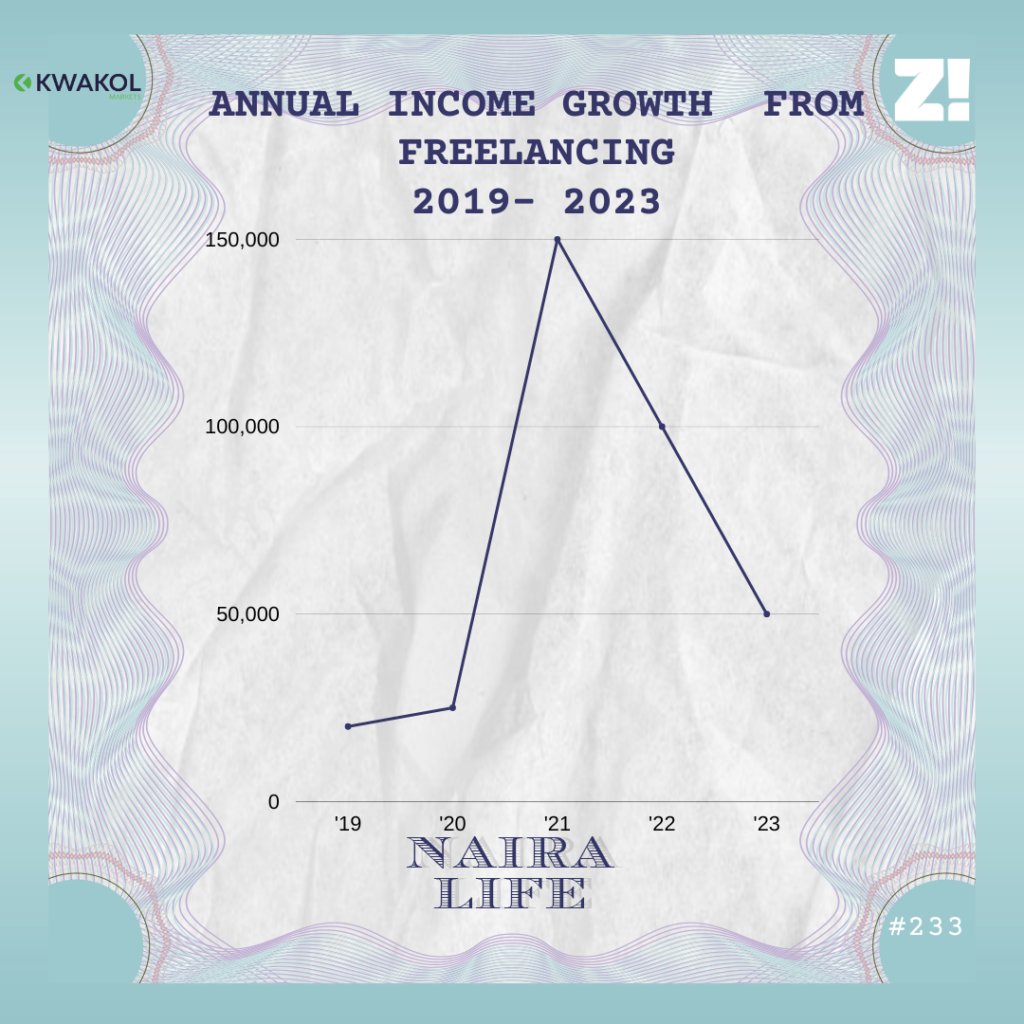
    I had about seven steady contacts, and I started charging around ₦4 per word, which brought about ₦150k/month. At that point, I decided I didn’t need to apply for jobs anywhere. I knew many of my coursemates earning ₦80k at bank jobs, and I was earning much more working from home. 

    Freelancing was treating you well

    It was. In 2022, I published my own fiction novel, but it didn’t turn out as well as I’d hoped.

    What happened?

    Firstly, it cost so much to publish. I’d initially tried to publish in 2019, but the publisher gave me a ₦300k estimate to print a thousand copies. I didn’t have the money, so I postponed it. 

    When I returned to the project in 2022, I found out I now needed ₦750k to publish the same number of copies. At the end of the day, I published only 100 copies at ₦220,000 — the way publishing works, it costs more to print a lesser number of copies.

    Secondly, I didn’t get as much support as I expected. I expected sales to come from family and friends who had been pestering me to publish a book, but support was minimal. I even had a deal with my alma mater to help sell the book to students in the general studies department. They saw the draft, agreed and promised to support, but in the end, it was just “aspire to Maguire”. When I didn’t have money to publish the 1000 copies, they said they needed at least 500 copies for a start, which I couldn’t afford.

    So the school was out of it

    I had to take my books home to sell. Maybe I should have done more marketing, but that would have also cost money I didn’t have. So, I relied on my social media to market. I sold them at ₦3k each, sometimes ₦2,500. The cost of publishing each one was ₦2,200, so I made ₦300 to ₦800 as profit. So far, I’ve only sold about thirty copies. The rest are still in my house looking at me.

    Did you only publish physical copies?

    I also published on Amazon and OkadaBooks, but sales have been very poor. My marketing efforts could have been better, but I’ve also realised that Nigerians hardly read. My money is still in OkadaBooks because they don’t allow you to withdraw until you make ₦10k in profits after their cut. I’ve only made ₦2k. I have other books there as well, but sales have been skeletal. I’m yet to make any profit from Amazon.

    What does your finances look like these days?

    Honestly, not great. I started noticing a dip in my writing gigs in August 2022. My dad was hospitalised, and I had to stay with him in the hospital for two months. I hardly worked during that period. My dad later passed, and it was a tough period for me.

    I’m really sorry

    Thank you. By the time I came back to focus on work in October, the gigs stopped. I reached out to my most consistent contact, and he explained that his Fiverr and Upwork accounts had been closed.

    Why?

    Anyone familiar with these freelance platforms knows how difficult it is to get jobs if your profile has “Nigeria” on it. So, most people use fake foreign accounts to get gigs. But the platforms started clamping down on fake accounts and anyone they found operating in a country different from what their profile stated. Once the account was closed, any money that was still there was confiscated as well. This affected most of my contacts, and many of them are yet to recover.

    Damn

    It made me decide to open my own Upwork account, but since November 2022 till now, I’ve only got one $25 writing gig. The competition on the platform has become so intense now. 

    You have to use “connects” to apply for gigs. But people also bid to get their applications seen. So you can use 50 connects to bid for a job now, and someone will bid 100 connects to get to the top of the list. Even that isn’t sure because yet another person can come and bid 200 connects to take first place. It’s like using money to look for money, but not even seeing the money.

    Wiun. Are you still getting any referrals from contacts, though?

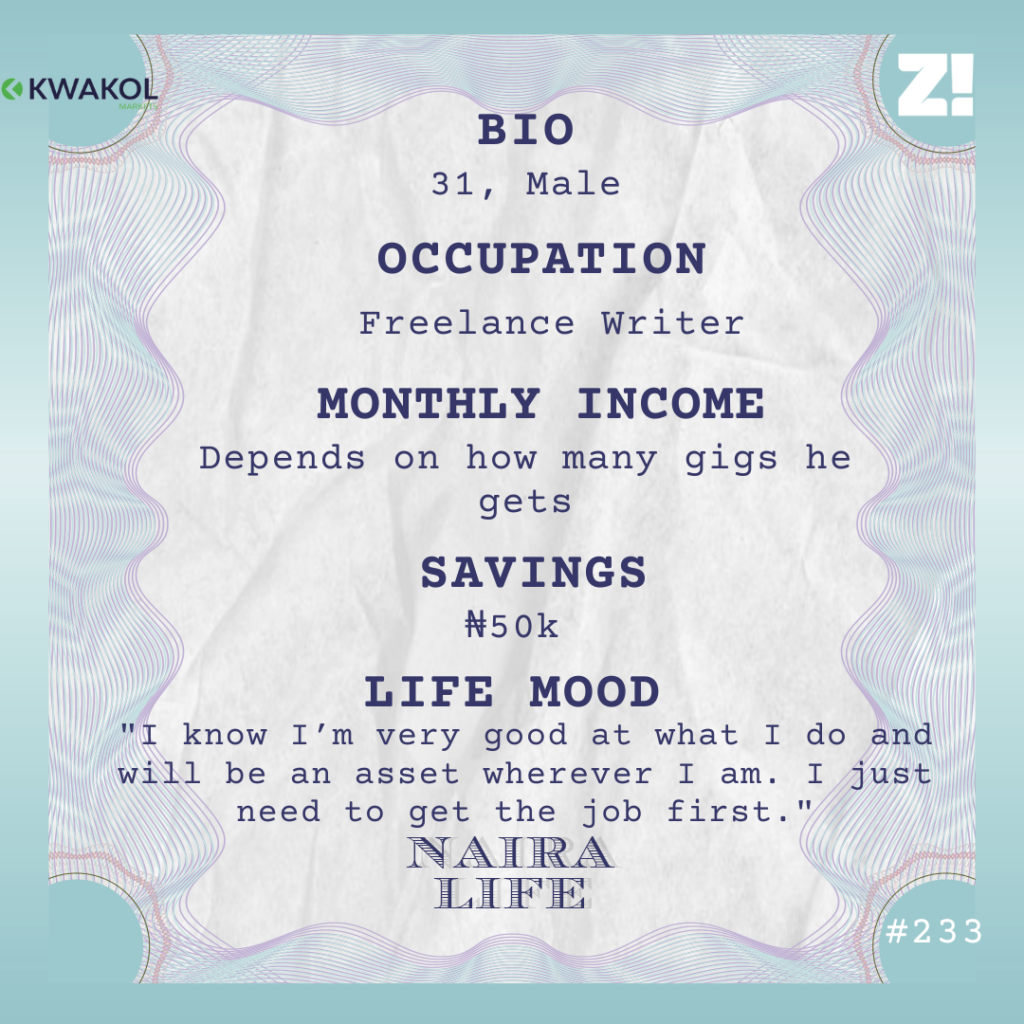
    Yes, but it’s far below 2021 levels. Now, I get about one or two gigs a month. I don’t think I’ve made up to ₦50k all year from freelancing.

    How are you surviving?

    I started writing final-year projects for students, charging about ₦25k to ₦30k per student. The last session just ended in April, and I wrote projects for about seven students in total. 

    How are you thinking about long-term career plans?

    I’m ready to leave the freelance life behind and work in a structured environment, at least for now. The gigs are no longer frequent, and I want to take a break from working from home. I’m looking for copywriting or content writing positions, and I’ve been applying everywhere. I’ll still take on writing gigs if they come, but I need the security and consistent income a salaried job will provide. On average, I put out at least 10 applications a week. 

    Any luck?

    I’ve only had about three interviews so far, but no job offer. I’m still holding out, though.

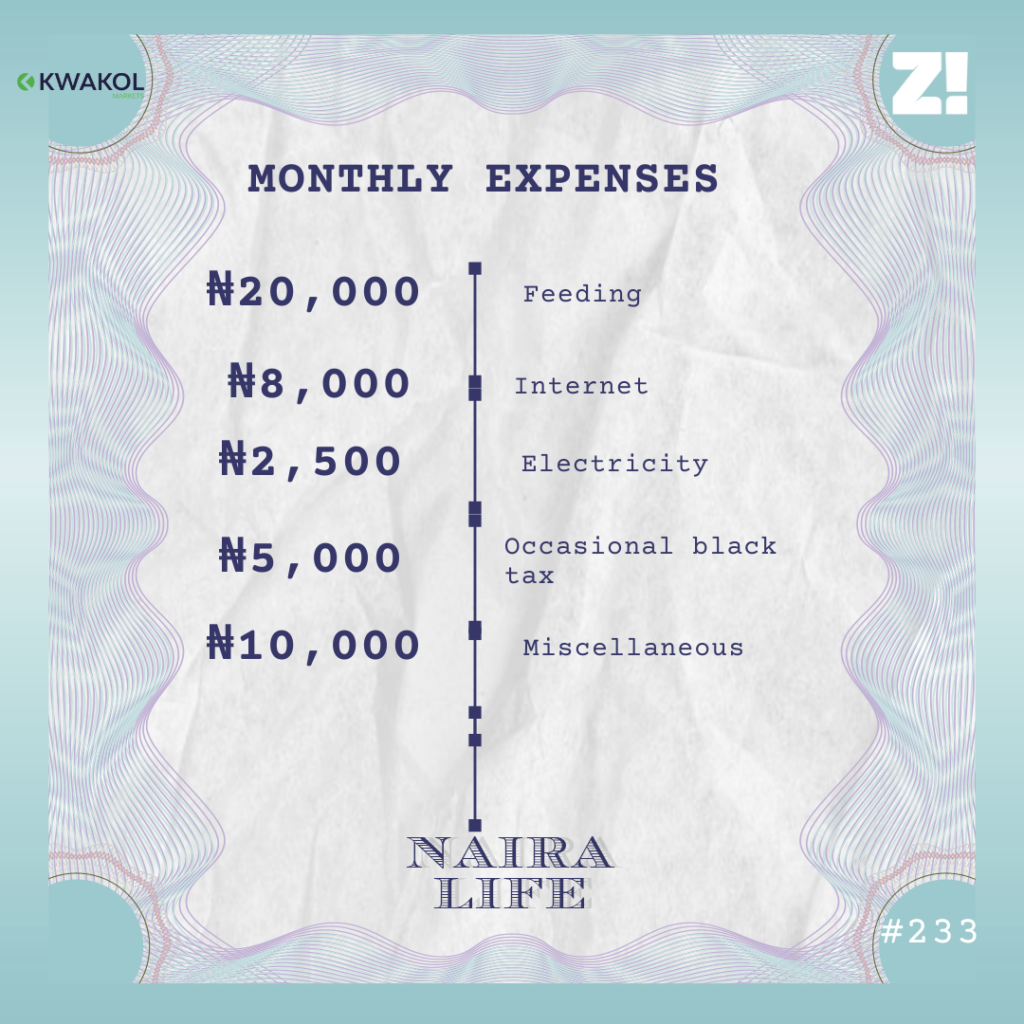
    What do your monthly expenses look like?

    The miscellaneous expenses include church offering, transport fare, and haircuts. I usually stock groceries that can last 2-3 months at a time, so the ₦20k for feeding goes to buying ingredients for soups/stews, bread and other perishable items that can’t be stocked. When I’m out of food items, restocking costs around ₦50k.

    What was the last unplanned expense you made?

    This question triggered me because I just fixed my phone’s screen last week for the second time this year. It cost me ₦20k to fix it. Imagine that kind of money going down the drain in this economy.

    I feel your pain. Do you have any savings?

    I have ₦50k locked up till next month in an online bank, and I’m too sure it’s what will save me by the time next month comes.

    How much do you think you should be earning right now?

    Anywhere between ₦150k and ₦200k, depending on if I get a job in Ibadan or Lagos, factoring in the cost of living, rent and transportation in both cities. I can even take any amount if it’s a remote job. I know I’m very good at what I do and will be an asset wherever I am. I just need to get the job first.

    Is there anything you want right now but can’t afford?

    A new laptop and phone. Both would cost about ₦400k — ₦250k budget for the laptop and ₦150k for the phone.

    On a scale of 1-10, how would you rate your financial happiness?

    3. There’s food on my table twice a day, and my laptop and phone are still manageable, so I can’t complain. But things can get so much better. I hope to get married in the next one or two years, but I’ll need my earnings to improve for that to happen.


    If you’re interested in talking about your Naira Life story, this is a good place to start.

    Find all the past Naira Life stories here.

  • You may have heard there’s money in writing, and of course, you want to know if there’s any truth to it. Let me start by saying, yes, it’s true!

    So, how do you start? How do you monetise your writing skill? What are the best sites for beginners? These are the question this article will answer.

    If you’re a beginner, look online

    For someone just starting out as a freelance writer, you may not have a steady network of jobs and opportunities, so your best bet is to take advantage of legitimate sites that allow you to offer your service in exchange for a fee.

    Which freelance websites are great for beginners?

    1. Writing gig websites

    When many people think of freelance writing, they automatically think of short writing gigs in exchange for money. Many sites allow writers to offer this service, and some of them require a paid subscription to access the opportunities.

    But what if you’re not ready to drop coins when you’ve not even started earning?

    Here are some free sites where you can secure writing gigs:

    iWriter

    This is a great site for beginners. To start, you’ll have to fill out a form and complete two 250-word writer prompts. Your results will determine your level and the writing jobs you can choose from. The higher you go as a writer, the more money you’ll make. 

    Upwork

    This is arguably the most popular site for freelancers that has an excellent market for writers. It’s set up to allow bids for both short-term and long-term jobs. Another great thing about Upwork is that the site keeps a record of all work done by freelancers, which helps build your reputation.

    BloggingPro

    This site regularly offers blogging and freelance writing gigs. It’s basically a job board where freelancers can search for gigs. You may need some writing samples to prove you know your onions.


    RELATED: Zikoko’s Guide to Freelancing Like a Pro


    2. Article submission websites

    Freelance writers also have the opportunity to submit stories, articles and write-ups to certain websites and get paid. Usually, all the freelancer needs to do is study the submission guidelines carefully, pitch articles, and then, wait for feedback. If the pitch is accepted, they submit their writings and get paid.

    Some websites that offer this service include:

    Which freelance website pays the most?

    Most freelance websites offer varying rates for writing jobs depending on the nature of the article requested, the writer’s skill, negotiation ability and the party seeking the service.

    Ultimately, consistency is critical for a beginner hoping to cash out through freelance writing. Not only will it build your reputation, but the more jobs you do, the better you get at it. Of course, the money wouldn’t hurt as well. Cha-ching!


    Note: While these are trusted sites for freelance writers, prospective users are advised to do due diligence when interacting with clients and other users on the sites.

    NEXT READ: #NairaLife: She’s 26, a Content Writer, and Saving Is Her Superpower