
• “A Week In The Life” is a weekly Zikoko series that explores the working-class struggles of Nigerians. It captures the very spirit of what it means to hustle in Nigeria and puts you in the shoes of the subject for a week.


    The subject of today is Femi, a writer at Zikoko. He talks about his experience covering the #Endsars protest in Lagos, how the protest is affecting relationships, and why every Nigerian should support the protest.
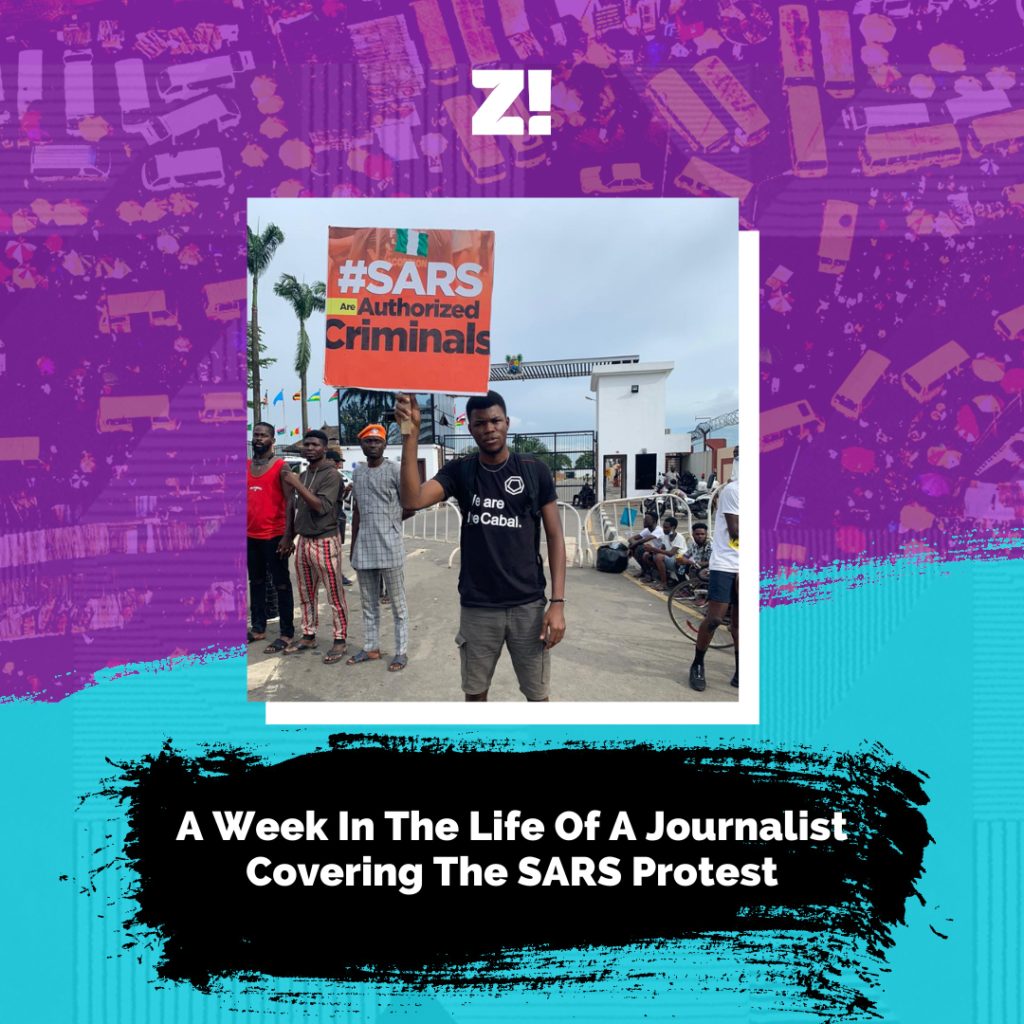
    FRIDAY:

    Today is a big day because I’m covering the #EndSARS protests in Lagos. I’m happy because lowkey, I’ve been annoyed about Nigerians not speaking up for their rights. So, seeing young people come together to stage a peaceful protest makes me proud of them. Of us. And that has gingered me to document the protest. As a journalist, it’s my duty to ensure that society works the way it’s supposed to. That’s why I’m up two hours earlier than I’d normally wake up to complete my tasks for the day. 

    My tasks include covering how protesters in Lagos have been harassed by the police. I’m also reporting the demands of the protesters in clear terms. By the time I’m done, I have renewed ginger to take to the protest ground.

    11 am:

    I left my house by 10 am, but I didn’t get to the protest venue [Alausa] until 11 am. There was a bit of traffic caused by the protesters. It’s easy to get carried away by protest frenzy, so I have to remind myself that I’m here in an official capacity. That means before I react to anything, my camera should be rolling. 

    12 noon:

    A thug tried to snatch my phone while I was recording videos. He was surprised that I didn’t let go of my phone easily. I even got a punch in the mouth for struggling. Thankfully, people surrounded us and pushed him away. It’s funny how he just kept on walking like he didn’t just try to steal from me. I’ve texted my friend safety tips for when he’s coming to join me: “Come along with water, snacks, ID cards, cash, comfortable clothes and no jewellery.”

    1 pm:

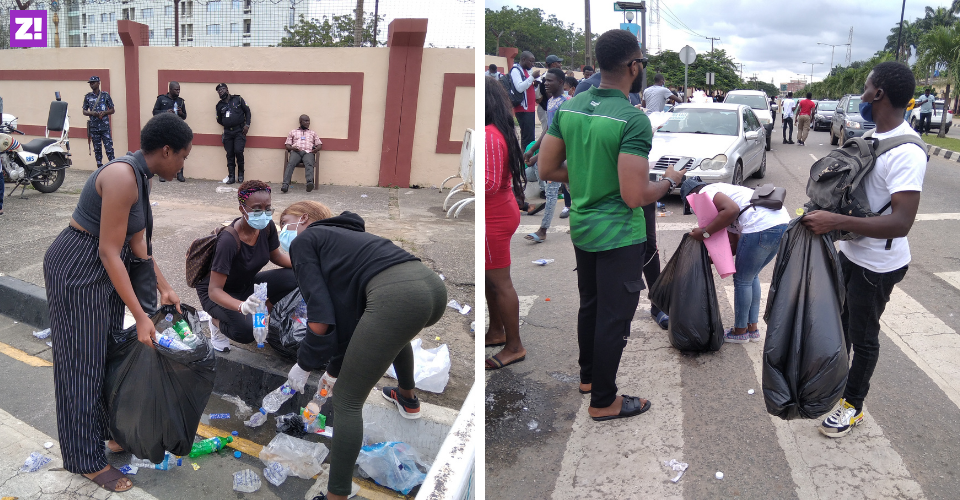
    The protest has been peaceful so far. We have people volunteering to clean up after people littering. I’ve lost count of how many times someone has offered me snacks and water. There are people here distributing facemasks for protesters. Everything is just so orderly. The one time we had an agitated person, we took them aside to ensure that the protest didn’t turn violent. I’m so proud of everyone here who showed up. 
    1:30 pm:

    I’m a bit worried. There are a lot of policemen stationed outside the house of assembly where we’re protesting. Even though it’s a peaceful protest, there’s that underneath fear that anything can happen. The police say they’re here to observe. I’ll soon go on IG live for work. Let me show the people at home how it’s going and that we’re safe. 

    2:00 pm:

    At some point, some agbayas with berets attempted to make themselves the centre of the protest. We promptly shouted them down and didn’t allow them to speak because we don’t want political affiliations with our protest. One of the ways we’re keeping the protest anonymous is to have everyone on equal standing. There’s no one person handling the crowd. There’s no one person talking all the time. The megaphone passes to different people so everyone has a chance to say something at any given time. There’s no central figure, and that’s good because the government can’t pick one person to either harass, bribe or use as a stumbling block to the protests. I think that’s one of the reasons why the protest has gathered momentum. 

    2:30 pm:

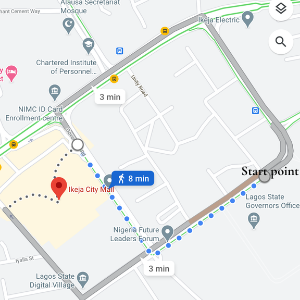
    At this protest, there are two types of people. People who urinate in a large drainage near the Lagos state house of assembly, and people who walk the distance to the city mall to use their toilets. Do with this information what you will. 
    3:00pm:

    Some people suggested that we block the Lagos-Ibadan expressway. Their reasoning is that we’re not making enough impact at the house of assembly as the traditional media is still ignoring us. 
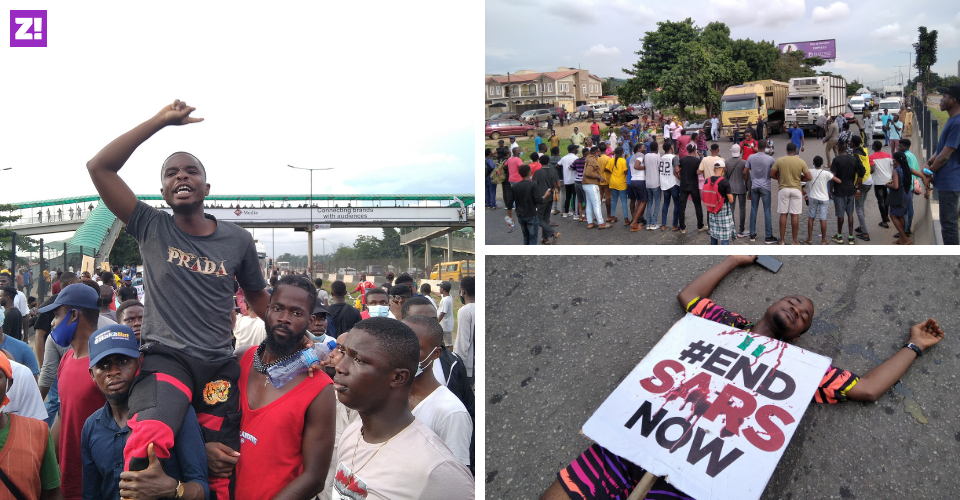
    We’ve blocked the traffic lanes on the express, and traffic is stretching as far as the eye can see. There are convoys, bullion vans, army and policemen in the traffic. I’m scared of an altercation, but I also understand the importance of this cause. 

    Some people came to negotiate, so we left one lane open for traffic on both sides. Instead of a total shut down, it’s now go-slow. I hope the government is paying attention. 

    4 pm – 6 pm:

    I was worried that morale would drop in the evening.  Apparently, someone has booked a DJ. Another person rented a generator. Someone else has gotten canopies, so there’s ginger at the protest ground. The first song the DJ plays is Fem by Davido, and the crowd loses it. Why everybody just dey para for us? 

    10 pm:

    Some people are hell-bent on passing the night at Alausa. However, I’m going home to sleep. Seeing all these people coming out to air their grievances gives me an overwhelming sense of pride. For the first time in this generation’s memory, we’ve decided to let our displeasure be known to the government. 

    I’m proud, tired, and I can’t wait to hit my bed. 

    SATURDAY:

    I’m up early. Again. 

    Today’s protest starts by 8:00 am, so I have to get there early. I’m thinking about the fact that Nigeria is notorious for human rights abuse, therefore protests require courage.  Every time you attend a protest, you don’t know if you’re going to be bundled away. Summoning bravery is the first barrier many Nigerians have to overcome before deciding whether they want to make their voices heard or not.

    I really don’t blame anyone that doesn’t come out to protest. If you can’t attend physically, you can still help by either donating or aggressively amplifying on social media. 

    I think protesters need to know that in addition to wearing correct gear, they shouldn’t incite violence. If any faction is becoming violent and destroying properties, they should immediately leave the area. It’s also crucial to have a protest partner who knows your full name, address and emergency contact. In case anything happens. I recommend as many protest partners as possible because the more the better. The more details people have, the better chance you stand if anything happens. 

    I’m running late with all this thinking. I need to get up and get going.

    They [government] must not take us for idiot.

    SUNDAY:

    I woke up tired today. Standing and walking around Lagos takes a toll on your body, but my eye is on the prize — our voices must be heard. I know that effort is not wasted, so that’s encouraging. We must keep gathering. We must keep pushing. If we don’t support the protests by our physical presence, we’ll donate. If we don’t have money, we’ll amplify on social media. 

    It’s been tiring, and I’ve had less sleep in the past few days than I should, but it’s for a worthy cause. We’re all fighting for a Nigeria we can be proud of. 

    The most surprising thing for me has been seeing the middle class come out to protest. I think that has given a lot of humanity to the protest. You see people who look like you, went to the same school as you. People who talk like you. And they’re putting themselves on the line. I didn’t think I was going to see Nigerians from different backgrounds protest together. At least, not anytime soon.

    Another thing from this protest is hearing how it’s affecting relationships. A friend called to tell me that he hasn’t spent as much time with his girlfriend in a while. Another friend had a similar complaint. After reminding ourselves why we’re protesting, we came to a conclusion: na person wey dey alive go fuck. 

    MONDAY:

    My biggest fears are coming to fruition. Two people in Lagos were shot by the police today. I was afraid of people losing their lives during this protest because people lose hope when the shootings start. However, it seems like the more they kill us, the more young people are ready to push for basic human rights. I’m concerned the protests will become a full-scale riot, and I hope that we don’t get there. 

    For me, this is bigger than a SARS Protest. We are at the point where Nigerians are finally fighting for what they believe in. We finally have a voice and can demand better.

    We’ve proven to govt and international bodies that Nigerian people will no longer be pushed around. That’s a major win for me even if the protest doesn’t meet its objective of ending Sars. 

    I have to work today, so I’ll support the cause on social media. Tomorrow, I go again. I’m pulling up with my guys physically to make sure that our voices are heard. Or I will stay back to document that we spoke, and the government was silent while we died.


    Check back every Tuesday by 9 am for more “A Week In The Life ” goodness, and if you would like to be featured or you know anyone who fits the profile, fill this form.
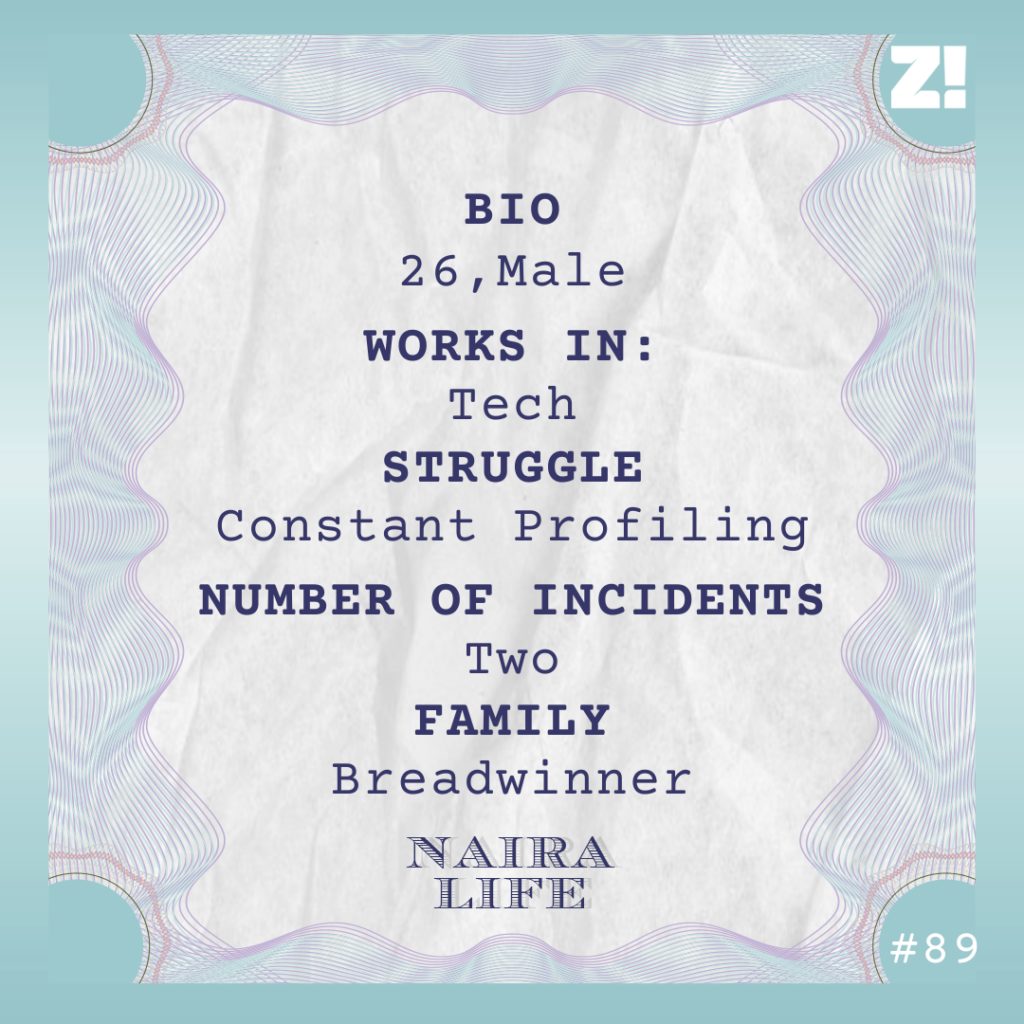
  • Every week, Zikoko seeks to understand how people move the Naira in and out of their lives. Some stories will be struggle-ish, others will be bougie. All the time, it’ll be revealing.

    This week’s #NairaLife is an attempt to explore some of the costs that exist and prices people have to pay because SARS just won’t leave them alone.

    Tell me about the first time it happened. 

    To avoid traffic, I used to leave the house very early – as early as 4 am – and leave work as late as 10 pm. There was this road on my way home – it was always dark at night, and the rule on dark roads is to drive really fast. 

    Out of nowhere, I saw flashlights at the side of the road, police-style. But I was too close to stop. If I’d tried to stop, I’d probably have killed myself. 

    Because of your car. 

    Yes. An SUV. Next thing, I just heard kpa! Kpa!

    Gunshots? 

    Yes. I don’t know if it was two or three, but the shock drove me to stop. Thinking about it, that was a stupid thing to do. They could have shot me when I came down from the vehicle. I came down and started screaming “WHAT THE FUCK?!” I was too angry. I can’t even remember if they slapped me, but I heard “I go slap you now! Wey your driver’s licence?!” and all that. My papers were complete, and when they couldn’t find anything to hold me for, they said I had to pay for the bullets. 

    Uhm, what? 

    After all my resistance, they took me to an ATM, and I withdrew ₦20k to give them; ₦10k per bullet. 

    I carried my damaged car for about a year before I sold it. But that wasn’t the only time it happened. 

    When did it happen again? 

    I went to see my parents. I didn’t even drive. I took an Uber because I realised that every time I drive, it ends with harassment or something getting spoilt in my car because of bad roads. I don’t even let my Uber drive to my house because of how bad the roads are. I was taking an okada for the rest of the way home when SARS officers stopped my okada. 

    They asked me where I was going, I told them. They asked me what was in my bag, I told them it was my laptop. They asked me to open it, and when I refused, one of them slapped me. 

    They grabbed the bag, opened it and saw a Macbook. 

    “Na Apple?! Na Apple be this?!” Another slap. A black bus came out of nowhere, and they were dragging me into the bus. I started screaming, hoping people would intervene. No one did. 

    Man. 

    They successfully dragged me into the bus and took my phone. It was an iPhone. 

    More Apple. 

    They forced me to unlock it, tried to read my chats, but they didn’t find any. They kept asking for my Facebook, which I don’t have. 

    “We go reach station today!” 

    When we got to the station, they took me to the back of the building, sat me on the ground and slapped me. They kept saying, “You be G Boy! Apple! We know your type!” Luckily for me, I had my ID card, and I showed them. 

    What did they say?

    “Alaye, all this one na story!” 

    I asked for them to let me call my lawyer, and what did these people say? “Where you think say you dey wey you go dey call lawyer?” They asked me to unlock the computer, and I don’t know where the confidence came from, but I refused. 

    I might kill myself one day, because I started screaming. “I no fit unlock am, na company property. You wan steal company money?” 

    One policeman came from inside the station and told them to allow me to make a call. I called my lawyer friend and when they spoke to him, they kept yelling, “So you be lawyer for this G boy?!”

    I dunno what my friend said, but when the call ended, they started saying, “Chairman, drop something.”

    When they eventually released me, one of the officers said, “We’ll catch you again, no worry.”

    When I got home, I told my mum I was never coming home again. 

    I imagine your friends have stories. 

    My flatmate was travelling across Southwest Nigeria and found himself on a highway with SARS. They told him they were going to kill him there, and nothing would happen. Since then, any time he’s driving and sees a police checkpoint ahead, he legit starts having panic attacks. 

    One of my other friends walked past a SARS point with his brother, and they grabbed them for nothing. He didn’t even argue;  he just went to an ATM, withdrew ₦100k for himself and his brother, and went on his way. 

    It got so bad for me that I had to leave my neighbourhood. 

    Because of SARS?

    Partly, but it was also just a bad neighbourhood where parking my car outside was a problem. And because it was a bad neighbourhood, SARS always came. I moved to a new side of Lagos, and I stopped experiencing SARS trouble. 

    Where? 

    Lekki. I moved before I could afford to. In fact, I had to take a company loan to be able to meet my rent in Lekki. My salary was ₦500k, and I took a loan of 1 million. This was in 2017.  

    It feels like a fortification for you. 

    It is o. Other efforts, I must say, might perhaps my car? So, my glass is tinted, and policemen tend to not want to offend powerful people. In fact, I’m considering getting police plate numbers. They cost up to 300k. 

    But even within my fortification, I still get profiled by my mostly older neighbours. What do you think they think of a person who hardly leaves the house because he’s been working remotely before the pandemic? 

    Beyond your personal life, it looks like this is a corporate problem. 

    Yes. Where I work, whenever you get arrested by SARS, you call the legal team at the office immediately. Even if you’re only able to call after, they double down to try to retrieve whatever was collected from you. 

    I work in tech, and at my company, we built a tiny, hidden in-house app. Once I open it, it triggers an alert to my company’s Slack channel, sending my live location and my name. 

    So, any time SARS stops anybody, if they’re able to, they just need to open that app, and everyone in the office knows where they are. 

    We worry about making it public because SARS guys might learn about it. But we want to at least start talking to companies to start using it. 

    What other hidden costs exist? 

    For me, when I want to hire people on my team, I have to consider where they live. Always. Once they mention one of those SARS hot spots like Shomolu, I start to mentally calculate the salary amount that it’d cost for them to move to a better neighbourhood. 

    I remember one of my team members moved after he was assaulted by policemen. He borrowed money and found the cheapest possible apartment.

    Another reason why this is important to me is that a lot of people on the team carry their laptops home. That means that if SARS accesses their computers, they might be able to access sensitive customer information that needs to be safe.

    How does this dread make you feel about your future in this society? 

    The thing is, even though I want to give my children, whenever I have them, a better passport, I still want them to be able to think of this place as home. Take me for example, I can japa, but I would have to leave my mum, dad, brother. I can’t carry all of them. Leaving Nigeria won’t give me peace of mind. 

    Ah, looks like there are serious stakes on the family front. 

    Well, I’m the firstborn, for starters. I have four other family members. I’ve essentially just taken the burden, or responsibility of my siblings. My dad is retired, my mum runs a shop. If the burden of my two siblings goes back to my parents, that’s going to be disastrous. 

    Currently, 25% to 30% of my income goes to my family monthly. It’s everything, allowances for all of them, food for the house. One of them is a student, so there’s always a school thing to pay for. 

    How many per cent of their monthly expenses do you think it currently covers?

    And that’s just monthly. There’s the occasional stuff; rent for myself and siblings, school fees. I bought all the phones in the house. 

    I actually don’t want to think about it, I just accept it as part of life.

    There’s always a moment when you realise that you’re the new breadwinner.

    It was my younger brother’s first school fees for me. My parents could not afford to pay, even though It cost about 180k. There was also the hostel rent. That was when it dawned on me that I’d taken on a new role in the family. Random, but it’s quite ironic that our parents aren’t proactive about #EndSARS, especially since many of their children are victims.

    There’s the pressure of me wanting to take my siblings out of that environment because it’s just not safe. They haven’t had any bad SARS experience, but they don’t have to. 

    You work in tech, that makes you a sitting duck for starters. 

    Look, I made locs, and I had to cut them because I didn’t want problems. The only reason I’m really scared of SARS is that people need me. 

    Another thing I’ve seen with every SARS video I’ve seen – and even my own experience – nobody is going to help you. It shouldn’t be. 

    Over to you, in what ways has SARS affected how you navigate your personal life?

  • Citizen is a column that explains how the government’s policies fucks citizens and how we can unfuck ourselves.


    Earlier this afternoon, the Nigeria Police Force tweeted that SARS has been dissolved.

    In 5 points, the Public Relations Officer of the Nigerian Police Force, Frank Mba, stated that SARS has been dissolved in the 36 state commands with immediate effect and that all men serving in the Unit will be redeployed to other Police Commands, Formations and Units.

    He also stated that a new policing arrangement for tackling Armed-Robbery and other violent crimes will be unveiled soon, a Citizens and Strategic Stakeholders Forum will be launched, and an investigative team will be set up to deal with the reports of crimes committed against citizens.

    Now, Let’s Break It Down:

    1. Don’t Trust The IGP

    First, it is important to shamelessly plug that this is not the first time SARS have been reformed (or acclaimed to have been reformed). So, what is the assurance that this “dissolution” will work?


    Read: 5 Different Times SARS Have been “Reformed”


    The way it appears (since 2017), the Police Force Headquarters itself cannot properly control this officers. And this is why everytime the IGP makes an order about a new SARS reform, you hear that SARS officers are still terrorising citizens somewhere, at almost the same time.

    2. Where are the SARS officers going?

    Secondly, what is that number 2? I  mean the second point? It reads:

    “All officers and men serving in the Unit will be redeployed to other Police Commands, Formations and Units”.

    Is the IGP whyning us?

    SARS officials will be redeployed to other units? So what will they be going there? Playing Ludo with citizens? Of course, they’ll continue what they used to do before! Robbing and extorting Nigerians.

    What I would have thought the IGP would have ordered was that every State Police Command will be ordered to conduct an assessment of the SARS operatives im their command, grade each of them on past records/performances and deal with the “bad eggs”, after which the fairly responsible ones can be further retrained before being deployed to another unit.

    You don’t just take a SARS officer and put him another unit. The man hasn’t changed. Omo, once a SARS always a SARS, I think.

    3. Do The Police Feel Remorseful?

    Remorse is an important thing, and it helps us determine if the Police are truly sorry for their actions over the years.

    But in this new order, you can hardly find remorse in it. Is the Nigerian Police really ready to reform itself and stop terrorising Nigerians even more than the criminals they are supposed to protect? I really don’t think so.

    In fact, there’s nothing in 5 point memorandum that makes me think so.

    WHAT MANY PEOPLE WANT

    To many Nigerians, this directive is just another false alarm. The Police have issues many (many) statements on SARS reforms, and this particular statement is no different.

    What I think will truly show that the message of young Nigerians has clearly been passed across is a clear statement from everyone in the Muhammadu Buhari Administration admitting that yes, the Police have failed and that SARS will be banned while proper police reforms will happen within the next three to six months.

    The President can decide to make a broadcast (which is better), and some sort of Executive order must be signed to show that SARS as a Police unit is ended.

    But look, nobody has to strictly follow any of the processes above. We’re tired of audio reforms. SARS must end, and the Government must reform the Police. Seriously.


    If there’s any information you think is important for us to cover ASAP, please let us know.

    Find more information on the EndSARS Movement here

  • After the series of #EndSARS protests across states in Nigeria yesterday, President Muhammadu Buhari finally addressed Nigerians through a series of tweets sent out from his Twitter handle. The tweets were posted at 9:41 PM. Here’s what he said:

    I met again with the IGP tonight. Our determination to reform the police should never be in doubt. I am being briefed regularly on the reform efforts ongoing to end police brutality and unethical conduct, and ensure that the Police are fully accountable to the people.

    The IG already has my firm instructions to conclusively address the concerns of Nigerians regarding these excesses, & ensure erring personnel are brought to justice. I appeal for patience & calm, even as Nigerians freely exercise their right to peacefully make their views known.

    The vast majority of men and women of the Nigeria Police Force are patriotic and committed to protecting the lives and livelihoods of Nigerians, and we will continue to support them to do their job.

    The general response to this update from the president is that the Special Anti-Robbery Squad (SARS) should be scrapped, not reformed.

    The protest continues today. Here are some updates as posted on Twitter.

    https://twitter.com/ladytiffs_/status/1314840304827207682

    More updates coming soon.

  • The Nigerian experience is physical, emotional, and sometimes international. No one knows it better than our features on #TheAbroadLife, a series where we detail and explore Nigerian experiences while living abroad.


    Today’s subject on Abroad Life is a woman who left Nigeria seven years ago. She’s lived in Scotland and England so far. She talks about how leaving religion made all her friends cut her off, and how she’s grown past the idea of living in Nigeria. 

    First things first, how long have you been in the UK?

    I came to the UK for college in 2013, but I was in Scotland for about a year. In 2014, I started undergrad in London. 2017 to 2018 was my master’s, I went back to Nigeria for a year to do NYSC. I got married in Nigeria, and I moved back this year. So that’s roughly seven years. 

    Did you initially move with your family?

    All my siblings were in the UK by the time I moved.

    How did you feel when you started living in Scotland?

    In college in Scotland, you’d see girls with purple hair, tiny shorts, crop tops. Scotland is cold and I don’t know how they managed to pull that off. Before I moved to the UK, I had done a year of undergrad atin Niger Delta University (NDU). There, you couldn’t wear sleeveless clothes past the gate. The security man would embarrass you. Another weird thing in Scotland was professors and teachers telling us to call them by their name.

    Culture shock?

    Definitely. During orientation, I met a bunch of people, and we became friends in the first week. There was an Indian, a Pakistani, a Russian, some Columbians and some Scottish people in our squad. It was in bonding with these friends I realised that once you’re out of Nigeria, you need to watch the way you speak. There are some things you’ll randomly say in Nigeria that you can’t say here because they’re not “progressive.”

    Did you have an incident?

    Yes. One time in college, I was talking about God with a friend, and her friend was there. She was Muslim, I was Christian, and he didn’t believe in God. I remember saying something along the lines of “Well, I won’t discriminate against you if you don’t believe in God,” and the atheist guy got a very bewildered look on his face, like “What does that even mean?”

    Haha. Did you say you “were” Christian?

    Yes, but leaving religion wasn’t due to culture shock. I blended into British culture as much as I could. My religion was part of my social life. When I left Scotland for England, all my major friends for at least one year were church mates. It was a lot of fun. We used to go out to a lot of parties and clubs a lot. It was great. But I was already getting some progressive ideas.

    Leaving religion was because of religion itself. I started dating my husband when I was religious. I used to be a Jehovah’s Witness. In 2018, one of our big conventions was coming up, and at that point I had already red flags with religion. I had questions. So I decided that I was going to listen and study this time during the convention and let the word dig into me and all of that. It was that extra listening that messed everything up. Everything just started sounding very very silly. 

    It was a three-day program and I was supposed to invite my husband to part of the third day, but I couldn’t because I was just there thinking “If he hears any of this, he’s going to think I’m crazy.”

    That was the beginning of the end.  I started researching and watching a bunch of videos and that was it. Apart from when I moved to Nigeria and had to make my mum happy and all of that, that convention was the last time I stepped into anything close to a Kingdom Hall. 

    How did that change your perception of life?

    First off, I lost my social circle because everyone cut me off. After that, it was just an extra fear of death. Before, I used to believe in resurrection after death. But now I had to accept that it was just a final sleep.

    Even till now?

    Yes. But I channel those thoughts into loving more and appreciating life. Because I only have one, I might as well make the most of it. I stopped restricting myself to opinions and views I had in the past. I just owned it and then I reconnected with some old friends. Leaving religion was scary, isolating and free.

    That’s cool. What’s it like living in England?

    I live just outside London. It’s been weird because of Covid-19 and lockdown so everything is on hold. When we moved, we went to London a lot because London is 30 minutes from where we are if you use a train. We would go to the theatre, restaurants, or shows. We saw Dave Chapelle live. I slept. 

    Then we went into lockdown. During lockdown, I started baking and my husband started working from home. So we would be home 24/7. We would bake, eat, sleep, watch a movie, and record videos for our YouTube channel. 

    What kind of videos do you make?

    We review Nollywood movies.

    I’m also job hunting. 

    How’s that going?

    Very stressful.

    I started job hunting when I got here. Covid-19  was teasing, but it wasn’t that deep. I was applying for jobs at universities because that’s kind of the space where I want to be. When lockdown happened and the schools closed, the jobs went on hold too. There was really nothing to do so I put my job searching on hold. A couple of months ago, I started applying again, so many people have become unemployed as well so the job market is full.

    Do you think it could be harder for you to find a job because you’re not British?

    Not right now.  Before I went back to Nigeria, I was job hunting and a lot of my problems were because I needed my visa to be sponsored. I almost got some jobs but because I did not have residence and they couldn’t sponsor my visa I lost the opportunities. But now they don’t need to sponsor my visa because I have a spouse visa.

    Wait. Please explain that for Nigerians like me who don’t understand.

    When you’re on a student visa, you can switch to a work visa if you get a job and the company is willing to sponsor your visa. They’re not paying money for it or anything. They’re just saying “This person is in the UK because they work for us.”

    Not every company has a sponsorship license and getting one is not so easy. So they would rather just interview and hire a lot of home and EU people. But my husband is a resident here, so after we got married, I got a spouse visa which means I’m technically a resident as well. 

    Does it mean you can stay there forever?

    Something like that. When my visa expires in about three years, I need to apply for an extension, and then after the extension, I need to apply for my resident visa. British people will always look for a way to eat your money for you to stay.

    What are the chances that all of this will work out?

    Very high. As long as you’ve gotten your first spouse visa, you’ll get the second one, except they have reason to believe that you and your spouse are not really married. It’s easy from there on. You’ll get your citizenship in about 5 years. 

    Nice, so you’ll be a British citizen soon. Does that excite you?

    I don’t think about it a lot. I just want it for the passport. I want to travel. Visa applications are the worst. I feel I wasted my uni years studying instead of travelling. I had a friend who said she was feeling stressed so she went to Italy for a day. You can’t do that unless you have a visa, but having the red passport is a beautiful thing. 

    I can’t wait to start travelling. Tickets are actually very cheap. The last time I went to Paris, a round trip ticket was about £60. I want the freedom of the passport.

    What would make you come and live in Nigeria again?

    I’ll only come back and live in Nigeria if there was a war in England I can’t go anywhere else. 

    I don’t hate Nigeria or anything, but being there really stresses me out. When I moved back to Nigeria for a year, I didn’t feel like I really fit in anymore.

    Why?

    I was biting my tongue on a lot of stuff even the things that I decided to talk about would have my mother freaking out.  

    I like to consider myself as one of the most benign feminists ever, but in my area in Nigeria my views were considered too extreme. I would say something simple and the older ones would be losing their minds. 

    I did NYSC, but there are parts of it that were kind of a humiliating experience and that just killed the whole Nigerian experience for me. Imagine someone inspecting my NYSC uniform and telling me to turn around or someone giving me a blade to cut my NYSC uniform because they don’t like it. 

    It sounds silly but those are things that put me off from coming back to live in Nigeria. I can fight for my rights here with my chest,  but you can’t do that in Nigeria because they will mess you up. Imagine trying to claim that you know your rights with a Nigerian police officer. I think I’ve taken myself away from that culture and going back into it will be hard.

    I also have learnt to dissociate myself from the idea that I have to be smart because someone might be trying to cheat me and I don’t want to have to learn that again.  

    What do you miss about being in Nigeria?

    My friends and my family.

    What’s the best thing about living in the UK?

    Freedom. I feel more like myself if that makes sense.

     And I don’t have to fight to go to the market.

  • Citizen is a column that explains how the government’s policies fucks citizens and how we can unfuck ourselves.


    #EndSARS protests are currently ongoing across different cities in Nigeria. Remember that many celebrities had tweeted that they will be leading #EndSars protests. 

    Amidst celebrity promises and tweets against SARS brutality, groups of young Nigerians have also decided to conduct their own protests to #EndSARS in the country.

    https://twitter.com/simbzzz/status/1314127972165660674

    Read: SARS Was Created When The Police Ran Away


    SARS’ Brutality

    SARS is the Special Anti-Robbery Squad, a “tactical unit” of the Nigerian Police Force dedicated to fighting armed robbery in the country. However, the squad is notorious for extorting young Nigerians, illegally arresting them and subjecting them to many human rights abuse.

    Last week, there were unconfirmed reports of SARS killings in Ughelli, Delta State Nigeria. And while the Police have called those videos “false and malicious”, SARS still remains a nagging issue for many Nigerians.

    https://www.youtube.com/watch?v=yW1UAkdS0b8

    At the end of the day, the message from many Nigerians is clear: SARS needs to end. But will it?

    Read: Can SARS End?

    Check back every weekday for more Zikoko Citizen articles.