• Every week, Zikoko seeks to understand how people move the Naira in and out of their lives. Some stories will be struggle-ish, others will be bougie. All the time, it’ll be revealing.
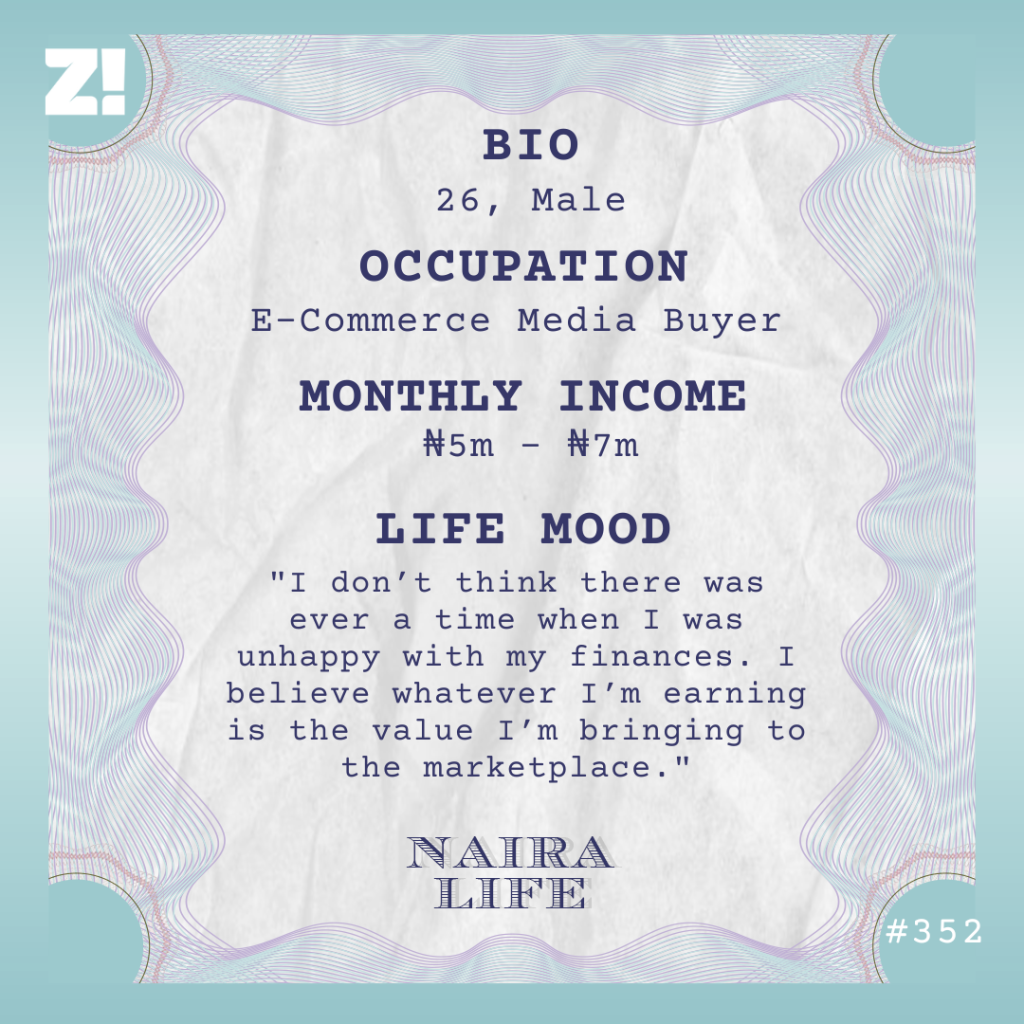

    Nairalife #352 bio

    What’s your earliest memory of money?

    The lunch money I got from my mum in nursery and primary school. ₦10 could get me ₦5 buns and a plate of rice. 

    Those were the days. What was growing up like financially? 

    Terrible. You know how people say their parents weren’t financially well off? My case was different. The roof of our house was once removed because we couldn’t pay rent. It was that bad.

    My dad was an artisan; he painted buildings for a living, and my mum was a petty trader. I noticed early that my mum was the risk-taker. If my dad didn’t get an opportunity he wanted, he was fine with what he had. He hardly pushed for more, but my mum was different. 

    She was constantly hustling, seeking new opportunities and exploring additional trades to try. I think I’m more like my mum in that regard. I started hustling at the age of 10. 

    Tell me about that

    I hawked sachet water in the market to make money. I even raised the business capital myself. 

    Here’s how: I grew up in a rural area with many cocoa farms nearby. Cocoa merchants bought cocoa pods from farmers and dried them in their stores. When these stores closed at night, they’d pack the cocoa inside, but a few cocoa beans would fall on the ground. 

    Then, the town children and I would go pick up the beans. If we gathered up to one kilogram of the beans, we could sell them for ₦500. If you could gather two or three kilograms, that was very good money. This gathering often took weeks to reach a decent size.

    Anyway, I sold my small stash of cocoa beans and started the business. My dad was against it, but I didn’t care. I bought a bowl for ₦130 and a bag of sachet water for ₦100. The first day I started didn’t end well.

    What happened?

    I didn’t know much about the business, so I made a few mistakes. After I sold the first batch of water, I went to buy more and repeated the process after selling them off. The sun went down, and I ignorantly bought another batch. Everyone who has sold sachet water knows that it was a wrong move because there was no way I’d sell off the water by that time. 

    When I inevitably couldn’t sell them, people advised that I return the stock to the person I bought it from. Most pure water sellers had agreements with their “suppliers” that allowed them to exchange warm sachet water for cold ones if they couldn’t sell. I tried to do the same, but unfortunately, the person who sold it to me wasn’t a good person. He refused to change them and even beat me up.

    Oh my God

    It was discouraging. I had to throw the remaining water away because we didn’t have a freezer at home. It was a big loss, and I was only able to start again because my friend gave me ₦200.

    I sold sachet water every day after school for about two years. I could make ₦200 – ₦500 profit daily, and that was big money in school. The business also taught me a great deal, particularly how wicked people could be. 

    A sachet of water cost ₦10, and someone could take the water, drink it, and then give a 10-year-old ₦1000 to go and look for change. They knew I wouldn’t have change for them, and they’d ask me to come back for my money. I never saw them again. 

    That’s wild

    I stopped the business when I was in SS1 or SS2 because my school started dismissing us late at 4 p.m., and I couldn’t keep up. 

    In SS3, I dropped out of school altogether because my dad couldn’t afford to register me for WAEC. While exploring what else I could do, I decided to apprentice at a business centre since I was naturally skilled with phones and computers. Plus, having briefly worked as an apprentice typist at a similar place a few years prior, it made sense to continue in that line of work. This was in 2014.

    The place I worked was popular with lawyers. They often came to type processes and court judgments. 

    Was it a paid apprenticeship?

    No o. I was essentially learning, so I didn’t have a salary. My dad encouraged me to be patient and just get the skill.

    I quickly became popular due to my fast typing skills, and the lawyers always wanted to work with me. Some even started asking me to come work for them, offering to pay more than what I earned at the business centre. I couldn’t even tell them I wasn’t being paid.

    My popularity didn’t sit well with the business owner; he didn’t like people praising me and always called me weird because I read a lot. I’d install PDF readers on the computers to read random things like philosophy. I often obsessed over learning random things. For instance, I could think about something like YouTube videos and go all in with learning everything about creating them. 

    So, I was really good. I could say I even knew more than the owner. I worked with him for about two years. During that time, he repeatedly promised to start paying me, but it never happened. I finally left in 2016, because I was considering returning to school and needed to save money. I went on to work with one of the lawyers who’d been trying to poach me. 

    How much did the new job pay?

    ₦15k/month to work as a typist for the firm. I also occasionally did some secretarial duties. It was the first time I earned a salary, and the money was okay for me. I was a 17-year-old living with my parents, so I didn’t pay rent or any major bills and was able to save. In 2017, I was able to raise enough money to write WAEC. 

    Besides the money, working with that lawyer was such a blessing. I still mirror his lifestyle to this day. He was very calm and organised. He taught me how to live a balanced life, and I really enjoyed working with him.

    In 2018, while still working with him, I found another income source. One of the other lawyers in the firm gifted me a laptop, and I began using it for research. Every day after work, I’d buy ₦100 data and explore the internet for different things I could learn. I also created a blog using one of the free hosting platforms; I think it was Blogger. I knew it was possible to monetise the blog and start earning from Google Ads, but I also knew it would take a considerable amount of time, effort, and web traffic. 

    Fortunately, I found a way.

    What did you do?

    Around this time, a betting company was really popular, and people were always looking for information on how to become a company agent and open a betting shop. So, I wrote a post about the process on my blog and used it to sell an ebook I created about becoming an agent. 

    My post ranked well on Google, and people started buying my ebook. At first, I sold it for ₦1k, then increased the price to ₦2500 when I noticed it was selling quickly. In a month, I could sell 10 ebooks. At the same time, my blog got monetised, and I could make $100/month — about ₦32k — using Infolinks to display ads. In addition to the ebook sales and my salary, I was making over ₦80k monthly.

    I wrote the JAMB exam that same year and had even gotten admission into the university when my income took a hit.

    What happened?

    Google regularly pushes out updates, and that year, one of these updates hit my site and affected my blog’s traffic. I stopped ranking, and revenue dropped. After gathering all I had (which was about ₦120k), I still needed about ₦350k to complete school payments and rent a place close to campus. The blog wasn’t bringing in money anymore, so I needed to shift direction.

    I came across a European site that sold football betting tips for gamblers. The tips were quite expensive at $499/month (approximately ₦140k at the time), and I had a crazy idea of reselling them. I took all the money I had, added my salary and sent it to the guy selling the tips. I could’ve easily been scammed, but fortunately, I wasn’t. The guy added me to a group where he sent the games. I noticed the tips were actually genuine and profitable, but I wasn’t interested in playing them.

    Instead, I went on Facebook, made a video and started running ads. In the video, I explained how, instead of $499/month for that site, people could just pay me ₦7k/month for the same genuine tips. I also showed proof that I bought them from the $499 site. 

    Omo, the kind of money I started seeing. 

    Too much sense wanted to finish you

    My offer was too stupid for anyone to refuse, and people were just buying left, right and centre. I just created a Telegram group, added them, and sent them the games. By the end of the first month, I had almost ₦600k in my account.

    The money helped me resume at uni and rent an apartment. I was still young and didn’t know a lot about money, so I was just spending. The iPhone 7 was in vogue at the time, so I bought one. I even changed my laptop.

    In early 2019, Facebook started disabling sports betting ads. Luckily, I’d grown an email list of subscribers who trusted me. The thing about betting is, it’s very difficult to find someone who is not a scammer. Since I didn’t scam them, they kept resubscribing. Plus, people were winning too, which was good. Sometimes, they even dashed me money. So, my income was stable and almost passive due to the monthly subscriptions.

    However, towards the end of 2019, I suddenly lost interest in the betting business. I don’t know why; I just stopped liking the idea and gradually stopped. My subscribers even reached out asking why I stopped, but I didn’t have a valid reason. That’s how that income source dried up. 

    Get More Zikoko Goodness in Your Mail

    Subscribe to our newsletters and never miss any of the action

    Interesting. What did you do next?

    My school was close to one of the most prominent markets in Nigeria, so I started going there, looking for products I could sell online and make 3x the cost.

    I mostly sold household products. I could buy an item for ₦1k, and list it on JiJi and Facebook ads for ₦4k. That became a major income source for me. I hardly attended class because I was always at logistics companies to sort out deliveries. 

    The money wasn’t as good as sports betting; that one was unlimited money. I could sell a game one million times. However, with physical products, I could only sell as much as the available stock allowed. Still, I was making around ₦500k – ₦800k monthly, which wasn’t bad. I lived a comfortable life in school. 

    I’m also glad I started dealing with products instead of relying on sports betting because it set me up for what I do today. I still work with products, just on a very different level.

    What do you do these days?

    I’d say it’s e-commerce. I look at the market trends and bring in possible solutions in the form of products. For instance, insecurity has been a significant challenge for Nigerians lately. As a business, I can decide to start selling security gadgets, and people would buy in volumes. If I make ₦3k from each gadget and sell 10,000 units, that’s ₦30 million profit.

    I use ads to push my products on Facebook, YouTube and MGID. It’s a thriving business now, and I work with a team of 12 people, generating an average monthly profit of around ₦12 million to ₦15 million. The expansion didn’t happen overnight. 

    In 2020, I recorded my first ₦1 million profit in a single month from selling a specific mosquito product, and we continued to grow from there. We also sold fitness equipment during that period.

    The business faced a small struggle in 2021 when Apple released the iOS 14.5 update. It came with a privacy update that made it difficult for third-party platforms to track user behaviour and show them targeted ads. Now, users had to give permission before an app could track their data, and if they clicked “no,” it was all over. 

    Ad performance was terrible during that period, but fortunately, we started to recover in late 2022, and it’s been going well ever since. 

    How do the business operations work?

    I have a way of knowing that a product will do well. I think it’s a muscle formed by how long I’ve been doing this. After picking the product, we’ll conduct a test run of like 100 units and use the performance data to determine whether we’ll scale or not.

    I have an office where I work with a few full-time employees, but I also have agents in different states in Nigeria who get the products and handle delivery. 90% of the orders we receive work with the pay-on-delivery model because Nigerians don’t trust the internet. When the agents deliver, they remit the money to the business. 

    I decided to operate this way because I believe there’s a limit to how well a business can perform if it’s a one-man operation. If I’m doing it all alone and making a total revenue of ₦100k, 20% net profit of that is just ₦20k. However, if I’m running a ₦100 million business and I achieve that same 20%, I’ve just made ₦20 million. 

    Both the ₦100k and ₦100 million could be the same personal level of work, but for the latter, I’m using the leverage of getting more people involved to scale faster. It’s better to own the leg of an elephant than a whole ant.

    Hmm. That’s a lot to think about. You mentioned a monthly profit of about ₦15 million. How much of that is your income?

    After removing operating costs, salaries, and returning capital to the business, my “salary” is usually about ₦5 million to ₦7 million monthly. 

    I’m specific about always returning money to the business because it’s easy to lose an opportunity if there’s no available capital to allocate to it. I also don’t joke with expansion. Every extra money returns to the business.

    You’ve had massive income growth over the years. How has that impacted how you think about money?

    I believe fear is a significant reason why many people struggle to make money. It’s the truth. If you don’t take some kind of risk, you won’t make money. Also, money is a reward for helping people out. 

    If you aren’t solving a need, making someone’s life better or offering value, it’s almost impossible to make money. I never had any doubt about whether I’d make money or not. It was always a matter of time.

    How would you describe your relationship with money?

    I have a problem. Once people around me start sharing their problems, I feel an obligation to help solve them. Recently, I calculated how much money I’d given out this year, and it was almost ₦10 million. I’m not happy about that, and I plan to stop giving money away so much.

    Beyond that, I’m not the materialistic type. My only guilty pleasure is food. It sounds unbelievable, but I spend at least ₦800k on food monthly. It’s that expensive because we (I live with my brother) have a chef whom I pay ₦180k monthly. I also eat out a lot and still spend at least ₦150k on protein powder every month. 

    Now would be a good time to walk me through your typical monthly expenses
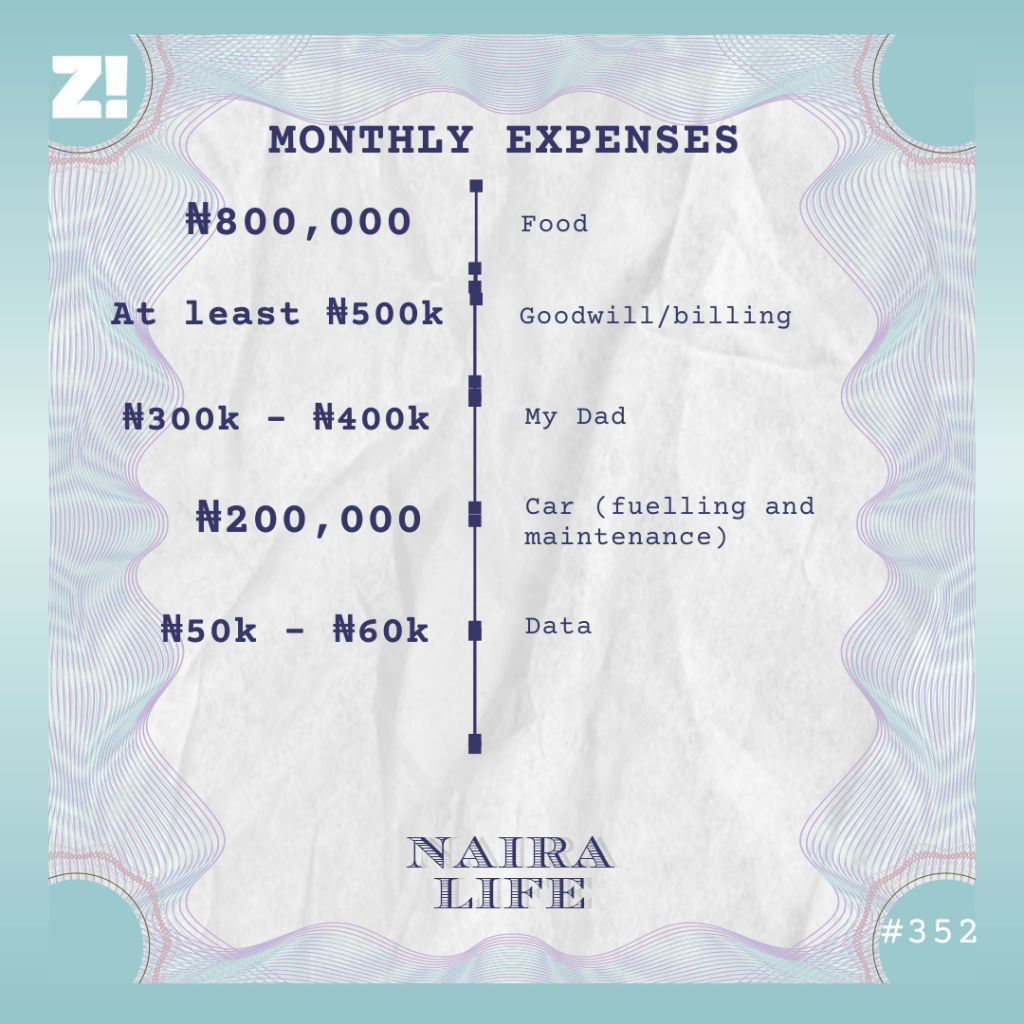
    Nairalife #352 expenses

    I don’t save money. Whatever reserve I have is reinvested in my business. Another thing that takes my money is travel. I believe travel helps me learn, so I typically spend ₦4m – ₦5m on an annual trip within Nigeria or to an African country. My rent is ₦4 million, but I don’t save for it. Once it’s time, I just pay. 

    Is there anything you want right now but can’t afford?

    Honestly, nothing. I would like to move to the US, but money is not what’s holding me back. It’s the visa; I know it’ll be hard to get as a young person right now.

    Is there an ideal amount of money you think you should be earning right now?

    I always think in terms of the business, so I think we should be doing a net profit of ₦100 million monthly. We’re currently working towards that, already planning structures and hiring needs to guide expansion to more countries. We already sell in some African countries, but the goal is to scale. By the grace of God, we should have hit over 50% of that ₦100 million goal before 2027.

    Rooting for you. What was the last thing you spent money on that made you happy?

    A vacation package to Southwest Nigeria in September. It cost me ₦3 million. I’m almost always working, so I don’t go clubbing or things like that, so it’s nice to enjoy travel experiences.

    How would you rate your financial happiness on a scale of 1-10?

    10. Even if you’d asked me this when I earned ₦15k, it’d still be a 10. I don’t think there was ever a time when I was unhappy with my finances. I believe whatever I’m earning is the value I’m bringing to the marketplace. Therefore, if I want to earn more money, I must bring more value. I might sound unconventional, but that’s just the way it is.


    If you’re interested in talking about your Naira Life story, this is a good place to start.

    Find all the past Naira Life stories here.
    Subscribe to the newsletter here.

    [ad]

  • There’s nothing funny about being a broke student. The endless “bro, abeg” texts, checking your account balance like money will suddenly appear, and doing mental maths to see if your last ₦5k can cover data, transport, food, and a little flex.

    But students across Nigeria have also managed to escape this struggle. From managing social media pages to editing videos and even gaming, students like you have figured out legitimate ways to make money online. 

    We spoke to some of them, and here’s what you need to know about how to make money online as a student in Nigeria.

    7 Real Ways Nigerian Students Are Making Money Online

    Good news: you don’t have to be broke when the internet exists. Here are 7 online income streams every student should know: 

    1. Social Media Management 

    Remember when your parents said, “You’re always on that phone”? Jokes on them because some students are getting paid to do exactly that. Social media managers handle Twitter, Instagram, YouTube and TikTok pages for businesses, keeping them active, engaging, and growing.

    This is how Ameen, a 20-year-old third-year engineering student, is making it work:

    “I started doing  Canva designs as a side hustle for extra cash in April 2024. I set up a Fiverr gig, and one day, a podcast brand in Manhattan reached out. At first, it was just small, one-off projects, but they kept coming back.

    After a few months of back-and-forth projects, we took things off Fiverr and started communicating over email. That’s when they put me on a $200/month retainer to handle their Instagram designs and upload content on YouTube, Facebook and TikTok. I have Zoom meetings with my client once a week, where we strategise different ways to expand the brand’s visibility and reach. 

    It’s not been difficult balancing it with my engineering degree. Once I schedule everything, I barely have to think about the workload.”

    How to get started:

    • Build an online presence: Grow your audience and treat your social media account like a portfolio.
    • Get hands-on experience: Manage a friend’s business page, intern for a brand, or offer free services to a small business to build your portfolio.
    • Master the Right Tools: Learn Canva (designs), Meta Business Suite (scheduling Instagram and Facebook posts), and Hootsuite or Buffer to manage multiple platforms simultaneously.
    • Find Clients: Cold pitch your services to small businesses or professionals on Twitter, LinkedIn, or Upwork.

    2. Video Editing 

    Everyone — from TikTok influencers to YouTubers — needs a good editor. If you can turn raw footage into a crisp, engaging video, you’re sitting on a skill that pays.

    This is how Khaerat, a 19-year-old fourth-year law student, is making it work:

    “I started creating video content on Twitter, Instagram, and TikTok in my second year in uni, just for fun. But I was building a portfolio without realising it, and it landed me paying gigs.

    I got my first gig in May 2024, about a year after I started editing videos for social media. I get paid according to my rate card. Right now, I have four video editing gigs: three pay me ₦50K each, and one pays ₦100K. I also juggle an ₦80K social media management job, all alongside my law degree.

    Since I work best at night, I batch-edit my videos and designs to stay on top of everything. It’s also my way of unwinding from the demands of studying law.

    I’ve landed all my jobs by simply tweeting about my work or commenting under posts to offer my services. It doesn’t feel overwhelming because I enjoy what I do, and with more experience, I’ve gained the confidence to charge higher and ditch toxic clients.

    I use CapCut for editing, Canva for designs and Buffer to create and schedule content. After school, I plan to continue doing this alongside my legal career, especially since I’m going into corporate or business law—not litigation. I know my earning potential will grow when I have more time to take on bigger projects.”

    How to get started:

    • Learn the basics: Start with free editing apps like CapCut, InShot or DaVinci Resolve before moving to more advanced software like Adobe Premiere Pro.
    • Offer free or discounted work: Edit videos for small content creators or friends for proof of work.
    • Create a portfolio: Showcase your best work on platforms like Google Drive, Behance, or a simple Instagram/Twitter thread.
    • Engage on social media: Post snippets of your work, engage with content creators and offer your services on these platforms.
    • Find paid gigs: Start freelancing on Fiverr and Upwork, and use Twitter and LinkedIn to network.
    • Charge your worth: Set competitive rates based on your skill level, but don’t undersell yourself. Increase your prices as you gain more experience.
    • Stay updated: Video trends change fast. Keep up with editing styles, effects, and platform-specific content demands.
    • Build client relationships: Deliver quality work, communicate clearly, and retain long-term clients by being reliable.

    3. E-commerce

    Some students aren’t waiting for jobs; they’re creating them. From selling thrift clothes to launching skincare brands, e-commerce is thriving.

    This is how Hikmat, a 22-year-old final-year Botany student, is making it work:

    “I sell skincare products and get customers through WhatsApp, TikTok, Snapchat, and Instagram. My Whatsapp catalogue makes ordering easy, and most of my customers are students in my hostel, department, and across campus.

    I stock up on sheet masks, lip and eye masks, pimple patches, and nose pore strips from a Chinese e-commerce website (1688) through an agent. 

    My first order cost ₦70k and included 160 sheet masks, 100 lip and eye masks plus shipping fee. Since I started in June 2024, I’ve made three times that amount in profit. In my first week alone, I pulled in ₦25k. I’ve restocked at least twice since then. However, I use sea shipping, which takes 2–3 months. I find that it’s best to order in bulk.

    On an average month, I make ₦35k to ₦40k; on a bad month, ₦10k. But on a good month, I make ₦50k. Skincare is huge among students right now, so I knew I was tapping into the right market.  My earnings fluctuate because I haven’t been consistent.

    I started this business because my ₦20k monthly allowance wasn’t cutting it, and I didn’t want to burden my family. 

    I recommend starting this business if you have enough capital to buy in bulk. The competition is tough, and many sellers drop their prices just to attract customers. It only works if you’re buying at scale.”

    How to get started:

    • Do your market research: Understand what sells and who your target audience is.
    • Choose a product with demand: Items like thrift clothes, skincare products, accessories, and gadgets are in high demand among students.
    • Source Smartly: Buy from local markets or platforms like 1688/Alibaba.
    • Choose the right channels: Sell on the right social media platforms (TikTok, Twitter, Instagram). By creating engaging content, you get free marketing.
    • Market your business: Build visibility and attract customers.
    • Manage your finances: Track earnings, reinvest and scale your business.

    4. Graphic Design 

    Logos, flyers, business cards, social media graphics; if you can design them, someone will pay you.

    This is how Korede, a 22-year-old final-year Computer Science student, is making it work:

    Korede, 22 (400 level, Computer Science)

    “I was in 200 level when I realised I could make money from design. We had a class assignment, and my lecturer singled out my work as one of the best. But since what I study is programming-heavy, that one design class wasn’t enough. I wanted more. So, I started practising and sharing my work on WhatsApp, and before I knew it, someone paid me ₦5K for a logo. That was shocking because I survived on a  ₦3k weekly allowance at the time.  

    I grew curious, obsessed and hungry for knowledge, but I didn’t have a laptop. So, I borrowed from friends and installed Corel Draw on a flash drive. A coursemate taught me the basics in a week, and I spent hours sitting behind students who designed after lecture hours, watching them navigate the software. That’s how I found Photoshop. It was tough at first, but I found a mentor on YouTube

    Now, I don’t even have to post my work. Referrals keep me busy, and I make between ₦500k and ₦700k monthly. I design at least 15 graphics daily—party flyers, social media graphics, stickers, logos, banners, etc. I also work a design internship at a Nigerian EdTech company, earning ₦80K/month. On Fiverr, I do photo manipulation gigs and regular designs, making around $250–$300 monthly. Occasionally, I design branding assets for UK wedding and event brands. I won’t lie — I spend a lot of it on food because I never imagined making this much. But the workload is insane. My grades have dropped, and I have no social life. Sometimes, I skip class to meet deadlines. It’s draining, so I plan to cut down on party flyers and new recommendations and focus on my internship and Fiverr. The money is sweet, but I still need to graduate.

    How to get started:

    • Learn a design tool: Start with Photoshop or Illustrator.
    • Build a portfolio: Offer free designs to small businesses and build a portfolio on Instagram and Behance.
    • Show your work: Post consistently on social media.
    • List your services: Sign up on Fiverr and Upwork.
    • Keep improving: Take online courses and study trends.

    5. Ghostwriting  

    If you have a way with words, ghostwriting can be a lucrative hustle. Clients pay well for high-quality, anonymous content, from fiction to nonfiction and blog posts. You just need to know where to find them.

    This is how Catherine, a 21-year-old final-year Human Physiology student, is making it work:

    “I ghostwrite fiction for an international web novel company in the U.S., earning $300 per book. If a book performs well on the app, I get a bonus of $50 to $100, which pushes up my monthly earnings. It’s basically a 9-5, except I don’t leave my house.

    I also take up side gigs on freelance platforms when I have time.

    Before this, I earned ₦60k a month doing outsourced work for Nigerian writers who landed big gigs but paid me peanuts. Over time, I gained confidence and started charging my worth. Now, I source my own international clients on Upwork, Fiverr, and LinkedIn and get paid in dollars directly. 

    The company I currently write for is similar to Wattpad, and they even have a partner company that adapts books into short telenovela films and repurposes them into bite-sized paid ads for platforms like Snapchat. My Nigerian friend, who currently works as a senior editor at the company, recommended me, and it’s been a great experience since I started working there in July 2023. 

    I typically write one book a month, but sometimes I push for two. When I write a full-length novel, the word count is 150,000 per book, while novellas are about 100,000 words.

    Writing romance may seem easy, but it’s brutal. Some clients make me edit the same document 10 times before they’re satisfied. I put in about 80 hours a week, balancing school and deadlines.

    I primarily work between lectures and late at night, but on free days, I wake up, check pending tasks, and grind all day. The workload can be overwhelming — tasks pile up, my head feels full, and sometimes, I just completely shut down. Now that I’m in my final year, juggling my thesis and writing is even harder, so I’m trying to cut back before it burns me out completely.

    Will I keep ghostwriting after school? Yes. Will I do it full-time forever? Hell no. If I could start over, I’d charge my worth from day one. I let people underpay and exploit me at first, but never again.”

     How to get started:

    • Pick a niche: Specialise in a specific area to stand out and attract clients.
    • Create a portfolio: Start small. Write Twitter threads, Medium articles, or LinkedIn posts to showcase your writing style.
    • Find clients: List your services on Fiverr, Upwork, and LinkedIn platforms.
    • Set your rates: Research how much ghostwriters in your niche earn and charge accordingly. Don’t undersell your work.
    • Write your own work: Avoid relying on AI to generate content. Clients pay for originality and creativity.  If you must use AI, limit it to best practices: research, brainstorming, or light editing.
    • Stay consistent: The more you write, the better you get. Deliver high-quality work on time, follow briefs carefully, and build relationships with clients for long-term success.

    6. Crypto Jobs 

    The crypto space is more than buying Bitcoin — it’s a whole economy. Some students trade, some play games to earn, and others take Crypto jobs.

    This is how Fehin, a 21-year-old third-year History & International Relations student, is making it work:

    “I make between $200 and $500 monthly from crypto jobs, but my highest monthly earnings have been up to $1,000. I got into crypto out of curiosity; I wanted to know how to make money online in Nigeria. 

    I started by learning the basics, trading, and immersing myself in crypto communities. Now, I manage social media pages, primarily on Twitter and Discord, for big projects and communities and create content to drive engagement. I also take ambassador roles because I’ve grown my crypto Twitter following to 6000 plus.

    Most of my gigs come from networking on Twitter. I got my current role because I was active in the community, engaging with projects and applying for ambassador programs. I dedicate 15–20 hours weekly to my crypto jobs, depending on my school workload.

    The hardest part is managing time during exams. I schedule tasks in advance and focus on high-priority work. I plan to go into the crypto space full-time after school. If I had to start over, I’d prioritise networking and building a strong personal brand on Crypto Twitter earlier.

    My advice? Learn valuable real-life skills: content creation, social media management, research, etc., be active in communities, and don’t be afraid to apply for roles. Networking and consistency are everything.”

    How to get started:

    • Learn the basics: Use YouTube and online resources to understand the fundamentals of crypto. 
    • Establish a social identity: Build your presence on Crypto Twitter and grow your reputation by engaging in discussions and sharing insights.
    • Penetrate communities: Look for active crypto communities to join on Telegram and Discord.
    • Look for job opportunities: Explore Telegram, Discord, Twitter and crypto job listing platforms for opportunities.  (CryptoJobsList, SuperteamEarn, etc.)
    • Apply and Network Relentlessly: Engage with community members and build connections.

    7. Virtual Assistance 

    If you’re good at handling tasks, replying to emails, or keeping things organised, you can make money as a Virtual Assistant (VA). Entrepreneurs, influencers, and busy professionals need help managing their workload and are willing to pay for it.

    This is how Grace, a 21-year-old third-year Engineering Physics student, is making it work:

    “I make an average of ₦120K monthly as a Virtual Assistant (VA).

    I recently worked with a medical student, helping her source and compile data into readable files for her research. The contract lasted a month and paid well.

    I got the job through a friend after consistently sharing my work and learning journey on social media. Building in public — documenting my training, progress, projects, and wins — helped me get noticed.

    I started earning four months after completing my VA training on ALX Africa in 2024. My highest monthly earnings so far is ₦150K. Before this, I got ₦20K monthly from home — barely enough for transport, feeding, and study materials.

    The job takes about 30 hours a week, which can be intense, but time management helps me balance it with school. I wake up early to complete tasks before class and structure my work hours around my school timetable. I also avoid taking on new projects during exams.

    If you want to become a Virtual Assistant, get proper training, master tools like Trello, Calendly, Google Workspace, Notion, and Canva, and find a mentor. Most importantly, put yourself out there—opportunities come when you stay visible and consistent.”

    How to Get Started:

    • Identify your skills: Stick to what you’re good at, whether it’s email management, data entry, research, customer service, or social media.
    • Learn the basics: Master tools like Google Workspace, Trello, Asana, and Notion with free courses on Coursera, ALX Africa, or YouTube.
    • Set your rates: VAs in Nigeria earn ₦80K₦468K/month (Glassdoor). Start low, gain experience, and charge what you’re worth.
    • Find your first client: If needed, skip Fiverr and Upwork, network on Twitter and LinkedIn, and ask around. Referrals work magic.
    • Create a simple portfolio: Show what you can do with sample emails, calendar schedules, or task management templates.
    • Sign a Contract First: Protect yourself with a contract covering payment terms, tasks, availability, and confidentiality. No contract? Big red flag.

    Bottom Line

    Making money online as a student in Nigeria isn’t rocket science. Pick one skill, start learning today, stay consistent and put yourself out there. Nobody will hand you money for free, but if you put in the work, urgent ₦2k will never be your portion again.


    ALSO READ: 5 Nigerians Open Up on How Relocation Has Shifted Their Financial Realities

    [ad]

  • Black Friday deals are the best; you get to buy goods, gadgets and household items at the lowest prices. Although there have been many controversies about the origin of the term, Black Friday, many people are willing to overlook it in their quest to acquire quality items at the cheapest rate. Who doesn’t like awoof?

    In Nigeria however, Black Friday deals are never straightforward because the discounted and flash sales by eCommerce companies in Nigeria are designed to frustrate everyone’s efforts.

    Here are some of the antics that online retail stores make to avoid selling customers items at ridiculously low prices, totally negating their advertisements and promises to that end:

    Hiked fees weeks before:

    So you think you’re really smart by waiting until November before buying anything from that eCommerce store?

    Well, you have another think coming because they are always one step ahead, which is why they increase the prices of all their items weeks before Black Friday, then plummet it back to the normal price for “discounted sales” and you’re there chopping that ela like no man’s business.

    Treasure hunts that lead nowhere:

    When you are told that the only way to get that IPhone X you’ve been lusting after is to canvass through lots of irrelevant items that you don’t want. So begins the merry go round of actually finding NOTHING or clicking on an item that gives a different result:

    Websites that take forever to load:

    Remember when I said everything is designed to frustrate your efforts? You should have taken that literally because the websites and mobile apps of these eCommerce companies only get temperamental when its Black Friday.

    So you’re there trying to login but it’s taking forever and you think it’s your bad network that’s causing it? Nah. You’re gonna miss the 6pm flash sale deadline because the company wants you to.

    Tik-tok clock that runs faster than Usian Bolt:

    Don’t forget the fact that you are trying to beat the 30 minutes clock of the flash sales while trying to actually get that preferred fridge–all to no avail, because everything is designed to work against you. Losing sleep is simply not worth it.

    Sold out items within nanoseconds:

    Yes, we know everyone is scrambling to buy every discounted item and the fastest finger wins but, isn’t it weird that some items are tagged as “sold out” and “out of stock” a minute after they were put on display? I smell a rat and its rotten.

    Price slash for irrelevant products:

    The most ridiculous thing is when you log on to an online store and see that all the items with a price slash are things you are not interested in buying because their original price isn’t that expensive sef and you can buy them at anytime–Black Friday or not.

    When you can’t checkout your cart:

    Yay! You scaled through and were able to prove everyone that ever said “Black Friday in Nigeria is a scam” wrong. Awesome. Err, have you been able to check out your cart? Ha, maybe you should refresh the website. What? The website has crashed? SORRY O.