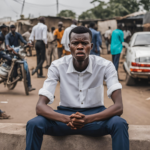
• There are two things we struggle to challenge in Nigeria — culture and age-imposed authority. In our culture, our elders are always assumed to be wise. The number of years a person has lived in Nigeria is synonymous with the depth of wisdom they are assumed to possess. For that reason, we’re taught that it’s the height of disrespect to challenge them.

    But Raye did both — she spoke up against bad governance and a 72-year-old president, defying everything culture says young people should be.

    “How brave!” I thought as I watched this brilliant young woman express her displeasure for over four minutes. It was the second time I had seen a young person on the brink of tears while speaking against the effects of bad governance that day. In the early hours, I interviewed Amaka, a 27-year-old lady who blamed the ruling party, All Progressives Congress (APC), for the avoidable death of her mother. For 30 minutes, I heard gaping pain and justifiable anger in her voice. 

    I wondered why I wasn’t speaking up like Raye and Amaka because I’d also bought a crate of eggs for ₦7,000 that week. So, I reposted Raye’s video on TikTok and carried on with my day. 

    Raye’s follow-up video left me in shock. An NYSC official had called her, sternly instructing her to delete the video. In response, Raye asked a question I wouldn’t have been brave enough to ask, “Ma, are you threatening me?” The video went viral in a couple of hours, and an important conversation started: Why is Raye being silenced? 

    If I were Raye, I would most likely have caved in fear, settled into a state of helplessness, and given into silence because that is all I’ve been taught to do. That is what I did when a lecturer locked me out of the exam room where I was supposed to write my final year exam because I was wearing a nose ring.

    I was too afraid to ask him why my nose ring bothered him, so again, I did as I had been taught. — I removed my nose ring quietly, went on my knees and begged until he allowed me to sit for my exam. At that moment, I had no say. The nose ring was mine, and it was on my body and no one else’s, but still, I had no say. It was his exam hall, his rules. With my future at stake, I chose silence instead of bravery. 

    So did Ada* (26), who spoke anonymously to Zikoko Citizen about her experience with a lecturer. “For five years, I was harassed and humiliated by my lecturer,” Ada narrates. “He would call me to sit in his office for no reason. Even when I told him I had lectures, he wouldn’t care. On some occasions, he would ask me to enter his car, drive me around town and return me to where he picked me up. I was helpless, and he seemed to enjoy controlling me.” 

    The power imbalance between Ada and her lecturer would eventually cause her mental health to deteriorate terribly and almost force her to drop out of university. In search of a solution to the constant bullying, she reported her lecturer to the Student Union and the university’s disciplinary panel.

    But it didn’t end well for her because instead of bringing her abuser to justice, she was advised to beg him out of respect for his age and position. “If I had known, I would never have reported him. After I reported, I couldn’t get above an F in his courses, no matter how hard I studied. I couldn’t request to see my script and have it remarked either”, she recounts. 

    After learning that she was at risk of spending an extra year in university, Ada eventually chose silence and begged her lecturer after enduring years of harassment. Only then did she finally get a C grade in his course. 

    Her luck wasn’t any better in the NYSC camp, where she met a soldier who bullied her till she left the orientation camp. “This soldier forced me to join the parade every day, even after I told him I was a member of the Orientation Broadcasting Service (OBS). He said he didn’t like how I spoke to him and forced me to parade. He would force me to stay back after everybody had left the parade ground, and I wouldn’t be allowed to leave until the lights were out. Most times, I went to bed hungry and woke up to the same torture”. Ada experienced the same power play, but this time, she had learnt not to challenge authority by speaking up. 

    Get More Zikoko Goodness in Your Mail

    Subscribe to our newsletters and never miss any of the action

    Perhaps this silence might have “saved” Senator Natasha Akpoti-Uduaghan from another questionable six-month suspension. Or Senator Abdul Ningi, who was suspended for three months because he called out an alleged padding of the 2024 budget. 

    In Nigeria, the cost of bravery is becoming too heavy to pay. And it’s not just Raye, Ningi and Akpoti-Uduaghan who are paying the price; it’s all of us. In December 2024, Olamide Thomas was arrested for cursing President Tinubu, his children, the Inspector-General of Police, Kayode Egbetokun, and Force Public Relations Officer Muyiwa Adejobi for the pain she was going through. On December 21, 2024, Olumide Ogunsanwo was arrested for similar reasons. Despite President Tinubu’s promise to promote freedom of speech and free press in Nigeria, even journalists like Daniel Ojukwu have become victims of illegal arrests. 

    2025 should be the year we all collectively agree that the silence culture is killing us. We learn it at home, school, workplaces, NYSC  camps and on social media. It has become a culture that urgently needs to be countered. Accountability cannot thrive in a country where people haven’t learnt to challenge authority.

    Perhaps it’s time we all took Raye’s advice and collectively challenged bad governance. Nigerian youths make up 70% of the country’s total population, but that number is only as useful as we make it. We could hold over 70% of 2027’s total electoral votes if we wanted. We could vote out bad leaders if we wanted— Anything is possible if we choose bravery instead of silence, no matter the cost.

    [ad]

  • In 2024, the New York Times reported that Nigeria was experiencing its worst economic crisis, and even though the government tried to downplay the credibility of the report by claiming that it was all “gloom and doom,” the deteriorating quality of life of the average Nigerian says otherwise. 

    In this story, Amaka*, 27, shares how her life has taken a drastic turn for the worse since President Tinubu took office and how her hatred for the ruling All Progressives Congress (APC) is fueled by the needless death of her mother.

    This is Amaka’s story as told to Margaret 

    My life has changed in the worst way possible since Tinubu became president. I went from having some essential luxuries to having nothing at all. It got even worse after I went for my NYSC. I’ve been speaking against the ruling party since 2014, and some people still think I’m joking.  APC has taken so much from me. I was 16 in 2014, when Buhari came into power, but even then, young as I was, I knew something was off with him. After he became President, I started picking up more interest in politics and current affairs because I wanted to know just how bad things would get. 


    If you’re interested in staying in the know, our daily newsletter simplifies and delivers news to your inbox at 7 AM every morning. Subscribe here.


    My parents told me how terrible he was during his time as Nigeria’s head of state. They narrated how he made old people queue for bread, so I was confused when everybody else fell for his tall promises about making ₦1 equal to $1. I was crying when he became president. I just knew that Nigeria was setting itself up for failure.

    Three years later, in 2017, I gained admission into the university and thought I would graduate by 2021. That didn’t age well because, in March 2020, ASUU decided to go on an academic strike for almost a year. It was at that time that my hatred for APC doubled.

    Shortly after the strike began, COVID-19 set in and forced us all to stay at home. But when things got better and other students returned to school, those of us in Federal Universities still had to wait because the strike was still ongoing. I stayed in school for two extra years because of bad governance. 

    But 2023 was the year that changed everything for me. My mom fell sick and eventually died because of a government-owned hospital’s inadequacies. She was at the government hospital because that was what my dad could afford. The treatment was subpar, but private hospitals were too expensive for us, so it was never a matter of choice. She eventually died, and my hatred for APC increased. There are basic things that the government owes us, and primary healthcare is one of them.

    Shortly after my mum died, I left Lagos to start my National Youth Service Corps (NYSC), and that was when I saw how deep Nigeria’s poverty ran. The sad part is that poverty is institutionalized and designed to make the poor get poorer while the rich get richer. When I was in NYSC camp, I often talked about politics. I was the Orientation Broadcasting Service (OBS) president, so I had the right platform for it. I discussed it so much that other corpers started telling me to tone it down, but I didn’t stop. My goal was to get young people to hate APC as much as I did.  Despite the initial kickback, I continued pointing out to corpers that all government officials are public staff who are being bankrolled by taxes from Nigerians. Even during CDS, I used to preach to them, telling them the need to take politics seriously and hate APC because the party is after our future. Unfortunately, some corpers started displaying tribalism and kicking against my opinion, which I still can’t understand because no tribe gets more electricity than the other, and neither do they get special discounts at the market. 

    Get More Zikoko Goodness in Your Mail

    Subscribe to our newsletters and never miss any of the action

    I am currently jobless, not because I want to be, but because I had to quit my former job, as the salary could no longer cover my monthly expenses. I was earning ₦180,000 and spending ₦110,000 on transportation alone. In addition to getting stuck in traffic every day, I saw no progress in my life—  It just felt like I was wasting away.

    I recently withdrew money at the ATM outside of the bank I use,  and when the debit alert dropped, I saw I had been charged ₦100 for withdrawing ₦20,000. That ruined my day completely. It might seem minor to some people, but not to me. Buhari should never have been president, and neither should Tinubu. My hate for these bad leaders goes beyond just them. I hate their children, too, and we should all hate them. I spent two extra years at the university, but their children are in Oxford. We shouldn’t be laughing with them.

    Right now, I have no APC supporter in my life, I’ve cut all of them off. They know me well enough not to say hi to me. I will be turning 28 soon, yet  I can’t account for my achievements. I deserve more than that and anybody who disagrees that we are victims of bad governance is my enemy. 

    I’m looking forward to 2027 because we’ll finally get another chance to make better choices. I don’t want APC in power anymore. I know that there are politicians who belong to different parties who are also capable of continuing the evil cycle. But I won’t be voting if Nigerians don’t come together to fight APC together. Not because my vote won’t count but because I don’t want to feel a repeat of what happened in 2023. 

    I am one of the Nigerians who believe that our votes still matter. Even government officials know that they need humans to manipulate votes. Why else will they be paying people to vote for them? They cannot rig without votes. So imagine if we all come out to vote out Tinubu. 

    I can’t even boast of 8 hours of electricity anymore. My dad and I spend more than ₦8,000 buying fuel every day. Even if electricity is the only thing a good president can give me, I’ll take it.


    ALSO READ: Is the Nigerian Senate Trying to Silence Natasha Akpoti? 

    [ad]

  • A year and a few months after a new Nigerian government came into power, Moses*, a voter who voted for President Tinubu assesses his performance.

    He talks about why he voted for the current president, how the government has affected his quality of life, and the major areas in which it has failed so far.

    As told to Akintomide

    Will I ever vote for Tinubu again?  

    Never. 

    Do I regret voting him in as the current president? No.

    Let me start from my first contact with him: his tenure as Lagos State governor. I saw dumping grounds and water-logged areas like Bar Beach, Ozumba Mbadiwe and Ahmadu Bello turn into high-rise buildings. Out of these came businesses like Silverbird Galleria, Civic Centre and Oriental Hotel.

    Long before the Lagos Atlantic Project happened, he did an ocean disembarkment project that reduced flooding. 

    It was a no-brainer that I thought Tinubu, the president, would put Nigeria on the same trajectory he put Lagos on.

    But now, the man has lost focus. He was sworn in as president at a time the economy was at an all-time low; Nigeria was broke, with food inflation, unemployment rate, etc., were at a high. More than a year later, this man has yet to show any urgency in his governance.

    To put it simply, there’s hardship in the land. 

    I work remotely, and try to go to the office almost every day. But since March, I’ve been in my house. It’s expensive to go out. Booking a ride is unbelievably costly. Although I can afford it, it has become unnecessary spending. 

    That said, I still spend more than necessary at home. I live in a one-bedroom apartment and used to spend ₦40,000 on power monthly. Now I pay double that. It’s a ridiculous price to pay for a Band B tariff.

    My TV hasn’t worked in four months. When I contacted the manufacturer, I received a repair bill of ₦500,000. I bought that TV for ₦450,000 in 2020, man. If the economic situation didn’t get worse, the fees and prices wouldn’t be so damn high. I can’t spend that much to repair a TV.

    I didn’t know I could kick my cravings to the curb so fast until this government happened. One bottle of VitaMilk sold between ₦800 and ₦1000; now it’s around ₦2000. I haven’t bought one since May. I loved to buy food online and eat out with friends, and ₦60k usually got two people a complete meal. These days, that’s what one person pays. 

    Tinubu came into power, removed the subsidy and floated the naira. Yet, he allocated ₦1.5 billion fund to purchase new cars for the office of the First Lady in the first supplementary budget he approved. Why spend money on cars when Nigerians can barely afford food to eat? Will Tinubu tell me he has no private vehicles? If he doesn’t, what about the cars the former presidents used? If those are discarded, where are his election campaign vehicles? He couldn’t use those? 

    Leadership goes a long way in (deciding) what citizens do. Tinubu has spent a whole year in the office and hasn’t spoken to the media once, just like he avoided the presidential debates. It’s evident that he doesn’t rate the citizens at all.

    Again, I have no regrets. It’s my constitutional right to vote and be voted. But anyone who defends this incompetent government is either a paid agent or hoping to be invited to eat at the table.

    Tinubu’s presidency has let the citizens down. It’s disappointing and painful because I did it for the nation, not myself.

    I want the type of economic growth that won’t force me to japa. It’s not sustainable for everyone to leave. Some of us will remain in the country, and if we’re here, we will have to live in a stable economy. I thought he’d deliver this type of growth, and that’s why I voted for him.

    The most important question now is: will I reinforce failure? No.

    I have no faith left in Tinubu. A Nigerian government has only two years to do proper work out of a four-year tenure. After the first two years of governance, the third year is dedicated to the primary election, which leads to the fourth year, also the election year. A year has already passed since Tinubu’s government. One would know a great weekend from the vibes of Friday. 

    It’d be ridiculous to keep having faith in the president who spent more than two months setting up and fixing his cabinet. He also had three months post-election to prepare for the inauguration. But what did the government do during that period? Nothing.

    If there’s a thing that should have been handled in the first six months in the office, it’s the minimum wage issue. The newly approved ₦70,000 minimum wage came late and it won’t work because the state government can’t afford it. Inflation is a problem, too. That money has no good value for the earners.

    Also, the government should have opened the borders and allowed importation. Nigeria can’t feed itself. Farmers can’t meet the high food demand due to insecurity chasing farmers out of their lands. There’s nothing wrong with supporting local farmers and allowing people to bring food into the country. 

    Instead of opening the borders, providing subsidies to local farmers, and addressing insecurity to solve the issue of food security, what’s Tinubu’s government doing? They brought trucks to share rice bags across Nigeria like the country is a refugee camp. Is that the next move? What about people who don’t eat rice? What do we want to do with the rice sef? Since the government has been sharing food, how many people has it reached?

    People are hungry. How can one crate of eggs be ₦5000? If you go to the market now, a few tomatoes go for at least ₦500 to ₦1000. Garri is very expensive. Can’t the president see or hear the people’s cry?

    When Tinubu was campaigning, he said, “Let the poor breathe.” I’m putting it to you now, Mr. President: Let Nigerians breathe.