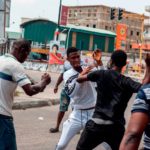
• The presidential candidate for the People’s Democratic Party (PDP), Atiku Abubakar, was attacked on November 9, 2022, while on his way to a campaign engagement in Maiduguri, Borno State. Reports say the attack was carried out by some supporters of the All Progressives Congress (APC) who were identified by the party emblems they were carrying.  

    The candidate’s supporters have been attacked before. On October 17, thugs reportedly invaded its rally in Kaduna and beat people up. In the recent Borno attack, 70 people were reportedly injured in the Borno attack, with dozens of vehicles vandalized. 

    It is unclear if Atiku was harmed, but he would probably think twice before setting foot in Borno State again. 

    Also recall that in October 2022, open threats were made by a member of the House of Assembly, Mohammed Gajiram, declaring the need for APC to win all their elections if it means “people being killed and buried in holes.”

    In response to the death threats, a PDP representative in Borno state, Alhaji Zanna Gaddama, has openly appealed to both the Director-General of the Department of State Services (DSS), the National Security Adviser (NSA) and the Inspector General of Police (IG) for help. 

    What does Nigerian law say about death threats?

    In Section 323 of our nation’s Criminal Code Act, there is only a punishment for the threat to kill if the threat is written. As it states, “Any person who, knowing the contents thereof, directly or indirectly causes any person to receive any writing threatening to kill any person is guilty of a felony and is liable to imprisonment for seven years.” 

    However, Gajiram did break Subsection 2 of Section 92 of the Electoral Act of 2022 which states that “abusive, intemperate, slanderous or base language or insinuations or innuendoes designed or likely to provoke violent reaction or emotions shall not be employed or used in political campaigns.”

    Who else has been attacked this election season? 

    Even with the signing of a peace accord by all the presidential candidates, there have been signs of bad faith. This ranges from violence, intolerance, and hate speech.

    Peter Obi

    The Labour Party candidate has received his own share of violence. In September,  gunmen threatened Peter Obi’s supporters in Enugu, while they were holding a meeting in the Awga community. 

    Four unknown gunmen suddenly showed up, shot in the air, and disrupted the meeting.  A day earlier, some members of the party were also attacked in Nenwe of the same state. 

    About a week later, Obi’s supporters were again attacked in Ebonyi state. This time, some members of the Nigeria Police were identified as assailants. In a statement, the Labour Party’s National Publicity Secretary accused APC of using the police to promote violence.

    In October, Obi’s supporters, known as “flag boys” were brutalized in Lagos. The flag boys were accused of carrying Peter Obi’s flags around Oshodi in Lagos. They got beaten by thugs and attempts were made to burn them alive. 

    Senator Ifeanyi Ubah

    In September, Ubah, was ambushed and attacked at Enugwu-Ukwu in Njikoka LGA of Anambra State. Five people were killed during this attack, including some police officers and the senator’s aides. 

    Why should you care about electoral violence?

    As a citizen, electoral violence goes against your right to vote for any candidate of your choice, as stated in the INEC’s Voter Education section. 

    You should also be allowed to attend any rally for any candidate without the fear of being harassed. Start by holding your preferred candidate accountable to the peace accord all parties signed.


  • In a little over 100 days from today, Nigerians will head to the polls to decide who their new president would be. And while it is campaign season now, it is easy to forget that Nigeria is caught in one of its worst flooding crises ever. 

    As at October 24, 2022, 612 lives had been lost, 3.2 million people directly affected, 123,807 houses totally damaged and over 392 thousand hectares of farmland destroyed. 

    The government’s response has sadly been largely inadequate. We hate to add to the piling list of things the flood has affected but can we talk about the pending impacts on the 2023 elections for a minute? 

    You should be worried about these things ahead of the elections: 

    20 INEC offices damaged by the flood

    The Independent National Electoral Commission (INEC), led by its chairman, Mahmood Yakubu, appeared recently before the House of Representatives. He disclosed that the floods had already destroyed at least 20 of its offices across the country.

    INEC office in Edo State [Image source: Eagle Online]

    He said, “We have office rent and residential rent. So many of our offices were attacked and some actually flooded after the recent floods. We have 20 offices in that situation. 

    “For others, we just have to look for a facility to rent. From Jigawa, there was a request for us to look for three offices, following the damage caused by flooding of the offices that we occupied.”

    Inaccessible road networks

    Last month, the Minister of Works and Housing, Babatunde Fashola, lamented that the full extent of the flood’s damage on road infrastructure cannot yet be known. He said it would have to recede before they could make any meaningful assessment.

    Flooding in Lokoja [Image source: NAN]

    Still, it’s not difficult to imagine how severe the damage is, with the floods having affected 34 out of 36 states. It is also unlikely that any large-scale repairs can take place between now and the 2023 elections. This could mean that some major road networks might remain in a bad state even when the flood abates. 

    This might discourage voters from traveling long distances to vote ahead of election day.

    Disconnected communities and difficulty in transporting election materials

    Flooded community in Nigeria [Image source: Abraham Achirga/UNICEF]

    Beyond major roads, the road networks in many remote communities in Nigeria may pose challenges. The INEC chairman has already voiced this concern. 

    At an event hosted by the Centre for Democracy and Development (CDD), he said one of the greatest problems it faces in the conduct of elections is poor transportation systems. This can hamper the distribution of election materials, create delays and affect the integrity of the elections.

    Displacement and disenfranchisement of voters

    While INEC promised in early September that three million Internally Displaced Persons (IDP) will be able to vote, the flooding emergency may make it difficult to live up to that promise. 

    Voters at an IDP camp in Borno [Image source NAN]

    Many more people have been displaced, with their polling units no longer accessible. Also, INEC has closed all registration for the 2023 election meaning that the newly displaced may unfortunately get disenfranchised.

    What can be done?

    For the electoral body, they’re in a tough position. Despite their best intentions, many people will find it difficult to vote. Unless a fast-tracked bill is passed by the national assembly making special allowance for newly displaced voters. 

    Also, the government needs to commit more to ensuring that more roads are fixed before 2023 to encourage higher voter turnouts than in 2019. And on the individual end, just try to stay alive. Only the living can vote.

    ALSO READ: 2.5 Million Nigerians Are Affected by 2022 Flooding Crisis

  • The Nigerian Voter is a series that seeks to understand the motivations that drive the voting decisions of Nigerians — why they vote, how they pick their candidates, why some have never voted, and their wildest stories around elections.

    The subject of today’s The Nigerian Voter is Safiya, a Muslim lady from Kaduna State in her twenties. She moved to Lagos in 2018 in search of greener pastures. She told us about her past experience voting in the North, and her views on religion and tribalism when it comes to the voting process. 

    What made you come from Kaduna to Lagos?

    I moved here in 2018. The economy is very poor there in Kaduna and farmers are not making ends meet. Here in Lagos, I am making more money than my secondary school teacher and I can employ him, even with my mama put business.

    So that being said, I came to Lagos to get what I want, which is a better life for myself. Kaduna was just too poor and it is not safe with Boko Haram attacks here and there. Most people living in the North are just branching out to different parts of the country. 

    Have you ever voted before?

    Yes, I have. 

    In 2019, I went to Niger State to vote (since that was where I registered), but it was a terrible experience because the INEC chairmen there did not allow one to vote. 

    It’s only the people that settled them with money (bribes) that they allowed to vote. If you don’t settle them well, the vote will not count.

    Have you ever faced any form of harassment during voting?

    Yes oh, very well. 

    I can remember an INEC guy slapping me across the face because I was arguing with someone that jumped the queue. Unknown to me, the person had already bribed this guy with N20,000, which back then, was a lot of money in the North. 

    Even a pregnant woman nearly lost her baby in my presence because she was pushed down with violent force. It was a really tough time.

    Who did you vote for then and why?

    That time, I voted for Buhari, because I was scared that nobody else would win if I voted for them. I know that with these elections, if someone is running for office a second time, it’s that person that will win. 

    So since 2019 was for Buhari’s second tenure, I just voted for him anyway.

    Do you regret voting for Buhari now?

    Ah, well, sometimes I wish I had the courage to vote for someone else. 

    Atiku may not be the best person for Nigeria, but he is better than this Buhari. Anyways, I’m just hoping that 2023 will be different with the right person, insha’allah.

    Who would you vote for in 2023 and why?

    Peter Obi, because we need an educated person that can develop the country financially. People know that supporting businesses will reduce the financial pressure on them as a government, instead of simply encouraging the usual employment by people. 

    Peter Obi has these ideas. And you know Igbos, they’re quite skilled with this business thing. So I know he would create financial freedom for businesses. We would also have our own Nigerian-made stuff instead of importing. I don’t trust men like Tinubu to deliver, and Atiku should go and rest. The man has been running for president ever since I was in primary school. 

    Igbo men are always very successful in business, so I know that if I vote for Obi, he will create ways for businesses to grow. Maybe I can get a restaurant instead of this mama put.

    But would you say religion should be a big part of your criteria for a candidate?

    Look ehn, Nigeria is the way that it is now because we are all voting based on tribe or religion. In 2015, my people voted for Buhari because he is from the North, but look at how that turned out. If I was ever told that my own Northern Muslim brethren could treat us this way, making us become refugees in other parts of the country, I would never have believed it. 

    Election is not about religion or tribalism. We need to vote for the right person. It is religion and tribalism that made us vote for Buhari the first time, and look at where that turned out. I can’t vote for Tinubu because he extorts people, and he doesn’t care. 

    Look at this flooding crisis for instance that happened in Kogi State. Did Tinubu ever go to visit any of those victims? How many days passed before Atiku visited? It was only Obi that had enough sense to go to those places and sympathize with them, and help them. Why would I not vote for that kind of leader? 

    Tinubu said emi l’okan and they’re playing with the presidential seat as some sort of royal seat that is turn by turn. Is it a royal family thing, that you’re saying emi l’okan? Rubbish. This time, we need to all vote and our vote has to count!

    Who are the people you know voting for? 

    It’s still Peter Obi oh, even in the North. 

    I can’t say I know a single person that wants to vote for Atiku or Tinubu. It’s because my own people are all into a business and they’ve seen that Peter Obi is their man. They will go to the polls en-masse in 2023 and cast their vote!

  • If you are ever sad and need something to cheer you up, watching what Bola Ahmed Tinubu, All Progressives Congress’ (APC) presidential candidate, does (or in this case, doesn’t do) will do the trick.

    Since Tinubu started running the presidential race for the APC in January 2022,  social media streets haven’t remained the same. From political gaffes to fitness jpegs, and even sleeping during critical events, Tinubu has done it all.

    In addition to his long list of sins, we find that Tinubu has made it a habit to be absent from crucial events, the most recent example being the Arise Presidential Town Hall Meeting / Debate on November 6, 2022. 

    In this meeting, the candidates were meant to give voters some oral insight into what they would achieve should they become president. Yes, Atiku Abubakar of the Peoples’ Democratic Party (PDP) did not attend but his running mate Ifeanyi Okowa went in his stead. 

    BAT did not send anybody, not even his usual errand boy representative, Kashim Shettima, and was too busy turning up at Col. Sani Bello’s 80th birthday owambe

    [Image Source: @TinubuMediaS on Twitter]

    As the social media pressure got werser over his absence, Tinubu’s campaign team felt that it was only fair to apologize to the public for his absence. But even that apology, well….

    What does the apology mean?

    To summarize the long grammar, here is what he basically said:

    • We couldn’t care less about any debates. Wetin concern us?
    • The reason why we can’t care for any debate is because we are too busy to think about the debate. If you want to know our plans, read the manifesto.
    • We are bosses that cherry-pick who we want to speak to, and when we want to speak to them. Selah.

    What does Tinubu’s attendance sheet look like?

    As I mentioned earlier, this isn’t the only time Tinubu didn’t feel like showing up. Let’s give some other examples:

    The 2022 NBA conference

    While his colleagues Peter Obi of the Labour Party (LP) presidential candidate, Atiku Abubakar of the PDP, Dumebi Kachikwu of the African Democratic Congress (ADC) candidate, and Adewole Adebayo of the Social Democratic Party (SDP) were present, Tinubu was absent from the conference and only represented by Shettima. 

    However, it seems as though Shettima had some dress code prepping on ‘fashion drips’ from BAT, as he came looking like a ‘cool kid’ wearing sneakers on a suit.

    [Image Source: Vanguard Newspapers]

    If you are waiting for an explanation of Tinubu’s absence, don’t hold your breath. He didn’t give any.

    The ICAN conference

    It’s interesting to note that Tinubu, who has repeatedly claimed to have an accounting background with big firms like Deloitte and Mobil, blatantly decided not to come to the Institute of Chartered Accountants of Nigeria’s conference in Abuja in October 2022.

    That could have been a very good time for Tinubu to showcase his economic plans for the country, as the conference was centered on sustainability for national prosperity.

    Even Yele Sowore, presidential candidate for the African Action Congress (AAC), took a swipe at him, as he wondered why a whole “Chicago University Accounting Guru” decided not to show up for an ICAN event. Well, we are wondering too.

    The LCCI conference 

    Yet again, Tinubu was too shy to share in detail his economic plans for the country, as he postponed his address for the Lagos State Chamber of Commerce and Industry (LCCI) on October 28, 2022.

    Instead, he set up a ‘business summit’ with the moneybags of the private industry to share those plans with them instead. Why was this done? Did he feel he would have more control over an audience that wouldn’t give him tough questions? We may never know.


    How do citizens feel?

    If there is one word that sums up the public opinion of Tinubu’s absence, it’s pissed. Here’s what some Nigerians had to say about this:

    https://twitter.com/MrOdanz/status/1589396951824355328?s=20&t=9JgnP3IB_FLmogyh0UPnbA

  • If Nigerian politicians were content creators, Rivers State governor, Nyesom Wike, would be one of the most-watched creators on the social media streets. Every new week is a new opportunity for content for Wike, from using a live band to diss Atiku Abubakar, to bullying the PDP national chairman, or showing he’s a baller by dashing ₦300 million to a handful of Lagos widows

    The latest episode of the Wike Show is the appointment of the first batch of 100,000 special assistants on “Political Unit Affairs” in Rivers. According to Wike, their job description is to “work among their people and hear their views of his administration.” In other words, they should do amebo on what the Rivers streets are saying about Wike’s government. Of course, we can only guess the colour of wahala that’ll emerge if those comments are negative.

    Some critics also think he’ll use these special assistants for vote buying, especially against whoever Wike doesn’t like. 

    But, is the only use of these 100,000 minions special assistants opinion monitoring? Because we have some creative ideas for how Wike can use them if he’s interested.

    Backup singers for his live band

    Wike could make these 100,000 special assistants the latest addition to his live band for diss tracks. The band has already made phenomenal hit songs, from “As e dey sweet us, e dey pain dem” to “Wike na bigi man.” They have great potential to top Asake and co on the music charts.

    New hires for his research team

    With the way Wike dishes out interesting scandals on the PDP chairman on a steady basis, we believe there must be a secret research team giving him all the dirt. If the team is ever in need of fresh hands, these new guys can definitely help.

    Content strategists for his battle against Atiku

    Since Atiku named the governor of Delta State, Ifeanyi Okowa, as his vice-presidential candidate, Wike has been a wrecking ball to all of his campaign efforts. From calling him out as a “fake founding father” and even calling his supporters “attack dogs,” Wike has targeted Atiku like a hunter would target his prey. 

    But it’s only human to run out of steam, even if you’re Wike. That’s why the governor needs these special assistants to back him up with fantastic Atiku comebacks every week. Two heads are better than one, so imagine what 100,001 heads can do.

  • We all know Bola Ahmed Tinubu (BAT) loves to put on a show — doesn’t matter if he’s riding a gym bike in London or taking fire jpegs to prove he’s not sick. 

    Now, barely two weeks after he released his manifesto, the All Progressives Congress (APC) presidential candidate arranged a glossy town hall meeting with the moneybags of the private sector to press home his proposed economic policies. We’re talking about billionaires like Aliko Dangote, Jim Ovia, Tony Elumelu, Aigboje Aig-Imoukhuede, and Herbert Wigwe. If the Avengers were a Nigerian billionaire group, they all showed up for the BAT.

    And since there’s nothing like a Lagos party, we recapped the most interesting things from Tinubu’s business summit.

    [Image source: Channels Television]

    Tinubu makes a lot of promises, as usual

    As always, Tinubu made the usual promises concerning some of his plans for Nigerians including:

    • Double-digit GDP growth.
    • The resurrection of industrial policy.
    • Promotion of the agbado agricultural industry.
    • The evergreen promise of 24/7 power supply.
    • CBN giving affordable rates for credit.
    • Another evergreen promise of better roads and public facilities.
    • Enlisting more Nigerians into the armed forces.

    Tinubu won’t stop talking about his master plan

    Tinubu reminded everyone about his background as a former Lagos State governor and how he made the state what it is today with his masterplan. He said, “My team and I developed a blueprint, a masterplan, for Lagos. I can say that plan has been largely successful. We turned this state into a safer, more prosperous place where people can go about any legitimate vocation or venture regardless of their ethnicity, religion, region, or prior social station.”

    Don’t forget this is the same person accused of extorting market women in Lagos for his presidential rally in October 2022. 

    Shettima isn’t a man of peace 

    Some lighthearted violence also got the spotlight at the business summit when Tinubu’s running mate, Kashim Shettima, took the mic. He targeted two of his party’s biggest opponents.


    Remember him?

    Atiku Abubakar

    Shettima first went after the academic qualification of the Peoples Democratic Party (PDP) candidate, Atiku Abubakar. He mocked the former vice-president for getting a “wole wole (sanitary inspector)” certificate from the Kano School of Hygiene where he graduated with a diploma in 1967.

    For his final shot at Atiku, Shettima said, “The ability to sell bottled water does not make one an expert on the economy. Atiku Abubakar is not Abraham Lincoln, he’s more of a Raila Odinga. Next year, we are going to permanently retire the political tourist back to Dubai.”

    Shettima signed the peace accord with other presidential candidates in September, but he didn’t show up to the business summit to preach peace.

    Peter Obi

    The presidential candidate of the Labour Party (LP), Peter Obi, was also in Shettima’s firing line. Shettima rated his tenure as Anambra State governor a “mediocre performance” and cast doubts on his leadership skills.

    “Leadership goes beyond glamourising poverty. We don’t glamourise poverty, we fight poverty. I won’t tell you that I have two pairs of shoes or I have a single watch. Leadership goes beyond dubious statistics or basking in a mediocre performance as the governor of Anambra State,” he said.

    Sanwo-Olu won’t stop kissing Tinubu’s feet

    The Lagos State governor, Babajide Sanwo-Olu, owes his position to Tinubu, so it’s not a surprise that he’s been all over his presidential campaign. In his tribute to Tinubu at the summit, the governor reminded everyone about his godfather’s achievements from ancient days.

    Sanwo-Olu promised everyone that Tinubu will use his business acumen to help the private sector and everyone make more money. But we all know he’s just watching out for his own interests.

    [Image source: Nigeria Info]

    Everyone is shocked Iyin Aboyeji is a BAT man

    It was surprising for many Nigerians on Twitter to see the founder of Future Africa, Iyin Aboyeji, making a case for Tinubu’s tech policy at the summit, especially since he criticised the APC in 2021.


    Here’s what some Nigerians had to say of his presentation:

  • MKO Abiola died 24 years ago, but he’ll always be remembered as Nigeria’s president that never was. Even though he was the winner of the 1993 presidential election, his village people — General Ibrahim Babangida and General Sani Abacha — denied him his mandate.

    Abiola’s presidential campaign is still mostly remembered for the tragedy that it was, but one of the other most memorable things from that period is his campaign ad which promised hope for Nigerians. In the video, the main character — let’s call him Polycarp — complained about the most frustrating things for him as a Nigerian in 1993.

    MKO Abiola's 1993 Campaign Video Is Still Valid in 2022

    Meet Polycarp: he believed in1993 Nigeria was one election away from becoming a paradise

    With the 2023 elections just around the corner, it’s only fitting to check in on Polycarp’s list of complaints to see how much things have changed — or not — in 30 years. 

    If Polycarp was angry about 1993 Nigeria and jumped inside a time machine to 2022 Nigeria, what would he meet?

    No work

    MKO Abiola's 1993 Campaign Video Is Still Valid in 2022

    Polycarp’s time machine may want to skip 2022 Nigeria if it’s gainful employment he’s seeking because we have some very bad news for him. Nigeria’s 2020 unemployment report pegged the unemployment rate at 33% which is the highest it’s ever been. Polycarp would still be unemployed and broke in 2022, and desperate enough to start selling affiliate marketing courses on Facebook.

    No food

    Like everything in Nigeria these days, the prices of food items aren’t obeying the laws of gravity. The National Bureau of Statistics reported that food inflation rose to 23.34% in September 2022 which is the highest it’s risen in more than 15 years. 

    Even worse, nearly 20 million Nigerians are potential victims of famine, according to the United Nations’ Food and Agriculture Organisation (FAO). What this means is that 10% of Nigerians face hunger of Biblical proportions. For context, that’s the combined population of Eritrea, Namibia, Gambia, Botswana, Gabon, Lesotho, and Guinea-Bissau at risk of hunger inside just one country.

    No house

    If Polycarp was complaining about housing issues in 1993 when you could probably rent or buy a home with money saved under your bed, then he probably wants to skip to 2072 Nigeria or something. Because in 2022, Nigeria has a housing deficit of about 28 million units and even the homeowners are being forced out of their houses by seasonal floods and terrorism.

    No light

    MKO Abiola's 1993 Campaign Video Is Still Valid in 2022

    Nigeria’s national electricity grid is more well-known than the governor of Jigawa State — and the fact you just tried and failed to remember his name proves my point. But the national grid isn’t known because it’s the eighth wonder of the world or sponsors Twitter giveaways. It’s always on everyone’s lips because of how frequently it collapses, leaving Nigerians in darkness. Whatever jungle Polycarp thought Nigeria was in in 1993, the country is still in the Dark Ages.

    Expensive transport fares

    MKO Abiola's 1993 Campaign Video Is Still Valid in 2022

    One of Polycarp’s most prominent complaints was the transport fare eating into his daily ₦2k, and we have news for him from the future. Just over the past year alone, the average bus fare within Nigerian cities rose from ₦435.36 in September 2021 to ₦615.69 in September 2022. The recurring fuel scarcities don’t help matters and the situation is likely to worsen with the proposed removal of fuel subsidies in 2023.

    Out-of-school children

    When Polycarp complained about school being a headache, the campaign ad showed a dozen shirtless little children roaming the streets. In 2022, that demographic has ballooned into a population of 20 million out-of-school children forced out of the classroom by government neglect, poverty and insecurity. The government keeps paying lip service to the problem and even 2023 presidential candidates are still talking about setting up committees to tackle it.

    Hospitals aren’t working

    MKO Abiola's 1993 Campaign Video Is Still Valid in 2022

    Nigerian doctors are some of the most prominent groups participating in the japa wave and even the president of the country travels to London every three market days to take paracetamol because the health sector isn’t where it needs to be. Not much has changed between 1993 and 2022. 

    MKO Abiola's 1993 Campaign Video Is Still Valid in 2022

    Polycarp was dealing with “so so palava” in 1993, but Nigerians are dealing with real shege in 2022. The unfortunate lesson here is 2023 presidential candidates are still using the same issues to campaign nearly 30 years after they already reached a critical point.

    Whatever choice Nigerians make in 2023 will determine whether things improve or we have to walk the wilderness for another 30 years. Polycarp may want to skip even further into the future.

    ALSO READ: This Nigerian Wants to Vote in 2023 but He Won’t Leave Germany

  • One thousand and one things are happening with a presidential election, especially one as chaotic as Nigeria’s 2023 race.

    Peter Obi Wants Your Shishi, and Other Campaign Lessons from Last Week

    These are the highlights of the 2023 presidential election campaigns in the past week.

    Obi won’t give shishi but he needs a lot of it

    The Peter Obi presidential campaign uncovered a deep dark secret last week that stunned everyone across Nigeria: presidential campaigns cost money. Who saw that one coming? Before you know it, someone would tell us Abacha was a thief.

    Peter Obi Wants Your Shishi, and Other Campaign Lessons from Last Week

    “He was only saving Nigeria’s money for future use”

    The national chairman of the Labour Party (LP), Julius Abure, opened the door to a dash of public ridicule when he appealed for donations to the party’s campaign for the 2023 presidential election. Crowdfunding for presidential elections isn’t an entirely new concept, but it was a bit comical coming from a campaign that has made penny-pinching a trademark.

    Nigeria’s electoral laws set a limit of ₦5 billion to run a presidential campaign. How much of that can the Peter Obi campaign raise?

    Tinubu finally wins something, but there’s a twist

    The presidential candidate of the All Progressives Congress (APC), Bola Tinubu, has survived a lot of things in his campaign — there was that pee thing, the constant questions about his health and his many gaffes.

    But his campaign has been turning a good corner in the past couple of weeks, and he crowned that last week with an endorsement by Fitch Ratings which projected victory for him in 2023.

    Peter Obi Wants Your Shishi, and Other Campaign Lessons from Last Week

    Peter Obi has won three major polls released in the past couple of months, but the Fitch report predicted a strong Tinubu victory — an outcome that validates his entitled campaign to succeed Buhari.

    But while the report may be good news for Tinubu, it’s not such a great one for Nigerians as Fitch also projected his victory will lead to social instability in Nigeria.

    Atiku’s American wonder

    Atiku has to tick three things on his checklist whenever he runs for president — prove he’s not a northern extremist, beg Obasanjo to take back the stealing allegations and take a trip to the United States.

    Last week, the former vice president packed his campaign team and flew to the U.S. to once again prove that he can waltz into the country where his critics say he’s wanted for corruption. He did a lot of standing around and taking fly jpegs in America and nobody saw him in handcuffs.

    Peter Obi Wants Your Shishi, and Other Campaign Lessons from Last Week

    Roc Boys no drip pass this one

    If the presidential election was a game of stunts, Atiku won last week hands down and should be crowned president as soon as he returns to Nigeria. But if he hopes to have a victorious campaign, there’s one more thing on his checklist he has to resolve and the name is Nyesom Wike.

    Kwankwaso has a miracle up his sleeves

    Does anyone still remember Rabiu Kwankwaso is in the presidential race? The former Kano State governor was primed as the dark horse candidate to challenge the APC and PDP in 2023. But even though he’s been dislodged from public consciousness by Obi’s rise and is now only rated fourth in a three-horse race, Kwankwaso isn’t giving up without a fight. 

    The former governor is still rallying his impressive crowd of Kwankwasiyya supporters with their famous red caps and posting photos of large rally crowds on his Twitter. 

    Peter Obi Wants Your Shishi, and Other Campaign Lessons from Last Week

    But does anyone trust it’ll translate into a win for the candidate of the New Nigeria People’s Party (NNPP)? A chieftain of his party, Buba Galadima, seems to think he’ll perform the miracle of the five loaves of bread and two fish by sweeping over “50-something million votes” in the north while nicking more votes in the southern region.

    If Galadima has seen the state of voter turnout in Nigerian elections, then he’d know he’s building castles in the air, but he’s no stranger to that.

    Imumolen is a local champion

    At 39, Christopher Imumolen of the Accord Party (AP) is the youngest presidential candidate in the race for the 2023 presidential election, and he won’t let you forget it. He’s made many claims about being the “authentic youth” option and wants young Nigerians — the most populated voting group — to elect him to make a statement

    Imumolen’s campaign got some kick last week when he commenced a tour of Nigeria’s West African neighbours to… campaign for president of Nigeria. 

    Christopher Imumolen started his tour in Togo with plans to also touch down in Benin Republic, Ghana and Liberia. Even though he refused to be drawn into a debate on why other candidates are doing diaspora outreach in exotic places in Europe and North America, Imumolen seemed to suggest his own West African tour had more substance. We can’t begrudge a man his days of local outreach.

    Sowore is pocket-watching

    Peter Obi Wants Your Shishi, and Other Campaign Lessons from Last Week

    Remember how the law says it should cost a maximum of ₦5 billion to run a Nigerian presidential campaign? Well, it’s kind of an open secret that Nigerian politicians spend more than the limit and they get away with it because authorities don’t enforce election finance laws. The candidate of the African Action Congress (AAC), Omoyele Sowore, wants that to change for 2023 to create a level playing field.

    Which is why you have laws and a referee like INEC

    You can understand why this is coming from a candidate who could only raise a grand total of ₦‎1‎57.9 million for his 2019 campaign. But Nigeria does need to get serious with enforcing laws to make sure everyone is playing by the books. Why have laws if you won’t enforce them? Is this a third-world country?

    ALSO READ: Village People Stopped These Nigerians from Becoming President

  • The Nigerian Voter is a series that seeks to understand the motivations that drive the voting decisions of Nigerians — why they vote, how they pick their candidates, why some have never voted, and their wildest stories around elections.

    The subject of today’s The Nigerian Voter is Victor, a 32-year-old energy commodity market analyst in Berlin, Germany. He told us about his reasons for leaving the country, his views on diaspora voting, and many more.

    Why did you leave Nigeria? 

    I left in December 2020 because I won a scholarship to study renewable energy engineering in Berlin, Germany. I wasn’t ready to pass that up because I had worked hard for it for a long time. 

    Did you consider how leaving the country would affect your ability to vote?

    It’s actually not something I thought of at the time. All I knew was that I have a scholarship in Germany and I must go. The election was the furthest thing from my mind, especially since I’ve never voted in Nigeria.

    Why?

    I felt it was a pointless exercise when they’d just rig to get their preferred candidate in anyway. This was until 2020 when #EndSARS happened — people were killed, and so brutally too, without any warning, without any justification. I just felt that omo, we have to be more involved in our country’s politics. If we don’t make any efforts to change the politicians, they’ll stay there and they’ll continue to be more corrupt. This may be cliché, but the power is in our hands big time.

    If you were still in Nigeria, would you feel the need to vote in 2023? 

    Yes, because this is the most crucial point in time for Nigerians to vote. I still follow everything that goes on in the country. Half of the country is flooded and yet our leaders are travelling out. The naira is currently 800 to a dollar and yet the Central Bank of Nigeria (CBN) has decided to redesign our notes. Nothing like a direction, nothing like a plan. Insecurity has engulfed the northern region — everything is going haywire. If we don’t vote right this time, Nigeria will fall as a republic in the next 10 years. Mark my words.

    What would you say every voter should consider before choosing a candidate? 

    Competence, but based on track record. 

    Let me use an example. Did you know that the Blueline project in Lagos, which was supposed to run from Mile 2 to somewhere on the island, has been under construction for 13 years? They started that project back in 2009 when I was in my second year of university. They’ve spent $1.5 billion on that project for only 27 km. Ethiopia which did the exact same project did theirs to cover 750km in less than six months. 

    The point I’m trying to make is, there’s a certain bare minimum of competence that Nigerian leaders must have, and we’re always forgetting that bare minimum. Someone who can leave a project hanging for 13 years and spend billions in public funds on this same project doesn’t deserve to be a leader. 

    What’s your favourite thing about Nigeria’s electoral system? 

    The adoption of the Bimodal Voter Accreditation System (BVAS).

    Can you explain BVAS to me like I’m five years old?

    BVAS is more or less a machine used to verify voters using their Permanent Voters Card (PVC). It’s meant to know if you’re really a registered voter or not. 

    It’s my favorite thing because I can remember how things used to be with long manual authentication processes. The BVAS is a welcome change. 

    What do you dislike the most about Nigeria’s electoral system? 

    The non-inclusion of diaspora voting. Nigerians in the diaspora contribute a lot more to this country than average Nigerians realize. The diaspora remittance in 2020 — or was it 2021 — was over $20 billion. That’s a lot of money and it goes to show that every Nigerian outside the country has invested interest in this country. 

    I’ve lived in Germany, Switzerland, and Egypt, but Nigeria is the only place that qualifies as home. I’d do anything possible to go back home when I achieve what I want to achieve here. I know Nigerians here who are just waiting for the right atmosphere, and the right leadership so that they can go and invest all their resources there. I’d rather build my fatherland than build the land of colonialists. 

    Diasporans should have a say and their voices should be heard. If anyone at home needs urgent ₦2k, it’s us they’ll run to. 

    Look at Kenya, which has five foreign countries where diasporans can vote. It shouldn’t be rocket science. If you have an international passport, that’s a unique ID. A Nigerian in the diaspora should be able to go to the embassy in their country of residence and vote. Officials can collate the ballots and send them to Nigeria. But instead, we hear that we can’t vote. What’s so difficult there? 

    Who would you vote for?

    Peter Obi for president and Gbadebo Rhodes-Vivour for Lagos State governor.

    Do you plan on coming back in 2023 to vote for your candidates? 

    No. The benefit-to-cost ratio for me flying back to add one vote is too low when I can use the same funds to contribute to sensitisation that can mobilise more voters already on the ground.

    How do you plan to show your support for the candidates from abroad? 

    Through sensitisation by engaging with my sphere of influence — family and friends — and monetary contributions. 

    Generally, what would you change about Nigeria’s electoral system? 

    I’d ensure there’s no clause that excludes the deployment of BVAS, and also increase the scrutiny of INEC. We should deploy live and visual updates on the electoral process that every stakeholder can see in real-time.

    What are the qualities you want to see in Nigeria’s next president? 

    Competence, one with regard for merit and one with a profound connection with the masses.

  • Earlier this year, a report by the Gender Strategy Advancement International (GSAI) noted that the participation of Nigerian women in politics falls below global standards. The national average is 6.7% which is low compared to the 23.4% African average and 22.5% global average.

    With just about four months left till the general elections in 2023, we look at some of the numbers that define the role that women can play in the elections and what they mean for their representation in Nigerian politics.

    1 — the number of women running for president in 2023

    She may not be as popular as her male counterparts, but Princess Chichi Ojei of the Allied Peoples Movement (APM) also wants to take over from Buhari next year. She’s the only woman out of the 18 candidates on the ballot for the 2023 presidential election. Twale for you jare.

    What the Numbers Say About Nigerian Women and the 2023 Elections

    25 — women running for governorship positions

    The 25 female candidates contesting in governorship elections across Nigeria fall just short of 6% of the total number of 419 candidates on the ballots. It’s even worse when you consider that a court recently disqualified the only female candidate running with a major party. We see you looking at that 419 with suspicion and we are too.

    What the Numbers Say About Nigerian Women and the 2023 Elections

    ALSO READ: How Politicians Use Nigerian Women Without Rewarding Them

    92 — women running for Senate seats

    That’s 92 women out of 1,101 candidates in total — representing a paltry 8%. We still have a long way to go to have gender inclusive politics at the national level.

    What the Numbers Say About Nigerian Women and the 2023 Elections

    286 — women running for seats in the House of Representatives

    Only 286 out of a total of 3,107 candidates running for seats in the House of Representatives are women. This is the kind of gender imbalance that allows the male-dominated House reject bills to give Nigerian women more rights.

    1,046 — the total number of women contesting for political offices in 2023

    Out of the total number of 10,225 candidates running for political offices in 2023, only 1,046 are female — just over 10%. Real ojoro, for a country where more than 100 million people are female. So uncool.

    What the Numbers Say About Nigerian Women and the 2023 Elections

    6,224,866 —  the number of newly registered female voters

    Of the 12.2 million newly-registered voters ahead of the 2023 elections, 6,224,866 are women. They won this category hands down and are ready to demand more at the polls.

    ALSO READ: One of These 18 Candidates Is Nigeria’s Next President