Trigger Warning: This story contains accounts of people who were exposed to pornography at a young age.
Jabbar* was only 12 the first time he saw people having sex.
He lived in a face-me-I-face-you compound on Lagos Island, where curious teenagers were mostly left to their own devices. A neighbour in his mid-20s often had women over, and one afternoon Jabbar peeked through a window and saw bodies moving in ways he didn’t understand.
Up until that point, sex education had been little more than vague warnings at home and technical diagrams in class. “I remember staring at the diagrams of male and female reproductive organs in my Biology textbook and barely understanding them,” he recalls. “Even though everything was labelled, they told me nothing about what the organs really looked like or what the process of sex itself involved.”
So, when an uncle later gifted him a Samsung touchscreen, the phone became his classroom. “I was constantly on websites like Toxic wap and Waptrick, looking for adult content,” he tells Zikoko. “Some of them had age restrictions, but how were they going to know I wasn’t 18?”
Jabbar clicked through hundreds of clips, mostly drawn to amateur videos because they felt closest to what he’d first seen through his neighbour’s window.
“At my peak, I watched every night,” he says, now 29. “Sometimes during the day, too, if I was alone.” Jabbar told himself it was harmless, but then it began blurring his idea of real life intimacy. He struggled to approach women, and even inside relationships, he’d return to porn for the familiar feeling of easy, almost effortless, access to pleasure.
Global research shows that most men first encounter porn in their early teens. For Nigerians who grew up in the 2000s and early 2010s, porn wasn’t hard to find. A 2016 Ibadan study found that 72% of young people had stumbled upon porn online, often in public places like cybercafés. More than 63% said they first accessed the internet between ages 15 and 19. Those early encounters didn’t just spark curiosity, for some, they set the stage for how many would later approach sex, often with unrealistic or unhealthy expectations.
Tunde*, 31, first encountered porn at 16, mixed in with music and videos a classmate shared via Bluetooth. He binged every clip. “I remember thinking, how are they doing this? And then realising my body was reacting strangely. I was having long, almost aching erections with pre-cum soiling my pants.”
From there, porn became a near-daily habit. Like Jabbar, Tunde watched every day, sometimes multiple times a day. He explored everything — straight porn, gay porn, BDSM, even extreme categories like bestiality, which he never really enjoyed, but couldn’t look away from. “It was like chasing the next thrill,” he admits. “Once one thing stopped giving me the same high, l’d try something more shocking.”
By his twenties, he knew it was a problem. He was masturbating two or three times a day, struggling to concentrate on schoolwork, and sneaking porn at home, in class, even at work. He remembers slipping away, again and again, to a farm near his parents’ house just to be alone with his phone and a clip.
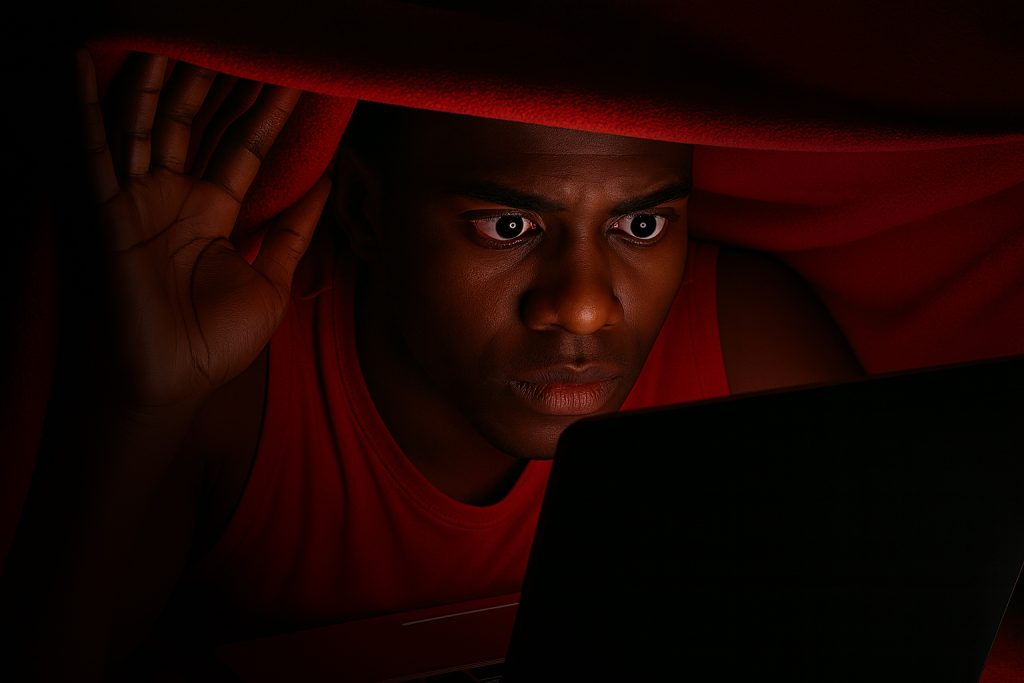
Like many men, he kept those struggles to himself. Porn isn’t something most openly talk about, even though many discovered it the same way Jabbar and Tunde did — out of curiosity, boredom, or chance — and it quickly became their first and only form of sex education. What begins as exploration, often grows into habit, and for some, a dependency they don’t admit to anyone.
Yet, the consequences seep into real life. Men who struggle with excessive porn use talk about how it reshapes their relationships, leaving them feeling detached from their partners. Over time, real intimacy starts to break down: sex becomes performance, partners sense something is off, and emotional distance grows in silence.
“It made me less attracted to women at one point because I hated how they were treated in those videos,” Tunde says. “Sometimes I skip foreplay and go straight to it, until maybe I catch myself. There are times I don’t get an erection until I watch porn. There are also times I just masturbate and ignore my partner completely. Sometimes I can cuddle, kiss and everything, but not want to consummate it with sex. It varies from relationship to relationship, but porn has definitely left its mark. I’ve tried to stop on religious and health grounds, but I always find myself going back.”
For others, the guilt is spiritual. In a country where faith plays a central role in daily life, porn habits clash directly with religious values. The cycle of indulgence, regret, and repentance leaves many men wrestling with a shame they can’t share, even with their closest friends.
Tobi*, 34, knows this cycle all too well. He grew up in a deeply religious home where even curiosity surrounding sex was considered a sin. “Even mentioning masturbation or sex in passing was enough for a long lecture,” he recalls. So when he stumbled on porn at 15, it felt like rebellion. But that rebellion quickly became an obsession.
By university, he was binging porn for hours, sometimes all night. He failed courses, but what weighed on him most was the guilt. “Every time I finished, I’d pray and beg God for forgiveness. It became a cycle: watch, regret, repent, repeat. And because you can’t gist your friends about porn, I carried the shame alone.”
He assumed marriage would cure it. If he had a partner, he thought, the cravings would vanish. But addiction doesn’t disappear just because sex is available. The first time his wife caught him, she didn’t say anything, until later that night when she stopped midway through sex and asked, ‘Am I not enough?’ I realised I’d been living a double life: a devoted husband outside, a struggling addict inside.”
Over the years, he’s tried prayer, fasting, accountability apps, even switching to monochrome devices. Nothing has stuck. He can go weeks without porn, then one stressful day pulls him back in.
Beyond relationships and religion, the toll on one’s mental health is just as heavy. Some men report isolation, anxiety, or a warped self-image tied to their consumption.
“Nobody talks about porn addiction, especially in religious circles.” Tobi says. “Yes, there’s the occasional preaching about how it’s a sin. But not so much helping you understand how you got to this point and how you can break free. So you just carry it like a dirty secret.”
But not every man sees consistent porn consumption through a lens of shame or struggle — for some, like Segun*, 29, it’s not a moral crisis but a harmless habit.
“I watch it when I feel like it, I masturbate, and I move on,” he says “Sometimes, I watch almost every day, and it has never stopped me from living my life. I did well in school, I’ve dated, and I’m in a stable relationship now. My girlfriend knows I watch porn sometimes, and she doesn’t mind.”
He even calls it educational. “Growing up, nobody gave us sex education. Porn filled that gap. Maybe not perfectly, but it helped me understand my body and even talk about sex more openly. I get that for some people it’s an addiction, but that’s not how I choose to see it. I can go weeks without it. I think the real problem is how Nigerian society demonises sex in general. For me, it’s just porn, nothing more, nothing less.”
While some men dismiss porn as harmless and others wrestle with shame, medical professionals are seeing the consequences of excessive consumption up close. Dr. Zainab Olayiwola, a US-based Nigerian physician, says porn addiction is “far more common than most men admit,” often disguised as nothing more than “insatiable male desire.”
“But when you look closely, it’s usually rooted in deeper issues like anxiety, depression, loneliness, and low self-esteem,” she explains. “One of the big consequences I’ve seen is desensitisation. Men get so overstimulated that they can’t respond to real intimacy unless they escalate to watching more extreme or violent porn. That desensitisation doesn’t just affect their body, it affects how they see women; they objectify them.”
Zainab recalls a patient who couldn’t ejaculate during sex with his wife unless he watched porn alongside her. “He thought it was normal to ask his spouse to watch together, but what he was experiencing was porn-induced erectile dysfunction. It also affects ejaculation — making sex prolonged — and can even lower sperm quality.”
And for the many Nigerian men who say porn doubled as their first sex education, she offers a mixed perspective. “Yes, it’s safer than experimenting recklessly with strangers. But it rewires the brain’s reward system. It trains you to crave instant gratification, which can spill into other parts of life. That’s why porn addiction often sits side by side with impulsivity, shame, isolation, even self-hatred.”
From her practice, she’s noticed that the most vulnerable group are young men between 18 and 35 — the ones with easy internet access and few guardrails. “They’re also the age group most likely to be impulsive and to carry unrealistic expectations about sex and life,” she adds.
When it comes to help, Zainab stresses that the options are there, but they require honesty and persistence. “Therapy, therapy, therapy. It’s not just about stopping porn, it’s about retraining behaviour. Cognitive behavioural therapy can teach coping strategies, but really any form of psychotherapy that tackles shame and impulsivity will help.”
While doctors frame porn as a medical and psychological concern, pastors often see it as a spiritual battle. Olamide Ologbonori, a Nigerian clergyman now based in the UK, says porn is “one of the biggest scourges of our time,” and far more men are quietly wrestling with it than the church likes to admit.
“It’s just too accessible,” he explains. “You hear men say they first saw porn when they were eight or nine. In my own case, I was about 11. This was before smartphones or social media. I remember finding a porn VCD hidden in my barber’s drawer. I stole it out of curiosity and played it at home. That was my first exposure, and I know many millennials — and now Gen Z — have similar stories.”
From his pastoral work, he believes this early exposure explains why porn feels almost “normalised” today. But for Christians, he insists it can never be. “The Bible doesn’t say manage it or try to resist it. It says flee. The very word ‘pornography’ comes from porneia, which translates to sexual immorality. And 1 Corinthians 6:18 is clear: flee all sexual immorality. That means Christians aren’t empowered to manage porn; we’re empowered to run away from it.”
He recalls counselling a man in his congregation who made him an “accountability partner” through a recovery app. “He would check in whenever he slipped, and I would encourage him to keep trying. If you did two weeks last time, let’s push for a month. That’s how we managed it. The journey isn’t easy, but walking in the spirit — prayer, studying scripture, acts of love — is what helps you replace the desire.”
But his advice isn’t just spiritual; it’s practical too. He urges men to cut off triggers, whether it’s deleting apps like X (formerly Twitter), or distancing themselves from peers who normalise porn. “Even men without faith admit it makes them feel guilty and drained afterwards,” he says. “But if you want to break free, you have to remove the triggers and fill your life with what feeds your spirit instead.”
While some suggest quitting entirely, others see porn as a tool that, when used intentionally, can enhance intimacy.
Sex therapist Elizabeth Adewale has worked with men and women who found porn useful in exploring or sustaining intimacy. She remembers a client who struggled with low libido until she introduced softer forms of erotica like audio porn and erotic literature. “It really helped boost her arousal and expand her sexual imagination. That change alone helped her reconnect with her partner,” Elizabeth says.
She also describes couples who’ve used porn intentionally to revive stagnant sex lives or stay connected across distance, per her recommendations. “One couple who had been together for years found things getting stale. Watching porn together gave them permission to laugh, experiment, and find new excitement. Another long-distance couple traded erotic videos to explore fantasies they could later try in person. It became less about porn itself and more about communication and creativity.”
For her, the problem isn’t porn itself, but how people engage with it. “See it as entertainment, not education,” she says. “Actors are performing with enhancements, editing, and unrealistic scenarios. If you try to measure your body or performance against that, you’ll hurt your confidence. But if you use it intentionally, it can spark conversations or fantasies without dictating your reality.”
She encourages men to choose ethical platforms, set personal boundaries, and, where possible, remove secrecy. That also means being intentional about frequency. “Decide when and how often you want to watch it, don’t let it take over your life,” she advises. “If you have a partner, be open about it instead of hiding it. You can even watch together if you’re both comfortable. The goal is to approach porn with honesty, balance, and intentionality rather than shame or secrecy.”
*Names have been changed to protect the identity of the subjects.
Click here to see what other people are saying about this article on Instagram