This article is part of Had I Known, Zikoko’s theme for September 2025, where we explore Nigerian stories of regret and the lessons learnt. Read more Had I Known stories here.
Amudalat*, 53, still remembers the day her father turned her lover away with the lie that she “wasn’t home.” Twenty-five years later, she wonders if that moment set the course for everything that followed: a marriage that collapsed, single motherhood, and a life spent nursing a love she was never allowed to keep.
In this story, she opens up about the weight of parental control, the ache of what could have been, and why she no longer sees the point in chasing a love that will only remind her of the one she lost.
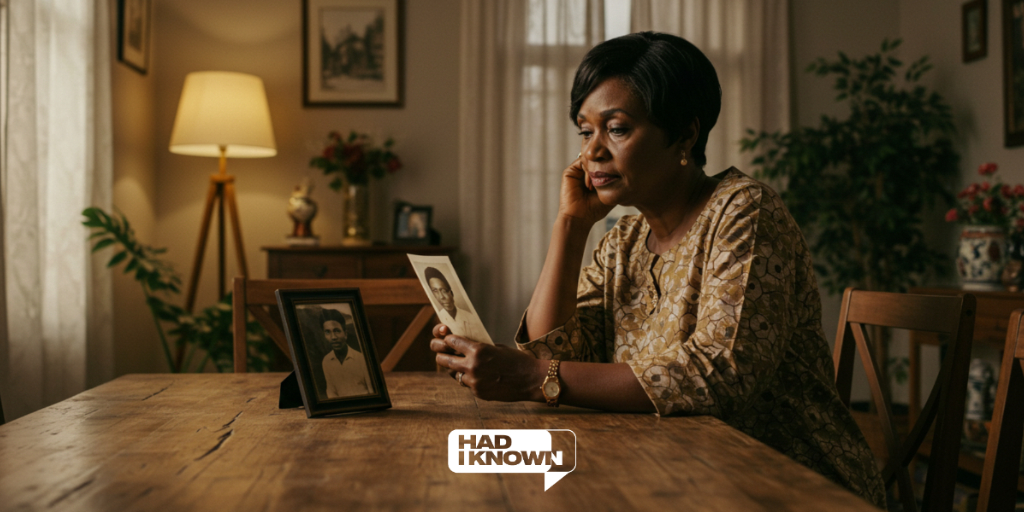
This is Amudalat’s story, as told to Adeyinka
My childhood home carried many memories.
Weekdays were quiet, the silence broken only by the tooting of motor horns and mindless chatter of wives who stayed at home while everyone else went about their business.
Saturdays were spent in a steady stream of activities: peeling and grinding beans for akara, gathering in front of our black and white TV in the afternoon for whatever the local stations served us, and ironing our white gowns ahead of Asalatu.
Sundays were divided neatly into four: mosque in the morning, a joint family lunch, an inevitable visitor who always arrived like it was prearranged and a solemn evening spent preparing ourselves for the new week.
So, of all days to introduce my lover, Sikiru*, to my parents, I chose a Sunday.
It made sense. I only had to tell them ahead, in case they’d extended an invite to a friend or distant relative who always carried tidings of unfortunate happenings.
“When did that one start?” my dad shot at me.
A plump, dark-skinned man whose grainy voice demanded rapt attention, his questions, especially when hinged on bubbling disinterest, never stopped at one. So I awaited, with bated breath, as he emptied his curiosity.
“Which family is he from? When did you people start? “Is your mother aware?” I answered what I could, each time pleadingly casting a gaze at my mother who, quite frankly, had no say in the decisions that mattered.
“She won’t marry herself,” she finally said, “Let him come.”
But Sikiru never made it past our entrance the following Sunday afternoon. I watched from the window, in my neatly pressed A-shape gown, as my father turned him back because “I wasn’t at home.” I wanted to call out, to let him know I could see him. But the weight of my father’s glare sealed my lips shut.
So I stayed there, watching helplessly as my lover walked away, each footstep registering his disappointment. Our hearts, both breaking at the same time, even if they made no sound.
***
There are first crushes who never become lovers, and there are almost lovers who slip through the cracks. Sikiru was the one true love who got away.
We met in 1996 at a disco party in Brickfield, Apapa Road. His aunt, a next-door neighbour who had always admired me from afar, often said I’d make the perfect match for her nephew studying in London.
“Yes, aunty,” I’d quip each time she reminded me, her resolve making it clear she was also teasing the young man with a promise of love.
So it came with little surprise when she invited me to his disco-themed homecoming party. He’d just graduated from university in the UK with a distinction and was back to celebrate, find a good woman, and do all the other things expected of a man his age.
At the party, I barely said much. It wasn’t that I didn’t want to, but his impeccable Queen’s English left me gathering and spreading my thoughts, as though I needed to rearrange them before they could reach my lips.
Even though I barely spoke that first night, I couldn’t stop thinking about him. It didn’t help that his perfume clung to me, hanging loose in my nose even after long baths on different days.
By the third day, when the scent still hovered — sharper, almost wasping around me as I walked home from an errand — I started to worry something was wrong. But nothing was.
There he was, right behind me, mouthing my name. Sikiru had been calling since he sighted me, but I was so set on my journey I hadn’t realised.
That day, I had a little more to say. And that was how it began: short walks after errands, longer ones on slow evenings, and sometimes, stolen moments at his aunty’s place whenever the opportunity presented itself. We became an item, and I sometimes whispered heartfelt prayers for his aunt; her persistence had made it all possible.
If my family noticed that I’d somehow found love under their noses, they didn’t say anything. My mum only asked why I stayed longer on errands. My dad barely commented on the days he saw me lingering on our neighbour’s front porch. My siblings carried on; ours wasn’t the type of siblingship where we discussed private affairs.
And so Sikiru and I blossomed in love, cocooned in our own little world and dreaming of things both big and small. How I would introduce him to my family. How we would have a decent wedding ceremony. How I’d follow him back to London. How we’d raise three children. How we’d live out the rest of our lives together. It all seemed perfect, and more importantly, doable.
After all, was it not every parent’s pride to see their firstborn daughter bring home a man, especially one who studied in London and promised relocation? I was certain my parents would be proud.
So when, that Sunday, they pulled me into a corner after Sikiru left and laid out all the reasons why a life with him would be a series of unfortunate events waiting to happen, I was heartbroken.
First, there was the issue of relocating.
They would not let a man from London whisk their firstborn daughter away to a foreign land. Was it not the same fate that befell a distant relative whose daughter had been unreachable since she left with her husband? What about a friend who could not speak to his own son without the wife’s permission, because African women became something other than themselves once they crossed into a foreign man’s land?
Then came the matter of omugwo and grandchildren. Did it mean they would never see their own grandchildren? God forbid.
They stacked the impossibilities one after another, and when they finished, my father voiced what surely was his only genuine concern: Sikiru was Christian. Over his dead body would his own child marry a Christian. It simply could not happen.
In the days that followed, I picked at those impossibilities, turning them this way and that, until they quietly lodged themselves somewhere in my subconscious — out of reach while I thought up ways that could still make us work.
Relocation wasn’t so bad, not if we returned from time to time. Parents sometimes uprooted their lives to help with grandchildren abroad; why would it be any different with mine? And religion? That could be talked about, too. I had uncles and aunties who’d embraced Christianity and still had their place secured on our family tree. All I needed were older relatives who could speak sense into my parents.
But when I finally saw Sikiru a week later, none of this came out. Instead, the impossibilities rolled off my tongue, each one slicing into his heart, deeper than the last.
His aunt was there to nurse his hurt. “I didn’t know your father is like that,” she said, her drawn-out sighs carrying what stayed unspoken: she wasn’t going to tell a man what to do with his daughter.
When I left, with a half-hearted promise to visit soon, she echoed conclusions I’d already drawn with a casual, “God will show us the way.”
Sikiru returned to the UK four months later with two big black travelling bags. By then, we’d grown apart.
I watched as his aunt and other relatives ushered him into the car taking him to the airport. I wondered if perhaps the love we shared — and the possibilities of reuniting — were tucked somewhere between those big black bags.
***
It’s been twenty-five years since then.
Two years after Sikiru left, I married a man who, in many ways, felt like a shadow of him. Dewunmi* wasn’t Sikiru, but he smiled like him; lips stretched until they formed a crease on both sides of his cheek. He didn’t wear expensive perfume, but his scent filled a room the moment he walked in, sharp and familiar, like camphor tucked inside freshly folded clothes.
His English was nothing like Sikiru’s, yet he wielded the language with such mastery that I often stared into his mouth, as if I could catch a glimpse of the words as they formed.
In the beginning, he adored me, almost to excess. He’d wake before me just to pour palm oil into the pot so the house would smell like stew by the time I woke up. Some evenings, he’d drag his chair to my feet, insisting I rest mine on his thighs while he ran his hands through my legs.
I had two children with Dewunmi, and for a while, I believed life had offered me another chance at true love. But I was wrong. The marriage barely lasted a decade.
The same man who once begged me not to leave his side disappeared without warning. One day he left the house and never returned.
The years after were a blur of custody hearings and lawyers’ offices with their cracked ceilings and stale air. My children’s small hands tugging at my sides, searching for comfort. Their wide eyes asking why we were always in strange places where people wore black gowns and wigs that looked like a cluster of white feathers.
I spent many nights turning the question over: how does a man who worships the ground you walk become one fighting you for your children?
The clerics had their answers. He’d been charmed by another woman, they said. “His eyes have been turned away,” my mother echoed, nodding as if that closed the matter. Maybe they believed it. Maybe they needed me to believe it. I never did, but I carried on anyway, because it was easier than holding on.
I never remarried. I faced my children and raised them alone.
During the Facebook era, Sikiru came back into my life briefly. But by then, the ship had sailed. He was married with children of his own. The few times we spoke on the phone, we barely touched on the past.
Our history sat quietly between us, unspoken, like a secret we both knew but had agreed never to bring to light.
***
Both my parents are gone now.
Sometimes, I blame myself for not fighting hard enough, for letting people who chose themselves decide who I could or could not choose.
When things with Dewunmi began to unravel, one memory stayed with me. It was a quiet evening when I went to pick the children up from my parents’ house. I found them in the parlour, tiny bodies slumped against each other, eyelids heavy but still fixed on the TV screen’s glow. My parents were in their room, unconcerned, like it was the most natural thing in the world to leave two small children alone in a room.
I was grateful then. Grateful they had stepped in, carried the weight of watching them while I tried to figure out my own mess of a life. But anger sat right beside the gratitude. Because they caused this. They had denied me a love so true, so certain in its promise of a life lived together until hair turned grey and teeth began to shatter.
Weeks later, I tried to talk to my father. I wanted to peel open the wound, to show him how the choices he made had seeped into my life. He sat in his chair, the evening light falling across his face, and when I pressed him, he shook his head slowly. “Time has blurred my memories,” he said, as though the past was a smudge on glass he couldn’t quite make out.
But I remembered. I remembered the questions he fired at me, the glare that kept my mouth shut, the way he turned Sikiru back at our gate. He may have blurred it out for himself, but I carried it all through the years.
Now, here I am, with both of them gone while I continue life alone. I’m grateful for my children, but they have their own lives now.
As for me, I don’t see the point in dating. I no longer have space for a kind of love that will only remind me of what could have been.
*Names have been changed to protect the identity of the subjects.
Do you have a story of regret? Share it with us by filling this form.