When Amudalat* (56) first left Abeokuta for Lagos as a teenage girl in 1989, all she wanted was to ease her family’s financial struggles. She didn’t imagine she’d spend decades raising other people’s children while barely being present for her own.
Now, with grown-up sons who keep their distance and children she helped raise who don’t remember her, she shares how working as a domestic help swallowed up the best parts of her life, leaving her to rebuild relationships with children who always felt abandoned.
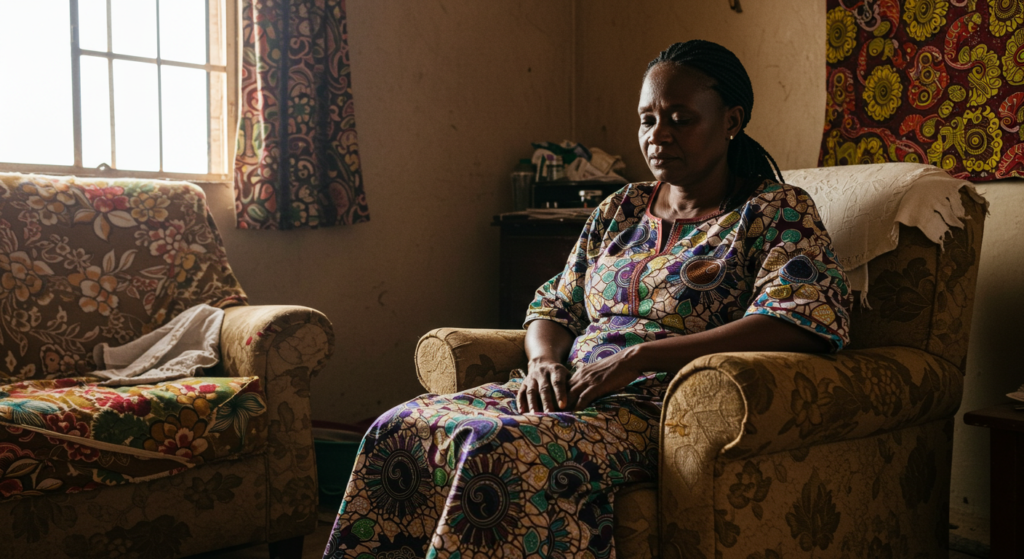
This is Amudalat’s story, as told to Adeyinka
I never imagined my life would turn out like this — a mother who sometimes feels like a stranger to her own children. Not because I abandoned them, but because I spent most of my life mothering other people’s kids while mine were left to figure life out without me.
I’m 56 years old now, and when I think about how it all started, I realise it was never the plan. I grew up in Abeokuta in the ‘70s and ‘80s. Nobody in my family had ever worked as a house help. We were simple people: farmers, traders, people who worked with their hands. The goal was always to finish secondary school and pick up a trade or help on the family farm. But I didn’t want that life. I was determined to get an education and build something bigger for myself.
Everything changed when my father died.
I was 18 when it happened, and I suddenly became the eldest child in a house full of little children. My mum didn’t have much, and we were five mouths to feed. I had to step up, but where would I start from? All around me, I heard whispers of young girls leaving the village for Lagos to work as house helps. They made good money, sent money home, and took care of their families. At the time, it sounded like a good deal. I wanted to further my education, but that dream died with my father. Caring for my family came first.
My mum eventually found a distant relative whose daughter needed domestic help in Lagos, and that’s how I left home in 1989. I barely knew the woman or her daughter, but that didn’t matter. It wasn’t openly said that I was their maid, but we all knew what it was. From the moment I entered that house, I was no longer Amudalat. I became “small mummy”.
I stayed with them for 10 years. I raised three children while their parents went about their lives. Everything in that house was my responsibility: the cooking, cleaning, school runs, and late nights with a sick child. I wasn’t just a domestic worker; I became their second mother. I didn’t have time to build my own life. Everything I had, I gave to those children.
Somewhere along the line, I met my husband. I got married and left domestic work briefly to focus on my marriage and children. But I stayed close to my former employers. They called me regularly to help on weekends, and I agreed because, after all those years, it didn’t feel like just a job. Those kids felt like my own.
My husband didn’t like it. He said no woman should serve another family after having her own. I didn’t listen. The extra money helped, especially after I opened my small provision store. I had two boys, and for a while, I thought things would get better. But things took a turn when my marriage ended.
My husband left, and life hit me harder than I’d ever known. Rent, feeding, school fees, everything became my burden. My little shop crashed under the weight of bills. The only job I could return to was the one I knew best: domestic work.
But things were different this time. I wasn’t a young, single girl anymore. I had my own children, but I had to raise other people’s children to survive. My first thought was to find work that would allow me to close by 6 p.m. every day so I could be with my boys. But people wanted live-in maids, people they could rely on for cooking, cleaning, helping with homework, and midnight fevers. And I didn’t know how to be mean. It’s my biggest flaw. I cared too much, and my employers loved me for it.
Before I knew it, I was back in the same cycle. I was the small mummy in another house. I cooked their meals, tucked their kids in at night, and knew their allergies and favourite cartoons. Meanwhile, my own kids were shipped off to their grandmother in Ogun State. I would visit, but each visit reminded me that I was slowly becoming a stranger to my children.
They wouldn’t come to me the way they went to my mother. I saw how my absence created a gap, but what could I do? I had to choose between providing for them or being present and watching them suffer.
As they grew older, the resentment grew deeper. They never said it out loud, but I saw it in how they treated me. They didn’t share things with me. They didn’t run to me when they had problems. And I couldn’t blame them. I had been gone for most of their childhood.
I stayed in domestic work until I was able to put my first son through university. I left that job only when I knew at least one of my children had something stable to build on. I restarted my provision store and swore never to work as a maid again. It doesn’t bring much, but at least I sleep in my own bed every night and see my children, even if they don’t talk much.
But the damage had already been done.
Today, the children I sacrificed everything for barely remember me. I see them on social media sometimes, all grown up, living their lives. I remember the songs I used to sing to them, how I stayed up with them when they had malaria, and the smiles when I bought them biscuits with my own money. Yet, I know if they see me now, they’ll greet me like a distant neighbour, not the woman who mothered them for a decade.
And my own children? We’ve patched things up, but the bond isn’t as strong as it should be. My youngest son still jokes about how I cared for other people’s children more than I cared for them. I always laugh it off, but the truth burns inside me.
If I could go back in time, maybe I’d have found another way. I would struggle with my children, even if it meant poverty. Because money can be replaced, but children can’t. I look at my sons and feel like I am trying to reconnect with strangers. But life didn’t give me many options. I gave the best parts of my life to other people’s homes because I wanted to survive. I wanted to keep my children alive, even if it meant sacrificing my presence.
Now, I spend my days in my small shop. I make enough to get by, but sometimes I wonder if I made the right choices. The kids I raised forgot me. The kids I birthed struggle to love me. I just hope my story reminds people that sometimes, survival demands sacrifices no one else will ever understand.
*Names have been changed to protect the identity of the subjects.
Click here to see what other people are saying about this article on Instagram