Think about the last Nigerian album you streamed from start to finish. Think about the one you still have in rotation. Not the one you added two songs from to a playlist. Not the one you remember only one or two songs from it. I mean the one you actually sat with (and still do), track by track, from intro to outro.
Think about this tweet by culture curator and journalist, Ayomide “AOT2” Tayo.
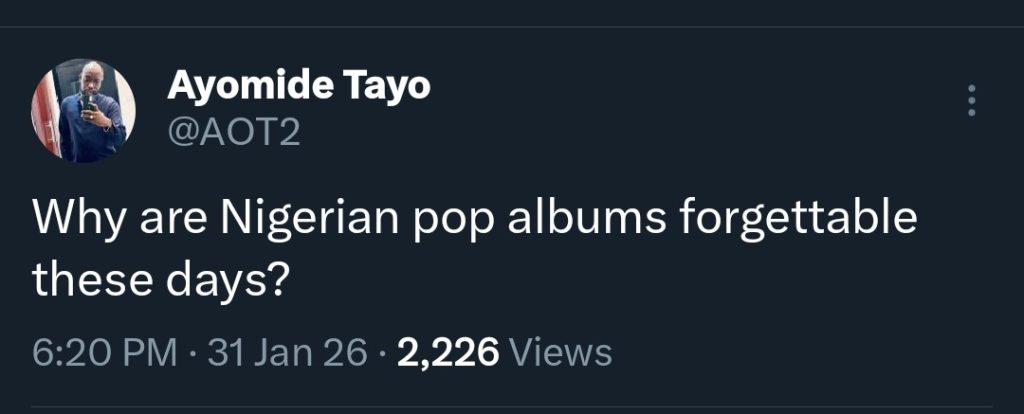
Take your time, I will wait.
If you’re struggling with finding one, you are not alone. Something interesting is happening to Nigerian pop albums. They arrive with massive rollouts (not hating on rollouts), trend on X for 72 hours, rack up first-week streams that’d make an early-2010s artist weep, and then… fade into oblivion. Three months later, except for the one popular single, no one can remember the tracklist. The songs blur into each other. The album has no shape, no spine, no reason to exist as a body of work, but rather a loosely assembled folder on DSPs.
Don’t mistake this for a rant or just another case of “Afrobeats journalists being shady again.” Nigerian music is objectively in its most powerful era yet. The artists are more diverse and more talented. The production is world-class, and the global reach keeps skyrocketing. So why do the albums feel like fluff the moment one presses play?
Albums used to be an experience. You bought the CD, whether an original or a pirated copy from Alaba Market, roadside or your area’s cassette/CD store, and you lived inside that album for months. You knew which track came after which. You knew the interludes. You had opinions about the sequencing. The album had a feel and a personality that mattered more than the sum of its singles.
Think about the projects from the mid-2000s to early 2010s that defined Nigerian pop music. Those albums have structure and sticking narratives. They open with intention, build momentum, shift gears in the middle and close as intended. The features amplify the album’s vision, and aren’t just pair-ups with who’s hot. Even the skits aren’t filler, but connective parts. All elements of the albums come together for a single purpose. When you finish listening, you feel like you’ve been somewhere.
Whether A-listers or mid-tier artists, they understood that an album is supposed to be a statement of where you are as an artist or what is happening around you at that moment. The ambition was as creative as it was commercial. Artists could prove they could sustain a vision across 14, 16, or 18 tracks.
Now? Most albums feel like they were built in reverse. Pick the singles first, fill in the gaps later, slap a title on it and ship.
Subscribe to Zikoko Pop newsletter, The Feed, for the most important pop culture news
Something-something about the streaming machine
There’s no doubt that streaming has redefined what success now looks like in music. In the streaming era, success isn’t measured by how good an album is. It’s measured by how many individual tracks chart. Every song on the project is competing for playlist placement, and playlists don’t care about an album’s narrative arc. Playlists only care about mood, vibes and saves.
Whether liked or not, this changes everything about how albums are made. If each track needs to stand alone and pass the 30-second test, why would any artist build a slow-burning intro? Why would they include an interlude that creates breathing room but generates zero streams? Why will an artist sequence tracks for emotional flow when most listeners will hear them on shuffle anyway?
We now have albums with hardly ten tracks, designed like EPs. It’s kept that way to appeal to short-attention spans and to hack the algorithm. We also have what one could call the Agbada Album: a collection of songs masquerading as a project. The tracklist is bloated because more songs mean more streams. Either route leaves the listeners unchallenged. Nothing asks them to wait and rewards them for paying attention, because most albums these days aren’t crafted for attention. They’re put together for quick consumption.
Is this a problem or just evolution? Some would argue that the album format was always an artefact of the physical media system. You needed 40 minutes of music to justify buying a CD. Now that singles are the real unit of currency, forcing 15 tracks into a cohesive body of work is almost considered nostalgia and an invitation to criticism.
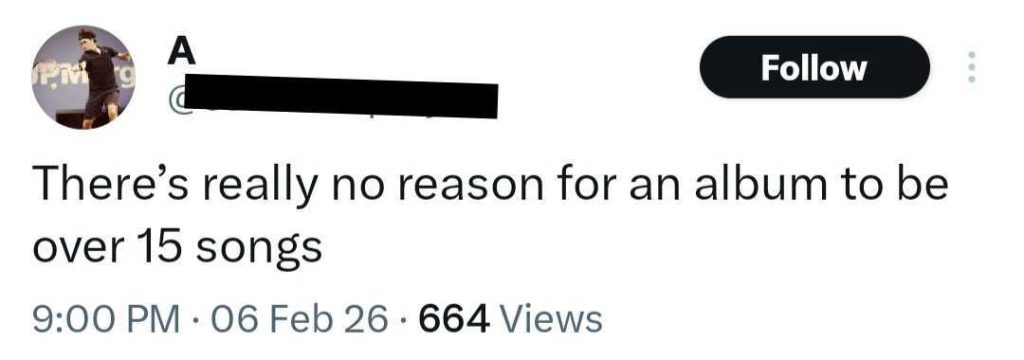
But before we rush to blame artists, these things are worth sitting with.
Even if we accept that the album format is evolving, something has clearly shifted in the creative process. The pace at which Nigerian pop artists release projects (read albums) has accelerated to the point that it feels unsustainable. Major artists put out a project, tour for a few months maybe, and then there’s already pressure to release the next one. The content cycle is ravenous, and it cares less about the artistic gestation period.
There’s a reason the albums that stick with us, anywhere in the world, tend to come from artists who take their time. Not because there’s magic in delay, but mostly because there’s time for reworking, for throwing away ideas that don’t work, for living with the project long enough to know if it actually holds together or accurately interprets the vision. Rushed albums don’t get the benefit of that crafting and self-editing. It’s mostly like submitting the first draft.
READ NEXT: What Billboard’s “One-Hit Wonder” Label On Rema Reveals About the Nigerian Music Industry
The fear driving this rush is quite apparent. Nigerian pop moves really fast. If you disappear for two years to cook (not everyone is the Big 3 or Rema), someone else takes your slot in the conversation. This keeps artists in perpetual release mode. They trade depth for frequency, and the albums pay the price, though this isn’t to say all rushed albums are bad and all long-gestated albums are good. There are definitely some great albums that got made quickly, perhaps under pressure. But the key thing here is intention, not speed. Are artists making music because they have something to say, or because the business or release schedule says it’s time?
As a listener, it’s completely okay to be genuinely bothered. Even if you accept the streaming economics and factor, and forgive the pace, what happened to the craft of album making?
Where did the story go?
Sequencing is an art. It’s the difference between a compilation/playlist and an album. The choices of where a song is placed, what comes before it, and what follows it create meaning. The unforgettable albums build conversations and impact memories.
Most Nigerian pop albums today have no discernible sequencing logic. You could rearrange the tracks in any order, and the listening experience would be roughly the same. There are no transitions, no storylines, no sense that the artist considered the album as a journey with a beginning, middle and end. Somehow, the whole thing is less than the sum of its parts.
This is also where storytelling has faded. The unforgettable albums in Nigerian pop history tell stories, not necessarily literal narratives, but emotional ones. They carry a feeling across their runtime. You can sense the artist’s growth, heartbreak, joy, conflict, and whatever emotions unfold across the tracklist. Now, most albums are flat and soulless. Just vibes (an unfortunate term that happened to music) throughout. Nothing that draws the listener in to pay attention to what’s happening between tracks.
But do we as listeners even care? Before we lay it at the feet of artists, labels and industry machines, we need to flip the mirror and look at the audience’s behaviour. The way we listen to music has changed as much as the way music is made. We skip relentlessly. Thirty seconds into a song that doesn’t immediately hook, it’s on to the next or the already familiar. We add two tracks to a playlist and forget the other fourteen exist. We engage with albums through discourse — X threads, IG stories, stan wars, Spotify wrapped, scrobble points — more than through sustained listening. We form opinions about albums within hours of release, then move on to the next thing.
In an environment like this, is it any wonder that artists have stopped trying to make albums that reward deep listening? Why build a cathedral when everyone’s just going to take a selfie in the doorway and leave?
This is the feedback loop that needs to be talked about. Artists, these days, make microwave music because we consume shallowly. We consume shallowly because the albums aren’t giving us a reason to go deeper. Round and round it goes, each side pointing at the other, and hardly anybody is trying or willing to break the cycle.
International appeal ≠ authenticity
As Nigerian artists have gone global and the push has been significant, their albums have begun to abandon a universal worldview and instead seek to speak different languages at once. A track for the UK market here, something for the American playlists there, a Francophone feature for a wider African audience, a Caribbean-leaning dancehall joint for crossover potential.
None of these choices is inherently bad. Nigerian contemporary music has always been a fusion culture, and the ability to move between sounds is part of what makes Afrobeats so powerful. But when an album is built to satisfy every possible audience, it often ends up with no real identity of its own. It’s everything and nothing. It’s a buffet when what you wanted was a chef’s tasting menu.
The albums from the previous era that we still remember? They weren’t really thinking about global playlist placement (they didn’t detest global appeal). They were thinking about what they wanted to say, in their own voice and primarily for their own people. The international audience came because of the authenticity and specificity, not in spite of it. There might be a lesson in that.
So what now?
Look, I’m not saying Nigerian artists need to go back to 2008. You can’t reverse-engineer the cultural conditions that made those albums possible, and you shouldn’t try. The industry has changed, listening habits have changed, and the economics are what they are. But none of that means the art of cohesive album-making has to die. It just means the album has to be worth it.
If you’re going to ask someone to spend 30, 40, or 50 minutes with your album, give them a reason. Tell a story. Build a world. Make the sequencing matter. Cut the three filler tracks that exist purely for streaming math. Have the confidence to make something that doesn’t chase every audience at once.
For the listeners? Let’s meet the artists halfway. Maybe we put the phone down, turn off shuffle and actually listen front to back once in a while. Maybe we stop treating albums like content to be consumed for “gotcha” moments, stan wars and trends, and start treating them like art to be experienced.
Or maybe the album really is just a relic of a different era, and the future of Nigerian music lives entirely in singles, compilations, EPs and playlists. Maybe that’s fine. Maybe it’s even better. But I don’t think so, and if you’re still reading this, I don’t think you do either.