Every week, Zikoko seeks to understand how people move the Naira in and out of their lives. Some stories will be struggle-ish, others will be bougie. All the time, it’ll be revealing.

Saving doesn’t stop life from happening. When things come up, Carbon doesn’t force you to choose between progress and survival. Your locked savings keep growing, and you can use it as collateral to access a loan at just 3% interest. It’s saving, built different so you can move different. Create a savings plan here.
What’s your earliest memory of money?
Opening a bank account in SS 3 and depositing my first savings in it. My savings were about ₦40k or ₦50k — money my siblings and parents had given me over the years.
Unfortunately, I got scammed not long after opening that account.
Ah. What happened?
I fell for a Ponzi scheme. Something about “mining” naira, performing tasks and referring people. I put in ₦10k to earn ₦50k in two months. On the night I was supposed to withdraw the money, the site didn’t open. I couldn’t tell my parents because I’d ventured into the scheme without informing anyone.
Phew. Speaking of your parents, what was the financial situation growing up?
My dad had a lot of businesses, from real estate to diesel. My mum was a baker. That’s what they still do today. I wouldn’t say we were wealthy. I had all I needed, but not necessarily all I wanted.
What was the first thing you did to earn money?
I sold shawarma in my first year at university. I attended a Seventh-day Adventist private university that didn’t allow meat or chicken meals on campus. The cafeteria only served tofu. Of course, students couldn’t eat that all the time, so we often smuggled food inside school. Shawarma was a popular choice.
I bought shawarma outside the school at around ₦1500 – ₦2000 a piece and resold them for ₦3500 – ₦4000. I honestly did it because everyone else was selling something, and it was an opportunity to make extra money on top of my ₦30k monthly allowance. I typically sold shawarmas every Friday and made around ₦14k in weekly profits.
After 100 level, I changed hostel halls, and it was much more difficult to sell because of constant checks. I didn’t want to get sanctioned. I also decided it was better to just focus on my studies, so the business died.
Did you try another business in uni?
Nope. I survived on pocket money. From the second year, my allowance increased to ₦50k, and later to ₦70k. I could also call home if I ran out of money. I continued like that until I graduated in 2025.
What came next?
I read a Zikoko article about someone who made ₦6m from YouTube and decided to give creating on YouTube a shot.
I’d actually made money from YouTube once, years ago, in 2015 or 2016. I was in secondary school and used to play football games on my mum’s tablet.
My sister told me I could make money from YouTube, so I recorded a few of these games and posted them there. Back then, it was so easy to monetise. They didn’t have the 1000-subscriber and 4000-watch-hour rule then. I think I got monetised in under a month.
I didn’t make much from the channel, though. Only $20. YouTube paused ads on the channel because they couldn’t verify my address. I uploaded two or three more videos after that, but I eventually lost motivation. Plus, I was in boarding school and couldn’t be consistent with it.
However, that article motivated me to try again. I did a lot of research and watched free YouTube tutorials. Then, just like the lady in the article, I created a faceless channel focused on revenge stories, using AI to script and narrate the stories. This was in August.
How did that go?
I uploaded a new video every day for a month and a week. Unfortunately, I only got nine subscribers. I might even have been shadowbanned because I wasn’t getting views anymore. I eventually abandoned it.
I didn’t give up on YouTube, though. I created another channel and started posting videos in the health niche, specifically health advice for elderly people. This one also flopped. After 35 videos, I only got three subscribers.
By this time, it was December, and I had stopped posting on the channel entirely. I decided to go back to the drawing board and find resources that would actually guide me. I spent ₦50k on a few courses on YouTube automation, learning about different niches and how to pick the right niche.
After watching the courses, I felt ready to try YouTube again and created another channel. This time, I picked fictional mafia boss stories.
Your third attempt. Did things go better this time around?
Much better. My first video, uploaded on the 2nd day of January, reached 11,000 watch hours in 24 hours. By the 6th, I’d hit 1,000 subscribers. I applied for the YouTube Partner Program the next day and got monetised on the 13th.
That January, I made $2,600 in ad revenue. US citizens make up 70% of my viewers, so I had to pay tax on that income. After taxes, it came down to $2,010. In February, I made $1,600. I’m still expecting my March payout, but I’m sure it’ll be over $1k. Everything I’ve earned so far is in my domiciliary account. I haven’t touched it.
That’s almost ₦5m in two months. How does that feel?
It feels really good, but I believe I’ve worked on it. I’ve been on it since August 2025. Most people would’ve given up. YouTube automation can be really frustrating. Imagine putting so much effort into a video that doesn’t do well. I made multiple videos that flopped, but my consistency is paying off.
I still have a long way to go, though. I’ve seen people who make $15k in a month. My friend sent me a screenshot of someone who earned $83k. One of the perks of the course I bought was access to a community of fellow YouTube creators. One of them quit his banking job (he was a contract staff) after making ₦60m in a few months. That’s how YouTube is.
That’s interesting. Do you intend to make YouTube automation a full-time hustle?
I can’t say. The thing is, no matter how much money I make, I can’t fully depend on social media. YouTube can demonetise or terminate a channel at any time. Terminating is even worse because it means you can’t create a new channel on the same device. You’d need to buy another device and get a new internet connection, so they don’t detect it’s you.
I know several people who got demonetised, especially in January. Even X (Twitter) recently paused monetisation for many Nigerian creators. The sad thing is that many of these demonetisations are automated decisions. So even if the creator doesn’t violate any rules, there can still be system errors. It’s not like there’s a human being somewhere closely monitoring every suspected violation.
So, I wouldn’t advise anyone to make YouTube automation their full-time hustle. I’m just focusing on it for now because I don’t have other plans. I haven’t gone for NYSC yet, so I’m not looking for a job. I’m going with the flow and directing all my time and energy to YouTube to see how much I can get from it. I currently upload 5 videos per week, which is very time-consuming. That’s more than enough on my plate for now.
That’s fair. How has this recent windfall impacted how you think about money?
I now think it’s quite easy to make money, as long as you have the right information. The person who earned $83k knows (and is doing) something I don’t, and that’s why networking is important. So, I’d say join as many communities as you can and seek out as many mentorships as you can.
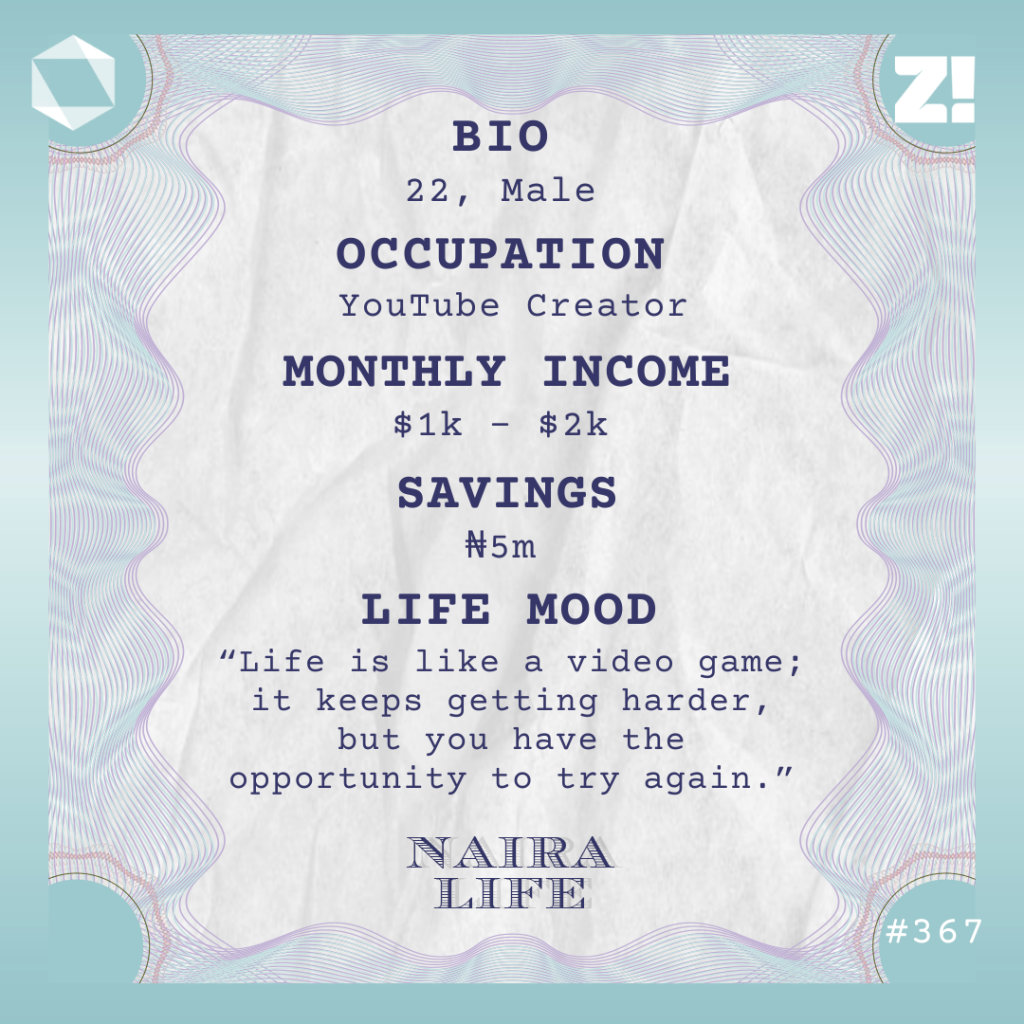
Also, fail as much as possible because it’s through failure that one succeeds. I recently tried to create a new channel on a new device, and it got disabled. It doesn’t mean I won’t try again. Life is like a video game; it keeps getting harder, but you have the opportunity to try again.
You mentioned you haven’t touched the YouTube money at all. Is there a reason why?
I live with my parents and don’t have financial responsibilities. I also have enough money — about ₦700k in my savings account — to cover my immediate needs, and about ₦5m in a mutual funds account.
Hol’up. Where did the millions in mutual funds come from?
I should clarify that I didn’t deposit the ₦5m in the account at once. It’s the result of compounding interest of at least 20% per annum over four years. I created the account when I was in 200-level at uni. Everyone in my family opened one at that point. We thought it was wiser to earn interest on savings there rather than leaving it in a bank account.
I’ve always been an aggressive saver, and throughout uni, I saved every extra I got from pocket money in the account.
Also, I did a bit of gambling in my uni days. I often went for high odds with small cash bets to reduce the amount of money I could lose and maximise profits.
I lost a number of times, usually between ₦2k and ₦30k. However, when I got lucky, I made like ₦50k-₦100k. My biggest payout was almost ₦1 million from a ₦2k bet in 300 level. I stopped gambling when I lost ₦200k on another game. I’d never lost that amount of money before. It was my sign to stop betting.
So, yeah, a lot of the money in that account came from gambling and allowances from my parents.
I’m curious. Do you have any savings and investment goals you’re working towards?
Not really. I’m just keeping money because there’s nothing else to do with it. I have an earnings target, though. I want to make $100k from YouTube by the end of the year. It’s very possible. I just need a couple of good months.
You mentioned not having financial responsibilities. What do you spend on in a typical month?
Mostly data and the various AI tools and subscriptions I use for YouTube automation. Those cost me about ₦100k a month, and I handle that from my savings. I don’t ask my parents for money anymore. The only things they give me now are shelter and food.
Is there an ideal amount of money you think you should be earning from YouTube right now, besides the $100k goal?
$20k a month. People make that regularly.
What about one thing you want but can’t afford?
Nothing.
How would you rate your financial happiness on a scale of 1-10?
8. I’m doing well for my age. I’m stable and growing. I’m not where I want to be yet, and I don’t even know if I’ll ever be because I’ll always want more.
If you’re interested in talking about your Naira Life story, this is a good place to start.
Find all the past Naira Life stories here.
The Naira Life Conference is returning in June 2026! Expect honest conversations and insightful sessions on building wealth, scaling businesses, as well as practical strategies to manage your money. Join the waitlist to be the first to know when tickets start selling.