Dr Anna Bethune (37) left Jamaica for Stanford at 16, built a prolific career across the US, but eventually moved to Lagos in 2020 for a job. For her first few months, she had nowhere to live, nearly transferred her money to a thief, and considered going back home.
In this story, Dr Anna talks about her Jamaican upbringing, being paid to do a six-year PhD, the three chaotic months she spent homeless in Lagos that nearly led to her being scammed, and why, even after experiencing “shege” in Nigeria, she still believes it is one of the most efficient places she’s ever lived.
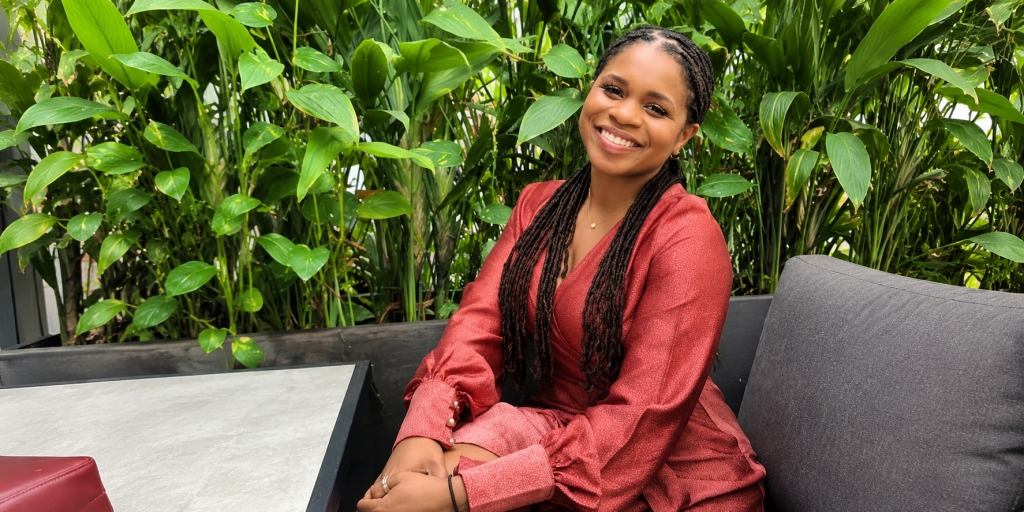
This is Dr Anna’s story, as told to Azara.
“This place is chaotic.”
That was my first thought when I arrived in Lagos, Nigeria, in September 2020.
But who can blame me? It was my first time moving to the country, and after 18 hours of travel and 10 suitcases in tow, I arrived with no visa and no clear idea where to go. After three hours spent sorting out my visa, I arrived at a hotel room that turned out to be too small for my luggage.
How did I end up in Nigeria in the first place? For one, it wasn’t for a lack of options.
I was born and raised in New Kingston, which is basically Jamaica’s version of Lagos’s Victoria Island. My family was comfortably middle-class. We travelled on most holidays, I went to some of the best schools, and we lived in an apartment building with a big pool in the backyard.
By 2006, at the age of 17, I had earned a scholarship to attend Stanford University. It covered my tuition, room, and board, everything I needed to complete a bachelor’s with honours in Economics in 2010.
Fast forward to 2011, I got a job as an economics researcher under a former prime minister of Jamaica. It paid around 2.5 million Jamaican dollars a year ($30,000) and was one of the best jobs I ever had. It gave me a sense of purpose.
By 2013, I wanted to continue my education, so I opted for a fully funded PhD from Northwestern University in the United States, where I studied Learning Sciences. The stipend was about $2,000/month, but because I was a competitive student, I negotiated it up to $2,500/month. I graduated in 2019.
When the offer to run a VC-funded foundation in Nigeria came up, I took it. I was ready for a new challenge and tired of America. I knew that social impact work in Nigeria, as complex as its society and economy are, would be a great training ground for the work I wanted to do in Jamaica later on. I knew the connection I made there would be important.
My friends have described me as crazy before. They think I do things on a whim, and I don’t always have a plan. But I do. They may have some gaps, but my plans are solid. I believe the rest will figure itself out.
Standing in the Lagos airport that day — September 14, 2020 — to start a job as the Director of Impact and Research at a brand-new foundation, I was sure I had made the right decision.
I spent two weeks living out of a hotel, and then the house hunting began.
I hopped between Airbnbs for the three months I spent house-hunting. Some of these apartments were in areas that, in hindsight, I never should have been staying in. I stayed in apartments where the tap water ran yellow. It wasn’t safe at all. I think that was the first time I actually considered leaving Nigeria.
The house-hunting was even worse. Every time I found a beautiful apartment, it would get scooped up before we could pay. And my desperation almost got me scammed.
I wanted this beautiful, airy, open 3-bedroom apartment in a high-rise building. Come to find out, the agent recommended to me didn’t have the authority to represent the landlord. In fact, he was trying to collect 10% rather than the usual 5% agent fee. That should have been a red flag, but in my desperation, I overlooked it.
I was 30 minutes away from transferring company money when, thankfully, someone in my office pointed out the deal’s sketchy nature, and I reluctantly let the apartment go.
A few weeks later, I finally found my current apartment. It was slightly over the ₦4 million – ₦4.5 million/year budget, but I was just glad to put house-hunting behind me.
My problems didn’t end with housing.
Work was another kind of adjustment. I came from professional environments where I had been rewarded for being direct, asking difficult questions, and saying exactly what I thought. In Nigeria, I quickly learned that being right was not always enough. How you communicated mattered. Relationships mattered. Respect, hierarchy, and recognition often carried meanings I did not yet understand.
At first, I found some of this frustrating. I thought the quality of the work should speak for itself. But Nigeria taught me that work never exists outside of people, and people need to feel seen, respected, and included. I did not become less direct, but I became more discerning about when to speak, how to say what needed to be said, and what might be happening beneath the surface of a professional interaction.
By 2022, I was also becoming clearer about the kind of career and life I wanted. I did not want my future to depend entirely on one employer, one country, or one traditional career path. So I left the foundation and moved into fractional strategic consulting. I get to continue earning in USD while living in Lagos.
Earning in a stronger currency while living in Nigeria gave me more room to save, experiment, and begin building a life with greater freedom.
And to this day, despite the mess of it all, Nigeria is still one of the most efficient places I’ve ever lived.
I know it’s surprising to say that, but “efficient” is really the best word to use. In Chicago, finding clothes was such a hassle, especially for thick-thighed women, but over here, I can have clothes made and sent to me in two days. Sellers follow up if I haven’t bought, and it’s all via text, from delivery to the door. The indifference from other countries is so glaring compared to Nigerian eagerness.
And for a foreigner like me, who speaks English as I do, I get my Nigerian friends to help me negotiate costs. I have to. My accent adds another ₦50k in some cases.
Last year, I threw a birthday beach party in Ilashe, and the cost of renting a boat for 20 people was close to ₦1 million, so I went to a friend who knew people who rented boats and asked him for help. He negotiated it down to ₦320,000 for a 10-seater boat. And we used his boat to take the other 10 people.
Domestic care is also incredible here. In Chicago, I cooked and cleaned for myself every day. But not here. I can afford to outsource cooking, cleaning, and walking my dog. It gives me so much more time to … work.
And then there’s the food. In the States, food can be quite expensive, and in Jamaica, the prices are not that different if I’m eating where I really want to eat. Lagos is a lot more affordable. Meals that cost about ₦20k here could cost roughly ₦30k – ₦40k back home.
Nigeria isn’t perfect; I’ve had to fire a cleaner for chronic lateness, and it’s still so jarring that a traffic light at a major intersection will sometimes just not work. Still, the speed of business and Nigeria’s affordability are unmatched.
I know that earning in US dollars has made this life more accessible to me. It has allowed me to save more intentionally, invest in my ideas, and imagine possibilities that did not feel available earlier in my career.
I still want to experience more of the continent. My dream is to create satellite homes across Africa. Places with more beautiful places and people to work with. There is so much we can do as a black family, and by that I mean a Global Black family. Kingston will always be home, and Lagos has become another kind of home. I am grateful.
READ NEXT: #NairaLife: He Made Millions From Crypto and Invested It In a Cab Business. Then Everything Crashed