This article is part of Had I Known, Zikoko’s theme for September 2025, where we explore Nigerian stories of regret and the lessons learnt. Read more Had I Known stories here.
Everyone talks about heartbreak from lovers. Nobody prepares you for the heartbreak that occurs because of the loss of a friend. The friend who knew all your gist, who saw you at your worst and still chose you, who felt more like family than anything else. Losing her isn’t loud or dramatic; it’s a quiet kind of grief that stays with you.
These seven women share how romantic partners cost them friendships they thought were unshakable, and why the regret still lingers.
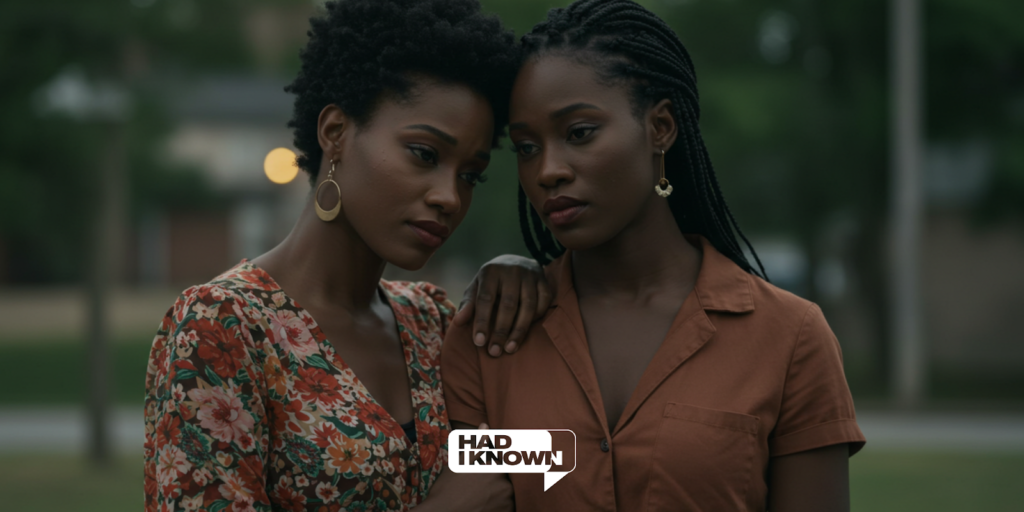
“I lost a friendship that had spanned over a decade because I refused to believe another woman.” — Ibifiri*, 31
Tofunmi* and I had been tight since we were teenagers. The type of friendship where you don’t need to talk every day, but you know the other person would ride for you. Then this man came into my life. Consistent, funny, and attentive. Everything I thought I wanted.
The cracks showed up one afternoon after church. We were walking back to my house when Tofunmi stopped and said quietly, “Babe, I need to tell you something. Your man has been trying to move to me.”
I froze. “Move to you, how?” I asked, half-laughing, half-uneasy.
She explained how he’d cornered her after choir practice, complimenting her body, offering her a ride home, and later sending late-night texts that went from “Have you eaten?” to “I can’t stop thinking about you.” She showed me the messages, but my chest tightened in defence.
“This is the same man who tells me I’m his world,” I thought. “How will my friend now tell me he’s chasing her?”
Instead of anger at him, I turned it on her. I convinced myself she must have liked him too and was only confessing now to clear her conscience. I brushed it off. Still, I brought it up with my man that night, expecting him to confess. He didn’t even flinch. He laughed, shook his head and said, “Babe, she’s jealous. She wants what you have. You know women like that will do anything to scatter a good thing.”
I pushed the screenshots in his face. The late-night texts, the compliments. He didn’t bother twisting the words too much. He just shrugged and said, “If I were moving to her, don’t you think it’d look different? Would I not be more direct? Why would I risk us for her of all people?”
It didn’t take much to sway me. Deep down, I didn’t want to face the possibility that my perfect man was exactly what my friend said he was. It was easier to believe his denial than the truth staring back at me. So I chose him, and in the process, I let my friendship slip away.
I stopped talking to Tofunmi. Every time I thought about reaching out, pride and anger held me back.
Years later, married with two kids, I found out she had been telling the truth. Not from her directly, but through the countless times I caught my husband cheating. Same patterns, same lines, the same stories other women told me about how he had tried with them, too. Each revelation was like a slap.
That was the day regret really set in. I lost a friendship that had spanned over a decade because I refused to believe another woman. My closest friend. Because I thought a man’s word weighed more, now I’m married to that same man who keeps embarrassing me with every small girl that enters his eye, and the friend who once tried to protect me isn’t here anymore.
“Even if I didn’t feel the same way, I could have handled it better.” — Sandra*, 30
I met my best friend in grade 10, on the very first day of class. We were both late, slipped into the room together, and ended up sharing a desk. By lunch, we were already laughing like we’d known each other for years. From then on, we were inseparable. Attached at the hip, sharing secrets, laughs, and even whispers in class. People teased us, saying we were “too close,” even speculating we might be lesbians. We laughed it off, but deep down, I sometimes wondered if the rumours held a grain of truth.
When we both moved to Manitoba for university, our closeness only deepened. We studied together, navigated the freezing cold, and made new Nigerian friends in diaspora. But it was in those years that I started to notice something unsettling. Her possessiveness whenever I had men over. If a boyfriend visited, her mood would shift instantly, and the air in the apartment would thicken with tension.
I started suspecting she had feelings for me. Instead of confronting it honestly, I panicked. It scared me. I began pulling away, choosing my boyfriend at the time as a safe distraction. He was serious about me, already talking about marriage, and I leaned into it, even overperforming the romance as if to send her a message: I don’t feel that way about you.
One night, she finally asked me directly: “What are you doing? Why are you acting like this?” I froze. I pretended not to understand, brushed it off, and shut the door on a conversation that could have saved us. After that, nothing was the same.
Two years later, I married. I had the ring, the pictures, the status. But the whole time, a part of me felt helplessly vacant. My best friend’s loyalty, her warmth, and her unconditional love were all gone. I’ve reached out several times since, but she wants nothing to do with me.
I regret it every day. Even if I didn’t feel the same way, I could have handled it better. She deserved honesty, not rejection masked as aloofness. No one has ever loved me like she did, and I threw it away because I was afraid.
“It’s been three, maybe four years, and she still doesn’t want to hear from me.”— Tife*, 27
I hadn’t seen my friend Lisa* in a long time, at least two years, not since she’d had her baby. When I finally got invited to one of her little tea parties, the kind where mums bring their toddlers together to eat cake and play with toys, I was ecstatic and, of course, showed up with a gift. Lisa was thrilled to see me. We sat in the living room, laughing, catching up, talking over the chatter of the kids. It felt easy, like old times.
Hours later, Amaka (another mum there) and her husband, Abdul, arrived with friends, and one of them was a man called Henshaw. He was tall, rich, light-skinned, with a beard, exactly my type. He introduced himself, and immediately there was banter, small jokes, the kind of eye contact that says too much. The sexual tension was thick.
At some point, most of the party had moved outside, and eventually, Amaka and Abdul stepped out, too. Lisa went upstairs to put her baby down, leaving just Henshaw and me in the living room. The silence between us was loaded, a lingering glance here, his knee brushing mine there. He cracked a joke, I laughed a little too loudly, and suddenly he was leaning closer. One minute it was small talk, the next his hand was on my thigh, and before I knew it, we had stumbled into the bathroom.
My cheek was pressed against the cool mirror, the sound of water dripping from the tap mixing with my shallow breaths. It wasn’t quick. Minutes passed, enough for me to forget where I was, until the door swung open. Lisa stood there, silent, eyes fixed on us.
The fury in her eyes said everything. Later, I learned that Henshaw wasn’t just married, he was married to Amaka’s childhood friend. It was a betrayal that stretched beyond what I’d realised in that moment.
At first, I tried to justify it: How was I supposed to know? Why am I being blamed? But as the years passed, and Lisa refused to pick up my calls or respond to my messages, the regret set in.
It’s been three, maybe four years, and she still doesn’t want to hear from me. I can’t lie, it was a good fuck. But it wasn’t worth losing her. No man is.
What She Said: I’m the Eldest Daughter Who Chose Herself, and I Make No Apologies
“Winifred fights dirty. She’ll drag your wig in public, tear your top, and insult you till you cry.” — Tari*, 26
I still can’t believe I lost an eight-year friendship over ₦2k.
One day, I asked Liam*, Winifred*’s ex and someone I’d known for a while, to send me small money to buy a phone cord. I even told Winifred about it because, in my mind, there was nothing to hide.
At first, she acted like she was fine. But not long after, she came back breathing fire. Screaming on the phone and in person, calling me a prostitute, accusing me of sleeping with Liam for money.
All I could think was, I slept with him for ₦2k? Not even ₦2 million? Meanwhile, this was the same man who had already used Winifred’s head front, back and centre when they were dating. By then, she was still running around as his side chick.
After the fallout, Liam started disturbing me more. Sending me money, ₦70k here, ₦150k there, and asking me out. I collected the cash, since they’d already accused me, but I never touched him, never even kissed him.
What hurt wasn’t the man or the money. It was Winifred. She ruined our friendship and humiliated me in front of everyone.
Winifred fights dirty. She’ll drag your wig in public, tear your top, and insult you till you cry. So it’s not like I was all that surprised. That’s the person I called my best friend. If I regret anything, it’s ever being close to her in the first place, not the ₦2k or the man I asked.
“So, because I have a man now, you want to guilt-trip me?” — Nengi*, 22
I remember when love first entered my life. My friend and I had just moved for uni. We did everything together: gist, eat, hustle classes. Then I met the “boy next door”, my neighbour. Suddenly, I understood why people made noise about love.
But my best friend didn’t see it that way. She started acting cold, accusing me of ignoring her. Instead of confronting me directly, she’d throw an attitude. I hated passive aggression, so I snapped. I reacted big time, and our friendship died on the spot.
“So, because I have a man now, you want to guilt-trip me? Abeg, if you can’t handle it, go your way.” Those were the last real words we exchanged.
Years later, I regret my reaction. I should’ve asked her straight up what was hurting her instead of going off. But I also wish she had come correct instead of forming an attitude. The boy? He wasn’t worth it. Looking back, I wish I had never dated someone in the same environment. It messes everything up: your friend group, living space, and even school. If I could redo it, that’s the one mistake I wouldn’t make.
“If I could redo it, I’d never even date him.” — Tomi*, 25
I used to be best friends with a girl I frequently went clubbing with. Kevwe* was wild, blunt, funny, and would publicly fight for you if anyone crossed you. And in a time when I was depressed, she was the one who always checked on me, dragged me out of the house, gave me unfiltered advice, checked up at odd hours, and reminded me to laugh.
But my boyfriend hated her. He decided she was a prostitute because of her lifestyle, and he didn’t want me hanging out with her anymore. I defended her at first — “I can’t be easily influenced. Even if she is, that’s her life.” But I also felt I had to be transparent with her.
So one night, I told her what he’d been saying, expecting her to laugh it off or cuss him out. Instead, she froze. Then she gave a tight smile and said, “Well, people will always believe what they want.” After that, she started withdrawing too. Cancelled plans. Short replies. The energy shifted completely.
It felt like confirmation to me, like maybe the rumours were true. I panicked and cut her off.
Now, I look back and wince. I regret telling my boyfriend so much about her. That’s what spoiled it. She was actually a true friend to me. Blunt, loyal, always there. And he wasn’t worth any of it. If I could redo it, I’d never even date him.
“My regret isn’t choosing Adaeze. She’s the love of my life.” — Morayo*, 33
Kosi* and I became friends in our mid-20s, when we were both grinding at the same marketing agency. We clicked instantly. Office gossip, late-night pitch prep, ranting about Lagos traffic, we did everything together. Even after I left the job, the bond stayed. She was the first call when life felt heavy, the first to show up with food or jokes when heartbreak hit.
Then I met Adaeze*. My first serious girlfriend. At first, everything was smooth. Kosi cheered me on, gave me pep talks about “allowing myself to be loved,” and even helped plan surprise dates. But as the months rolled by, Adaeze began to bristle at how much space Kosi occupied. If I fell asleep mid-text, Adaeze would assume I’d been with Kosi. If I posted a goofy selfie with Kosi, she would go quiet for hours.
One evening, after a small fight, Adaeze told me straight: “I don’t like that your friend. It feels like you choose her over me sometimes.”
I didn’t know how to balance it. Instead of having the hard conversation, I slowly started reducing Kosi’s presence in my life. Less calls, fewer hangouts, excuses piling up. Kosi noticed, of course. One day, she sent a blunt message: “I get it. She doesn’t like me, and because of that, things have changed. I just wish you’d admit it instead of pretending.” That was the beginning of the end.
Years later, Adaeze and I are still together, older, wiser, both having learned to talk through jealousy instead of acting on it. She has even admitted she was wrong back then, that her insecurity cost me something important. But the friendship never recovered. Kosi moved on, and though we occasionally bump into each other, the warmth is gone.
My regret isn’t choosing Adaeze. She’s the love of my life, and we’ve both grown since then. My regret is how I handled it. I should have set firmer boundaries early on instead of letting things fester. I should have been honest with both of them. Now I’ve lost someone who was like a sister, and it didn’t have to happen that way.
*Names have been changed for the sake of anonymity.
Do you have a story of regret? Share it with us by filling this form.
Read Next: Female Genital Mutilation is a Lifelong Health Thief, and We Need to Talk About It