Every week, Zikoko spotlights the unfiltered stories of women navigating life, love, identity and everything in between.
What She Said will give women the mic to speak freely, honestly and openly, without shame about sex, politics, family, survival, and everything else life throws our way.
This week, Chioma*, 34, from Lagos, shares how her mother’s terminal cancer diagnosis led her to make one of the biggest decisions of her life: to have a baby. She reflects on the weight of that choice, the bittersweet joy of watching her mother hold her granddaughter, navigating an undefined relationship with her child’s father, and finding peace in a decision born from grief.
Can you tell me a bit about yourself?
My name is Chioma*, I’m 34, and I’m a photographer based in Lagos. I have a two-year-old daughter, Zina*, who is the funniest, most curious little person I’ve ever met. I work mostly in documentary and portrait photography, and I’ve been doing this professionally for about 10 years now. Before my daughter, I travelled a lot for work, residencies across Europe and Africa, fellowships, and exhibitions. My twenties were very much about chasing that freedom and building my craft. Now my life looks different, but I’m still very much myself. Just with a tiny person who needs snacks every two hours.
Having a child at 34 after a decade of prioritising your freedom and career is a big shift. What led to that decision?
My mother was dying. She had been asking me for a grandchild since I turned twenty-three, and I had always said no. Not yet. I have time. I have things to do first. But when the doctors told us she had months, maybe a year, I realised time had run out. So I made a choice.
I am sorry for your loss. What was your relationship with your mother like growing up?
My mother was loud, opinionated, deeply religious, but also surprisingly open-minded when it mattered. She was a teacher, so she had that mix of strictness and warmth. Growing up, she pushed me hard academically, but she also encouraged my photography. She bought me my first camera when I was fifteen with money she had been saving for months. That kind of mother.
We were close, but we also clashed. Especially in my twenties, when I was travelling all the time and not “settling down.” She wanted me to be married with children by twenty-five. I wanted to live. We argued about it a lot, but underneath all that noise, there was deep love. She was proud of me, even when she didn’t fully understand my choices.
What did that look like?
So my twenties were pure, beautiful chaos. I was in and out of Lagos, applying for every residency and fellowship I could find. I spent months in Berlin, Amsterdam, a summer in Paris, time in Accra, Dakar, and Kampala. I was broke most of the time, eating mostly bread in tiny studio apartments or making fellowship stipends stretch through the month, as much as I could. Sometimes, I relied on daddy’s family money when I had access to it, but I was doing the work I loved. I was learning, creating, meeting other artists, falling in and out of situationships that went nowhere. It was selfish in the best way. I wasn’t answering to anyone. I was just being.
My mother hated it. Every time I came home, she would ask when I was going to “start my life.” I would tell her I already had. But for her, life meant marriage and children. We went round and round about it for years.
When did things change?
When I was about 28, my mother was diagnosed with breast cancer. It wasn’t her first time. She had beaten it once before when I was a teenager, so we thought, okay, we know this fight. We can do it again. She went through chemo, radiation, the whole thing. It was brutal, but she made it through. For a few years, things felt stable. I was still travelling, still working, but I was also home more. Checking in. Being present.
Then, when I was thirty-two, it came back. This time it was more aggressive. Stage four. It had spread to her lungs and liver. The doctors said treatment could buy her time, but there was no getting rid of it this time. That shift from “she’ll be fine” to “she’s dying” was the most disorienting thing I’ve ever experienced. You think you’re prepared because you’ve been through it before, but you’re not.
What She Said: I Found Out My Boyfriend Had Another Babe After He Died
How did you cope with that news?
I didn’t, really. Not in any healthy way. I threw myself into work, into being there for her, into researching treatments we couldn’t afford. My family tried everything. We maxed out savings, crowdfunded, and begged for help from family abroad. We got her the best care we could, but it was never going to be enough. Deep down, I knew that. But admitting it felt like giving up.
I also became obsessed with time. How much time did she have? What could we do with it? How do I make sure she knows I love her? It was exhausting. I wasn’t sleeping. I wasn’t eating properly. I was just existing in this constant state of dread.
During all of this with your mother, did you have support besides the people helping financially?
Yes and no. My extended family was there, obviously. But my mum practically raised me alone. I hardly heard from my father and saw him even less. He only rarely assisted financially. My extended family supported us financially as much as they could, and some showed up, but mostly, I had to deal with the day-to-day.
Emotionally, I was also leaning on Emeka*. We had been on and off for years at that point. We met when I was about twenty-six at an art festival in Lagos. He’s a creative too, and works in film production. We started something casual, and it stayed casual for years. He wanted more, but I didn’t. Or maybe I did, but I didn’t trust it. He was the kind of man women fall for easily, charming, talented, but also a bit scattered. To put it mildly, he was an ashawo, and I convinced myself he would never fully commit to me. I thought I was too smart to think anything else. So I never let myself fully commit either. It was never what I wanted anyway. Not at the start.
Around the time my mother got sick the second time, we were in one of our “on” phases. He was around more, being supportive, but we still hadn’t defined anything. Then, maybe a year or so before I lost my mum, he asked me to have a baby with him. Just like that. Out of nowhere. We were lying in bed one night, and he said, “I want to have a child with you.”
I laughed. I laughed for days. I thought he was joking or testing me, or I don’t even know what. But he was serious. He kept bringing it up, and I kept deflecting. I wasn’t ready. I didn’t see the point of bringing a child into an undefined relationship. And honestly, I didn’t think he meant it. So I said no. Repeatedly.
Did your perspective shift?
Yes. When the doctors told us my mother had maybe a year left. Maybe less. It wasn’t one moment; it was gradual. I started noticing how she looked at children, how she would talk about wanting to see me settled, wanting to hold a grandchild before she died. She never said it directly to me anymore, but I heard her say it to her sisters. “I just want to see one grandchild. Just one.”
And then something inside me cracked. I thought I could give her that. I’m old enough. I have someone who wants this with me. Why not now? It wasn’t about me being ready. It wasn’t even fully about wanting to be a mother at that exact moment. It was about giving my mother something to hold onto. Something to smile about in her last days. A grandchild.
So I decided.
That must have been difficult. Did you tell Emeka about your decision?
Not directly. I didn’t sit him down and say, “I’ve changed my mind, let’s have a baby for my dying mother.” I just stopped being as careful. I had been on birth control on and off; sometimes I’d miss days, sometimes I wouldn’t bother with the morning-after pill if we slipped up. I wasn’t actively trying to trap him or deceive him. I just opened the door and let things happen.
A few months later, I was pregnant.
How did you feel when you found out?
I cried. I cried so hard I scared myself. I wasn’t crying because I didn’t want the baby. I was crying because of the weight of what I had done. The enormity of it. I had made a decision that would change my entire life, and I had made it for someone who was dying. Not for myself. Not really. And that terrified me.
I remember sitting on the bathroom floor with the test in my hand, just heaving. My body knew before my mind could catch up. This was real. There was no going back. And my mother was still dying. The baby wouldn’t stop that.
I’m sorry. How did you tell Emeka?
I waited a few days to process it myself. When I finally told him, he was happier than I had ever seen him. He cried. He held me. He kept saying, “Thank you, thank you.” It was overwhelming. He thought I had changed my mind because I finally believed in us. And maybe part of me had. But the bigger truth was my mother. He knows that now. He knew it then, too, I think. But it didn’t matter to him. He just wanted the baby.
And your mother?
Telling her was different. I went to her house, and before I could say anything, she looked at me and just knew. She started crying before I even finished the sentence. She held my face and said, “God has answered my prayers.” For her, it was a miracle. For me, it was the heaviest gift I had ever given anyone.
What was the pregnancy like?
Bittersweet. Every milestone felt like I was racing against time. My mother was getting weaker, and I was getting bigger. I would go to my scans, and she would ask to see the pictures. She picked out the name. She said it meant “beautiful”. I didn’t even argue. It was her grandchild. She could name her.
There were beautiful moments. She would put her hand on my belly and talk to the baby. She knitted terrible little booties that didn’t fit any baby’s foot. She planned a small baby shower even though she was too weak to attend. And there were hard moments. Nights where I would wake up panicking, thinking, What if she dies before the baby comes? What if this was all for nothing?
But she held on.
Did your mother get to meet Zina?
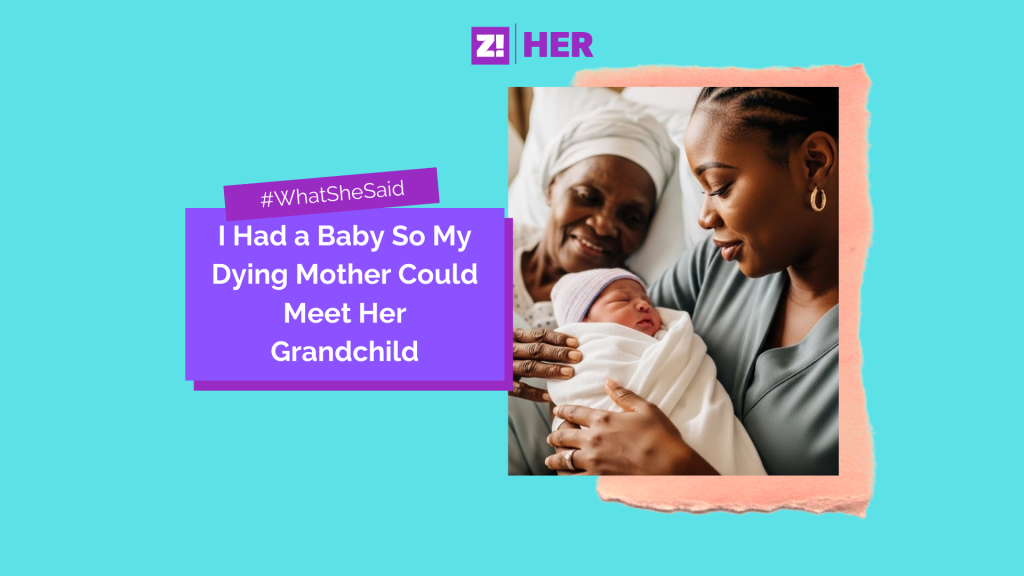
Yes. Zina was born three months before my mother died. Those three months were the most precious and painful of my life. My mother held her granddaughter. She looked into her eyes. She blessed her. She would sit with Zina in her arms for as long as her body allowed, which wasn’t long, but it was enough.
My family kept saying, “Mama, na for you. Take your eye see your pikin before you go.” And she did. She got her wish. I gave her that.
What was it like when your mother passed?
My heart broke in a way I didn’t know was possible. Even though I had been preparing for it, nothing prepares you. She died at home, surrounded by family. Zina was three months old. I was holding my daughter when it happened, and all I could think was, she’s gone. The woman I did this for is gone.
The grief swallowed me whole. I couldn’t function for weeks. Emeka took over with Zina because I couldn’t even look at her without crying. Not because I resented her, but because she was the reminder. The living, breathing reminder of the decision I made. The gift I gave. And now the person I gave it to was gone.
How did you eventually come out of that grief?
Slowly. With a lot of help. Emeka was a rock. He took care of Zina; he took care of me. He didn’t push, didn’t demand anything. He just showed up every single day. That steadiness surprised me. I had spent years thinking he wouldn’t be reliable, and here he was, proving me wrong.
Time helped too. Getting up every day and giving myself grace on the days when I couldn’t. And my daughter, she pulled me back. Her laugh. Her little face. Her tiny hands reaching for me. I started to see her not just as the baby I had for my mother, but as her own person. My daughter.
What’s motherhood like for you now?
Complicated, but not in a bad way. I love Zina deeply. She’s funny, stubborn, and curious about everything. She’s two now, and watching her grow has been one of the most grounding experiences of my life. I was scared I would resent her, resent the decision, resent the loss of freedom. But I don’t. She’s been a gift. Not just to my mother, but to me.
There are hard days, of course. Days when I’m so exhausted, wondering how I’m going to finish an edit with a toddler screaming for my attention. But I’ve learned to make compromises. I still work. I sometimes travel when I can, though that has slowed down a lot. I bring her with me sometimes. Other times, Emeka takes her. I’ve built a life where motherhood is an addition, not a replacement.
What’s your relationship with Emeka like now?
We’re basically together, but we’ve never had “the talk.” You know, the exclusive, official, what-are-we conversation. I don’t want to have it. At first, I was drowning in grief and new motherhood, so it didn’t matter. Now, I think I’m scared. Scared that if I push for a label, he’ll disappoint me. He’s been solid, present, and loving. He’s an incredible father. But I don’t want to risk it. So we exist in this undefined space, and for now, that works. But I can always feel him waiting for me.
Are you happy?
Most days, yes. I’m not drowning anymore. I’m not paralysed by grief. I have a daughter I adore, a career I’m still building, and a partner who shows up. But I also carry the weight of the choice I made. Not regret, just weight. I made a life-altering decision for my dying mother, and I’m living with the aftermath of that every day. Some days it feels like a blessing. Other days, it feels heavy. But I don’t regret it. That’s the most important part. I don’t regret her.
For the first year after my mother died, I couldn’t create anything. The grief was too loud. But slowly, I started again. I’ve been documenting Zina, not in a cutesy mommy-blogger way, but really seeing her. Capturing her. I’ve also started a project about women and grief, mothers and daughters, legacy. It feels important. It feels like the work I’m supposed to be doing now.
Does Zina know the story of why she’s here?
Not yet. She’s two. But one day, I’ll tell her about her grandmother, who loved her before she was born. About the decision I made. About the love that created her. I hope she understands. I hope she sees it as the gift it was meant to be.
What do you want people to understand about your story?
I don’t really care if people understand or not, honestly. I made a decision for my dying mother, and I’m happy I don’t regret it. That’s a blessing I’m not questioning. People might judge it, call it pressure or duty or whatever. But it was my choice. I did it with open eyes. And I’m living with it. That’s all that matters.
*Names have been changed for privacy.
You’ll Also Love: My Gynaecologist keeps asking If My Husband ‘Lets Me’ Use Birth Control