Every week, Zikoko spotlights the unfiltered stories of women navigating life, love, identity and everything in between.
What She Said will give women the mic to speak freely, honestly and openly, without shame about sex, politics, family, survival, and everything else life throws our way.
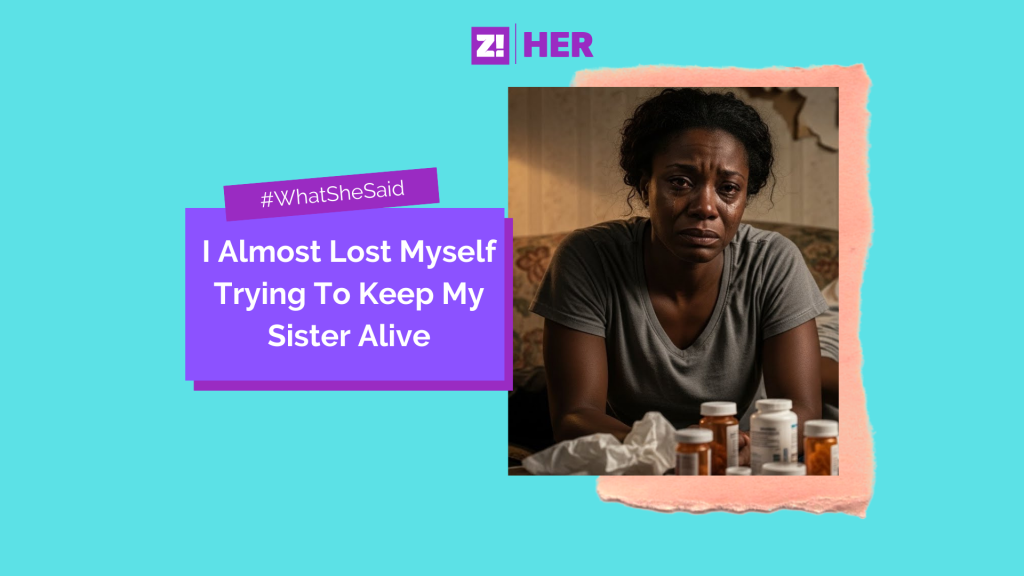
This week, Amaka*, 38, from Lagos, shares how taking on the role of family caretaker after her father’s death eventually led to severe burnout and a deep personal crisis. She reflects on the shock of her younger sister’s unexpected disappearance, the difficult choice between love and intervention, and how she finally learned that caring for others should not mean losing yourself.
Can you tell me a bit about yourself?
My name is Amaka*, I’m 38, and I grew up in Lagos. Though I’ve lived in Kaduna and Abuja at different points in my life. I work in corporate communications. I am the first of three girls, which already comes with a certain kind of responsibility that Nigerian families understand very well. Outside work, I’m still learning how to exist as a person who doesn’t have to be strong all the time. It has taken me years to realise that I don’t have to pour from an empty cup. I’m still practising it.
What was your childhood like? Tell me how you grew up.
Dami* and I were the siblings people thought were twins, even though we are four years apart. She is the lastborn, and being the first daughter, I naturally became her second mother from childhood. She wasn’t a spoiled lastborn; she was just deeply loved.
Growing up in Ojodu, it was always the two of us. We shared a room until I left for university. We wore each other’s clothes without asking, we had the same taste in music, and we created inside jokes no one else understood, except sometimes Nnnena*, our sister, the second. Our house was a comfortable middle-class home. Mum worked at a bank, Daddy was a civil engineer, and there were always books around. Mum’s food, often stew, was the constant smell of evenings.
Dami was the “sunshine” of the family. Loud, funny, dramatic in the best way. She could make a whole room laugh without trying. She got away with a lot of things our parents may have killed Nnenna and me for. If the house felt dull, everyone knew she wasn’t around. She leaned on me a lot, too. Even as adults, she would call me to follow her to the salon, go to the market with her or sit with her at home if she had a cold. I never got tired of it. I liked being needed.
Looking back now, I think that is why everything hit me harder. We weren’t just sisters. We were best friends.
I am very sorry for your loss. What does ‘everything’ mean? What happened?
My childhood was peaceful enough. Daddy was mostly quiet but present. Mum was the kind of woman who would fight heaven and hell for her girls. We were loved and protected. Our family wasn’t perfect, but it was stable… until Daddy got sick.
He had cancer and eventually passed away, which changed everything. I was 22, and Dami was 18. Even though we had months to prepare for the loss, the grief still rearranged our lives.
After Daddy died, I stepped into full responsibility. I supported Mum emotionally, handled bills when I could, and helped my sisters with school. Nobody asked me to do it; it just felt like the natural thing to do.
Dami, my baby sister, reacted differently. She didn’t cope well, but she also hid things well. She still laughed, still made jokes, but something in her softened in a way that looked like sadness. She became quieter. It broke my heart. I thought it was grief. It affects us all differently. I thought she would go through it and come out of it. I tried to be there for her as much as I could, but I didn’t understand the depth of it then.
What do you mean?
When Dami relocated to Abuja for a job with an NGO about 10 months later, she was excited. She hadn’t started uni yet, but she wanted independence. We all thought it might be good for her. To get some distance from the house and the city that held so much memories of her father. Abuja felt like a fresh start. I saw a light in her eyes I hadn’t seen in so long.
At first, she would call every evening to give me updates. She sounded happy. Then the calls reduced. Then the time we stayed on the line got shorter and shorter. Then she started replying to messages with one-word answers.
She said she was tired all the time. She stopped posting her usual jokes on WhatsApp. Even her voice notes dried up.
When she came home for Christmas, the difference was clear. She looked worse than she did when we first found out he died. She slept a lot. Ate very little. Barely talked. When she talked, she brushed everything aside with “I’m fine” or “Work is just stressful.”
But I knew my sister. Something was wrong.
When did you realise it was serious and not just stress?
After that Christmas, we didn’t see my sister for 2 good years.
While retaining her NGO work, she enrolled in a university in Abuja and started furthering her studies. We all thought it was a good sign. She got on video calls, she walked me through everything she needed as she started school, spoke about annoying lecturers, I helped her house hunt and all that. And I thought, okay, maybe school will bring some structure back into her life. Not long after we had started talking about me visiting, I stopped hearing from her. She didn’t take my calls or respond to texts for weeks. We tried to reach her friends, but they all said they never see her for too long and no one really knows where she goes.
After about 2-3 weeks of silence, Nnnena and I booked our flight to Abuja. My mother had begun to have restless nights and shortness of breath. It was like she was grieving a child that was still alive. Nothing was okay. We went to her school, her house, her office, everywhere. We did not see our sister. Eventually, Nnnena had to return to Lagos to look after mum, but I stayed behind to look for her. By the time I was ready to go to the police, Dami suddenly called.
She sounded irritated, almost angry, and said, “I’m fine. Stop stressing me. I’ll call when I can.” And she cut the call. I truly cannot tell you the anger and rage I felt in that moment. But also the relief, quickly followed by fear and worry. Where was my sister? What was she doing? Who was she becoming?
We had to move on with our lives. There were bills to pay and milestones to meet. She called occasionally, mostly to ask for money and on rare occasions, she picked up my calls. She never sounded like she was okay, and I begged her to talk to me, to come back to the house. I threatened her, but nothing happened. I let it go.
After two years, she unexpectedly showed up at a family member’s wedding. It was the most surreal thing I had ever experienced. We couldn’t say or do much, as we couldn’t interrupt the wedding. When we tried to pull her aside to talk, she refused and began to cause a scene. Since she smelled heavily of alcohol, we decided not to risk a confrontation until after the ceremony. Surprisingly, she was well-behaved, and that night she agreed to stay at my place. Nnnena was in the UK at school, so I told Mum to let me take care of her for a while. I asked her to give me time. Dami completely ignored our mother and would not respond to her.
That night, she woke me up at 2 am, crying uncontrollably. She was shaking and struggling to breathe. It was a panic attack, though I didn’t know that then. I did my best to help her calm down. Telling her to breathe and attempting to hold her.
After, she told me she had been having these episodes for over a year now. She said her workplace was toxic, that her supervisor threatened to fire her constantly, that she had fallen out with a close friend and didn’t feel safe with anyone in Abuja. She also admitted she had been isolating herself. No social life. No energy. No joy.
My sister said she felt empty. And so she started taking drugs.
I just held her. I didn’t know what to say. When she fell asleep, I called Nnenna. She suggested therapy, and I agreed. I decided to talk to her about it the next day. But the next morning, she acted like the conversation never happened. That was the moment true fear entered my chest.
What She Said: I Lost Myself Trying to Be Everything for Everyone
Can you tell me more about the drug use?
Yes. So after that conversation, Dami stayed in Lagos for about a month. We never spoke about what she brought up again, because she threatened to leave when I did. She started warming up to Mum as well. So we decided to just watch it. I kept an eye on my sister like a hawk.
She didn’t tell us about the drug use fully at first. We found out slowly. She kept slipping, and I would keep catching her with weed. She said Abuja can be a lonely place, so she started with sleeping pills to manage the insomnia. Then weed. Then one of her new friends introduced her to something “stronger” to help her “relax.”
The first time I saw my sister high on something harder than weed, I cried. She looked like a stranger wearing my sister’s body.
Eventually, she returned to Abuja for her job.
I am so sorry. What was the final straw? The moment you knew something had to change?
Two things happened around the same time.
First, she lost her job because of repeated absences and poor performance. She told them she was sick, which was true, but she was also spiralling.
Second, something else happened. Mum visited her in Abuja for a weekend and found her unconscious on the bedroom floor. It wasn’t an overdose, thank God, but she was dehydrated and disoriented, and had mixed anxiety medication with alcohol. That shook her. And it shook us.
At that point, Dami agreed to return to Lagos for a while.
What happened when she came home?
The first night, she slept for almost fourteen hours. I kept checking her breathing because I was scared. Over the next days, she looked like a ghost of herself. She barely ate. Barely spoke. Would suddenly cry without reason. She said her mind felt like it was shutting down.
Mum didn’t even need an explanation. The moment she saw Dami, she started praying from pure fear.
We decided it was not only time for psychiatric care but also rehab. She resisted at first, saying therapy was for “mad people” and that she was okay, what was wrong with us. We got a lawyer involved and got her there against her will. It is, to date, the most difficult thing I have ever done.
She was then diagnosed with severe burnout, depression, panic disorder and substance use disorder. Hearing the words out of a professional’s mouth made everything clearer. It wasn’t stubbornness or bad behaviour. It was an illness she had been carrying alone for too long.
What did all of this do to your own health?
Honestly, it broke me in ways I didn’t realise until much later. While trying to keep Dami stable, I stopped paying attention to my own mind. I wasn’t sleeping, I was constantly on edge, and I developed anxiety without having a name for it. I felt responsible for keeping her alive and functioning, and that pressure sat on my chest every day. I also felt a lot of guilt. I kept asking myself why I didn’t notice the signs earlier or why I couldn’t fix things fast enough. It took a toll on my self-esteem and the way I moved through life.
When did you start your healing process?
After Dami got into rehab, everything I’d been ignoring caught up with me. I realised I was burnt out. A friend was actually the one who suggested therapy for me, not just my sister. I started going because what else could I do? Nnnena had been on our necks for it for months now. The self-awareness that came with it helped me separate myself from the role of “fixer.” I learned that supporting someone doesn’t mean losing myself. Now I take breaks, I set boundaries, and I allow myself to rest without feeling guilty.
And Dami’s healing process?
Slow, hard and hopeful. Rehab helped, medication helped, but the biggest part was the daily work. Even after she was released, we created routines at home: morning walks, breakfast together, journaling, limiting screen time, and talking. On some days, she came home from therapy lighter. On some days, she came home drained.
There were weekends she didn’t leave her room. I would sit on her bed and keep her company. Sometimes we watched old Nigerian films just to fill the silence.
Healing wasn’t linear. She relapsed into silence several times. She cancelled therapy appointments. She doubted herself constantly. But she kept trying.
Eventually, she resigned from her Abuja job completely, which bruised her confidence, but it gave her space to breathe again.
You’ll Like: He Told Me He was 16. Two Years Into Dating Him, I Found Out He Lied
What moment made you feel like your sister was coming back?
The first time she made us laugh again. Real laughter. We were watching a ridiculous telenovela, and she mimicked the actor so well that Mum choked on her tea. The house suddenly felt like home again. I felt like my sisters and I were between the ages of 14 and 18 again.
Another moment was when she said she wanted to volunteer at one of the many NGOs mum had her hands in. She said she didn’t want to advise anyone, but she could help sort files or arrange chairs. That told me she was reconnecting with the world.
Where is everyone now? How are things today?
Mum now fully understands mental health and the problems that can come with not looking after your own. It’s not just prayer and church. She even reminds us of therapy appointments. That is growth.
Dami is a decade and some years clean. After finishing school, she started working remotely as a program officer for a different NGO in Abuja. My sister journals, meditates, goes to therapy consistently and takes her health seriously. She has bad days, but she doesn’t hide them anymore. She lets us hold her.
Nnnena has a thriving job and family in Manchester. We visit sometimes. So does she. I am happy she got to escape the bulk of the problems.
As for me, I am good. Truly good. I sleep. I laugh. I have a relationship that doesn’t drain me. And I no longer describe myself as the strong one. I am just a woman learning to live.
Looking back, what did this whole experience teach you about love, family and womanhood?
Strong women break too. That love cannot replace professional help. That caring for someone, even your sister, should not mean losing yourself. That sometimes the loudest people are carrying the heaviest pain. And that healing is slow, messy and absolutely possible.
If you could say one thing to another Nigerian woman caring for a struggling sibling, what would it be?
You are not a saviour. You are a sister. And you deserve softness too. Get support. Rest. Let people care for you. Get your sibling the professional support they need. There are so many free and discounted options out there today.
You’ll Love: A Zikoko Girl’s Guide To Dealing With Inflation