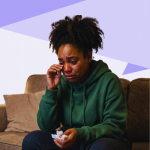
A little over a decade ago, a then 14-year-old Denyefa* returned home from school and was greeted with accusations of promiscuity by her father. Unsatisfied with her response, he beat her, demanded names, and the next morning, took her to women in their community for a public virginity test.
TW: Sexual abuse, Assault, Violence

This is Denyefa’s Story as told to Princess
The pasty white ceiling had a crack shaped like a river.
I traced its course with my eyes as if my life depended on it — memorising every bend, every fork where it split into smaller branches. One, two, three, four, five, si… At some point, I lost count, but my eyes never left the crack.
I couldn’t look anywhere else. I couldn’t meet the faces of the women surrounding me, women I had known my whole life, whose laughter I could recognise from across our compound, women who had carried me as a baby and should have been shielding me from what was about to happen.
My heart pounded so hard it felt like my ribs were rattling. The room was so quiet I could hear my own shallow, ragged breathing and the faint swish of fabric whenever someone shifted or moved closer.
“Just relax,” my aunt said, her voice warm and gentle, the way you’d speak to a child with a fever. But her hands, cold, hard, unflinching, told a different story. When her palm met the under of my thigh, I could have sworn I felt a bruise. Nothing about this moment was relaxing.
This was the same aunt who, just the week before, had been in Aba buying lace fabric and gold earrings for her upcoming wedding. The aunt I had been excited to see, to hug, to help unpack her bags. But now, she was the one holding my legs apart while other women leaned in to watch or help pin me down.
My fists were clenched so tightly my nails dug into my palms. I could feel the blood pooling beneath them, the small half-moons they were carving into my skin. Those marks stayed for weeks, little echoes of that day, but they were not the real wound.
The betrayal was worse.
It had started the day before. I’d come home from school sweaty and hungry, thinking only about the rice and stew I was planning to have for lunch.
Our street in Bayelsa was unusually quiet. It felt ominous, but I brushed it off. Inside, my father was in the living room, half-sitting, half-slouched in his old wooden chair, the one with the worn cushion that always smelled faintly of palm oil. He looked like he’d been sleeping, or at least resting, but the moment he saw me, his eyes sharpened.
“Denyefa,” he called.
I answered and greeted him, my voice wary.
“I know what you’ve been doing,” he said, no greeting, no preamble.
“What?” I asked.
“Are you stupid? You’re asking me what? I know where you have been going and what you have been doing.”
The words felt like smoke in the air — thick and choking. My stomach turned cold. I couldn’t feel air passing through my nostrils and into my lungs. Everything was still. This wasn’t new. Ever since my chest began to swell and my hips filled out, my father had looked at me differently, no longer with what I thought was adoration and pride, but with suspicion and contempt. The way men in the street turned their heads when I walked past wasn’t, to him, evidence of their disrespect. It was proof of my guilt.
I shook my head, confused and already afraid. “Daddy, nothing is happening. I haven’t done anything wrong.” I said, placing my school bag gently on the floor, afraid that any sudden movement might further agitate him. “I’m not—”
Before I could finish, he was on his feet, the chair scraping against the floor. He grabbed the cane from behind the door inches to his left, and the belt from his waist.
The first lash caught my arm. The second, my back. Then it was just blinding pain everywhere. I was crying, pleading, swearing on anything holy that I hadn’t done what he thought. But the more I begged, the harder he swung.
“Tell me their names!” he barked. “The boys from your school you’re riding — tell me!”
I shook my head until my neck hurt. “I’m not—”
“NAMES!” Another belt strike.
That day, I really did think I might die. I started calling random names. Boys I barely knew. Boys I’d only passed in the corridor. Boys whose faces I couldn’t even picture properly. Anything and everything to make it stop.
Something in me shattered into so many pieces, and 12 years later, I still haven’t found them all.
Finally, he dropped the cane, breathing hard. “Get ready. We’re going to your school.”
That was when I bolted to my room, locked the door, and pulled out my small travel bag. My hands were shaking so badly I could barely fold my clothes.
I called my aunt, the one who would later hold my legs open, and told her through sobs that Daddy wanted to drag me to my school to shame me, to parade me as proof of his suspicions. She told me not to run away, that she’d be coming in from Aba the next day.
By the time my father came out of the bathroom, towel slung around his neck, he said it was too late in the day to go to the school. We would go the next day.
That night, I couldn’t stay asleep longer than 20 minutes.
The next morning, I woke up feeling sick. The kind of sick that makes you feel like you’ve had a heatstroke for days, and your skin feels too tight. My head throbbed, and the air felt stuffier than usual. My stomach churned, and I had a fever so high, the bed was burning up. I could hear voices downstairs, women’s voices, soft and serious, like people talking at a funeral.
Then, footsteps on the stairs.
When I opened my eyes fully, my aunt was in the doorway. She was not alone. Behind her were three other women from our compound — neighbours, family friends, women I’d greeted every morning before school. Women who had clapped for me when I danced at Christmas.
“Come,” my aunt said from the doorway. Her eyes avoided mine.
They led me to the kitchen.
It was the same kitchen where I learned to slice onions without crying, where my mother and I had laughed over burnt plantains, where the smell of pepper soup used to wrap around me like a blanket. Now it felt like a courtroom or a prison or maybe even an execution ground.
A mat had been spread on the floor.
“Lie down,” one of them said, like it was the most normal instruction in the world.
I felt my chest tighten even more. My hands were trembling.
“Please,” I whispered. I didn’t even know who I was speaking to — maybe my mother, who was miles away in another country, working. Or maybe God. Maybe anyone who could hear me. It all fell on deaf ears.
I lay down. The women moved around me, their skirts brushing against my legs. Someone knelt beside me; I could feel her breath near my thigh. The air smelled of kerosene from the stove, of sweat, of perfume clinging weakly to skin.
It didn’t take long. The “test,” if you can call it that, was over in minutes. But each second stretched until it felt like I had lived an entire lifetime on that mat. My aunt pulled my labia apart and placed an egg there. I could hear a muffled “Ah, ah. There’s nothing now.” She tried to force it in until I cried out a little.
When they finished, there was no conversation. No verdict. They didn’t even tell me what they thought they’d found. They simply stood up, smoothed their wrappers, and left me there, still staring at the crack in that ceiling, the only witness to what had just happened who wasn’t pretending it hadn’t.
Next Read: The Hospital Told Me to Wait Until I Had Another Baby Before They’d Give Me Birth Control
The days after were a blur. I walked through them like a ghost.
I couldn’t eat. At night, I’d lie awake, replaying every sound, every movement. Sometimes I’d wake up sweating, heart pounding, and for a split second, I’d think I was still on that mat, legs apart, women’s faces above me.
My father never mentioned it again. He didn’t apologise. He didn’t explain. He spoke to me like he always did, about chores, about school, about keeping my skirt length decent, as if nothing had happened.
But everything had changed.
I couldn’t look at him without remembering his voice saying, “Tell me their names.” I couldn’t respect a man who would rather have strangers examine his daughter’s body than believe her word.
I stopped going to family events. I couldn’t stand to see those women again. Some of them still smiled at me like nothing had happened. Others avoided my eyes, but not one of them ever said, I’m sorry.
Not even my aunt. I felt violated. It feels like I have carried that violation on my back, my entire life.
For years, I carried it alone.
I didn’t tell my friends. I didn’t tell my teachers. How do you explain something like that to someone who’s never heard of it? How do you describe the way your stomach drops when you realise your body isn’t yours anymore, or never really was? And I never breathed a word of it to my mother. It wouldn’t have done anything. My father’s word was absolute.
Part of me thought maybe I deserved it. Maybe I had been too friendly with boys at school, too quick to smile. Maybe my walk was too fast, or too slow, or too something. I didn’t have the language yet to know that none of this was my fault.
It took growing older, meeting other women, and hearing their stories, to realise it wasn’t just me. This happens to other girls, fathers sending them to nurses, aunties, “traditional birth attendants”, to prove they are “still pure.” It’s control disguised as concern. Violence disguised as protection.
Now, almost 13 years later, I’m telling this story because I want it to stop happening.
If you’re a father reading this: your daughter’s body is not your property. Your fear doesn’t justify humiliating her. Your tradition doesn’t make this any less of a violation.
And if you’re a girl who has gone through it, listen to me: it was never your fault. You didn’t deserve it. You were not wrong for existing in your own skin.
I’m in a better place now. I have people who trust me, people who believe me when I speak, people who know that healing isn’t linear. But that fourteen-year-old girl deserved better than what she got.
She deserved to keep staring at ceiling cracks because she was bored in class or daydreaming about her future, not because she was trying to climb inside them and drown a nightmare her own family created.
Next Read: 4 Nigerian Women Talk About Taking Virginity Tests