“I want to get married so I can spend my husband’s money” is a statement many Nigerians are familiar with. Depending on where you live, you’ve most likely met at least one ‘oga wife’, ‘asa odogwu’ or an ‘Iyawo alhaji’.
Unlike in the 70s and 80s, ‘oga’s wife’ has now evolved from suggesting financial dependence into an aesthetic for women with wealthy partners who, in most cases, have jobs and successful side businesses. Even so, many marriages still feature financially dependent wives. About 13 million Nigerian women (11.6%) identify primarily as housewives, and men are the primary breadwinners in 78.9% of Nigerian households.
The decision to become a housewife could be either personal or influenced by circumstance. But its consequences rarely affect a woman alone. They often extend to family, children and even friends in certain situations.
23-year-old *Vanessa knows this too well; a front-row seat to her parents’ marriage has left her with a lifetime of lessons on what to avoid when it comes to love and money. In this article, she talks about growing up in a financially abusive household and how those experiences continue to influence her romantic relationships.
When did you realise that there was something off about your parents’ relationship?
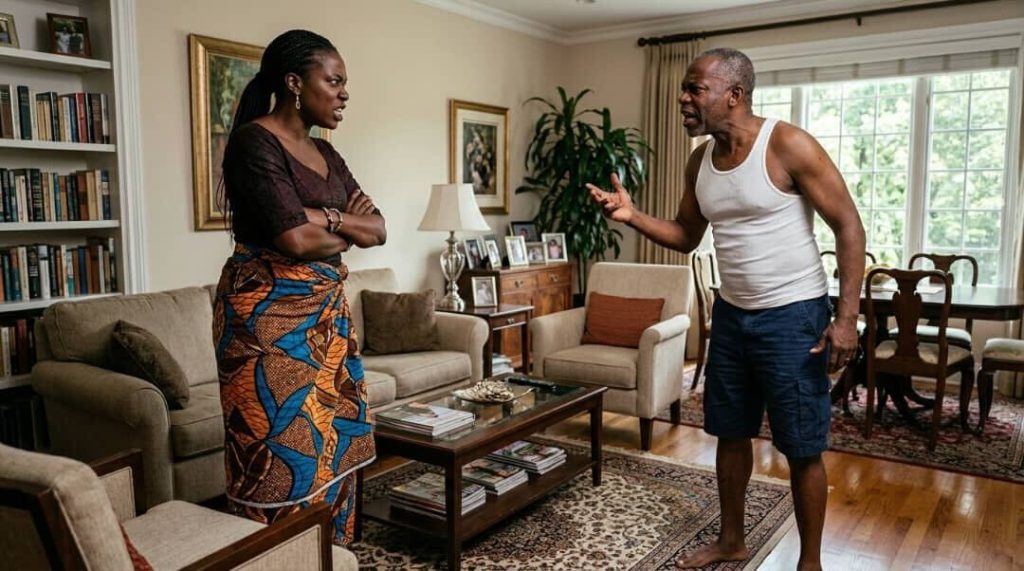
I was 5 when I first noticed that my father beat his wife and that she did not fight back. My mother’s philosophy is that the solution to living with a violent man is to be a submissive wife. So she would take his beatings and keep her mouth shut to avoid further violence. The issue with this is that my mother was a full housewife who was reliant on the man beating her for everything. So, she would ask me to go meet him for basic things like money for bread, toothpaste or shoes. Just like that, I became a messenger for the better part of their 26-year marriage.
Why did your mum choose to become a housewife?
It is only people who are given choices that can choose. My mother got married at age 23 to a man who was six years older, without any marketable skills or a source of income. Then she had me shortly after. By the time I was fourteen, I had five more siblings. He had courted her with the promise that he would give her support to further her education. But as soon as she moved in with him, he did not allow her to work and kept her occupied with bi-annual pregnancies.
How did the fact that your dad was the sole provider affect their marriage?
There’s a very big difference between a trad wife with a dormant bank account married to a working dad and a woman earning 500k a month who is married to a man earning four times her salary. Only one of these women has the choice to leave. In addition to physically and verbally assaulting my mother, my dad controlled her access to food, sex, her family, children and even church.
How?
For instance, when I was a teenager, my mum got pregnant. Since my dad did not want any more kids, he told her to abort it. She refused for religious reasons, so to punish her, he shipped my brother and me to a boarding school that was 13 hours away. She had taught me to cook, and she had taught my brother how to clean the house to make things easier for her. He knew he was leaving a pregnant woman alone with four young children and no domestic assistance, but he did it anyway. To make things worse, he would scrape the pots clean, then take away every other food item in the house before he went to work each morning. He did that knowing that my mum did not have the money to buy food. She would remain hungry till he came back at night.
Ah
When she went into labour for that particular child, my dad watched her try a natural birth for four days and did nothing. It wasn’t until her brother, tired of watching her suffer, sent her money for a Cesarean section. After she was discharged from the hospital, my grandmother headed down from the village to help her through the recovery process. But when her husband was informed that my grandma was on her way, he told my mother’s family that he didn’t want anybody in his house. I’ve noticed that many men do not have empathy for a woman’s struggles, and my dad is no exception.
Last year, ( when she thought I was finally old enough to handle it), my mum told me that when she heard that he had stopped my grandmother from coming, she tried to kill herself. She had thrown herself violently against the wall and bed repeatedly so that her stitches would open and she would bleed to death. She had to be sedated afterwards so that she would stop harming herself. As soon as the baby could walk, she learned a skill and borrowed money to start a business.
How did that work out for her?
She had our pastor stand in for my father when collecting loans to start her business. My dad would lock her outside if her customers kept her outside later than 8 pm. He stopped giving her money for food with the hope that she would use all of her capital to feed herself and her children. Regardless of my father’s efforts to sabotage the business, she kept at it. Now she has two big shops in the market. Because of this, she is the biggest advocate for financial independence. She tells anybody willing to listen that no woman should get married without first establishing herself.
Although my mother has refused to leave him, I’m happy that she’s no longer scared of making his life hell. Since he can no longer order her around, she’s not afraid to hit back when he starts to beat her. She has done a lot of physical damage to him as part of self-defence in recent years.
How did your parents’ marriage influence your childhood?
As admirable as it is, my mum’s decision to become financially independent affected me almost as much as her passiveness did. By age 14, she had turned me into a mini-parent to my siblings. My mom believed that she had suffered for me, and so it was now my turn to suffer for her. In addition to managing the household, I also had to serve as a salesgirl at her shop.
I would also say it made me grow up really fast. I made a promise to myself in my teens that I would never give a man the kind of control my dad has over my mum and the people she loves. I say this because my father did not stop at just his wife. My siblings and I were also not spared from his ill-treatment. While I was in university, my father would randomly stop sending me my weekly allowance for different reasons. From ‘You did not back me up in an argument’ to ‘the sun shone brighter on you today than it did on me’. At some point, I realised that it was up to me to get myself out of there. I started working very early, and by age 17, I already had a working CV.
Were your parents aware that you had started job hunting so early?
I tried to limit how much they knew, but it’s hard to hide motion. We fought often because at one point, I flat out refused to be my mum’s salesgirl. At the time, I was learning a digital skill, and it was nearly impossible to focus in the middle of a noisy market. My parents began to do everything in their power to sabotage my learning, job applications, and job interviews.
During the lockdown, I had just gotten an entry-level job that was paying close to #50,000. To a 17-year-old at the time, this was big money. My parents suddenly began to find a lot of chores for me to do. During work meetings, they would walk into my room to yell at me for ridiculous reasons like ‘the stew has not been warmed’. They frustrated me to the point that I quit the job after a month.
Why do you think your mother played an active role in sabotaging you?
My mum is not a saint. She is religious and has very traditional beliefs. My mum believes in the concept of a virtuous woman. I also think she considers herself a martyr for staying married to my father. Because of this, she can be male-centred sometimes.
She joined him in his bullying campaign, but I don’t think she did it out of spite. I believe she is envious of the choices I made early in life that were not available to her. Also, I don’t like to take her advice because a lot of her beliefs didn’t turn out well for her. I guess she was trying to humble me a bit. Anyway, till I left home, I learnt to start hiding my growth from my family.
Has your upbringing influenced how you approach dating?
Yes, it has. I fully expect the man I am with to go out of his way to make my life easy. But at the same time, I’m scared that it’s impossible to be in a heterosexual relationship without losing my sense of self and my autonomy.
Are you in a relationship at the moment?
Yes. I’ve been dating my partner for two years, and we started to cohabit last year. When I met him, he was earning one-sixth of what he currently earns. Because of this, he couldn’t do more than buy me takeout and become my dedicated taxi man. I was a student in my final year, so covering transport and buying me food was a really big help. As soon as I graduated and we became more stable, I started to ask for more.
Why did you decide to move in with him?
I did not move in with him. We both moved to Lagos for work. While we were househunting separately, I realised Lagos is expensive. After doing the maths, we decided that it made more sense to find a place we both liked and move in together.
Did you have any fears or problems at the initial stages of living together?
At first, it was a mental struggle. I’m downright paranoid when it comes to financial independence. I used to wake up in the middle of the night to cry when we first came up with the idea. I felt like such a failure and a traitor for even considering it. But I knew that living alone in Lagos was super expensive, and this was someone who, by all indications, loved me and was giving me an out.
How did you resolve your fears?
I don’t think I can ever get rid of the financial anxiety, no matter how hard I try, and I do not want to. The Nwunye Odogwu (Odogwu’s wife) psychosis is real, and I saw it happen to my mother in real time. In the end, my boyfriend is a man, and I’m not deluded enough to think I’m special. I have enough money saved up to rent a self–con in Ibadan, and I put about 150k into that fund every month, just in case. I also have a friend in Lagos whom I could temporarily move in with if things go south. My parents are my last option, but I hope it will never come to that.
My partner is also a very understanding person, and I set strong boundaries with him. For instance, we have two separate rooms, and I’m left alone whenever I want to be. Despite the fact that he pays 65% of the bills, I don’t perform any “wifely” or domestic duties. I’m a lazy woman, and he’s much more domestic. We have a house choring sharing schedule that favors me, but he still cleans the house a lot more than I do, and he makes me breakfast regularly.
Do you think it’s possible to take support from a romantic partner without feeling an obligation?
No. Well, yes.
Let me explain. I come from the East, and in that area, a lot of women have a transactional mindset. I suspect that a lot of them are really lesbians who have been socialised to date men. These women know that they are beautiful and also have professional degrees. Surprisingly, having a degree is a relationship requirement for a lot of Igbo men. They also know that these superficial reasons are why wealthy men approach them. They are the product, so to them, financial support is a value exchanged for money. Hence, they feel no obligation to the man.
On the other hand, a large majority of women out there are people I like to call ‘civilians’. These are women who believe men are doing things out of the kindness of their hearts. So, they overcompensate by providing free labour and accepting ill-treatment. I feel like if I hadn’t witnessed and been impacted by financial abuse as a child, I would be one of these women.
Have you ever felt financially restricted in your relationship?
Not controlled, per se. Just insulted, sometimes. Whenever my man starts to complain or nitpick about money, I send about 70% of the cost of the service/item in question. Or I refund him, if it is money that he already sent to me. I do this to show him that our arrangement is by choice. I can survive on about 250k monthly, and I earn twice that amount.
Whenever I do that, he starts apologising, and usually, he makes it up to me with an even bigger gift or expense write-off. I think someone would have to be a saint not to complain at all, especially when they’re having a bad day. But having grown up in an abusive household, I know that you need to nip that shit in the bud. Abusers need to know that you’re not powerless and you can remove yourself from the situation at any point. I am not saying he is abusive. In fact, far from it. But we live in a patriarchal society, and people think stories like my mother’s are rare, but they are not. Reproductive and financial autonomy should be the most important thing to any woman. No man is immune to conditioning.
Next Read: This Nigerian Woman Turned Her Concern For Brides Into a Business