In Nigeria, walking up to the front desk of any hospital to ask for an abortion is the equivalent of asking the hospital to give you a human head. You may find yourself in police custody for daring to make such a request. If by some miracle, you manage to get the abortion procedure done, all it would take to put you behind bars is concrete evidence of what you have done in the hands of a vindictive person. There are even worse consequences for medical professionals who face the risk of 14 years in prison if they are found guilty of carrying out abortions. This is because elective abortions are illegal in Nigeria. They are only legally permitted to save the life of the mother.
However, studies have shown that criminalising abortions has done very little to stop them from happening. A survey conducted in 2012 showed that there were 33 abortions per 1,000 women between the ages of 15 and 49. Approximately 1.25 million abortions occur annually in Nigeria, and 57% of the women in the survey admitted that they used unspecified medications or traditional methods to terminate their pregnancies. Desperate women have found ways of terminating unwanted pregnancies, such as inserting sharp objects like bicycle spokes and clothes hangers into their uterus, inserting herbal preparations or objects like twigs or chicken bones into the vagina, and, in certain instances, jumping from high places to cause trauma to the abdomen.
According to the WHO, an abortion is unsafe when it is carried out by a person lacking the necessary skills or in an environment that does not conform to minimal medical standards, or both. Unsafe abortions do not occur without consequences. They cause complications like sepsis, punctures in the uterus, damage to internal organs and heavy, uncontrollable bleeding (haemorrhaging) that could lead to death. There are as many as 6000 recorded abortion-related deaths in Nigeria annually, the majority of which are preventable. No one knows the true estimate of how many abortions happen in Nigeria yearly.
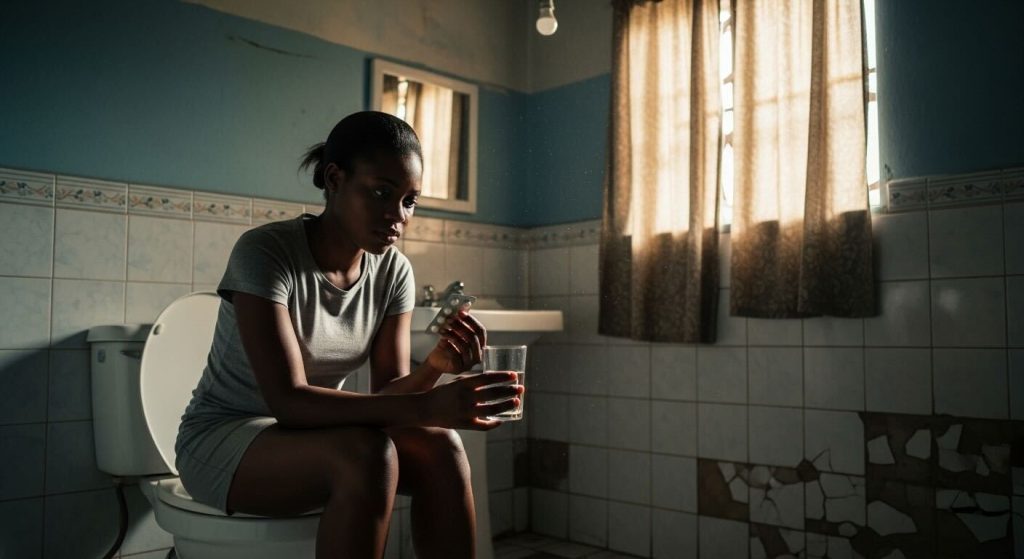
Despite knowing these risks, many women, like 22-year-old Zara*, still opt to have them anyway. In her case, having tried and failed to get a surgical abortion, she decided to get popular medical abortion pills (mifepristone and misoprostol) off the black market.
Why did you decide to get an abortion?
I’m not someone who wants to have kids, and I’ve never liked the idea of being pregnant. To make things worse, I was 22, still living with my parents and had just quit a toxic job. Physically, emotionally and financially, I was in no position to raise a child.
I already knew I wasn’t going to carry that baby to term. It was just a matter of finding a good method to get rid of it.
What method did you decide on?
After doing a Google search, I found an abundance of information on abortion. A lot of the articles I found were written in good faith, advising pregnant women on things to avoid, but information is dangerous in the wrong person’s hands.
There were articles suggesting that if I consumed a large amount of cinnamon and thyme, I could induce an abortion, and others indicated that things like zobo and certain herbs could cause abortion. The only reasonable options I found were Dilation and Curettage (surgical abortion) and the abortion pills. If there are any others, I don’t think they are available in this country.
At some point, I thought about inducing a miscarriage myself by hurting my stomach, but I knew that would be an idiotic decision. The idea of using a hanger left my mind five seconds after I thought of it because I really hate pain.
Aside from the fact that I had no idea where I was going to find a qualified doctor to do a surgical abortion for me, I wasn’t comfortable with the idea of a stranger (that no one can hold accountable) putting tools inside me. For some reason, pain medicine doesn’t work on me, and anaesthesia has a 50/50 chance of failing. Taking that kind of risk when I could die on the table, and no one would know, was a scary idea.
Plus, I couldn’t afford to leave the house for it. What excuse would I have given my family?
Where did you get the pills?
I know this sounds somehow but my partner has someone I can only describe as a ‘drug dealer friend’. The person got me Mifepristone (1 tablet) and Misoprostol (2 tablets). His friend also advised me to get some antibiotics and antacids. He talked about Flagyl, too, but I told him my body doesn’t take it well.
The irony is that with a prescription, those three pills are less than 3,000 naira, but my partner paid 30k to get them from that person.
How were you sure that they were the right ones?
I had no idea. I made a life and death decision with those pills. You can’t understand if you’ve never been in my position. At that moment, anything (including the fact that I could be potentially committing suicide) was better than carrying and giving birth to a baby. I did try to do my own research, though, and most of the information I found tallied with what the guy and the drug instructions said.
To be safe, I had gotten a scan before to make sure the fetus was in the right place, and then after the bleeding had stopped properly to make sure everything had been cleared out.
The first pill had to be taken a day before, and the other two pills were to be taken 24 hours later. They took about six hours to work.
What was the process like?
I’ve never experienced that much pain in my two decades on earth.
Within those six hours, it felt like I wasn’t going to see the next day.
I had intense stomach cramps and was writhing in pain or slumped over the toilet vomiting for most of it. I was also very weak and bleeding very heavily. My pads were getting completely soaked every three hours.
Ah
I had to clean up immediately if I missed the toilet bowl, because it would be hard to explain if someone came in. If it felt like I was starting to get too loud, I would muffle my screams into the pillow
I now see why they advise people to have other people watch them. I live with my parents, so having my friend or partner around for so long would have raised suspicions. All I could do was keep them updated by the hour.
My younger sister was the only family member I had informed. During the hardest part, she forgot and was watching TikToks in her room upstairs. It was such a lonely and very traumatic experience.
By the time I had fallen asleep at the 6th hour and woken up, the worst of it had passed. I still can’t believe I wanted to do it at night so that no one would know, but I watched too much Nollywood growing up. The way they portrayed nighttime abortions was very scary. I’m so glad I did it in the afternoon. I was adamant about terminating it, but part of me knew I didn’t really want to die.
What happened after that?
I bled for more than a week after. The bleeding stopped for about four days, and started again right after. I was always anxious, and I relied heavily on Google. Even at that, I didn’t know how much bleeding was expected and how much should have sent me to the hospital.
Every time I think about that period, I feel sad for the girl I was at that moment. She shouldn’t have gone through all that with so little support.
How did medical professionals react when you came for your post-abortion scan?
I hated all the hospital visits I had to make. From the day I took the pregnancy test to the day I went for a post-abortion scan. During the first two hospitals, the doctors kept giving me unsolicited congratulations. My life was falling apart, and they were saying things like ‘Would you like a boy or a girl first?’, ‘Your husband must be so happy, ’ ‘I know the economy is hard, but God will provide. ’
I brought up how the Nigerian medical system and society aren’t well equipped to be a mother or give birth in, and was told that I could just go to Germany to have the baby, then come back.
The ones I asked for removal options either side-stepped the question or gave me a disapproving look.
The only medical professional who was sympathetic to me was the person I went to after the abortion. He noticed an abnormal growth in my uterus and asked for my medical history, so I lied that it was an ectopic pregnancy. I didn’t think the lie through, so he quickly caught me, but he didn’t judge me for it.
Did you have any complications from the procedure?
Aside from the polyp in my uterus, I’m lucky to have gotten away without further complications. It’s like an abnormal growth, that’s the best way I can put it.
The doctor said it’s a non-cancerous growth and was most likely a result of all the shedding from the pill. He also said I can do another scan in a month if I’m still worried, but who has that kind of money?
How much did the entire procedure cost?
You’d be surprised at how much I spent on a barely safe abortion. I’m just lucky that I had a sensible partner and savings from the job I quit.
Aside from the 30k my partner spent on the pills, I spent about 40k on the scans, 10k on the blood-based pregnancy tests. I had miscellaneous costs of about 18k — transport, at-home pregnancy tests, antibiotics, and about three packs of sanitary pads. In total, I spent about 100k.
You’ll Also Love: I Got Harassed and My Friend Refused to Let Me Stay Quiet
What emotions did you feel through the process?
All of this happened less than six months ago. I can’t say I’m over it or that I’ll be anytime soon. From when I found out I was pregnant to the day I took the pills, I felt anxiety and fear.
After the process, I felt relieved. It felt like my life was relatively in my hands again. But I was still anxious because I had to monitor myself for any sudden complications. I’m not even sure I can look all the medical professionals I visited in the eye again. If your will isn’t strong enough, you’d start feeling extremely self-conscious.
The doctors didn’t directly shame me, but the fact that they kept making comments suggesting that I was abnormal for not wanting the pregnancy and that I didn’t have a choice but to keep it kept me on edge.
After I got rid of it, I felt a little bad because I had subconsciously named the foetus Ringo. But when I look at the grand scheme of things, I know it was the better option. I’m not willing to be a mother, I couldn’t afford a kid, and I’d feel selfish for bringing a child into a world that feels like it’s on fire every other day. It’s weird how logical I was about everything when I felt I was running mad, but part of me hopes that Ringo is much happier wherever it is and doesn’t hold a grudge against me.
Were you aware that you could have gotten post-abortion care afterwards?
I was aware, but I was scared. I know that abortion is illegal in Nigeria, so I didn’t want to open my mouth to the wrong person. Imagine going through all this just to be thrown in a dirty jail?
I considered a popular post-abortion clinic in Lagos, but fear wouldn’t let me. I didn’t want to hear ‘just have the baby’ again, or hear a price I know I simply couldn’t afford.
For the next few weeks, I just focused on taking my antibiotics, staying hydrated, eating any fruit I could get my hands on, and just doing things I’d do if I were recovering from a very bad illness.
How did the experience change you?
I discussed with my partner recently about how my body doesn’t feel safe anymore, and how I’d like us to avoid anything that might make that situation repeat. A part of me was scared knowing how Nigerian men can be, but he was really receptive.
For me, I can now say I have a strong conviction that I want to remain childfree, since I’ve experienced pregnancy now. I wouldn’t tell just anybody what happened, but now I have a stronger will to tune people out when they start pressuring me about children.
My man, on the other hand, tells people that we lost a baby once if he’s present whenever they try to pressure me about childbirth. He does it to embarrass them into silence, and it works most of the time.
HERtitude 2026 is happening this April, and the theme is Main Character Energy. Get your tickets here: hertitude.zikoko.com
Have you been able to engage in intimacy since then?
Omo, no o. It’s like my anxiety around intimacy heightened after the whole thing. All the contraceptives we’ve tried before now have resulted in bad side effects.
I get a rash whenever my partner uses condoms, birth control pills give me very bad nausea, and I’m scared of getting an IUD because I’m prone to UTIs. Emergency contraception is the only thing that doesn’t affect me, but I know it’s not meant to be taken often. I’m looking into injections and patches, but everything has the potential for side effects that scare me.
We’ve avoided penetration since then, and we’ve been exploring other kinds until something permanent can be done about it. Hand holding is an example of intimacy, isn’t it?
What do you wish more people knew about abortion?
Not all unwanted pregnancies are a result of recklessness. You can’t say I wasn’t informed or that I didn’t try my best with what was available. It just happened.
And it would be unreasonable to say abstinence is the answer, because these things don’t happen in a vacuum. Women like sex as much as men do. It’s unfair that we have to bear a lifelong consequence because we want intimacy.
Anyone in my situation deserves understanding and support, not extra judgment. That’s the smallest humane thing you can do.
Also, please don’t date your enemy. I can’t imagine how much harder this would have been with someone who didn’t have my best interests at heart.
This story is an honest look at what many young women in Nigeria quietly navigate because of limited access to reproductive health care and reliable contraception. If you’re sexually active, please prioritise safe sex and always use protection.
If you ever find yourself unsure, afraid, or in need of guidance, speak to a trusted medical professional or visit a certified reproductive health clinic for accurate information and safe options.
You can also reach out to organisations that provide confidential support and sexual health resources:
- Marie Stopes Nigeria (MSI)
Offers contraception counselling, sexual health services, and post-abortion care. - NURHI / SFH Clinics
Provide youth-friendly reproductive health services in various states. - Komfot Health
Confidential post-abortion care and support.
Your health matters, your future matters, and whatever decision you make about your body should be informed, safe, and free from shame.
NEXT READ: What She Said: How Femicide Happens No Dey Pass Like This