Let’s be honest: at least one in every three women has been dismissed or ignored by a doctor, nurse, or some other healthcare practitioner. For some insane reason, people still believe women are the queens of drama and that when we complain about pain, we’re exaggerating. The worst part? Even doctors, people trained to listen to and treat patients, carry that bias into their practice.
Medical misogyny is what happens when women’s health concerns are routinely dismissed in healthcare settings. It’s not just about a few bad doctors; it’s a system-wide problem built on the historical exclusion of women from medical research and education. The consequences are real: dismissed pain, delayed diagnoses, and treatment based on data that never included women’s bodies in the first place.
We spoke to eight women who’ve experienced medical misogyny in Nigeria. Their stories reveal a pattern that’s shaped how they approach healthcare today.
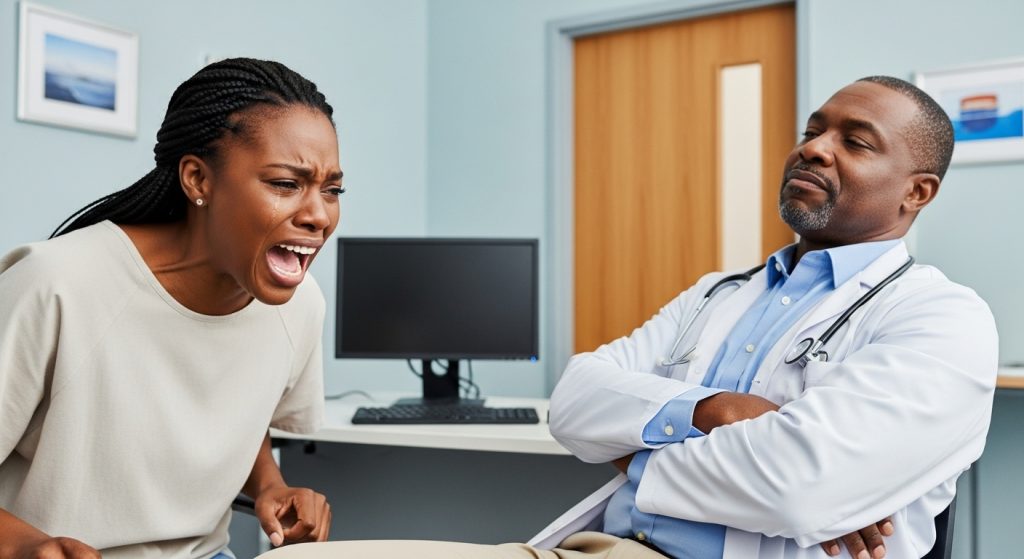
1. “He started squeezing my breasts like he was moulding akpu that wasn’t properly pounded. I screamed in pain” — Ada*, 31
I was in 100 level at the time, some 14 years ago. As a late bloomer, I was just starting to develop breasts. They became so tender; any movement gave me sharp pain. I couldn’t wear a bra or even go braless; both hurt. I couldn’t move my arms or do anything that pulled my chest muscles. I went to the hospital to complain. When I told the doctor and nurse I needed my breasts checked, they looked at each other and burst out laughing.
I still remember it vividly. The doctor’s name was Dr Dominion. He asked my age, and when I said 15, he smiled and told me the pain was normal for girls. He said since I was just developing breasts, it was meant to be painful. I told him this pain was different. He laughed, pressed his phone for five minutes while the nurse watched a movie on hers, and then wanted to prescribe simple painkillers. I refused and asked for a full check-up. That irritated him.
He told me to lie down and remove my bra. Then, without warning, he started squeezing my breasts like he was moulding akpu that wasn’t properly pounded. I screamed in pain. It was excruciating. Only then did he realise something was wrong and sent me for a test. It turned out to be a hormonal imbalance.
That experience left me horrified and added to my dislike for hospitals. I felt less than human. The snide remarks he made made it feel like I wanted someone to feel me up.
Since then, I have always consulted my sister. She’s a doctor, or go to a trusted family hospital.
What do I wish healthcare workers understood about women’s pain? It shouldn’t be undermined. Women’s anatomy is different, and so is our pain threshold.
2. “He just kept insisting, ‘These things come from sexual activity. It’s from your boyfriend.’ But I didn’t have a boyfriend.” — Eka*, 20
I went to a hospital because my vagina hurt and itched. The doctor didn’t even examine me. He just asked if I had a boyfriend. I said no.
I told him everything: the itching, the pain, that it had been going on for days and getting worse. He didn’t even look up properly from whatever he was writing. Just asked again, “You have a boyfriend?” I repeated my no. He asked again, like he didn’t believe me. “You’re sure? No boyfriend at all?” Then he said, “These things come from sexual activity. It’s from your boyfriend.” I kept saying I’d never had sex, but he didn’t believe me. He gave me some drugs without explaining what they were for. The drugs didn’t work. The infection got worse until I had to go somewhere else entirely.
It made me angry and frustrated. Now, I just go to the pharmacy and buy anything that looks like it might work.
What do I wish healthcare workers understood about women’s pain? Everything.
3. “The doctor said, ‘Lumps are nothing, they don’t kill.’ I left the medical centre with tears in my eyes.” — Tomi*, 24
It was last year, after my first semester in university. All students had to undergo a medical test. There was an eye, blood and a breast one. After the first two, I was happy to complete the tedious medical tests, not knowing something else was awaiting me.
During this routine test, the matron who administered the breast examination started talking about lumps. Immediately she mentioned it, I knew it was the thing I’d been noticing in my breast. After examining us, she told me to wait back. When the others left, she confirmed that I did have lumps in my breasts, and the one on the left was too big. She asked me to see the doctor before leaving.
The male doctor she referred me to didn’t even examine me. He just said, “Lumps are nothing, they don’t kill.” Another male doctor entered and said the same thing. I left crying. The next day, after telling her what happened, the matron referred me to a female doctor, who took me seriously and sent me for further tests.
The whole experience made me feel small, unseen, and scared. The examination confirmed it wasn’t cancer like I feared, but they should’ve at least done or said something to calm me. I was just in 100 level. Now, it’s made me pay too much attention to my health. Whenever I feel a little pain now, I overthink and overthink, worried it’s something deadly.
I wish medical practitioners would listen more, no matter the gender. My dad once had to undergo surgery for cataracts at a federal hospital in Abeokuta, and one of the male doctors around there, I don’t even know if he is a doctor, said, “Cataract doesn’t kill” in Yoruba. It felt like deja vu. I was taken back to the moment that doctor said the same to me at my school medical centre.
4. “The first doctor just pressed my stomach small and said, ‘It’s your endometriosis. You’re used to this kind of pain.’” — Chioma*, 38
I went to the hospital four times with sharp pain on my right side, fever, and vomiting. I told them, “I’m worried this might be an appendix.” But because I have endometriosis, they kept saying it was an endo flare.
“Madam, you know how your body is. It’s the endo acting up again.” They gave me painkillers and sent me home. Four times.
The fourth time, my husband came with me because I was getting worse. The moment he opened his mouth and said, “Doctor, we’re really concerned this might be appendicitis,” suddenly they started listening. Suddenly, it was worth investigating. They did the scan, ran proper tests, and lo and behold – appendix. It had been appendix all along.
Each time I came in, they barely examined me. The first doctor just pressed my stomach small and said, “It’s your endometriosis. You’re used to this kind of pain.” The second time, a different doctor looked at my file, saw the endo diagnosis, and basically made up her mind before I even finished talking. She was like, “Have you taken your usual medication?” I said yes, that this pain is different. She didn’t care.
The fourth visit, before my husband spoke, they were already preparing to discharge me. When he talked, the doctor’s whole demeanour changed. Suddenly, there was urgency. “Ah, we should do a scan to be sure.” I wanted to scream. I’d been saying the same thing for days, but it took a man’s voice for them to actually hear it.
I felt invisible. Like my words meant nothing. I’m almost 40 years old, I know my body, I know what endo pain feels like, and I knew this was something different. But they treated me like I was just being dramatic. And then to watch them take my husband seriously when he said the exact same thing I’d been saying? I felt foolish for thinking my voice alone would be enough.
Their reaction was 100% influenced by my gender. If I were a man coming in four times with those symptoms, they would’ve investigated from the first visit. But because I’m a woman with a “women’s disease,” they assumed everything was related to that.
Now, I don’t go anywhere without my husband anymore if it’s something serious. It’s sad, but that’s the reality. I also now insist on tests even when they try to brush me off. “I want a scan. I want bloodwork. I want it documented.” I’ve learned to be very forceful because being polite and trusting them almost cost me my life. My appendix could have ruptured while they were busy telling me it was just endo.
What do I wish healthcare workers understood? That having one condition doesn’t mean every pain we feel is from that condition. I have endo, yes, but I can also have other things wrong with me at the same time. Stop using our medical history as an excuse to not investigate new symptoms. And for God’s sake, believe us when we say something is different. We know our bodies better than you do.
What She Said: Loving My Boss Cost Me My Fallopian Tube
5. “He pressed the stethoscope all over my chest without permission. Afterwards, he told me it was anxiety.” — Sade*, 23
I recently went to see a doctor for some symptoms I’d been having — dizziness, headaches, and eye aches. The doctor, some old dude probably in his late fifties or sixties, asked whether I was married. I said no. Then he asked me some sexual health questions: when I last saw my period, whether I had pain while urinating, etc.
He asked me to lie down and lift my blouse. None of my symptoms pointed to respiratory issues, but he pressed his stethoscope all over my chest without permission, and without another female present. Afterwards, he told me it was anxiety. Later, he suggested an ultrasound “to check for infection.” I shouldn’t have kept quiet through it all, sha.
It made me very uncomfortable and made me doubt myself. Their reaction was very much influenced by my gender. Now, I’d request a female doctor. I’d speak up when I feel uncomfortable and stand up for myself. And if I should have a male doctor, I’d make sure he knows what he’s doing. I’d tell him, “Doctor, the symptoms are up here, not down there.”
What do I wish healthcare workers understood? Listening is literally what’s required of them.
6. “Like, ah, na toto o, no be elbow! I laid curses on her in my heart.” — Kemi*, 25
I was donating eggs at a fertility clinic. This particular nurse kept acting like because I was different (mixed), I was getting better treatment, and she wanted to punish me for it. She was the head nurse, so she was in charge. She was wrong, though. I was just showing up and doing my own thing.
She made the process very uncomfortable for no reason. She wasn’t gentle in any way. Not even when wiping my vaina or administering painkillers down there. Like, ah, na toto o, no be elbow! I laid curses on her in my heart.
I think their reaction was influenced by my gender, skin colour, height, everything. Now, tbh I cannot be specific enoughhhhh when dealing with medical workers, but if I see you’re chill, it’s all good. If I see you look at me like the devil, I’ll keep myself together and get someone else.
What do I wish healthcare workers understood? That you should listen when someone is telling you this is how my body is doing me, and not just be leaping into conclusions and also as a caregiver, kindly be light-handed and hearted biko.
7. “He asked if it was ‘all in my head.’ I’d been in pain since I was 8 years old.” — Lucy*, 29
After getting diagnosed with ADHD — which was a whole journey of being told by male psychiatrists that it was BPD, anxiety, or depression — my therapist asked me to do some tests: iron levels, potassium, the works. While at it, I mentioned a pain I’d had since I was eight, sharp stomach pain that made it impossible to stand straight. It came before or after eating, or if I hadn’t eaten in a while. My dad always said it was “jedi jedi” and gave me over-the-counter meds.
It never stopped. In high school and uni, antacids helped a bit, but the pain became part of my life. At 19, my grandparents thought it was an ulcer. The blood test came back clean. The lab tech suggested a faeces test, but I was tired, so I left it.
At 25, I’d learned about acid reflux and brought it up with this doctor. I explained everything, but because I wasn’t in pain at that exact moment, he asked if it was “all in my head.” I laughed. “It’s all been in my head since I was eight? Me not being able to move after meals is all in my head?” He went quiet, did the useless stomach press test, and reluctantly ran an ulcer test, which came back positive.
No apology, no acknowledgement that he’d dismissed something real. Just business as usual. I felt exhausted. It’s the same old story: woman reports pain she can’t prove immediately + a history of mental illness? Must be psychological. Everything must be anxiety. Meanwhile, I’ve been tracking symptoms longer than some of these doctors have been practising.
Now, I come prepared. Folder in hand: symptom logs, test results, family history. I switch doctors mid-appointment if I need to. And I no longer downplay pain to seem “reasonable.” If it hurts, I say it hurts.
Health workers need to stop treating diagnostic conversations like detective games where we’re the suspects. We’re not trying to trick you into unnecessary tests; we’re giving you data. Also, psychiatric diagnoses and physical illness aren’t mutually exclusive. My ADHD didn’t cause an ulcer. I had both. Revolutionary concept, I know.
8. “‘ Why are you acting like a small pikin?’ I was too weak to be truly angry, but it was deeply demeaning.” — Amanda*, 34
I was maybe 18 at the time. It was at my uni clinic. I’d just had a bad asthma attack and recovered with oxygen. I was still weak, and they were trying to set up a drip. The nurse kept stabbing my hand over and over, saying she couldn’t find a vein. My cousin had to look away.
Eventually, she called the doctor to do it. He grabbed the same hand she’d been stabbing, but I quickly pulled it away and gave him the other. They made side comments, “Is it painful?” “Why are you acting like a small pikin?”, and pressed my hand all in the name of cleaning.
I remember looking him in the eye and saying, “No o, it’s not painful. Let me stab your own hand over and over again.” Then I hissed and lay on my side. I was too weak to be truly angry, but it was a deeply demeaning experience.
The whole thing felt performative, like they were punishing me for having the audacity to be in pain and show it. I was clearly unwell, but they treated my reaction to their roughness like I was being dramatic. I felt furious. What made it worse was knowing that if I’d been stronger, if I hadn’t just had an asthma attack, I would’ve caused a scene. But they caught me at my most vulnerable and took advantage of it.
“Small pikin.” They wouldn’t talk to a grown man like that. There’s this thing where women’s pain responses are seen as excessive by default. We’re either overreacting or attention-seeking. A man wincing would be taken as a sign that something’s genuinely wrong. Me pulling my hand away from someone who’d already brutalised it? Childish behaviour, apparently. Now, I’ve become one of those “difficult” patients, and I’m fine with it. I ask for a different nurse if the first one misses. I ask questions about every procedure. I’ve walked out of appointments before.
Healthcare practitioners, nobody’s asking for a five-star hotel experience; just don’t mock people who are already suffering. Don’t make demeaning jokes while you’re hurting someone. Don’t treat pain management like a favour you’re doing us. It’s literally the job description.
If you’re a healthcare worker reading this and thinking “not all doctors,” ask yourself: when was the last time you dismissed a woman’s pain as anxiety or drama? Told someone their symptoms were “normal” without running tests? Made a patient feel like they were being dramatic for expressing discomfort?
These women’s stories aren’t about isolated incidents with “bad” doctors. They’re about a system that taught you, however subtly, that women exaggerate pain. Unlearning that is long overdue.
You’ll Also Enjoy Reading: “I Borrow Sanitary Pads and Return Them When I Have Money” — 4 Women on the Cost of Periods in Nigeria