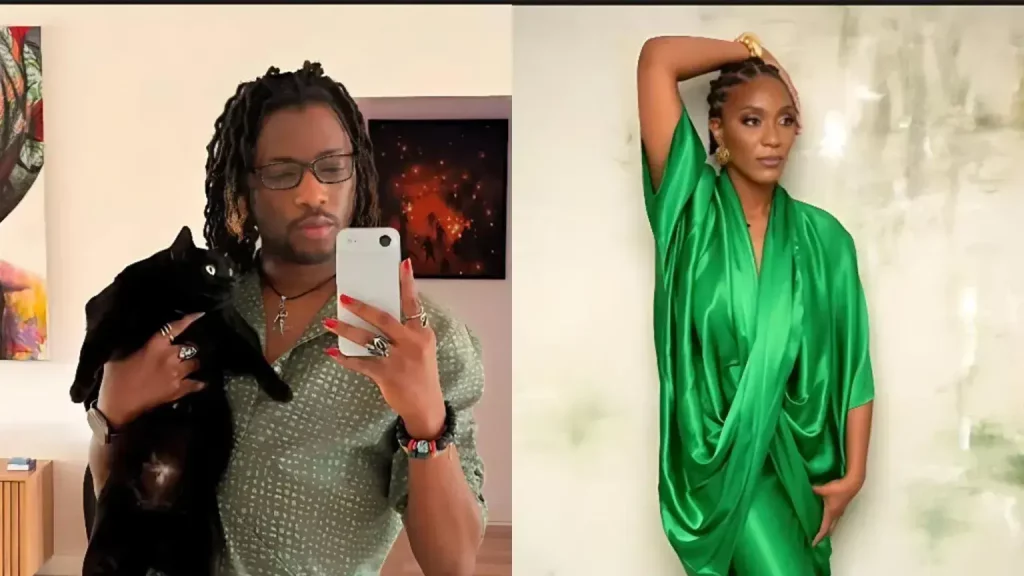
Earlier this week, finance professional Max Obae publicly accused Paystack co-founder Ezra Olubi of manipulation, abusive behaviour, and misconduct during their past relationship. In a detailed public disclosure, titled “My Piece”, Max outlines what she describes as patterns of control, emotional detachment, and mistreatment, not just toward her, but toward others within Ezra’s orbit. She spoke about these issues in a now-private X Space session, where she discussed the relationship and her experiences.
Max’s disclosure is a mix of a personal reflection with a call for public accountability. She says the relationship started remotely in September 2023 and became physical in December. She claims that what she witnessed, including alleged interactions involving a junior employee, compelled her to speak out after months of concern about Olubi’s behaviour. Though the relationship ended in June 2024, she decided to make these events public now to alert others to what she calls “the depth of the depravity” surrounding Olubi.
Paystack’s Response
Shortly after Obae’s post gained traction, Paystack issued an official statement confirming that Ezra Olubi has been suspended from all duties pending a formal investigation. In a statement reported by TechCabal, the company said:
“We take matters of this nature extremely seriously… Effective immediately, Ezra has been suspended from all duties and responsibilities pending the outcome of a formal investigation.”
The statement did not address the allegations in detail, but it reinforced the seriousness of the situation and the company’s intention to investigate the claims.
Public Reaction and Resurfaced Tweets
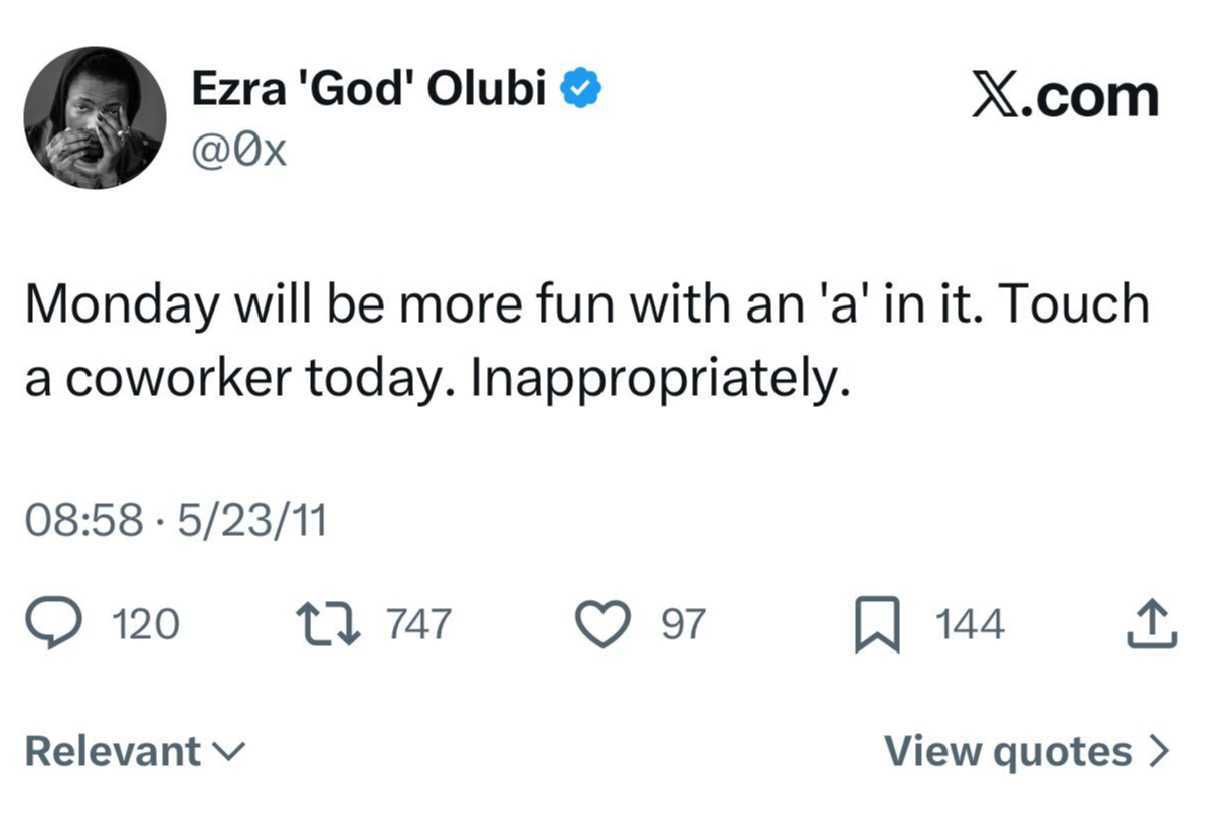
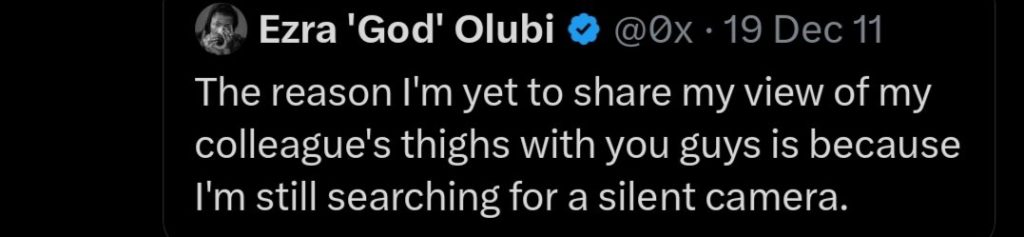
The news of Max Obae’s post quickly started a surge of conversation across social media. Many users pointed to decade-old tweets from Ezra Olubi, dating back to circa 2009–2013, which have resurfaced online. These posts include sexually explicit jokes about colleagues, references to minors, and comments about wanting to photograph a coworker’s thighs. One widely cited tweet from May 23, 2011, read:
“Monday will be more fun with an ‘a’ in it. Touch a coworker today. Inappropriately.” — @EzraOlubi
Olubi’s X (formerly Twitter) account has since been deactivated following the resurfacing. Users have been actively collecting, sharing, and archiving these tweets, with some calling for a public repository. As Unkle Ayo (@UnkleAyo) posted:
“Ezra Olubi has deactivated. Please reply and quote this tweet with screenshots of those diabolical tweets. We need a GitHub repository.”
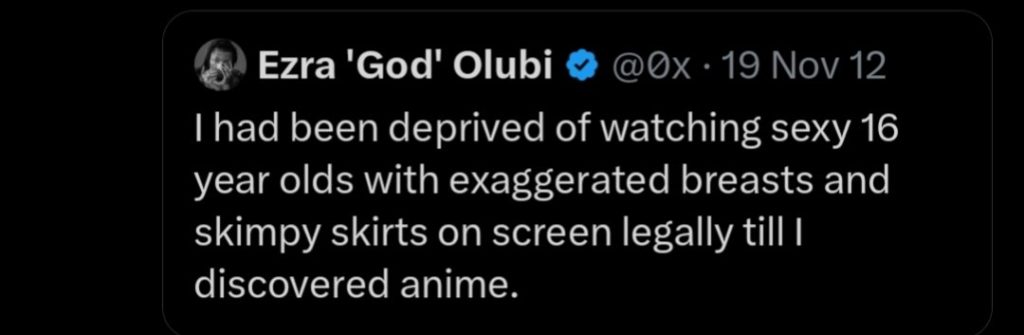
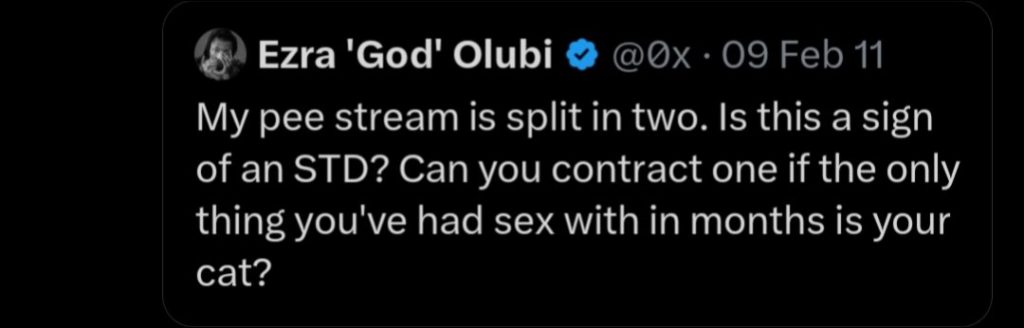
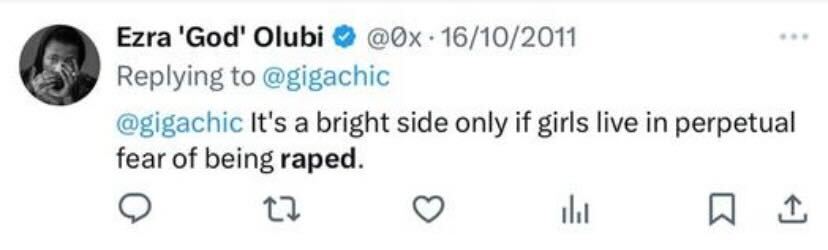

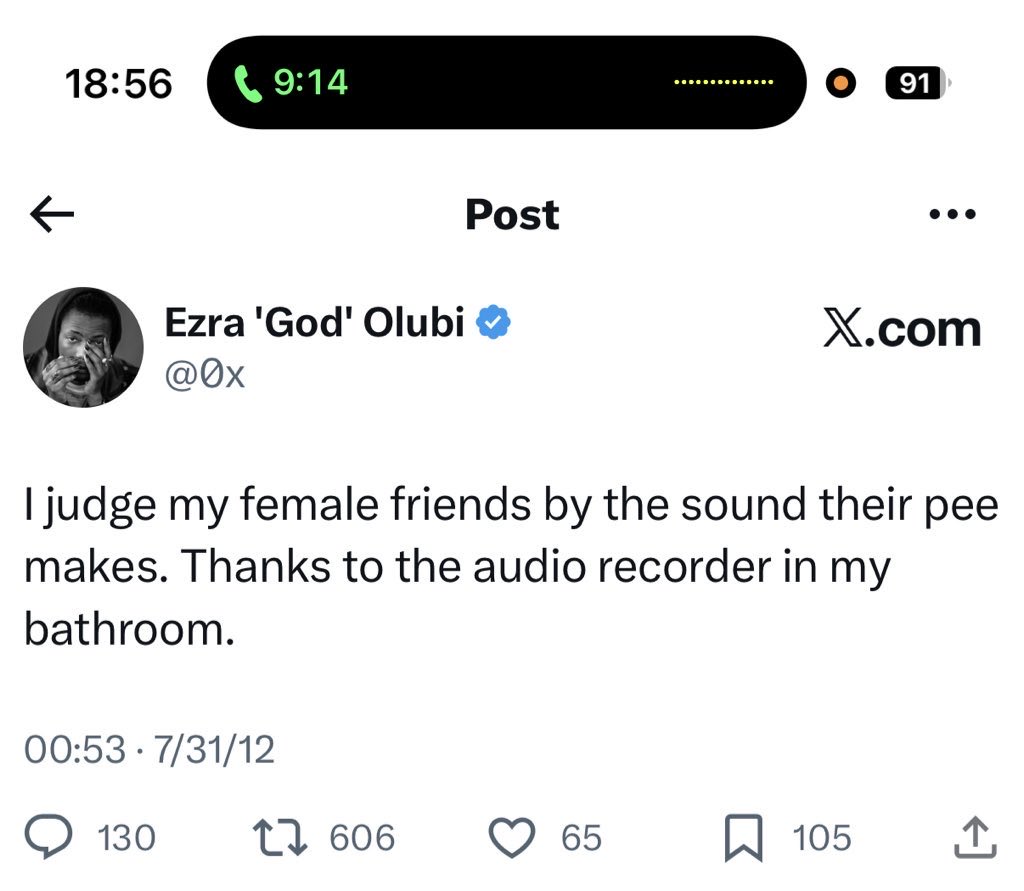
The public conversation around these posts reflects both outrage and attempts to contextualise the behaviour. Some users focused on patterns of entitlement in tech culture, particularly the male-dominated fintech space:
“But sorry, why is there so much depravity prevalent with ‘tech bros’?” — @SkinwithLolami
“Because last last, they are still men. Men with more money than most. People also need to remember how weird early gamer/nerd/internet culture was and how perverse and bullying the space used to be. Edgelords etc.” — @Jollz
Others offered a counterpoint, emphasising Olubi’s professional accomplishments and contributions to fintech:
“The man is a model, he’s successful, he’s smart, and he’s very good at his work. He even co-founded an app that changed how people do business.” — @TheHN1C
Additionally, some users highlighted alleged broader ethical concerns involving Olubi. Oyinyeola (@oyinyeola) tweeted:
“This Ezra guy was also the person who helped Femco syphon the Bitcoin donations during EndSARS.”
Collectively, these posts show how social media users are both documenting and debating Olubi’s behaviour, reinforcing the point that digital footprints are lasting and public accountability can arrive long after the fact.
Digital Footprints and Public Consequences
This moment extends far beyond one individual or one company. Tweets and online behaviour that might once have been ignored are now being scrutinised, archived, and shared widely. For women in male-dominated spaces, especially in tech, this isn’t just gossip; it’s a glimpse of what it’s like to work in spaces where money, power, and gender collide.
The resurfacing of decade-old posts shows a simple truth: what you post online can follow you forever. Even founders who seemed untouchable now face public consequences, and the court of social media can act faster than formal investigations.
Culture, Power, and Women in Male-Dominated Spaces
Nigerian tech is still overwhelmingly male, and very few women hold leadership roles. HR frameworks are still evolving, and in many startups, the founders themselves shape the culture. When people at the top behave badly, it often goes unchecked, and women often have to navigate these spaces carefully.
The Olubi suspension puts this into focus. It’s not just about one person’s actions; it’s a reminder that who’s at the top sets the tone, and that a company’s culture is shaped by their behaviour. Women watching this story unfold are left asking: are Nigerian tech companies ready to protect employees and take misconduct seriously, or do power and privilege still decide what gets addressed?
Also Read: Regina Daniels Is Not Your Perfect Victim. So What?
Why This Matters
The Ezra Olubi case is more than a tech controversy. It is a cultural checkpoint for Nigerians in tech and for anyone navigating workplaces where power is unevenly distributed. It demonstrates that digital footprints are lasting, that public accountability is possible, and that women’s voices, in Obae’s words, can compel conversations that demand attention.
For Nigerian tech, the message is clear: founders are no longer beyond scrutiny, and past behaviour, online or offline, can define professional and personal credibility. But are Nigerian tech companies ready to move beyond scrutiny to actual structural change? They can start by implementing independent, third-party investigations when founders or executives are accused, not internal reviews that protect the brand. They need clear reporting channels that bypass leadership entirely, so employees aren’t forced to report misconduct to the very people who benefit from silence. And they need transparent outcomes: public accountability for what was found and what actions were taken, not just vague statements about “taking matters seriously.”
Until these mechanisms exist, every suspension feels performative, and every investigation feels like damage control. For women, vigilance and community support remain crucial in spaces where privilege and power are still disproportionately concentrated because the systems that should protect them are still being built, or worse, still being ignored.
You’ll Also Love: Who Gets to Decide If Toke Makinwa’s Pregnancy Is a Blessing?
Single? Married? Divorced? Dating? In a situationship? We’re surveying Nigerians about love, relationships, marriage, and everything in between, and we want to hear from YOU.
You only need to give us a few minutes of your time and participate in this quick survey. It’s 100% anonymous too!