Written by Tezor Dedam
Every morning, Omegie sends out food to a range of vendors, and it’s been a part of her daily routine. Every morning, except on Thursday, September 3, 2026, when she was left scrambling as her plans fell apart.
That morning, Omegie was dealing with late food delivery from vendors because the Uber ride-hailing app had shut down. She is an operations associate who works in the logistics/delivery department of a food & catering company in Benin.
For the past two years, their logistics had relied heavily on Uber’s existence because, according to her, “they were affordable, their drivers were polite and responsible, and because we deliver delicate items, they handled them with care.” But that morning, Omegie and her co-workers were stranded between losing out on food deliveries and seeking out other transportation platforms.
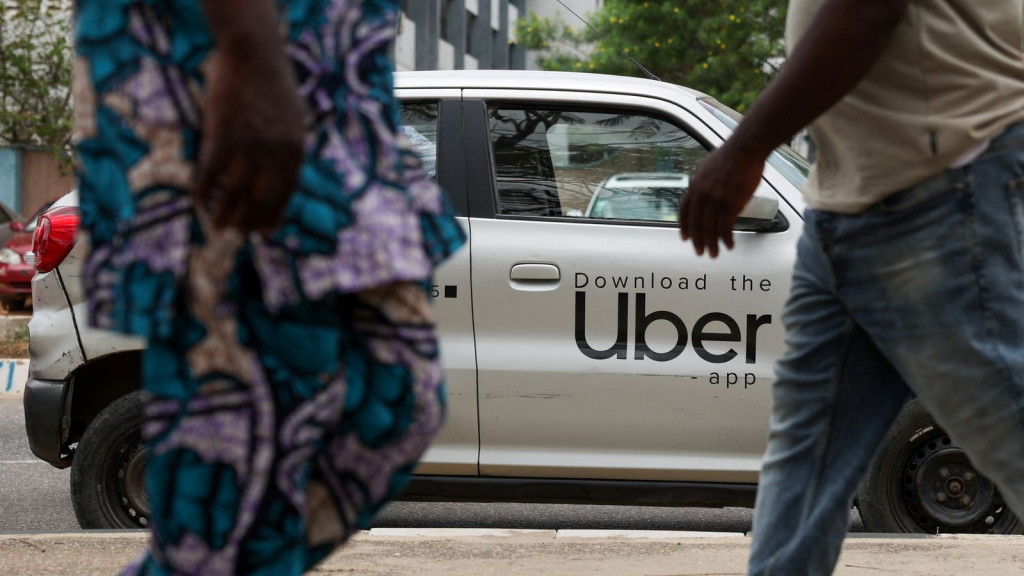
In Lagos, Deborah has had to largely restructure her work and social life since Uber had been the core of her daily movements. She said, “Uber was preferred because it is safe, trusted, and for me personally, it was cheaper on the island”.
The shutdown caught her in the middle of a typical day where she had to move between work, home, and a family function, leaving her wondering what might have gone wrong with the app. She got the update from social media that the company was leaving Nigeria on the very day her app went blank.
This sudden need for adjustment must have been the case for the thousands of Uber users in the country. This adjustment could have meant disrupted timelines, people being stranded mid-ride, and an abrupt absence of one of the country’s leading ride-hailing apps.
On Wednesday, September 2, 2026, Uber announced in an email to customers that it would be winding down its operations in Nigeria, after being a major ride-hailing company in the country since its launch in 2014.
The company ironically clicked “End Trip” on a 12-year journey in one of its earliest African markets: one email, zero prior notice, and plenty of stranded Nigerians.
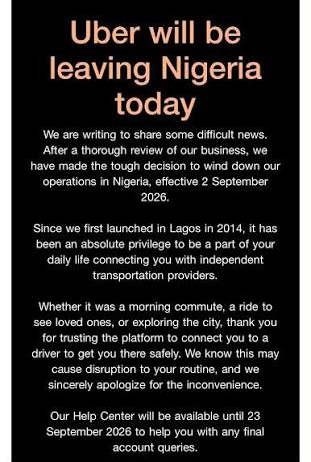
Uber did not give a detailed reason for its sudden departure, leaving many to speculate about a global restructuring and the macroeconomic pressures of operating in Nigeria.
However strongly these speculations are felt, the truth remains that we do not know for sure why they left. What we do know is that Uber made a unilateral decision, and even though it pledged support for drivers in the email, it largely leaves drivers and riders to absorb the loss with zero recourse. With this decision, Uber has shown that it can disrupt nationwide services without having to explain itself. It also shows an apparent power imbalance that the company exploited. Nigerians did not appear to have any leverage in the entire thing. There was no regulator Uber had to answer to, no union to cause a ruckus, and no customer base whose loyalty they wanted to protect on their way out.
Why always us?
Uber is not the only foreign company to have treated its Nigerian customers this way.
From 2004 to January 2026, PayPal restricted Nigerian accounts to “send only,” effectively blocking them from receiving funds on the platform while allowing them to send funds.
The American company cited fraud and weak identification systems as the reasons for its restriction on Nigerians. But interestingly, countries like Russia and the United States did not face these same restrictions, despite being first and fourth on the World Cybercrime Index (WCI), with WCI scores of 58.39 and 25.01, respectively, against Nigeria’s 21.28.
This obviously pokes some holes in PayPal’s explanation, leaving Nigerians to wonder about the true reason behind its decision. With the recent development, Nigerians are wondering why Uber has treated them with the same apparent disrespect.
We, too, have wondered, and the closest we can come to an explanation is that PayPal and Uber’s actions might be a strong reflection of the Nigerian experience. Every day, Nigerians go through systems which demand that we absorb unexpected shocks. Either fuel subsidies are being removed overnight, national grids are collapsing without notice, or kidnappers are greeting our loved ones mid-trip.
So Uber might just be mirroring the exact systems that we have been subjected to – ones that take little to no accountability, internally or externally. These exact systems were cited in the departures of Glaskosmithkline, ShopRite, and Equinor – where these companies had to leave or largely scale back because of Nigeria’s macro-economic pressures.
The interesting thing is, Uber might end up fine, and Nigerians will probably survive this as well. But survival is different from being owed better. If a company leaves the Nigerian market carelessly after 12 years, then it is a strong verdict on where we stand as a country. For now, people like Omegie and Deborah are the ones paying the human costs.