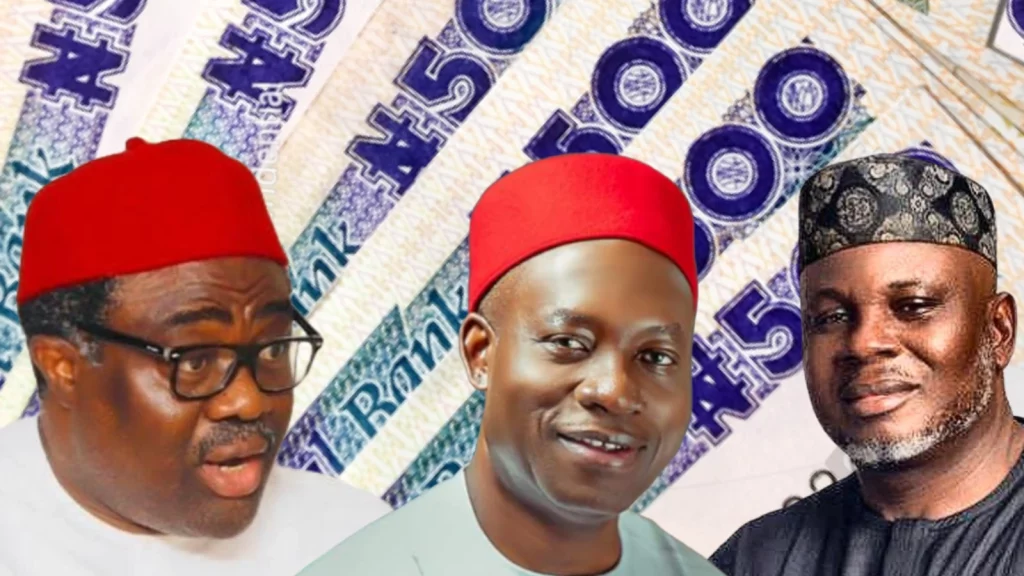
On Sunday, November 9, 2025, the Independent National Electoral Commission (INEC) announced that the incumbent governor of Anambra, Chukwuma Soludo, had won the governorship elections held the day before.
According to INEC, Soludo received 422,664 votes, while his closest rival, Prince Nicholas Ukachukwu of the All Progressives Congress (APC), got 99,445. On paper, it looked like a landslide. But truthfully, it had less to do with popularity and more to do with who had the deepest pockets.
How much does a vote cost these days?
Election observers said the process was surprisingly smooth. INEC officials actually showed up on time, and the Bimodal Voter Accreditation System (BVAS) worked without the usual drama. And there were hardly any reports of violence.
Basically, it was as good as elections get in Nigeria, except for one thing: vote buying.
Civic participation non-profit, Yiaga Africa, confirmed that the final results reflected the actual votes cast. So no rigging in that sense. But they and other observers couldn’t ignore the shameless vote buying that went down.
Reports say parties handed out anything from ₦1,000 to ₦30,000 to voters.
Reacting to the news, former Anambra governor and presidential hopeful Peter Obi said, “Someone who is not employed will collect ₦30,000 for his vote. That means you’ve sold your school, your hospital, your job opportunities, and your future. And that’s what’s very worrying about our democracy.”
Vote buying is nothing new in Nigeria. It’s one of the oldest tricks in the book. Campaigns often feature sharing items ranging from spaghetti, loaves of bread, bags of rice and cold, hard cash. Sadly, it’s part of the political culture.
But this new level of shamelessness, where party reps hang around polling units and openly buy votes in front of INEC officials and police, is a growing trend. And it’s very disturbing.
The 2023 general election is mostly remembered for violence and alleged rigging. But there were also reports of people handing out cash or making transfers at polling units to voters who backed their party.
The National Bureau of Statistics (NBS) reported that there was a significant jump in the amount of vote-buying in 2023 compared to previous years. Agents of the Economic and Financial Crime Commission (EFCC) were even attacked at a polling unit in Bwari, Abuja, while trying to arrest a vote buyer.
In September 2024, during the Edo governorship election, Yiaga Africa reported that voters were paid between ₦5,000 and ₦10,000. And all the major parties were involved in the act.
Kimpact Development Initiative (KDI), another civil society group, estimated that over ₦2 billion was spent on vote buying during the Edo and Ondo governorship elections in 2024.
With the 2027 general elections around the corner, we won’t be surprised if vote buying gets even bolder.
Na who don chop dey vote
At the heart of this sad vote buying culture is poverty.
Nigeria is poor. Like, really poor. The NBS says 63 per cent of the population (over 130 million people) are multidimensionally poor. So it’s not shocking that people are trading their votes for literal daily bread.
The choices we make at the ballot box affect our lives for at least four years, most likely longer. Like Peter Obi said, selling your vote is selling your future.
But how do you convince someone to vote for a better tomorrow when they’re hungry today?
It’s clear that Nigeria’s political class has mastered the art of weaponising poverty to grab and hold onto power. As long as Nigerians stay poor, their votes will stay cheap.
But in Nigeria, vote buying isn’t just about poverty.
Why are you here? I thought you were financially stable
During the People’s Democratic Party (PDP) presidential primaries in 2023, candidates reportedly paid delegates between $10,000 and $20,000 for their votes.
One delegate, Tanko Sabo from Kaduna, spent ₦12 million of his earnings from the primaries on his community. Amongst other donations to the less privileged, he paid WAEC and NECO fees for students who couldn’t afford them.
He said he’d promised his people he’d use the money for them if they made him a delegate. After giving the money away, he said, “I’ve satisfied my conscience and all my people are happy.”
In August 2025, Ibrahim Auyo, a House of Representatives member from Jigawa, claimed that lawmakers pay between ₦1 million and ₦3 million to present bills in the National Assembly.
At the risk of understating things, we can safely say that Nigerian lawmakers are well-fed. They get all sorts of allowances and perks, paid for by taxpayers. They’re not starving like the everyday Nigerians selling votes just to eat for one day.
Still, whether it’s ₦20,000 on the streets of Anambra, $20,000 at a party convention in Abuja, or ₦3 million in the National Assembly, votes in Nigeria are always for sale. The only thing that changes is the price tag.
Nigeria’s political class doesn’t know any other way to do politics.
Nigerian voter, how market?
One big reason vote buying works so well for Nigerian politicians is simple: it’s cheap. And it’s cheap because Nigerians don’t vote.
INEC registered almost 2.8 million voters ahead of the Anambra election. But only about 598,000 showed up on election day. That’s a 21.4 per cent voter turnout.
Here’s the thing: when people show up en masse to vote, it makes all kinds of electoral malpractice (violence, vote buying, ballot snatching, rigging, etc) less effective.
Vote buying especially becomes too expensive to be practical. In Anambra, if every registered voter had shown up, buying votes would’ve cost politicians five times more.
Also, Nigerians who are above the poverty line, who can afford not to sell their votes, need to actually show up and vote.
Fixing this country requires collective action, and voting is a key part of doing your bit.
Having money problems
Like we said earlier, Nigeria has a poverty problem. And that poverty creates the perfect environment for vote buying.
We need a serious approach to poverty reduction. And while that’s in progress (hopefully), safety nets must be put in place to protect the most vulnerable members of society.
The International Monetary Fund (IMF) and Ngozi Okonjo-Iweala, director-general of the World Trade Organization (WTO), have repeatedly urged President Tinubu to provide safety nets. But so far, we’ve seen little to no action from his administration.
Nigerians need to be able to afford the dignity of not selling their votes.
But here’s the tragic loop: we’re asking vote buyers to fix the very poverty that allows them to buy votes. Personally, I’m not holding my breath.
The political class has weaponised poverty to gain and keep power. As long as things stay the same, they have zero incentive to fix a system that rewards them for doing the barest minimum.
And as we’ve already pointed out, even the political elite, regardless of how rich they are, still sell their votes for the right price. So this isn’t just about poverty or lack of choice. It’s a culture.
We need to redefine how Nigerians see politics and governance. Right now, we’re too selfish, too cynical, too pessimistic, and way too short-sighted. If we can’t see past our noses, we won’t walk far. If we can’t look beyond the credit alert we’ll get today, we’ll never get more than that.
Not in my job description
If you’ve been reading and wondering where INEC is in all this mess, you’re not alone. We’ve been wondering too.
Turns out, they’ve been right there, watching it all happen. And according to them, there’s not much they can do.
In 2024, after getting criticised for the vote buying seen during the Edo governorship election, INEC said it shouldn’t be blamed.
Rotimi Oyekanmi, Chief Press Secretary to the INEC Chairman, said INEC couldn’t be held responsible for what political parties do. He added that “other stakeholders should also play their part and stop undermining the electoral process.”
Basically, every time politicians act out of line, INEC says its hands are tied. For example, ahead of the 2027 elections, candidates have already started campaigning way before the legal 150-day window. But INEC says it can’t do anything because it can’t prove it.
Victoria Etta-Messi, the INEC Director of Voter Education and Publicity, said that since the politicians are using proxies to put up their campaign posters, there’s nothing INEC can do to punish them.
Similarly, in Anambra, the Resident Electoral Commissioner (REC) for Anambra State, Queen Agwu, said they had no proof of vote buying, so they would not be taking any action against the parties or candidates.
Technically, there really isn’t a lot INEC can do about vote buying except reporting it to law enforcement agencies. It is the job of the police, EFCC, and the Independent Corrupt Practices Commission (ICPC) to prosecute vote buyers.
In fact, INEC has asked for assistance to prevent vote buying, including calling on the National Assembly in February 2025 to pass laws prohibiting the possession of large sums of cash near polling booths.
INEC’s Director of Litigation and Prosecution, Tanimu Muhammed, also said it is important for an Electoral Offenses Commission to be established because INEC lacks the ability to prosecute offenders.
According to Muhammed, INEC is doing its best currently, but a dedicated institution with the legal authority and resources to investigate and prosecute electoral crimes is needed urgently.
Who is responsible?
After the Anambra election, the Socio-Economic Rights and Accountability Project (SERAP) has urged INEC to report vote-buyers to these organisations responsible for actual enforcement.
But the Anambra INEC Resident Electoral Commissioner, claiming INEC did not witness any vote buying, is honestly quite disappointing. Especially when so many election observers noted the prevalence of vote buying during the election.
It feels very much like selective blindness on the part of INEC. Even if it can’t prosecute them, INEC officials on the ground are the first witnesses of electoral malpractices and should be ready to report offenders to the organisations that can prosecute. Currently, they aren’t even doing that much.
There are also reports of police officers at polling booths watching vote buying happen and doing absolutely nothing. And while the EFCC does make a few arrests, it’s clearly not enough. The EFCC said it arrested three people for trying to buy votes in Anambra, but observers still say the election was heavily influenced by vote buying.
INEC, EFCC, the police—all the institutions meant to protect the integrity of our elections—need to step up and do their jobs. Politicians can’t keep breaking laws so publicly, so shamelessly, without consequences.
But institutions are made up of individuals. And as individuals, Nigerians need to realise: we can’t keep selling our votes (futures).
What can you do?
- We need more electoral reforms, including possibly establishing a dedicated body for prosecuting electoral offenders. Call your representative in the National Assembly (NASS) to demand this. You can find their contact details here.
- Get your PVC and vote. Vote buying is possible thanks to low voter turnout. Do your part and show up on election day.
- We think this one is obvious, but we’ll still spell it out: Don’t sell your vote!
- Educate those around you on the importance of political participation. You can do that by sharing articles like this.
- Help enlighten others on the true cost of vote selling.
Before you go, help us understand how you and other young people feel about the 2027 general elections by taking this 10-minute survey.