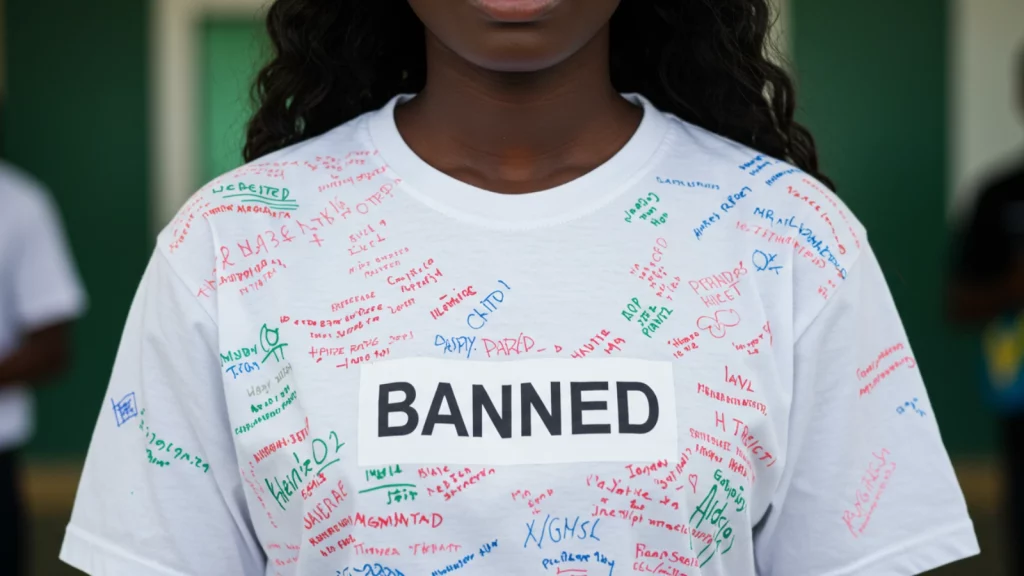
I thought the tradition of sign out ceremonies was a little silly. So I refused to wear a white shirt on the day of my last exam at the University of Lagos. Several of my course mates, unwilling to let me escape the merriment unscathed, signed on my skin.
In the end, it was a really fun day. One of my best memories from my time at Akoka. I was won over by the joy of that day, but unfortunately, the powers that be in Nigeria hate joy and are banning sign out ceremonies left and right.
Who are these joy-killers?
On March 24 2021, the management of the Ladoke Akintola University of Technology (LAUTECH) banned sign-out ceremonies, claiming they led to gross immorality and indiscipline.
The institution’s Public Relations Officer (PRO), Lekan Fadeyi, said the events had always involved “indisciplined activities.” He said they were not trying to stop students from expressing the joy of graduating, but that joy should be expressed through officially sanctioned events like the school’s convocation ceremony because, apparently, it is the only way you can derive enjoyment.
He said, “When you say you are signing out and use that as a smokescreen to attend gatherings that have not been officially sanctioned, I do not think that there is any joy that you can derive from that.”
Later that year, in August 2021, Usmanu Danfodiyo University (UDU) instructed students to “desist” from sign-out celebrations and instead celebrate by creating a “photo album for their class.” The UDU senate restated the ban in 2023, saying the university’s Security Division would “apprehend any perpetrators for appropriate disciplinary measures.”
These bans may have been sparse before, but 2025 has seen an even greater and more widespread effort to stop the sign-out tradition. Over the last few months, there has been a wave of bans across the country targeting sign-outs either by institutions or by state governments.
The Kwara State Polytechnic, which had already banned sign-outs in 2022, visited the Kwara State Police Command in July 2025 to seek assistance in enforcing the ban, which had been largely ignored by students.
On August 19, Nnamdi Azikiwe University (UNIZIK) announced its own ban.
While institutions are implementing bans at the tertiary level, state governments have their eyes on the lower levels of education.
Even the babies?
In July 2025, the Sokoto and Jigawa State Governments banned sign-out parties by graduating senior secondary school students across the two states. In September, the Oyo State Government issued its own ban on graduating secondary students.
The Oyo State Commissioner for Education, Science and Technology, Olusegun Olayiwola, said the government could no longer overlook the events, which he claimed were chaotic and a threat to public safety.
Who can afford joy in this economy?
This wave of bans is not coincidental. They might be happening at the state level, but they are actually part of a federal programme. The federal government, through the National Orientation Agency (NOA), is carrying out a campaign against “sign-out excesses” in schools.
The Director-General of NOA, Lanre Issa-Onilu, made this known in August while commending Imo State for its ban of sign-out activities for nursery, primary and junior secondary schools.
In his statement, Issa-Onilu said that organising graduation ceremonies encouraged a culture of waste and placed unnecessary financial pressure on parents.
This sentiment was echoed in Ogun State, where graduation parties are now banned across all classes except Primary Six, Junior Secondary School Three and Senior Secondary School Three.
While announcing the ban, the Ogun State Commissioner for Education, Science and Technology, Abayomi Arigbabu, said they were unnecessary and placed undue financial pressure on parents.
ALSO READ: Nigeria’s Defence Chief Thinks You Should Learn Karate to Fight Bandits
Signing your lap is bad for national values
The reasoning behind these bans exposes the disconnect between the ruling class and the Nigerians they govern.
On August 29, 2025, during a civic engagement event, NOA’s Director of Human Resources, Ayisola Olowoyo, said sign-out parties were fine in theory, but that students were now going to extremes. “They write on the laps of their colleagues, they write on the breasts of their colleagues. This is against national values,” he said.
This hyper-conservative, optics-focused attitude is not surprising, but it shows the mindset of those in power in Nigeria. It shows the things that bother them enough to drive them to immediate action. Unfortunately, it is not the welfare of the people, but what people are doing with their breasts and laps.
Actual terrorists are being hosted by the government and allowed to speak on public platforms. Isiya Kwashen Garwa, one of the most wanted terrorists in Nigeria, was given a peace deal by the Katsina State Government at a public event on 14 September 2025, which he attended fully armed.
What national values does it reflect when murderers and rapists are entertained publicly by the government?
Do you hate parties or are you just broke?
Many of the institutions announcing bans also cite security issues. It is interesting that improving security is not their solution. Instead, they are banning the events altogether. Should we ban banks as the solution to bank robberies?
The bans on ceremonies for the lower levels of education under the guise of watching out for parents’ pockets are condescending and show just how tone-deaf the government is.
Instead of looking in the mirror and asking themselves why they have run the economy so badly that parents cannot afford to celebrate the academic milestones of their children, their solution is to ban parties.
If it is illegal to celebrate, maybe we will forget just how broke they have made us. It is honestly very insulting.
What can we do about this?
Students, you can:
- Bring the issue up with your student unions so they can pressure the senate of your institution to undo the ban.
- Be an active citizen. If you are eligible, get your PVC and do your part to vote in a better government that represents your interests and values.
Parents, you can:
- Pressure your state representatives to reverse the bans if you are in any of the affected states.
- If your state has not banned it yet, find out if they are considering a ban and pressure your representatives to stop it.
- Be an active citizen. Get your PVC and vote in a government that can grow the economy so you can afford to do nice things for your children.
Everyone, you can:
- Use whatever platform you have, including social media, to demand that the government reverse these bans and that the NOA end their silly campaign.
- Start and sign online petitions to push for the above demands. Platforms like this one are pretty easy to navigate.
- Share this article to raise awareness about the issue.
Talk to us here. If you have had any experience when Nigeria’s systems made life harder or unexpectedly easier, we want to hear about it.
Click here to see what other people are saying about this article on Instagram