Someone you know has left or is planning to leave. 1,000 Ways to Japa speaks to real people and explores the endless reasons and paths they take to japa.
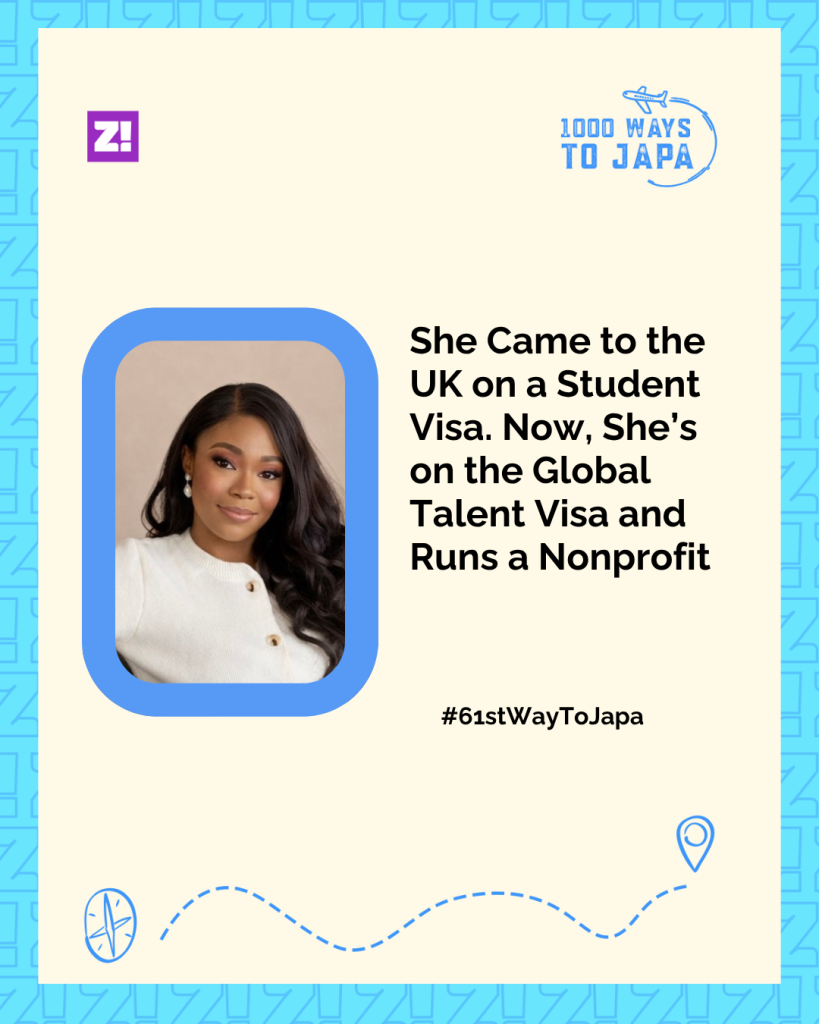
Obii (28) knew she had to leave Nigeria to get ahead in her chosen career. So when she made up her mind to study in the UK, she went for it. In this story, she shares how she got to the UK, her initial struggles, and how she’s settled into a beautiful life.
Where do you currently live, and when did you leave Nigeria?
I live in London, United Kingdom (UK), and I left Nigeria in August 2022.
What inspired your decision to leave?
I was primarily inspired by my search for greener pastures and the need to further my studies. I was fresh into tech in 2022, and I knew I’d have to get a degree in a related field if I was going to succeed at it. It was especially important because I studied English Language and Literature at the University. So, I packed my bags, went to the UK and got a master’s in Digital Business Management. It was totally worth it. The best decision I ever made.
What school did you go to?
The University of Portsmouth.
Is it a school you’d recommend to someone looking to study in the UK?
I absolutely recommend it. One thing that most people who come to the UK to study look out for is flexible schools, and the University of Portsmouth was just that for me. Some schools, for instance, require students to come in five times a week, which isn’t really ideal for an immigrant. At my school, nearly all our classes were online, and we came to school once a week. Now, I hear it’s been changed to one week of physical classes in a whole semester.
Aside from the flexibility of the classes, there was a lot of support from my lecturers. It also has an employability centre that does just what its name suggests. They helped me revamp my CV, and they provided so many opportunities for me to pitch to investors when I did my project.
Location-wise, the school is also great, because it’s close to London and you can meet like-minded people.
My lecturers have remained super helpful; they connect me with people in the industry, invite me to speak to students, and actually share my posts on LinkedIn.
So yes, I definitely recommend the University of Portsmouth for anyone looking to study here in the UK.
That’s so nice. Were your studies self-funded or a scholarship?
It was self-funded, and I’d come to regret it later on. I wanted to leave Nigeria as fast as I could. I also wasn’t well-informed about available funding opportunities, so I missed out on them. I did a lot of meaningful work in the Abuja Non-Governmental Organisation (NGO) space and would have gotten funding from Chevening and the likes if I had sought it.
My family and friends chipped in to support my studies, but I still had a hard time here, and I fully regretted my decision to self-fund. I strongly advise against that. I hadn’t paid all my fees when I got here, so at the point when I had about three months left to pay up, I was so pressed for funds that I started doing all sorts of jobs to keep up. I did support work and also filled shelves at a supermarket, among other jobs.
Again, I would not advise self-funding. Explore all your options, and explore all platforms to secure full or partial funding. Even the University of Portsmouth had something called the Vice Chancellor’s funding, but I didn’t apply because I came with the last batch of students. Please, do your research before coming.
So, what was the visa application process like for you?
I used a service called Intake, and it was so helpful. They assigned an agent to me whom I didn’t pay a dime to. He took care of everything in the application process; all I had to do was show up. The school already pays them, so I didn’t have to.
What specific documents were you asked to submit?
I remember this part of the documentation so well because it was quite stressful for me. Applicants are required to take a Tuberculosis test at a test centre in Ikeja. I remember waking up early to queue up for it. I came at 5 am and left at 5 pm.
You also have to submit all your transcripts and the original results of your West African Senior School Certificate Examination (WASSCE). To get this, you need a scratch card from the West African Examinations Council (WAEC) board.
Other things you need to submit are your degree certificates, your National Identification Number (NIN), your birth certificate, a certificate from your state of origin, a statement of account, and, proof of full or part payment for your school fees, and of course, your Confirmation of Acceptance for Studies (CAS), which the school gives you after you apply to them.
How long did it take you to get your visa?
It took me two weeks. It was quite fast. I started my process in May, and by June, I had my visa. Everything was just fast. I think this is why people choose the UK over Canada and the rest.
How was the application process to the school like?
There was no interview involved, although I hear they do that now.
What do you think the interview is about?
I think they’d ask questions that help them understand what you know about the school, the course you want to study there, and other such things.
What else were you required to do?
I had to write a Statement of Purpose (SOP) to show why I chose the course I want to study, my original school certificate and transcripts.
Are there any SOP tips you can share?
First of all, you should hype yourself up in your SOP. The school doesn’t know who you are, so that’s your opportunity to sell yourself and explain why they should pick you. Pour out your heart to them, and ensure you stay away from ChatGPT while doing so.
You start by writing out all the things you’ve achieved, all the things that make you a superstar, then tie that to your course of choice. I was just starting in tech and worked for a Dubai-based company called Tafa Bot. Before then, I had produced shoes in Nigeria; I mentioned both and mentioned the revenue I made from it, then tied them to my course, Digital Business Management. After the initial draft, I sent it to people for proofreading and peer review.
In a nutshell, show them you’re a superstar who can do terrific things if given the opportunity. Make sure you end the SOP by telling them how impactful you intend to be when you get your degree; don’t lie or be vague about this; actually explain it.
Most schools have a quota for people of African descent, and this helps give everyone a fair shot.
Do you have general tips for people looking to move to the UK to study?
There are a couple. The first one is to reduce your expectations while coming here. Find people who already go to your school of choice and follow them on social media so you can get firsthand feedback about the school. I had a whole spreadsheet of people I had asked.
Look for people at the school who are on scholarship and ask questions so you can always be one step ahead, especially in terms of time. Also, reach out to lecturers at your school of choice to learn what to expect. I reached out to a lecturer from my school and got that information from him.
There are so many boards that help with scholarships; do well to find out about them. Some social media accounts always post about them, so you can follow and monitor them closely. Lastly, research, research, and research.
We’ve talked about how you got to japa. Let’s talk about how you stayed back. How long did it take you to get a job?
Before, people on a graduate visa had 2 years to find a job that would sponsor them, but that has been reduced to 18 months. Lucky for me, I never got there; ten months into my visa, I switched to the Global Talent Visa.
The graduate visa isn’t that great because it doesn’t count as your time to get Indefinite Leave to Remain (ILR). It’s almost like you are in a state of limbo.
Love that for you! Let’s talk about the Global Talent Visa. How did you make that switch?
The Global Talent Visa is the best thing ever. It’s the kind of visa that lets you do everything. It’s literally like having a permanent residency in the UK. You can travel outside the UK for up to 180 days a year. It gives you so much freedom. You can open a business here and live and work in the UK without sponsorship.
There are two types: exceptional talent and exceptional promise. I’m under exceptional promise, so it’ll take me five years to get my Indefinite Leave to Remain (ILR), which is like Permanent Residency (PR). Those under exceptional talent only need three years to get their ILR.
To qualify for exceptional talent, you need to have more than five years of work experience. You need less than five years of work experience for exceptional promise. I had three at the time, so I was eligible.
To be given the exceptional promise, you have to show that you’re a promising talent who will bring impact to the UK and will do exceptional things if given the opportunity. To be fair, I have proven myself time and time again in this country. I believe I’ve done my share of impact and still intend to do more.
That’s beautiful. What was the application process like?
You have to gather evidence of your talent or promise. For exceptional promise, you have to submit at least ten pieces of evidence that show you are promising.
A body called Tech Nation refers you to the Home Office. So you first have to get through to Tech Nation; they will endorse you to the Home Office. After that, you do your biometric, pay your Immigration Health Surcharge (IHS) fee, and the Home Office will send you the visa.
So, you’ve got your master’s and the global talent visa. What do you currently do?
I’m a Senior Product Manager (PM), and I’m the Chief Executive of PM Help, a nonprofit that helps people from underrepresented backgrounds break into product management.
PM Help helps people understand what product management is, among other crucial things. We created a Learning Management System (LMS) to facilitate the process, and we offer free certificates upon completion of learning. We have a community that helps people, that provides support, and we also do webinars and workshops where we teach things like vibe coding. We have an AI tool called a CV review tool that will review your CV and tell you what you can do, practical steps you can take to make your CV more product-oriented. There’s also our free interview prep that helps people prepare for interviews. We have something called product therapy, where people just come and vent about their frustrations with job hunting. We also place people on internships with our partner companies.
These sound nice.
We also have a general interview prep session and something called PM Buddy, a mentorship programme that matches 20 mentors with 20 mentees according to their strengths. They have a three-month cohort, just understanding how best to be a product person.
Curious, why are you offering them for free?
Because when I came here, I struggled, and nobody helped me; everyone wanted money, so I kept paying and paying. It was quite frustrating. When I finally got into the space, I realised I had paid for resources that were available online for free. If you go to our learning management system, you’ll find that we literally use existing resources to craft a roadmap.
This is my social impact. It’s me giving back.
Really love it for you. So, what’s your favourite thing about the UK?
I live in London, and I think that’s my favourite part. Sometimes, I can’t believe I live here now, because we’ve read so much about it. London is a good mix of culture; you can literally meet anyone on the streets of London.
It’s also a city that constantly challenges you to do better. It has redefined my thinking and reshaped me in a way. I used to be set in my ways, but I’ve become more flexible since I came here. It’s also opened me up to so many opportunities, making it easier for me to travel to other parts of the world. It’s just great.
Nice. On a scale of one to ten, how do you rate the UK and why?
It’s a ten over ten for me. It’s such a multicultural place, and you never feel like you’re alone. It’s not perfect, but it’s better than most places, especially Nigeria, where I spent all my life. It’s safe, and most importantly, the system works.
Sounds like you’re having a swell time. I wish you the best of luck
Thank you!
Want to share your japa story? Please reach out to me here.
Zikoko’s HERtitude is back this April 2026. Grab your tickets here.

Click here to see what other people are saying about this article on Instagram