Someone you know has left or is planning to leave. 1,000 Ways to Japa speaks to real people and explores the endless reasons and paths they take to japa.
Stephanie (29) planned to further her studies about six years after school. But that plan came crashing down after she suffered a traumatic loss. In this story, she shares how she went to the UK rather hurriedly, how she settled in and how she’s now thriving.
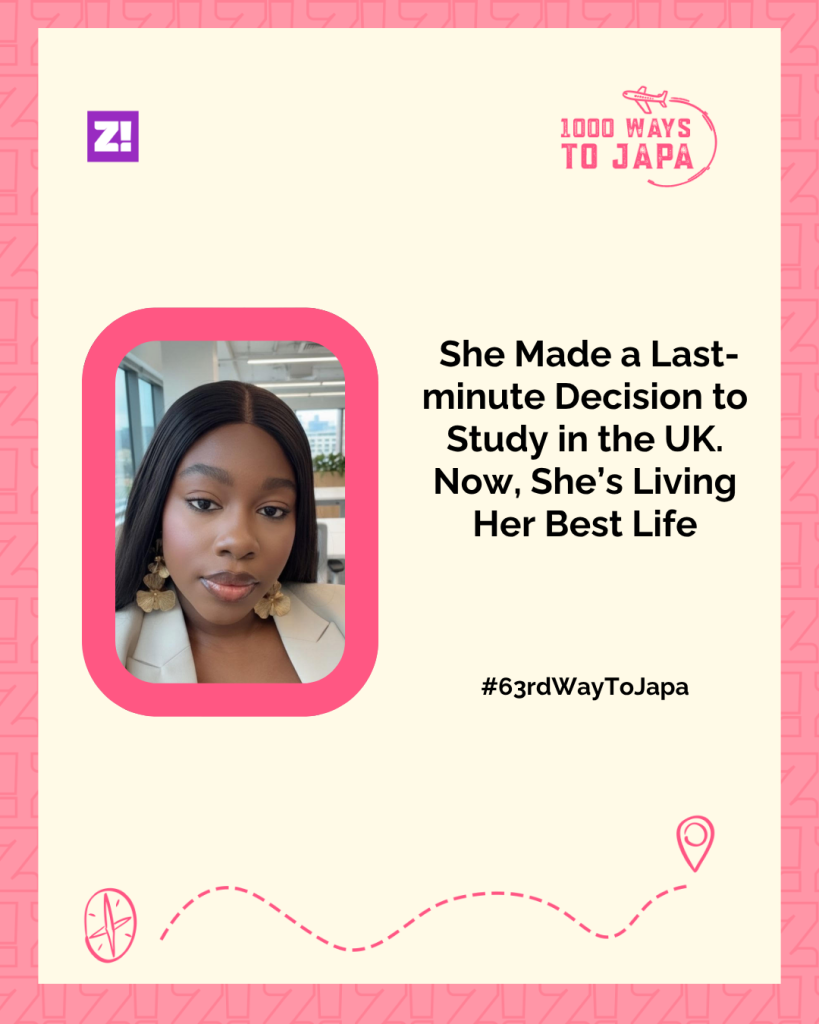
Where do you currently live, and when did you leave Nigeria?
I’m currently living in the United Kingdom (UK). I left Nigeria in January 2023.
What inspired your decision to move?
I had always wanted to further my education abroad, but the catalyst to my decision was the death of my father. I lost my dad in 2022, but by 2023, I still hadn’t moved past it. I couldn’t. I decided I needed a change of environment and that I needed to channel my energy and efforts into something that would help me manage the grief.
And so, even though I initially planned to work for about five years after my bachelor’s degree before getting a master’s, I had to speed it up. That was how I ended up in the UK.
Oh my. I’m so sorry to hear about your dad
Thank you.
What course did you study for your master’s?
I did my master’s in Project Management at Leeds Beckett University in Leeds, England.
What was the financing like?
It was self-funded, and I strongly advise against it. I only had to do it because of the circumstances surrounding my decision. I encourage people to do their own research to see the array of options out there and then determine which is most suitable for them. That’s exactly why I decided to share my story on this edition of 1000 Ways To Japa.
How did you find out about Leeds Beckett University?
I found the school myself. I did the hard work of researching things because I was particular about where I was going to live. I’m not a country girl; I was really keen on a city that was not too busy, but comfortable enough to give me what I wanted. I wanted a small city.
I found a couple of schools in cities that ticked my boxes, and I applied. Leeds Beckett was one of them. I got the admission, and the rest is history.
What other qualities were you looking for?
Before I chose Leeds Beckett, I read reviews online about them, went through their curriculum to see if the classes they offer under my chosen course aligned with what I wanted to learn and what I needed at that point in my life.
I also spoke to a representative of the school, whom I asked a couple of questions, and I reached out to some of their alumni on LinkedIn with questions, which helped give me insight into the school’s culture and the overall experience of studying there. These things helped me make up my mind. Both the school representative in Nigeria and the alumni were kind and super helpful with the process.
That’s nice
Yes. When I had a bit of a hiccup with my Confirmation of Acceptance for Studies (CAS), the school’s representative pursued it for me and helped me get in right on time for my visa application.
What were your classes like?
It wasn’t anything strenuous. I was required to be on campus three days a week, and two days some weeks. A handful of times, our classes were rescheduled and held online, but it wasn’t a fixed thing; it was based on contingencies like a train strike or a disruption on the road.
That sounds fair. What was the application process like?
I applied online after I had gotten all the answers I needed. As I mentioned earlier, the school’s representative was quite helpful throughout the process.
One of the things I submitted was a Statement of Purpose (SOP). The SOP is a detailed essay where you get to explain why you want to pursue your master’s (or any other degree) at the school, as well as why you have chosen a specific course.
I was a Product Manager back in Nigeria. So, while applying, I explained in detail what Project Management meant to me, particularly in regard to how it’d enable me to gain certain leadership, resource management, and time management skills.
I also ensured, while writing, that I presented myself as someone who has done due diligence on the school, so they have a mental image of someone who is fully committed to success. I noted some of the feedback I got from the alumni of the school, why I wanted to study there, why I wanted to be in the city, how drawn I am to the school’s cultural diversity, some of the things I hope to achieve and how I hope to give back through active participation in the school’s cultural activities, membership of some of its societies and communities, particularly its diversity community.
After I submitted my SOP, the school offered me a conditional offer to apply for my CAS. It took about a month for me to get it, and I think it was largely due to the influx of applications during my time.
Anyhow, I couldn’t apply for a visa without a CAS from the school, so I waited till it came. When it finally came, I applied for my visa and got it in about two weeks.
What were the requirements for the visa?
I was required to present my passports, proof of funds, CAS document, and my National Identification Number (NIN). I also had to do a mandatory tuberculosis test and present proof that I had made some form of payment to the school. My school’s requirement was for a 50% down payment, while some schools accepted 15%, 20%, and 25%; I already knew this from research, but I didn’t mind because I really wanted to go to that school.
Can you remember how much the entire process cost you?
The cost has increased for sure. At the time, Leeds Beckket was offering a 3% discount to applicants from countries like Nigeria, which reduced my school fees. There were my flight ticket, visa fees, and other things I can’t quite remember. Altogether, I estimate the entire process of coming to the UK cost me about £8,000- £10,000.
Did you use a travel agent for the process?
I did everything myself. It looked doable, so I didn’t think I needed to pay someone else to do it. It also helped that the school’s representative in Nigeria created a WhatsApp group for applicants in the country to communicate and help each other with frequently asked questions. In the group, you’d find that a lot of your questions had already been asked by someone else and that they had been answered thoroughly.
The application process is honestly not that difficult. As long as you’re a person who is not afraid to ask questions. You’ll find that people are willing to help for free. Also, do your research; that helps.
Do you recommend Leeds Beckett to people looking to study in the UK?
Yes, I absolutely do. In addition to its multicultural nature, the school often organised a lot of self and career-building events where they invite companies to come talk to students about the entailments of certain job roles as well as other careers we can venture into with our certificates.
I spoke with representatives from different companies, from banking and construction to the force and police, and tech. I told them what I did back in Nigeria, the course I was studying, and what I want to do afterwards. I also asked them how I could get my foot in the door. I got lots of helpful tips from them. Those events were so helpful; they opened my eyes and showed me the possibility of returning to my career field, Product Management.
Some companies also offered things like paid internships for people doing more technical courses, like software development, and others to gain practical experience.
That’s really nice. Did you say you had a career in Product Management?
Yes, I did. I was a Product Manager in Nigeria, but I did a master’s in Project Management here. I see how that can be confusing. I chose to do it because there were no Product Management courses at the time, and it was the closest thing to the field I already had a career in.
What do you currently do?
I’m a Product Manager.
Awesome. What visa are you currently on?
I’m currently on a graduate visa. The UK gives student visa holders two years after their studies to gain work experience, but I hear it’s now been changed to 18 months. You’re supposed to find a visa that’ll keep you here more permanently if your goal is to stay. You can get either a work visa, a Tier One visa like the global talent visa, or a spousal visa if you happen to find love.
What is the UK work culture like?
While I was still studying for my master’s, I did some part-time jobs to provide for myself. From a teaching assistant, supermarket assistant, to an event steward. The experience was different then than it is now that I’m working a full job in my field.
Working in the UK is amazing, particularly as a Product Manager, because I work cross-functionally: I not only get to mix with the teams, but also with people from diverse cultures and backgrounds. From Asians, Caucasians, and Africans, it’s all so interesting.
When we meet outside of work and get into relaxing conversations, we find that we actually share similar experiences across cultures. It’s always a pleasant surprise to learn that people did, saw, or ate the same things you did growing up, even if they’re from across the world. One of the most memorable ones was our software engineer who grew up drinking Milo and pronounced it differently. Before that conversation, I always thought it was only Nigerians who drank it.
So, the blend of cultures is interesting both in their differences and similarities. I am grateful for the opportunity to be in that scene filled with people from different mindsets, different journeys, and everyone coming together to achieve our shared goal, which is building a product that works and serves its users.
That’s so beautiful
It is. Thank you.
What’s your favourite thing about the UK?
I love the blend of cultures and how efficient the system is. I also love how accessible opportunities are to everyone; as long as you know what you’re doing, it doesn’t matter who you are, you’ll get the job.
Another thing I love is how respectful they are of your work experience from your home country. Everyone respects each other and works together. I know I’m far away from home, but the UK is gradually becoming a second home to me.
Lovely. So what’s your least favourite thing about the UK?
The cold. The UK is quite cold, and it was particularly chilly for me when I came because my school is in the north and the north is significantly colder than anywhere else here.
I came in January, and by February, I was already seeing heaps of snow. It was sweet in the first 2-3 days, and after that, I was begging the snow to stop. It was so cold, and it made everything messy.
If you’re coming here to live or study, especially in the north, please come prepared with jackets, socks, and gloves to stay warm. It’s quite important.
What’s your piece of advice for people looking to move to the UK?
I would like them to know that leaving Nigeria is not an instant success, but it eventually works out.
Secondly, it’s important to recognise that journeys differ; you might have it easier or harder, but that’s just how life goes. I didn’t realise this earlier; I had spoken to some of my friends who had it easier and believed it’d be the same for me. It took me about three months to get a job, and in that time, I was changing naira to pounds to pay my bills, and it felt like I was bleeding; it hurt so much I considered going back home. But I stayed back, and it worked out. Everyone’s journey might not be the same, but it’ll always work out; as long as you’re focused and you’re determined that you know where you’re going, you definitely come out smiling.
So keep learning. Meet people. Don’t be scared to meet people. Meet people, ask questions, create a community for yourself, and help each other. I’ve lost count of the times I’ve gotten help, like job referrals and interview prep from people I met on LinkedIn, at church, and in other places.
On a scale of one to ten, how would you rate the UK in comparison to Nigeria?
It’s a 9.9. It’d have been a solid ten, but I miss my siblings and my mom. It might sound crazy, but I also miss the heat in Nigeria.
Ah, the heat?
I do miss the heat. Trust me, you would too if you were here. I wish we could exchange weather. It’s the only thing I don’t like about living here. Other than that, it’s a ten. I remember watching UK movies back home and imagining myself living in the cities they were set in. It’s so thrilling that I get to live here and see them.
Love that for you. You’re having a great time. I wish you the best of luck
Thank you!
Want to share your japa story? Please reach out to me here.
Zikoko’s HERtitude is back this April 2026. Grab your tickets here.

Click here to see what other people are saying about this article on Instagram