The Nigerian experience is physical, emotional, and sometimes international. No one knows it better than the amazing people on #TheAbroadLife, a series where we detail and explore Nigerian experiences while living abroad.
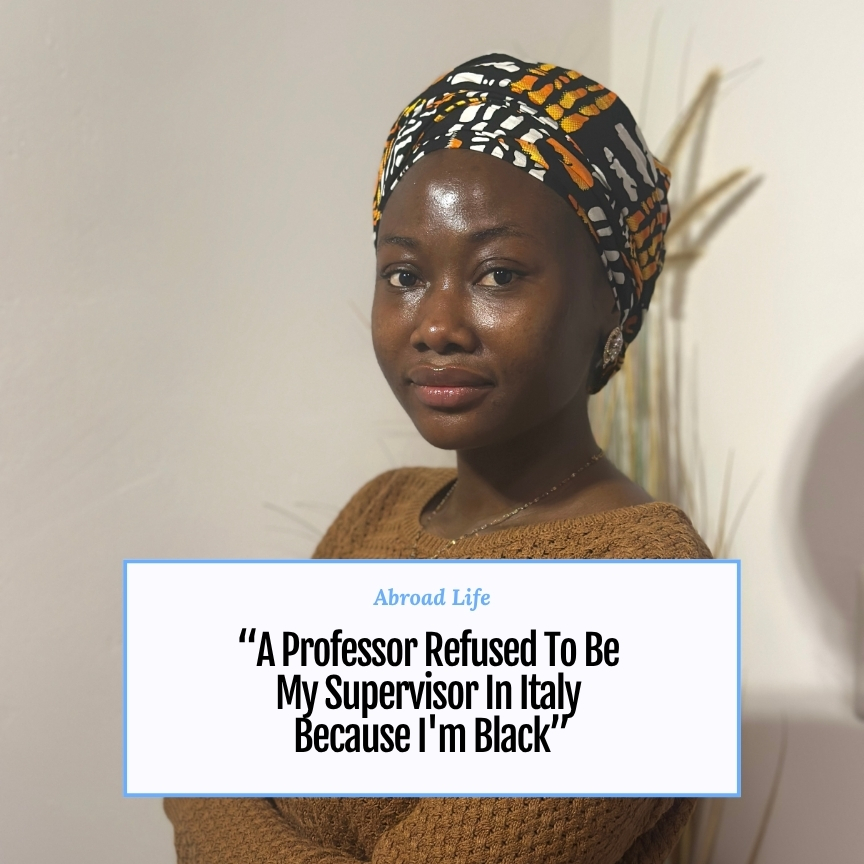
Raimot (30) had always wanted to study abroad. So, when the opportunity presented itself, she jumped at it and said goodbye to Nigeria. In the midst of adjusting to a new life and settling down, she experienced a mix of the good, the bad, and the ugly.
Where do you live at the moment, and when did you leave Nigeria?
I’m currently in Italy, and I left Nigeria in October 2022.
Why did you move to Italy?
I relocated because I got a scholarship to study.
Was that your plan all along?
Yes, when I was at university in Nigeria, I knew if I was going to get a master’s degree, it wouldn’t be in Nigeria. I had been trying to study abroad since around 2017 or 2018. Initially, Italy wasn’t even part of the plan. It was all about the US. One of my biggest priorities was securing full funding. I started applying to US universities around 2018, and in 2020, I finally got an adviser. For people in Science, Technology, Engineering, and Maths (STEM) and research fields like mine, you often need an adviser who can support or fund your research.
So what happened?
Everything seemed to be going well. The professor told me I could apply by around July, but then COVID-19 happened. After that, I stopped hearing from him.
To be honest, I still don’t know what happened to him because he used to be very responsive. I even checked his website, but there was no updated information. At some point, I just thought, Maybe we lost him. So, I moved on.
Then one day, I was scrolling online and came across the University of Padova. I checked the requirements and immediately noticed that they had scholarships. By then, I’d been applying for years, so I understood the process a bit better. I looked at everything and thought, It looks like I have a better chance here. Let me shoot my shot.
The application opened in November, and I submitted mine in the first week because I was already prepared. I just had to edit a few documents.
Twenty-four hours later, I got an email saying my application had passed the first evaluation stage. I was happy, but I had been through this process before, so I knew that wasn’t the main issue. The biggest thing was funding.
What happened after you passed the evaluation stage?
The scholarship list was supposed to come out in March, so we waited and waited. I remember the day the results came out. I was at work and just praying, God, I beg. The information was that successful applicants would get an email, and the list would also be published online.
So I kept refreshing my email. Then, around noon, I saw an email pop up. I was in the cold room at work, and the moment I saw the highlight, I hadn’t even opened the email yet, I screamed. That was what changed everything for me. Honestly, that was the beginning of Italy.
What was your family’s reaction to the news?
My family knew about the process, so they were very excited that I would be leaving because it’s something I’ve always wanted.
How did you fund your travel and living expenses in Italy as a student?
I was awarded the Padova International Excellence Scholarship, which funded my studies and living expenses in Italy at the time.
Did anything impress you when you finally arrived in Italy?
To be fair, I don’t think I was impressed when I first arrived. I came during winter, and everything was strange. It was also my first international flight, so I was just taking everything in.
Really? So, when did your first big impression happen?
The first time I actually thought, “Oh, wow, I think I like this place”, was when I started classes. I found out that, depending on the university, you could rewrite an exam up to three times. And not just because you failed. If you got a score you weren’t comfortable with, you could choose to rewrite the exam.
So, if the grading was over 30, maybe you got 20 and wanted 28 instead. You could reject the score and try again. I’m someone who really loves excellence in everything I do, so when I heard that, I was like, Wow. This is good. It gave me the feeling that I could pursue the level of excellence I actually wanted from my degree.
What course did you study at Padova?
I studied Marine Biology and specialised in aquaculture production and management
The Big Daily is your weekday shortcut to the biggest news shaping Nigeria. We cut through the noise, connect the dots, and explain why the news actually matters, all in one quick read.
Outside the classroom, what was your first real struggle with life in Italy?
The language barrier. Italy isn’t an English-speaking country. Though my programme was taught in English, and my professors spoke English to us, the community itself wasn’t English-speaking.
It was very difficult and frustrating to communicate. Even with a translator, it wasn’t always easy. Sometimes, someone would literally tell you, “I’m sorry, I don’t speak English,” in English.
Why do you think this is?
It was obvious. They weren’t interested in communicating in English. It was either Italian or they wouldn’t speak with you at all. That was probably the biggest challenge I faced when I first arrived.
How did you navigate this challenge of language?
I am so poor at learning the language. I tried registering for an Italian class and using Duolingo, but most of the time, it’s the Google Translate app to the rescue.
Sounds like a culture shock. Were there any others you experienced?
Yes, one would be paying for nylon bags to pack their groceries. They also value family time. Italians have a particular lunchtime everywhere, both in corporate environments and local communities. By 1–2 p.m., everywhere will be closed, including pharmacies. I’ve had that experience a couple of times when I needed to buy something. I’d forget they’d be closed and already walk for minutes, or even take a bus, before I realised it. So, I had to wait until they reopened their shops.
I actually like that culture. Some people can even be inside their shops during lunchtime, but they won’t attend to anyone. Some may go home to their families for a meal and then come back to their shops.
How did you sustain yourself after graduating?
I didn’t get a job immediately after graduating. One good thing about Italy, though, is that you get a one-year post-study period to look for a job. During that period, you can legally remain in the country while figuring things out.
Another thing is that the job doesn’t necessarily have to be in your field. As long as you get a job that gives you a contract, you can use it to apply for a work permit.
At first, I was looking for research assistant roles and other opportunities in my field, but I couldn’t find any. It was challenging.
So I had to go back to the odd jobs I used to do. I worked in a supermarket, helping with stock arranging and all. I did that for months before I eventually got my current job in my field.
What do you currently do in Italy?
I work as an aquaculture technician. The job is to care for aquatic species and ensure they grow well in their habitats.
Would that be your advice for any Nigerian abroad struggling to get a job in their field of study?
Sometimes, you have to survive first before you find the career you actually want. You can’t always insist that it has to be your field. Bills have to be paid. You have to eat. You have to be okay.
Who or what helped you survive emotionally during that period of job scarcity?
One thing I always say is that going abroad isn’t a journey you should do alone. You need good people around you. You need people with similar interests and people you can confide in.
I have colleagues here who have become more than colleagues. We share opportunities and support each other. And back home, I have a very strong community of friends. Honestly, my friends can lay down their lives for me.
So during that period when I was trying to transition into the career I actually wanted, that’s how I survived. Financially, I took the jobs that were available. Emotionally, I had support both in Italy and back home.
Was there anything about the Italian system that made you think, “Ah, Nigeria could actually emulate this”?
For me, it was the willingness of professors to help students. I’m not saying every professor is perfect. I don’t expect everyone to like me, just as I don’t like everybody. But I believe that if you’re in a room of 100 people and 80 of them are willing to help you, you focus on the 80.
In my experience, most of my professors were willing and ready to help, especially if you showed up, participated in class and made an effort. You didn’t always have to know somebody or pay somebody before you could get support.
What’s one experience that gave you this impression?
One of the best examples was when I was looking for an internship. I’d planned most of my journey from the beginning, and I knew I didn’t want to do my internship in Italy. I wanted to explore another part of Europe.
I was applying through LinkedIn and other platforms, but nothing was working. It was always, “Unfortunately…”. Then one day, I decided to speak to one of my professors. I liked his course and participated actively in his classes, so I felt comfortable approaching him.
I told him I wanted to do my internship outside Italy. He started mentioning Spain and Portugal, but I said, “Professor, I love Europe, but maybe Germany, Canada or the Netherlands?” I wanted to explore places with stronger economies. He said he’d look into it.
What then happened?
Two or three days later, he sent me an email saying one of his colleagues had reached out because they needed an intern in Germany. He asked if I was interested.
I was like, “Ah! I love Germany!” He simply forwarded me the person’s email and asked me to send my CV and application. There wasn’t even a formal application process like that. They needed someone, reached out through their network and found someone through a recommendation. That’s how I got my internship in Germany.
And that taught me something important about the European job market. Sometimes, your grades and skills aren’t enough. Recommendations and relationships can open doors, too.
That’s why I always advise people not to just go to class, say hello, and go home. Build genuine relationships because those relationships can help you long after you finish studying.
When life gets overwhelming, what do you do to unwind?
I love videos and pictures. If I’m overwhelmed, I make myself happy by dressing up, visiting places, taking pictures and making videos. The memories make me happy.
Hmm, sounds nice. Italy is popular for romance. Any gist for the timeline?
No gist oo. I got married two months before my relocation. So, there’s no space for any relationship that is strictly not business or just a casual friendship.
Nigerians abroad usually say they encounter racism. Can we say you’re an exception?
No, I’ve actually experienced racism a couple of times, actually.
Could you share one?
The first one I can’t forget happened with a bus driver. I had an exam that morning, and my school was about an hour away, so I had to leave early.
It was winter. I got to the bus station and waited for the bus. I was the only person at the bus stop at the time. When the bus came, I waved it down. But instead of stopping, the driver just drove past me.
I cried that day. And it wasn’t because I was going to miss an exam. It was because the driver didn’t see me as important enough to drive me. Another bus came about 30 minutes later, and I got on it. Thankfully, I’m a “what if ” person, and that’s why I left my house very early. Otherwise, I’d have missed that exam.
How did that make you feel?
What hurt was that I’d already been standing outside in the cold for about 45 minutes. I had my jacket and gloves on, but I was already freezing. Then the bus finally came, and the driver just left me there.
I stood there crying and asking myself, What is the meaning of this? To me, there was only one reason he did it: I was Black and the only person at the bus stop. That experience has stayed with me since. There’s another one that was as heavy as that.
That’s a lot. And you said there was another experience?
Yes. This one happened in an academic setting, and I feel like people don’t talk about this type of racism enough. There was a professor whose course was closely related to an area I was very interested in. I actively participated in her classes, and at one point I thought she could be a good supervisor for my project.
So I reached out to her by email, which is the normal process. But she wouldn’t respond. Even if she replied today, the next reply could come weeks later. I kept wondering what was happening.
Then I was talking to another international student who mentioned that they had found a supervisor. I asked who it was, and when they mentioned the same professor, I realised they had sent an email just the day before, and she had already responded positively.
I’d sent my own email weeks earlier. I thought, “Okay, maybe she didn’t see it”. So I sent a follow-up to my last email, but she didn’t respond. I sent another one, still no response. I sent the third one. I didn’t get any response. That was when I stopped reaching out. But I thought she could have just said no. Meanwhile, I used to notice a certain attitude with her during classes. I was pained because she could have just responded.
Sorry about that. So, how do you navigate dealing with racist people and places that may not be too comfortable for you?
Racism is everywhere. I just focus on the good ones. There are days their actions make me question why I am there but then, some of them have been so nice and kind to me when they don’t have to.
Is there any plan to come back to Nigeria?
Yes. I’ve lived here for a while, but I’m not an abroad person. I’m a proper Yoruba. I like going out and parties. Sometimes, I feel like life is short here. If you don’t make time for fun stuff, you’ll realise you’re just working and working.
It might sound strange to people, but I might come back after weighing my long-term options. However, I have to be strategic about it.
What’s one thing you’d want any Nigerians thinking of coming to Italy to know?
Bureaucracy is very real here. Many things take a long time. And to find good jobs in Italy and progress in any career, you cannot joke with the language. You must learn Italian. Otherwise, you may not get a job at all, or you may end up with a job you can’t survive on.
How would you rate your experience in Italy on a scale of one to ten?
I’d say 7.5. Italy is treating me well to a large extent. So, I give them their flowers.