Someone you know has left or is planning to leave. 1,000 Ways to Japa speaks to real people and explores the endless reasons and paths they take to japa.
Toyyib (40) left Nigeria for the UK way before the japa wave was a thing. In his 18 years abroad, Toyyib has seen governments come and go, and immigration laws do the same. In this story, Toyyib shares his UK journey and dishes out the best immigration advice for Nigerians.
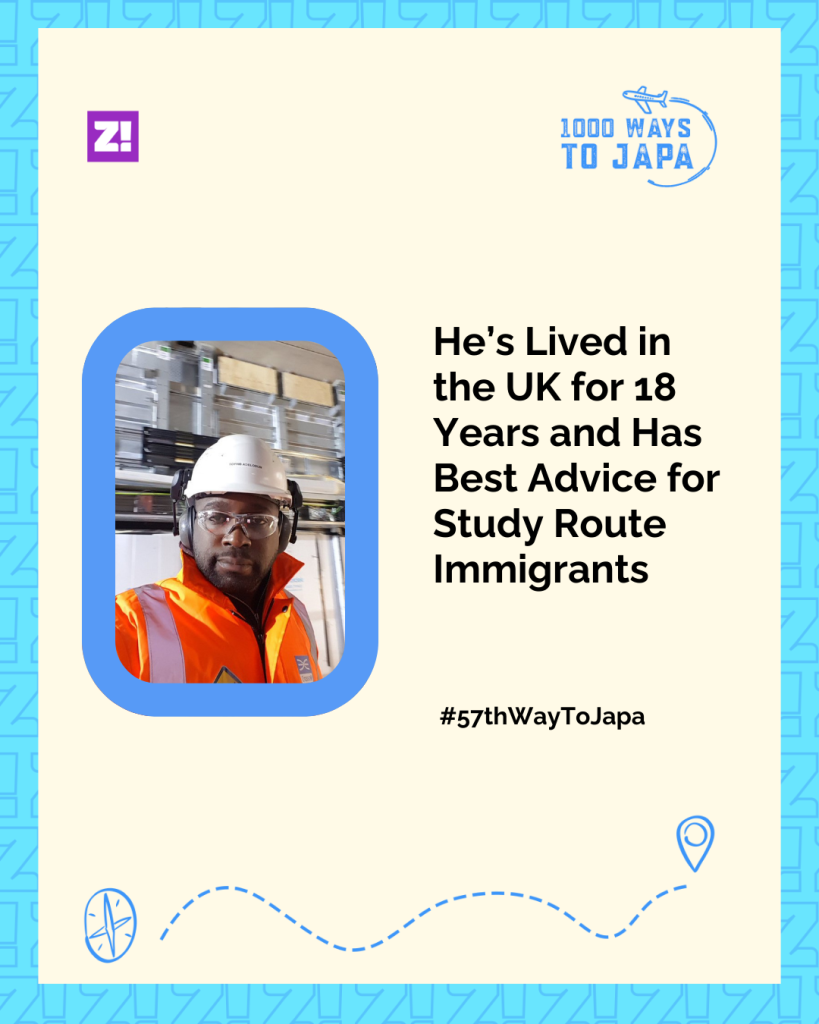
Where do you currently live, and when did you leave Nigeria?
I live in London, United Kingdom (UK), and I left Nigeria in 2008
Wow! You’ve been a while. What inspired your move?
It was the opportunity to study and work that inspired me. I am the first child of my family, and we were quite poor. I struggled through school and had to drop out twice, not because I wasn’t smart enough, but because of finances.
I was at home after I dropped out. Coincidentally, it was around that time that the internet was getting into Nigeria. Someone told me there was a scholarship exam (SAT Test) I could write to study abroad for free, and that was like a lightbulb moment for me; I saw the scholarship not just as an opportunity to study but also as an avenue through which I’d support my family.
So, how did you proceed?
The story doesn’t quite go the way you’d think. My discovery of the scholarship was only the beginning of the journey. I lived in Mushin, a poor and densely populated area in Lagos; at the time, there were hardly any opportunities in that area, so a handful of people and I formed a group aimed at finding tuition-free opportunities to study abroad.
There was no YouTube, Facebook, or Twitter at the time. Nobody was doing travel content either, so we only used Google. We’d buy overnight browsing tickets, and we’d email hundreds of schools in different parts of the world. We also found local institutions that could help us, and we spent a lot of time at the British Council and at the United States Information Service (USIS).
My numerous emails to various schools meant I was getting many prospectuses too, from the UK, US, St Kitts and Nevis, Germany, Sweden, and other countries. But they didn’t come with a scholarship, so that was an issue.
I finally did get a full tuition scholarship in the US, but the embassy denied my visa five times. I also tried the UK and other parts of Europe, but was denied. I kept trying and got the UK again on the eighth attempt. However, it wasn’t with a scholarship.
How did you fund your studies?
Unlike now, where you need to pay a lot of money to get admission, you didn’t need to pay any deposit to get admission at the time. That was how I was able to get into the country.
What advice would you give to people from a similar background looking to move?
Firstly, I’d like people to understand that every time period presents its own opportunities, so you have to be alert to know what the opportunities are in your time. This means you have to know every single thing about every country and almost every school. There are a lot more resources to do this now, too.
Another thing is that you should go for opportunities that best suit your condition, not necessarily the one you want. I met a student in Paris, for instance, who had to learn French because the tuition fees for French schools are much lower; it wasn’t an easy thing to do, but he had to, because it was the best way for him based on his situation.
What university did you attend, and would you recommend it?
I would refer to my advice about researching opportunities open to you; at the time I came in, there were a lot of colleges that had the license to sponsor students’ visas and also offered certificate programmes. So even though I had a science background, I studied Business Management, because that was the opportunity available to me at that time. Those colleges no longer exist; they were phased out by the government at some point.
Years later, at the age of 30, I went back to school to study Civil Engineering. I studied at South Bank University, and I’d recommend it for anyone looking to study here. It’s a great school to go to.
I don’t expect the cost of your education to be reflective of the current cost
It certainly isn’t. But I can give you a recent price. One of my younger siblings just graduated, and I was at the forefront of raising the money for her studies. The school fees alone were £14,000, and that does not include living expenses.
You have to budget about £1000 a month for your living expenses, depending on which part of the country you are in. So if you’re studying for one year, your living expenses alone would cost £12,000; when you add that to the average school fees of £14,000, you’ll be looking at £26,000.
That’s a lot of money
Absolutely. Studying in the UK now is a very expensive thing to do without a scholarship. The problem is that a lot of people assume they can gather that money when they get here, but they forget they’re only allowed to work 20 hours a week; the only expenses you can cover with those working hours are your living expenses. I strongly recommend that people who cannot afford the cost of studying here up front apply for scholarships instead. Scholarships like the Erasmus Mundus scholarship, the Turkish government scholarship, Switzerland government scholarship, the Stefan Banach scholarship in Poland and many more.
Were you working when you were in school?
Yes, I was. There was an opportunity to work, and I worked as a cleaner at a nightclub. I worked behind the bar. I also cleaned the club’s toilet before. That job was good at the time because I got extra money from customers asides what I was paid, and I was able to float my bills. That’s the great thing about working in hospitality; people can give you tips which you share with your co-workers.
There were times when I cleaned car parks, but the nightclub job was really helpful.
This worked for me at the time, but the advice I currently give people is to find community. I cannot overemphasise the importance of community. It’s also particularly easier for us now because there is nowhere that you won’t find Nigerians.
You can find the Nigerians around you through Facebook, religious communities, and ethnic communities. As you network within your community, also network outside of it. It’s people that’ll help you, tip you off on opportunities, and so much more.
You also have to be open to those opportunities. Some people let things like shyness and ego stop them, but they don’t realise that you need to put those aside and put your head down. Abroad can make you suffer even if you were already big in Nigeria. It’s a reality that you’d have to embrace if you’re coming here. You must be like water, ready to adapt. Do not mind what people would say because it’d hinder you from taking necessary actions to find the people who will help you.
Some mosques and churches help new arrivals find jobs. If you tell them what you’re open to, they will rally round to support you.
Once you get a job from those communities, work hard at it because that’ll get you a good reference, and references matter more here than qualifications. Also, volunteer for charities; that’d give you the reference you need for a head start.
You’ve been in the UK for a while now. Are there any dos and don’ts you think people should know?
I’m not sure there are necessarily dos and don’ts, but I’d say you should definitely learn how to drive before you leave Nigeria, because you might meet an opportunity that requires you to drive. It’s also important because it’s expensive to learn it here; at the moment, it costs circa £30 per hour for an instructor, and much more in some places.
Also, learn a craft; it could be barbing of hair, braiding, or anything at all. One of our brothers here makes money from tying gele for people during weddings. Some people also get health and safety certifications, and they start cooking for people. Your school certificate might not immediately earn you money, so try to be as solid as possible before coming.
Also, bring all your transcripts with you from home. You might need to evaluate them when you are looking for a job.
Another thing you should do is to start reaching out to people in your field early enough. It’s good to focus on your education once you get here, but you should also connect with people. Find out the people who already work in the industry you aspire to; find out if there are any Nigerians there, and if you can network with them. Also, find out the events that the people in that industry go to and plan to attend.
Don’t wait till your visa is near expiration to do all these. Once you get here, build publicly and share your knowledge publicly. Talk about the things you’re already doing and talk like someone already in employment, not a student.
What visa are you currently on?
I’m a permanent resident now.
Have you been back in Nigeria since you left?
I come home regularly. I was home last year. It’s usually family time when I’m in Nigeria, unless I have official engagements.
That’s nice. Do you have any plans to come back to Nigeria permanently?
That might be in the works, and it’d be mainly to help out. We are an ever increasing young population, and all hands need to be on deck. I can’t say for certain now, but I might split my time between Nigeria and the UK.
Nigeria has a huge youth population; we are projected to be the third largest population in the world in the next 20-30 years. We need to invest heavily in our young people so that we can be a strong pipeline for the global economy to grow; that will, in turn, help Nigeria to grow as well. And since everything I do is mainly to encourage personal development among other people, I might do some work here in the future, but we’ll see.
That’s great. How would you rate the UK on a scale of one to ten?
In comparison to Nigeria, the UK would always be better, especially in terms of economy and other things available to everybody. There was a time I saw former UK Prime Minister, Theresa May, taking the same thing that I was taking when she suffered from a sore throat.
Former PM Boris Johnson was treated for COVID in the same hospital most people use.
The basics are available for everybody here, yes, but there is also the argument that this country has been here for thousands of years and has run the world for hundreds of years. So, you can’t really compare it to Nigeria in the real sense.
How would you rate the UK now compared to the year you came?
I’ll say things are harder now than they were when I came. This is the reason I am out there sharing as much information as possible so that people do not suffer the same things I suffered.
There was someone, for instance, whom I advised to go into Social work over another option of hers, and now, she called me five years down the line to tell me she had bought her first property. The UK is definitely harder now, so I’ll continue to help people find the right path to ease things for them.
Want to share your japa story? Please reach out to me here.
Politics affects your life every day and in so many ways. And you should have a say in who gets to decide things that affect you. Apathy only rewards bad leaders. Your silence only hurts you. So come, let your voice be heard at the second edition of The Citizen Townhall.

February 28, in Lagos, there won’t be a more important place to be. Come through and join the conversation. Register here.
Click here to see what others are saying about this story on Instagram