Someone you know has left or is planning to leave. 1,000 Ways to Japa speaks to real people and explores the endless reasons and paths they take to japa.
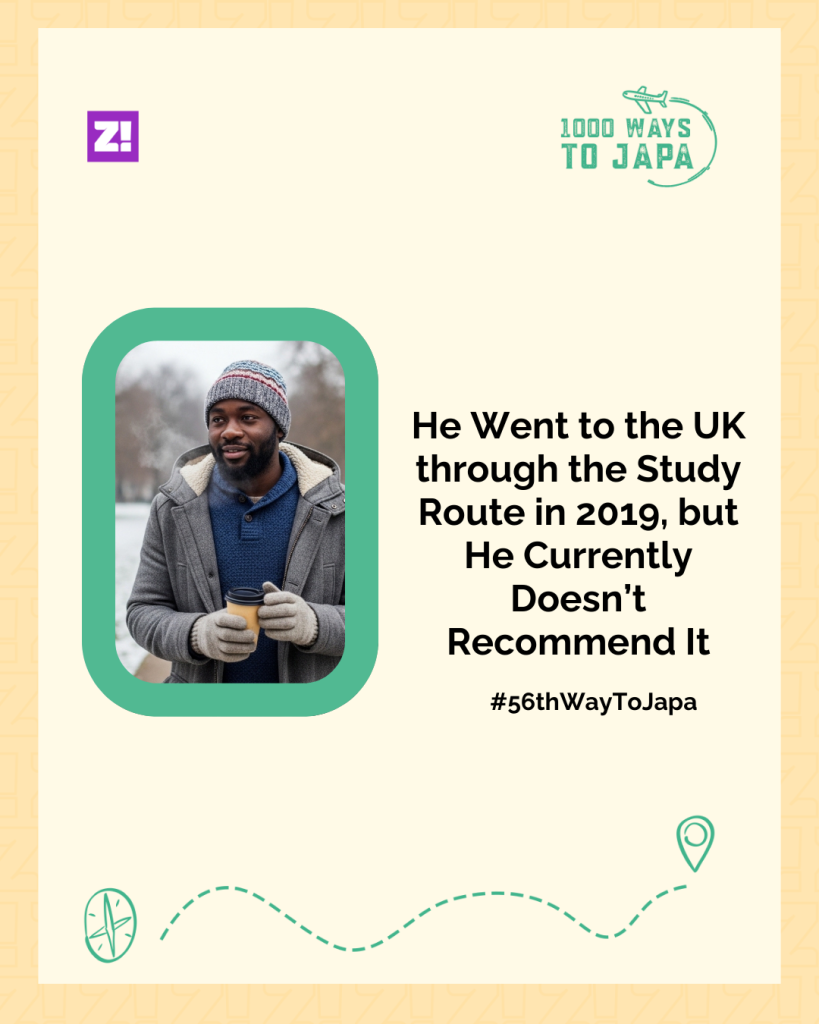
Uzor* (31) left Nigeria through the study route in 2019 to escape the difficulties of Buhari’s Presidency. Now, seven years later, he has settled in and is working a stable job. In this story, Uzor explains why he believes the study route is no longer an advisable way of coming to the UK and what working in the country feels like.
Where do you currently live, and when did you leave Nigeria?
I currently live in the UK. I first left Nigeria in 2013, but I returned and left again in 2019.
Curious… Why did you come back to Nigeria before?
I thought I could come back and do something meaningful, but I thought wrong. Also, I didn’t like it in the UK at the time, mostly because of the weather; it gets dark very early in the winter, which gets very depressing. More importantly, I thought there’d be a lot more to do back home.
What inspired your second move to the UK, and what visa did you go with?
I went back to the UK as a student; It was Buhari’s Presidency that inspired me to go back. I just couldn’t bear being in Nigeria.
I understand. Did you get a scholarship for the studies?
Not really. I had a sponsor who paid for it.
Can you remember how much it cost you to leave?
Well, things have changed a lot since then. I know I had a ₦3.5 million budget at the time, which covered the flight I took for the visa application, the hotel I stayed at, a school fees deposit, a Tuberculosis test, and my flight to the UK. My memory is a bit rusty now, and I’m not quite certain, but I think this was what it cost.
What was your visa application process like?
The visa application took me about three weeks. My case wasn’t anything out of the ordinary. I don’t know how it works now, but when I applied, I got it within three weeks.
After I paid a deposit to the school, I got a Confirmation of Acceptance for Studies (CAS). It was after the CAS that I applied for my visa.
I also needed proof of funds to demonstrate I could afford my education and welfare. The money also had to have been in the account for 28 days. I don’t know what the rules are currently, but this is what it was when I applied. I also needed to have my Tuberculosis certificate, as well as payment for the Immigration Health Surcharge (IHS). I was eligible for the refund of my IHS, even though I never applied for it.
Why were they refunding the IHS?
They weren’t refunding everyone; I was eligible for a refund because I was in the health service. You can apply for a refund of the IHS if you work in the health service. People who work in social care are also eligible for it.
What university did you attend?
I had four offers from different schools, and I chose the University of Lancashire.
Why did you choose the university?
I had an offer from the University of Plymouth, one from Oxford Brookes, another from Hertfordshire, and, of course, the University of Lancashire, called the University of Central Lancashire at the time. I chose the school because it offered me the most money.
Nice. How much were you offered?
Lancashire offered me £6,000, Oxford Brookes offered me admission, but with zero pounds, the University of Hertfordshire offered me £4,000, while the University of Plymouth offered me £2,000. Obviously, I went to the University with the highest offer.
Another deciding factor for me was the affordability of Preston, the city where the University is domiciled. Compared to other cities like Oxford (Oxford Brookes University), Plymouth (Plymouth University), and Hartfield (University of Hertfordshire), Preston was the cheapest, and it was also close to Manchester. I like quieter cities as well, so all of these factors helped me decide.
What was it like studying at the University of Lancashire?
I don’t mean to be rude, and I can’t speak to the current time, but back then, the University was underwhelming. I say this because I had studied at a much better University for my undergraduate degree; lectures were recorded at the school, and people who couldn’t make it to class got access to them, whereas in Lancashire, the lectures were not recorded. The feedback time was also longer in Lancashire.
I should add that I didn’t consider my experience at Lancashire bad because the school I compared it with is much more expensive. I paid a lot less in Lancashire, so it was alright in its way. I encouraged other people to study there after my time, and I think they had a good time too.
Do you remember how much your tuition was at the time?
Yes. I think it was £9,950.
Did you have a job while you studied?
Yes, I did. I was a support worker.
What do you do now, and what perks do you enjoy?
I currently work as a neurodiversity clinician. In terms of perks, I don’t think there are any perks in particular, except that the sickness policy is very generous; if perhaps I got ill for six months, and wasn’t going to work, for about nine months or 12 months, I’d still be paid my full salary until I return.
I also like the stability of my salary, even though I’m in public service; My salary comes on the 27th of every month, no matter what. I know it’s not the same in Nigeria, where public servants are owed for months, and have to protest for it.
What visa are you currently on?
I am currently on the Skilled Worker visa.
What’s the process of upgrading?
You first need to get a paying job, get your Certificate of Sponsorship (COS), and that’s it. It’s a straightforward process and shouldn’t take you more than five seconds.
What advice would you give to people looking to japa through the study route?
It’s no longer how it used to be. There have been a lot of changes to the immigration rules, so spending so much money to come here to study a course when you know you can’t stay back is pointless. Before, you’d get two years post-studies to secure a job, but now, they’ve decreased it to 18 months and then you’d have to get a job that’ll earn you a lot of money.
I wouldn’t say that coming to the UK via the study route will give people value for their money. A lot of people who came to study, especially in 2023/2024, are currently struggling because their visas are running out, and it’s been tough getting jobs.
Anyone who wants to come to the UK through the study route has to factor in the things I’ve mentioned because it’s an investment, and you have to get the best out of every investment. With the current exchange rates and high school fees, people will be running into about ₦50 million to come here. Its not wise to spend that money just based on the hope you have about securing a job immediately after your studies.
Think long and hard before you do anything; what is the cost of study, and what is the employability of the course you intend to study? If you must use the study route, think of other options like Australia, because I can’t even suggest Canada now.
Do you have a support system in the UK?
Yes, I have a support system here. But I had to work for it, and I think that’s one thing that many people fail to understand; you have to be intentional about making friends in adulthood because they can no longer be thrust upon you.
Last year, when I moved to a new city, I joined a local church, even though I don’t describe myself as a Christian. I made friends through the church. I also made friends through an online community of Nigerians living in the UK. I attended events and involved myself in things. While I still lived in another city, I was a part of the community groupchat there, and I commented regularly.
Support systems don’t just happen; you have to be intentional about building one because you’ll need it.
On a scale of one to ten, how would you rate the UK?
Living in the UK? Well, because I can only compare the UK with Nigeria, I would give it a seven. The UK is home, but I won’t lie, there have been times I wanted to move. I’m still harbouring that thought because I feel like my earning potential in other countries would be higher.
Want to share your japa story? Please reach out to me here.
Politics affects your life everyday and in so many ways. And you should have a say in who gets to decide things that affect you. At the second edition of The Citizen Townhall, we’ll be answering the big question: Who gets to shape our lives and what can we do about it?

February 28, in Lagos, there won’t be a more important place to be. Come through and join the conversation. Register here.
Click here to see what others are saying about this story on Instagram