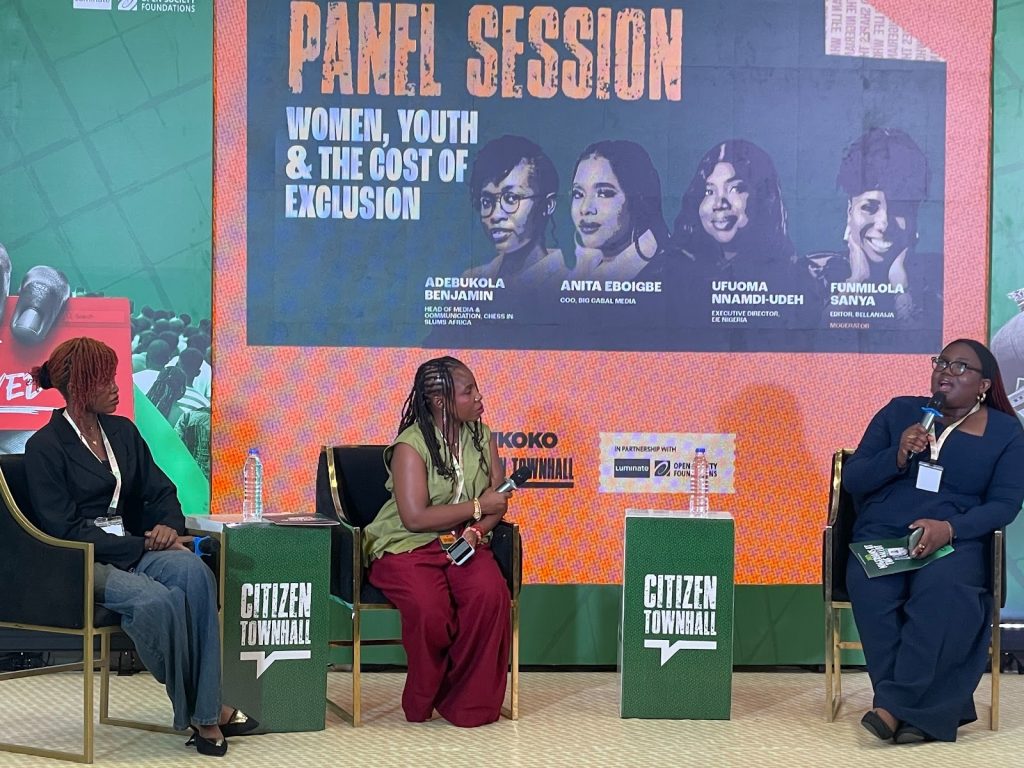
The exclusion of women and youth from governance in Nigeria was among the important issues addressed at the Zikoko Citizen Townhall 2026.
Held on Saturday, February 28, at Four Points by Sheraton in Lagos State, the Town Hall welcomed over 200 Nigerians to examine the question, “Who shapes the Nigerian life?”
During a panel discussion titled Women, Youth, and the Cost of Exclusion, experts examined the economic, political, and security costs of excluding women and young people from governance, emphasising that this exclusion is not just a fairness issue but a structural problem with clear national consequences.
BellaNaija Editor, Funmilayo Sanya, who moderated the panel, kick-started the discussion by focusing on representation and decision-making. She asked the audience to reflect on policies made without their input and questioned whether the outcomes might have been different and better if the policy-makers “looked like you” or “lived like you.”
She continued by pointing out that exclusion shouldn’t just be regarded as a moral concern but as a tangible national problem, highlighting that exclusion “actually costs a country real, measurable things”
EIE Nigeria Director, Ufuoma Nnamdi-Udeh, noted that exclusion often weakens policymaking because those most affected by policies are often absent from the decision-making process.
“The people that make the laws don’t bear the repercussions of those things”, she said, explaining why issues affecting women and youth are not treated as urgent policy priorities.
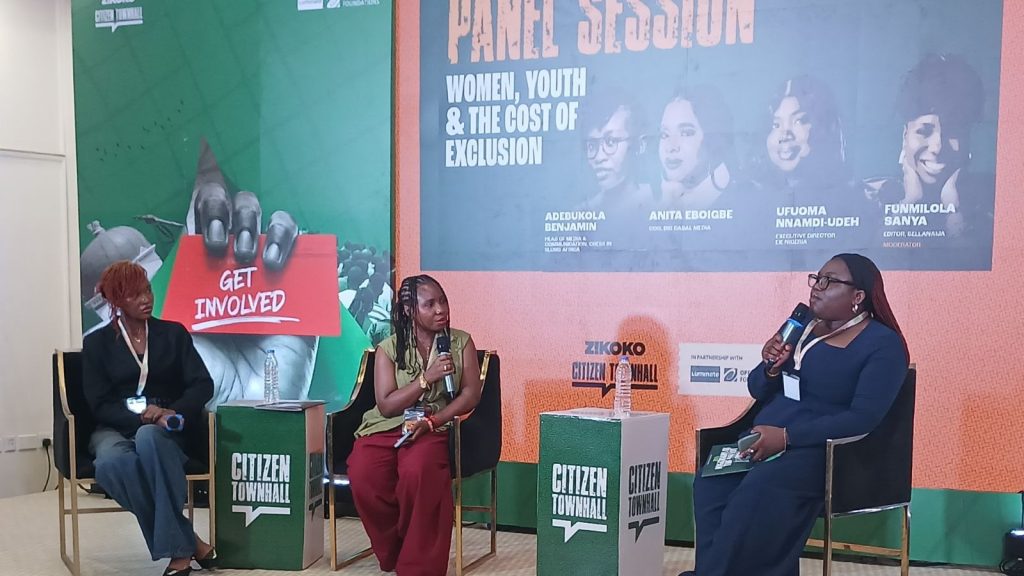
She argued that this disconnect is especially visible in healthcare policy, where decisions on issues such as maternal health and even debates around abortion laws are often made without the participation of the women who can actually relate to them.
“Once that perspective is not in the room from the beginning, then there is no way that you can have proper execution or implementation of those policies,” she added.
The discussion also highlighted the economic consequences of exclusion. Nnamdi-Udeh pointed to sectors such as banking and fintech, where women are beginning to be recognised and are taking on leadership roles, noting that similar progress is nowhere to be found in political leadership.
From a security perspective, she pointed out that women and children are often the most vulnerable during crises and yet, they are rarely included in peacebuilding processes, resulting in policies that fail to address their realities.
Head of media and communication at Chess in Slums Africa, Adebukola Benjamin, expanded the focus of the discussion to marginalised youth, who are often absent from conversations about inclusion. She described a persistent gap between these young people and government institutions:
“You will find that there is no trust whatsoever between them and the government,” she said. Many see themselves as pawns in political conflict rather than as stakeholders in governance. “When the system that is supposed to protect them is exploiting them, they create their own system for survival,” she explained. This alienation, she believes, has long-term economic and security implications, as young talent is diverted into harmful pathways.
Benjamin continued to emphasise that inclusion cannot be symbolic or left to chance.
“Representation cannot be left to charity alone,” she said. “It has to be intentionally planned, funded and enforced as part of governance.” Being in the room, she argued, is just the first step. Marginalised voices must be empowered to meaningfully influence decisions.
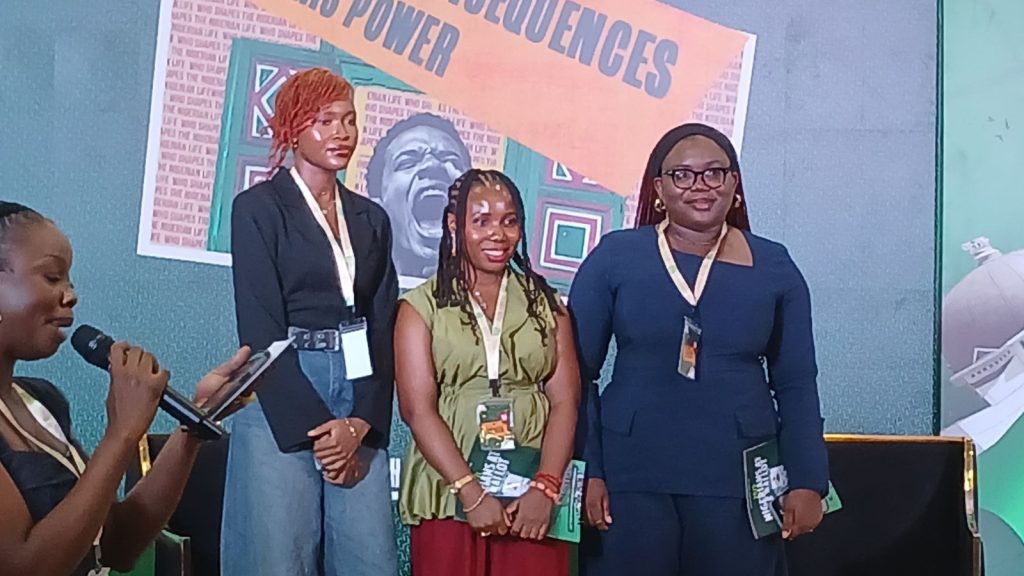
The panel also highlighted practical entry points for participation beyond elections. Local politics was highlighted as the most accessible avenue for engagement. “Politics is local,” Ufuoma Nnamdi-Udeh said, urging citizens to attend ward-level meetings, hold officials accountable, and organise strategically over multiple election cycles.
Adebukola Benjamin also emphasised the need for foundational civic education. “We have to go back to grassroots civic education,” she said, stressing the need for citizens to cultivate participation as a habit. She also pointed to early and consistent engagement, as key to ensuring that women and young people can sustainably influence policy.
The session concluded with the acknowledgement that meaningful change requires both institutional reform and shifts in societal attitudes, and it was agreed that only through intentional, sustained participation and structural reforms can Nigeria bridge the gap between the population and its leadership.